
Содержание
лекции: виды
контроля качества разрабатываемого
ПО; ручной контроль; структурное,
функциональное и оценочное тестирование;
классификация ошибок; методы и средства
отладки ПО.
Цель лекции:
ознакомиться с видами и способами
контроля и тестирования ПО, методами и
средствами отладки программ.
Недостаточно
выполнить проектирование и кодирование
программного продукта,
также необходимо обеспечить его
соответствие требованиям и спецификациям.
Многократно проводимые исследования
показали, что чем раньше обнаруживаются
те или иные несоответствия или ошибки,
тем больше
вероятность их исправления и ниже его
стоимость [4].
Современные
технологии разработки ПО предусматривают
раннее обнаружение ошибок за счет
выполнения контроля результатов
всех этапов и стадий разработки. На
начальных этапах контроль
осуществляют вручную или с использованием
CASE-средств,
на последних — он принимает форму
тестирования.
Тестирование
—
это процесс выполнения программы, целью
которого является
выявление ошибок. Никакое тестирование
не может доказать отсутствие
ошибок в сложном ПО, поскольку выполнение
полного тестирования становится
невозможным
и имеется вероятность, что остались
невыявленные ошибки. Соблюдение основных
правил тестирования и научно обоснованный
подбор тестов может уменьшить их
количество. Процесс разработки согласно
современной модели жизненного цикла
ПО предполагает три стадии тестирования:
автономное
тестирование компонентов ПО; комплексное
тестирование разрабатываемого ПО;
системное
или оценочное
тестирование на соответствие основным
критериям качества. Для повышения
качества тестирования рекомендуется
соблюдать следующие основные
принципы:
-
предполагаемые
результаты должны быть известны до
тестирования; -
следует избегать
тестирования программы автором; -
необходимо
досконально изучать результаты каждого
теста; -
необходимо
проверять действия программы на неверных
данных; -
необходимо
проверять программу на неожиданные
побочные эффекты на неверных данных.
Вероятность
наличия необнаруженных ошибок в части
программы пропорциональна количеству
ошибок уже найденных в этой части.
Удачным
считают
тест, который обнаруживает хотя бы
одну ошибку. Формирование набора тестов
имеет большое значение, поскольку
тестирование является одним из
наиболее трудоемких этапов создания
ПО. Доля стоимости тестирования в
общей стоимости разработки возрастает
при увеличении сложности ПО и повышении
требований к их качеству.
Существуют
два принципиально различных подхода к
формированию тестовых наборов: структурный
и функциональный.
Структурный
подход
базируется
на том, что известна
структура
тестируемого
ПО, в том числе его алгоритмы («стеклянный
ящик»).
Тесты строятся для проверки правильности
реализации заданной логики в коде
программы. Функциональный
подход
основывается на том, что структура ПО
не известна («черный
ящик»).
В этом случае тесты строят, опираясь на
функциональные спецификации. Этот
подход называют также подходом,
управляемым данными,
так как при его использовании тесты
строят на базе различных способов
декомпозиции множества данных. Наборы
тестов, полученные в соответствии с
методами этих подходов, объединяют,
обеспечивая всестороннее тестирование
ПО.
Ручной
контроль
используют на ранних этапах разработки.
Все проектные решения анализируются с
точки зрения их правильности и
целесообразности как можно раньше, пока
их можно легко пересмотреть. Различают
статический
и динамический
подходы к ручному контролю. При статическом
подходе
анализируют структуру, управляющие и
информационные связи программы, ее
входные и выходные данные. При динамическом
—
выполняют ручное
тестирование (вручную
моделируют процесс выполнения
программы на заданных исходных данных).
Исходными данными для таких проверок
являются: техническое задание,
спецификации, структурная и функциональная
схемы программного продукта, схемы
отдельных компонентов, а для более
поздних этапов — алгоритмы и тексты
программ, а также тестовые наборы.
Доказано, что ручной контроль способствует
существенному увеличению
производительности и повышению надежности
программ и с его помощью можно находить
от 30 до 70 % ошибок логического проектирования
и кодирования. Основными методами
ручного контроля являются: инспекции
исходного текста,
сквозные
просмотры,
проверка
за столом,
оценки
программ.
В
основе структурного
тестирования
лежит
концепция максимально полного тестирования
всех маршрутов,
предусмотренных алгоритмом
(последовательности операторов программы,
выполняемых при конкретном варианте
исходных данных). Недостатки: построенные
тестовые наборы не обнаруживают
пропущенных маршрутов и ошибок, зависящих
от заложенных данных; не дают гарантии,
что программа правильна.
Другим
способом проверки программ является
функциональное
тестирование:
программа рассматривается как «черный
ящик»,
целью тестирования является выяснение
обстоятельств, когда поведение программы
не соответствует спецификации. Для
обнаружения всех ошибок необходимо
выполнить исчерпывающее
тестирование
(при всех возможных наборах данных), что
для большинства случаев невозможно.
Поэтому обычно выполняют «разумное»
или «приемлемое»
тестирование, ограничивающееся
прогонами программы на небольшом
подмножестве всех возможных входных
данных. При функциональном тестировании
различают следующие методы формирования
тестовых наборов: эквивалентное
разбиение;
анализ
граничных значений;
анализ
причинно-следственных связей;
предположение
об ошибке.
При
комплексном
тестировании
используют тесты, построенные по методам
эквивалентных классов, граничных условий
и предположении об ошибках, поскольку
структурное тестирование для него не
применимо.
Одним
из самых сложных является вопрос о
завершении тестирования, так как
невозможно гарантировать, что в программе
не осталось ошибок. Часто тестирование
завершают потому, что закончилось время,
отведенное на его выполнение. Его
сворачивают, обходясь минимальным
тестированием
[15], которое
предполагает:
тестирование граничных значений,
тщательную проверку руководства,
тестирование минимальных конфигураций
технических средств, возможности
редактирования команд и повторения их
в любой последовательности, устойчивости
к ошибкам пользователя.
После завершения
комплексного тестирования приступают
к оценочному
тестированию,
целью которого является поиск
несоответствий техническому заданию.
Оценочное тестирование включает
тестирование: удобства использования,
на предельных объемах, на предельных
нагрузках, удобства эксплуатации,
защиты, производительности, требований
к памяти, конфигурации оборудования,
совместимости, удобства установки,
удобства обслуживания, надежности,
восстановления, документации, процедуры.
Отладка
—
это процесс локализации
(определения
оператора программы, выполнение которого
вызвало нарушение
вычислительного процесса) и исправления
ошибок, обнаруженных
при тестировании ПО. Для
исправления ошибки
необходимо определить ее причину.
Отладка
требует от программиста глубоких знаний
специфики управления используемыми
техническими средствами, операционной
системы, среды и языка программирования,
реализуемых процессов, природы и
специфики ошибок, методик отладки и
соответствующих программных средств;
психологически
дискомфортна (нужно искать собственные
ошибки в условиях ограниченного времени);
оставляет возможность
взаимовлияния ошибок в разных частях
программы. Четко
сформулированные методики отладки
отсутствуют. Различают:
-
синтаксические
ошибки –
сопровождаются комментарием с указанием
их местоположения, фиксируются
компилятором (транслятором) при
выполнении синтаксического и частично
семантического анализа; -
ошибки
компоновки —
обнаруживаются компоновщиком (редактором
связей) при объединении модулей
программы; -
ошибки
выполнения — обнаруживаются
аппаратными средствами, операционной
системой или пользователем при выполнении
программы, проявляются разными способами
и в свою очередь делятся на группы:
-
ошибки
определения исходных данных (ошибки
передачи, ошибки преобразования, ошибки
перезаписи и ошибки данных); -
логические
ошибки проектирования (неприменимый
метод, неверный алгоритм, неверная
структура данных, другие) и кодирования
(ошибки
некорректного использования переменных,
вычислений, межмодульного интерфейса,
реализации алгоритма, другие); -
ошибки
накопления погрешностей результатов
вычислений (игнорирование ограничений
разрядной сетки и способов уменьшения
погрешности).
Отладка
программы в любом случае предполагает
обдумывание и логическое осмысление
всей имеющейся информации об ошибке.
Большинство ошибок можно обнаружить
по косвенным признакам посредством
тщательного анализа текстов программ
и результатов тестирования без получения
дополнительной информации с помощью
следующих методов:
-
ручного
тестирования
(при обнаружении ошибки нужно выполнить
тестируемую программу вручную,
используя тестовый набор, при работе
с которым была обнаружена ошибка); -
индукции
(основан
на тщательном анализе симптомов
ошибки, которые могут проявляться как
неверные результаты вычислений или
как сообщение об ошибке); -
дедукции
(вначале формируют множество причин,
которые могли бы вызвать данное
проявление ошибки, а затем анализируя
причины, исключают те, которые
противоречат имеющимся данным); -
обратного
прослеживания
(для точки вывода неверного результата
строится гипотеза о значениях
основных переменных, которые могли бы
привести к получению данного результата,
а затем, исходя из этой гипотезы, делают
предположения о значениях переменных
в предыдущей точке).
Для
получения дополнительной информации
об ошибке выполняют добавочные тесты
и используют специальные методы и
средства: отладочный
вывод;
интегрированные
средства отладки;
независимые
отладчики.
Общая
методика отладки программных продуктов,
написанных для выполнения в операционных
системах MS
DOS
и Win32:
1
этап —
изучение проявления ошибки;
2
этап – определение
локализации
ошибки;
3
этап —
определение причины ошибки;
4
этап — исправление
ошибки;
5
этап — повторное
тестирование.
Процесс
отладки можно существенно упростить,
если следовать основным рекомендациям
структурного подхода к программированию:
-
программу наращивать
«сверху-вниз», от интерфейса к
обрабатывающим подпрограммам,
тестируя ее по ходу добавления
подпрограмм; -
выводить пользователю
вводимые им данные для контроля и
проверять их на допустимость сразу
после ввода; -
предусматривать
вывод основных данных во всех узловых
точках алгоритма (ветвлениях, вызовах
подпрограмм).
Дополнительную
информацию по теме можно получить в [1,
2, 4, 7, 9, 14, 15].
Соседние файлы в предмете [НЕСОРТИРОВАННОЕ]
- #
- #
- #
- #
- #
- #
- #
- #
- #
- #
- #
ТЕСТИРОВАНИЕ И ОТЛАДКА
Определение и принципы тестирования
Тестирование программного средства (ПС) — это процесс выполнения программ на некотором наборе данных, для которого заранее известен результат применения или известны правила поведения этих программ. Указанный набор данных называется тестовым или просто тестом. Тестирование программ является одной из составных частей более общего понятия — «отладка программ». Под отладкой понимается процесс, позволяющий получить программу, функционирующую с требующимися характеристиками в заданной области изменения входных данных.
Процесс отладки включает:
действия, направленные на выявление ошибок (тестирование);
диагностику и локализацию ошибок (определение характера ошибок и их местонахождение);
внесение исправлений в программу с целью устранения ошибок.
Из трех перечисленных видов работ самым трудоемким и дорогим является тестирование, затраты на которое приближаются к 45 % общих затрат на разработку ПС.
Невозможно гарантировать отсутствие ошибок в программе. В лучшем случае можно попытаться показать наличие ошибок. Если программа правильно ведет себя для большого набора тестов, нет оснований утверждать, что в ней нет ошибок. Если считать, что набор тестов способен с большой вероятностью обнаружить возможные ошибки, то можно говорить о некотором уровне уверенности (надежности) в правильности работы программы, устанавливаемом этими тестами. Сформулируем следующее высказывание: если ваша цель — показать отсутствие ошибок, вы их найдете не слишком много. Если же ваша цель — показать наличие ошибок, вы найдете значительную их часть.
Надежность невозможно внести в программу в результате тестирования, она определяется правильностью этапов проектирования. Наилучшее решение проблемы надежности — с самого начала не допускать ошибок в программе. Однако вероятность того, что удастся безупречно спроектировать большую программу, мала. Роль тестирования состоит в том, чтобы определить местонахождение немногочисленных ошибок, оставшихся в хорошо спроектированной программе. Попытки с помощью тестирования достичь надежности плохо спроектированной программы безнадежны.
Тестирование оказывается довольно необычным процессом (поэтому и считается трудным), так как этот процесс разрушительный. Ведь цель проверяющего (тестовика) — заставить программу сбиться.
Программы, как объекты тестирования, имеют ряд особенностей, которые отличают процесс их тестирования от общепринятого, применяемого при разработке аппаратуры и других технических изделий. Особенностями тестирования ПС являются:
отсутствие эталона (программы), которому должна соответствовать тестируемая программа;
высокая сложность программ и принципиальная невозможность исчерпывающего тестирования;
практическая невозможность создания единой методики тестирования (формализация процесса тестирования) в силу большого разнообразия программных изделий (ПИ) по их сложности, функциональному назначению, области использования и т.д.
Тестирование — это процесс многократного выполнения программы с целью выявления ошибок. Целью тестирования является обнаружение максимального числа ошибок. Поэтому тестовый прогон, в результате которого не выявлено ошибок, считается неудачным (неэффективным).
Существуют несколько эмпирических правил проведения тестирования программ, обобщающих опыт тестировщиков.
1. Процесс тестирования более эффективен, если проводится не автором программы. По своей сути тестирование — это процесс деструктивный (разрушительный). Именно этим и объясняется, почему многие считают его трудным. Особенно трудным и малоэффективным он является для самого автора программы, так как после выполнения конструктивной части при проектировании и написания программы, ему трудно перестроиться на деструктивный образ мышления и, создав программу, тут же приступить к пристрастному выявлению в ней ошибок. Поэтому для проведения тестирования создаются специальные группы тестирования. Это не означает, что программист не может тестировать свою программу. Речь идет о повышении эффективности тестирования.
2. Необходимой частью тестового набора данных должно быть описание предполагаемых значений результатов тестовых прогонов. Тестирование как процесс многократного выполнения программы проводится на многочисленных входных наборах данных. Чтобы определить правильность полученных в результате очередного тестового прогона данных, необходимо знать ожидаемый результат. Таким образом, тестовый набор данных должен включать в себя два компонента: описание входных данных, описание точного и корректного результата, соответствующего набору входных данных. Этот принцип сложно, а в некоторых случаях и невозможно реализовать на практике. Сложность его заключается в том, что при тестировании программы (модуля) необходимо для каждого входного набора данных рассчитать вручную ожидаемый результат или найти допустимый интервал изменения выходных данных. Процесс этот трудоемкий даже для небольших программ, так как он требует ручных расчетов, следуя логике алгоритма программы. Из рассмотренного принципа, который трудно реализуем, но которого следует придерживаться логически, вытекает следующий.
3. Необходимо изучить результаты каждого теста. Из практики следует, что значительная часть обнаруженных ошибок могла быть выявлена в результате первых тестовых прогонов, но они были пропущены вследствие недостаточно тщательного анализа их результатов.
4. Тесты для неправильных и непредусмотренных входных данных должны разрабатываться также тщательно, как для правильных и предусмотренных. Согласно этому принципу при обработке данных, выходящих за область допустимых значений, в тестируемой программе должна быть предусмотрена диагностика в виде сообщений. Если сообщение о причине невозможности обработки по предложенному алгоритму отсутствует, и программа завершается аварийно или ведет себя непредсказуемо, то такая программа не может считаться работоспособной и требует существенной доработки. Тестовые наборы данных из области недопустимых входных значений обладают большей обнаруживающей способностью, чем тесты, соответствующие корректным входным данным.
5. Необходимо проверять не только, делает ли программа то, для чего она предназначена, но и не делает ли она того, чего не должна делать. Это утверждение логически вытекает из предыдущего. Необходимо любую программу проверить на нежелательные побочные эффекты.
6. Следует тщательнее проверять те участки программ, где обнаруживается больше ошибок. Утверждается, что вероятность наличия необнаруженных ошибок в какой-либо части программы пропорциональна числу ошибок, уже обнаруженных в этой части. Возможно, что те части программы, где при тестировании обнаружено большее число ошибок, либо были слабо проработаны с точки зрения системного анализа, либо разрабатывались программистами более низкой квалификации.
Основные определения
Тестирование (testing) — процесс выполнения программы или ее части с целью найти ошибки.
Доказательство (proof) — попытка найти ошибки в программе безотносительно к внешней для программы среде. Большинство методов доказательства предполагает формулировку утверждений о поведении программы и доказательство математических теорем о правильности программы. Доказательства могут рассматриваться как форма тестирования, хотя они и не предполагают прямого выполнения программы.
Контроль (verification) — попытка найти ошибки, выполняя программу в тестовой, или моделируемой, среде.
Испытание (validation) — попытка найти ошибки, выполняя программу в заданной реальной среде.
Аттестация (certification) — авторитетное подтверждение правильности программы. При тестировании с целью аттестации выполняется сравнение с некоторым заранее определенным стандартом.
Отладка (debugging) не является разновидностью тестирования. Хотя слова «отладка» и «тестирование» часто используются как синонимы, но под ними подразумеваются разные виды деятельности.
Тестирование — это деятельность, направленная на обнаружение ошибок.
Отладка направлена на установление точной природы известной ошибки, а затем на исправление этой ошибки. Эти два вида деятельности связаны, т.к. результаты тестирования являются исходными данными для отладки.
Тестирование модуля, или автономное тестирование (module testing, unit testing) — контроль отдельного программного модуля, обычно в изолированной среде (изолированно от всех остальных модулей).
Тестирование модуля иногда включает математическое доказательство.
Тестирование сопряжений (integration testing) — контроль сопряжений между частями системы (модулями, компонентами, подсистемами).
Тестирование внешних функций (external function testing) — контроль внешнего поведения, определенного внешними спецификациями.
Комплексное тестирование (system testing) — контроль и/или испытание системы по отношению к исходным целям.
Комплексное тестирование является процессом контроля, если оно выполняется в моделируемой среде, и процессом испытания, если выполняется в реальной среде.
Тестирование приемлемости (acceptance testing) — проверка соответствия программы требованиям пользователя.
Тестирование настройки (installation testing) — проверка соответствия каждого конкретного варианта установки системы с целью выявить любые ошибки, возникшие в процессе настройки системы.
Отношения между этими типами тестов и процессами проектирования показаны на рис. 15.
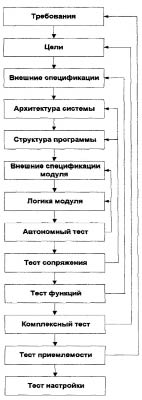
Стратегия проектирования тестов
В тестирование ПО входят постановка задачи для теста, проектирование, написание тестов, тестирование тестов, выполнение тестов и изучение результатов тестирования. Важную роль играет проектирование теста. Возможны следующие подходы к стратегии проектирования тестов:
1. Тестирование по отношению к спецификациям (не заботясь о тексте программы).
2. Тестирование по отношению к тексту программы (не заботясь о спецификациях).
Чтобы ориентироваться в стратегиях проектирования тестов, стоит рассмотреть два крайних подхода, находящихся на границах спектра. Следует отметить также, что многие из тех, кто работает в этой области, часто бросаются в одну или другую крайность.
Сторонники первого подхода проектирует тесты, исследуя внешние спецификации или спецификации сопряжения программы или модуля, которые он тестирует. Программа рассматривается как черный ящик. Логика их такова: «Меня не интересует, как выглядит эта программа, и выполнил ли я все команды. Я удовлетворен, если программа будет вести себя так, как указано в спецификациях». То есть в идеале проверить все возможные комбинации и значения на входе.
Сторонники второго подхода проектируют свои тесты, изучая логику программы. Они начинают с того, что стремятся подготовить достаточное число тестов, чтобы каждая команда была выполнена, хотя бы, один раз. Чтобы каждая команда условного перехода выполнялась в каждом направлении хотя бы раз. Их идеал — проверить каждый путь, каждую ветвь алгоритма. При этом не интересуются спецификациями.
Ни одна из этих крайностей не является хорошей стратегией.
Это приводит к следующему принципу тестирования: тестирова- ние — это проблема в значительной степени экономическая. Поскольку исчерпывающее тестирование невозможно, необходимо ограничиться чем-то меньшим. Каждый тест должен давать максимальную отдачу по сравнению с затратами. Эта отдача измеряется вероятностью того, что тест выявит не обнаруженную прежде ошибку. Затраты измеряются временем и стоимостью подготовки, выполнения и проверки результатов теста. Считая, что затраты ограничены бюджетом и графиком, можно утверждать, что искусство тестирования, по существу, представляет собой искусство отбора тестов с максимальной отдачей. Более того, каждый тест должен быть представителем некоторого класса входных значений, чтобы его правильное выполнение создавало убежденность в том, что для определенного класса входных данных программа будет выполняться правильно.
Интеграция модулей
Вторым по важности аспектом тестирования (после проектирования тестов) является последовательность слияния всех модулей в систему или программу. Выбор этой последовательности (должен приниматься на уровне проекта и на ранней стадии) определяет форму, в которую записываются тесты, типы необходимых инструментов тестирования, последовательность программирования модулей, тщательность и экономичность всего этапа тестирования.
Существует несколько подходов, которые могут быть использованы для слияния модулей в более крупные единицы. В большинстве своем они могут рассматриваться как варианты шести основных подходов, описанных ниже. Методы тестирования
Большая трудоемкость тестирования и ограниченные ресурсы приводят к необходимости систематизации процесса и методов тестирования. В практике тестирования используются следующие последовательно применяемые методы: статический, детерминированный, стохастический и в реальном масштабе времени.
Статическое тестирование — проводится без использования ЭВМ путем просмотра текста программы после трансляции, проверки правил структурного построения программ и обработки данных. В качестве эталонов используются, во-первых, внутренние спецификации, а, во-вторых, коллективный опыт специалистов-тестировщиков. Применение статического тестирования достаточно эффективно. Для типичных программ, по данным фирмы IBM, можно находить от 30 % до 80 % ошибок логического проектирования и кодирования. Этот метод способствует существенному повышению производительности и надежности программ, позволяет раньше обнаружить ошибки, а значит уменьшить стоимость исправления.
Детерминированное тестирование — это многократное выполнение программы на ЭВМ с использованием определенных, специальным образом подобранных тестовых наборов данных. При детерминированном тестировании контролируются каждая комбинация исходных данных и соответствующие результаты, а также каждое утверждение в спецификации тестируемой программы. Этот метод наиболее трудоемкий, поэтому детерминированное тестирование применяется для отдельных модулей в процессе сборки программы или для небольших и несложных программных комплексов.
Стохастическое тестирование предполагает использование в качестве исходных данных множество случайных величин с соответствующими распределениями. Для сравнения полученных результатов используются также распределения случайных величин. Стохастическое тестирование применяется в основном для обнаружения ошибок, а для диагностики и локализации ошибок приходится переходить к детерминированному тестированию с использованием конкретных значений исходных данных, из области изменения ранее использовавшихся случайных величин. Стохастическое тестирование наилучшим образом подвергается автоматизации путем использования датчиков случайных чисел (генераторов случайных величин) и применяется для комплексного тестирования ППП.
Тестирование в реальном масштабе времени осуществляется для ППП, предназначенных для работы в системах реального времени. В процессе такого тестирования проверяются результаты обработки исходных данных с учетом времени их поступления, длительности и приоритетности обработки, динамики использования памяти и взаимодействия с другими программами. При обнаружении отклонения результатов выполнения программ от ожидаемых для локализации ошибок, приходится фиксировать время и переходить к детерминированному тестированию.
Каждый из рассмотренных методов тестирования не исключает применения другого метода, скорее наоборот, требование к повышению качества ППП предполагает необходимость подвергать их различным методам тестирования и их сочетаниям, в зависимости от сложности ППП и области его применения.
Восходящее тестирование
При восходящем подходе программа собирается и тестируется снизу вверх. Только модули самого нижнего уровня («терминальные» модули; модули, не вызывающие других модулей) тестируются изолированно, автономно. После того как тестирование этих модулей завершено, вызов их должен быть так же надежен, как вызов встроенной функции языка или оператор присваивания. Затем тестируются модули, непосредственно вызывающие уже проверенные. Эти модули более высокого уровня тестируются не автономно, а вместе с уже проверенными модулями более низкого уровня. Процесс повторяется до тех пор, пока не будет достигнута вершина. Здесь завершаются и тестирование модулей, и тестирование сопряжений программы.
При восходящем тестировании для каждого модуля необходим драйвер: нужно подавать тесты в соответствии с сопряжением тестируемого модуля. Одно из возможных решений — написать для каждого модуля небольшую ведущую программу. Тестовые данные представляются как «встроенные» в эту программу переменные и структуры данных, и она многократно вызывает тестируемый модуль, с каждым вызовом передавая ему новые тестовые данные. Имеется и лучшее решение: воспользоваться программой тестирования модулей — это инструмент тестирования, позволяющий описывать тесты на специальном языке и избавляющий от необходимости писать драйверы.
Нисходящее тестирование
При нисходящем подходе программа собирается и тестируется сверху вниз. Изолировано тестируется только головной модуль. После того как тестирование этого модуля завершено, с ним соединяются (например, редактором связей) один за другим модули, непосредственно вызываемые им, и тестируется полученная комбинация. Процесс повторяется до тех пор, пока не будут собраны и проверены все модули.
При этом подходе возникают два вопроса: что делать, когда тестируемый модуль вызывает модуль более низкого уровня (которого в данный момент еще не существует), и как подаются тестовые данные. Ответ на первый вопрос состоит в том, что для имитации функций недостающих модулей программируются модули-заглушки, которые моделируют функции отсутствующих модулей. Фраза «напишите заглушку» часто встречается в описании этого подхода, но она способна ввести в заблуждение, поскольку задача написания «заглушки» может оказаться трудной. Ведь заглушка редко сводится просто к оператору RETURN, поскольку вызывающий модуль обычно ожидает от нее выходных параметров. В таких случаях в заглушку встраивают фиксированные выходные данные, которые она всегда и возвращает. Иногда это оказывается неприемлемым, так как вызывающий модуль может рассчитывать, что результат вызова зависит от входных данных. Поэтому в некоторых случаях заглушка должна быть довольно изощренной, приближаясь по сложности к модулю, который она пытается моделировать.
Интересен и второй вопрос: в какой форме готовятся тестовые данные и как они передаются программе? Если бы головной модуль содержал все нужные операции ввода и вывода, ответ был бы простым: тесты пишутся в виде обычных для пользователей внешних данных и передаются программе через выделенные ей устройства ввода. Но так случается редко. В хорошо спроектированной программе физические операции ввода-вывода выполняются на нижних уровнях структуры, поскольку физический ввод-вывод — это абстракция довольно низкого уровня. Поэтому для того, чтобы решить проблему экономически эффективно, модули добавляются не в строго нисходящей последовательности (все модули одного горизонтального уровня, затем модули следующего уровня), а таким образом, чтобы обеспечить функционирование операций физического ввода-вывода как можно быстрее. Когда эта цель достигнута, нисходящее тестирование получает значительное преимущество: все дальнейшие тесты готовятся в той же форме, которая рассчитана на пользователя.
Нисходящий метод имеет как достоинства, так и недостатки, по сравнению с восходящим. Его достоинство заключается в том, что этот метод совмещает тестирование модуля, тестирование сопряжений и частично тестирование внешних функций. С этим связано и другое его достоинство — когда модули ввода-вывода уже подключены, тесты можно готовить в удобном виде.
Нисходящий подход выгоден и в том случае, когда есть сомнения относительно осуществимости программы в целом или если в проекте программы могут оказаться серьезные дефекты.
Преимуществом нисходящего подхода часто считают отсутствие необходимости в драйверах; вместо драйверов следует написать «заглушки». Однако это преимущество спорно.
Нисходящий метод тестирования имеет и недостатки. Основным из них является тот, что модуль редко тестируется досконально сразу после его подключения. Дело в том, что основательное тестирование некоторых модулей может потребовать крайне изощренных заглушек. Программист часто решает не тратить массу времени на их программирование, а вместо этого пишет простые заглушки и проверяет лишь часть условий в модуле. Он, конечно, собирается вернуться и закончить тестирование рассматриваемого модуля позже, когда уберет заглушки. Такой план тестирования не лучшее решение, поскольку об отложенных условиях часто забывают.
Второй недостаток нисходящего подхода состоит в том, что он может породить веру в возможность начать программирование и тестирование верхнего уровня программы до того, как вся программа будет полностью спроектирована. Эта идея на первый взгляд кажется экономичной, но обычно дело обстоит наоборот. Большинство опытных проектировщиков признает, что проектирование программы — процесс итеративный. Редко первый проект оказывается совершенным. Нормальный стиль проектирования структуры программы предполагает по окончании проектирования нижних уровней вернуться назад и подправить верхний уровень, внеся в него некоторые усовершенствования или исправляя ошибки, либо иногда даже закончить проект и начать все сначала, потому, что разработчик увидел лучший подход. Если же головная часть программы уже запрограммирована и оттестирована, то возникает серьезное сопротивление любым улучшениям ее структуры. В конечном итоге за счет таких улучшений обычно можно сэкономить больше, чем те несколько дней или недель, которые рассчитывает выиграть проектировщик, приступая к программированию слишком рано.
Модифицированный нисходящий метод
Применяя нисходящее тестирование в точном соответствии с предыдущим изложением, часто невозможно тестировать определенные логические условия, например ошибочные ситуации или защитные проверки. Нисходящий метод, кроме того, делает сложной или вообще невозможной проверку исключительных ситуаций в некотором модуле, если программа работает с ним лишь в ограниченном контексте (это означает, что модуль никогда не получит достаточно полный набор входных значений). Даже если тестирование такой ситуации в принципе осуществимо, часто бывает трудно определить, какие именно нужны тесты, если они вводятся в точке программы, удаленной от места проверки соответствующего условия.
Подход, называемый модифицированным нисходящим методом, решает эти проблемы: требуется, чтобы каждый модуль прошел автономное тестирование перед подключением к программе. Это решает перечисленные проблемы, но здесь требуются и драйверы, и заглушки для каждого модуля.
Метод большого скачка
Один из подходов к интеграции модулей — это метод большого скачка. В соответствии с этим методом каждый модуль тестируется автономно. По окончании тестирования модулей они интегрируются в систему все сразу.
Метод большого скачка по сравнению с другими подходами имеет много недостатков и мало достоинств.
Заглушки и драйверы необходимы для каждого модуля. Модули не интегрируются до самого последнего момента, а это означает, что в течение долгого времени серьезные ошибки в сопряжениях могут остаться необнаруженными.
Метод большого скачка значительно усложняет отладку.
Если программа мала и хорошо спроектирована, метод большого скачка может оказаться приемлемым. Однако для крупных программ он обычно неприемлем.
Метод сандвича
Тестирование методом сандвича — это компромисс между восходящим и нисходящим подходами; попытка воспользоваться достоинствами обоих методов, избежав их недостатков.
При использовании этого метода одновременно начинают восходящее и нисходящее тестирование, собирая программу как снизу, так и сверху и встречаясь, где-то в середине. Точка встречи зависит от конкретной тестируемой программы и должна быть заранее определена при изучении ее структуры. Например, если разработчик может представить свою систему в виде уровня прикладных модулей, затем уровня модулей обработки запросов, затем уровня примитивных функций, то он может решить применять нисходящий метод на уровне прикладных модулей (программируя заглушки вместо модулей обработки запросов), а на остальных уровнях применить восходящий метод.
Применение метода сандвича — это разумный подход к интеграции больших программ, таких, как операционная система или пакет прикладных программ.
Метод сандвича сохраняет такое достоинство нисходящего и восходящего подходов, как начало интеграции системы на самом раннем этапе. Поскольку вершина программы вступает в строй рано, как в нисходящем методе, уже на раннем этапе получается работающий каркас программы. Поскольку нижние уровни программы создаются восходящим методом, то снимаются те проблемы нисходящего метода, которые были связаны с невозможностью тестировать некоторые условия в глубине программы.
Модифицированный метод сандвича
При тестировании методом сандвича возникает та же проблема, что и при нисходящем подходе. Проблема эта заключается в том, что невозможно досконально тестировать отдельные модули. Восходящий этап тестирования по методу сандвича решает эту проблему для модулей нижних уровней, но она может по-прежнему оставаться открытой для нижней половины верхней части программы. В модифицированном методе сандвича нижние уровни также тестируются строго снизу вверх. А модули верхних уровней сначала тестируются изолированно, а затем собираются нисходящим методом.
Таким образом, модифицированный метод сандвича тоже представляет собой компромисс между восходящим и нисходящим подходами.
Сравнение методов тестирования
С точки зрения надежности ПО стратегии тестирования можно оценить по семи критериям (табл. 9).
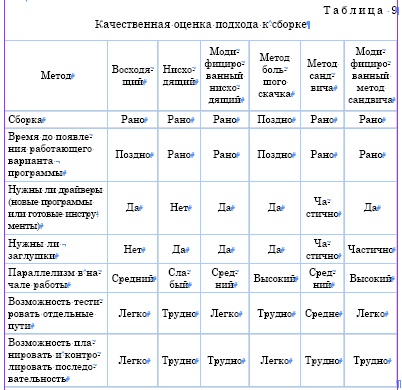
Первый критерий — время до момента сборки модулей, поскольку это важно для обнаружения ошибок в сопряжениях и предположениях модулей о свойствах друг друга.
Второй критерий — время до момента создания первых работающих «скелетных» версий программы, поскольку здесь могут проявиться главные дефекты проектирования.
Третий и четвертый критерии касаются вопроса о том, необходимы ли заглушки, драйверы и другие инструменты тестирования.
Пятый критерий — мера параллелизма, который возможен в начале или на ранних стадиях тестирования (но не концу цикла тестирования).
Шестой критерий связан с ответом на вопрос: возможно ли проверить любой конкретный путь и любое условие в программе?
Седьмой критерий характеризует сложность планирования, надзора и управления в процессе тестирования.
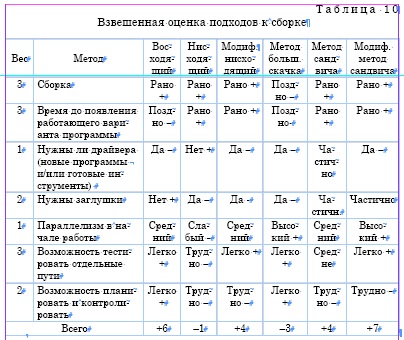
Оценим шесть подходов тестирования с помощью перечисленных критериев. В качестве исходного приближения для выполнения оценок приведен вариант грубой оценки. Прежде всего, следует взвесить относительное влияние каждого критерия на надежность программного обеспечения.
Ранняя сборка и раннее получение работающего каркаса программы, а также возможность тестировать любые конкретные условия, представляются наиболее важными, им дается вес 3.
Сложность подготовки заглушек, планирования и управления последовательностью тестов также важны, они получают вес 2.
Третий критерий, необходимость драйверов — вес 1 ввиду доступности общих инструментов тестирования.
Критерий, связанный с параллелизмом работы, имеет вес 1 (он может быть важен по другим причинам, но на надежность сильно не влияет).
Шестой критерий — вес 3.
Седьмой критерий получает вес 2.
В табл. 10 приведены результаты этой оценки. В каждой графе таблицы вес берется со знаком плюс или минус либо не учитывается, в зависимости от того, благоприятно, неблагоприятно или безразлично проявляется соответствующий фактор при рассматриваемом подходе. Модифицированный метод сандвича и восходящий метод оказываются наилучшими подходами, а метод большого скачка — наихудшим. Если способ оценки оказывается близким к вашей конкретной ситуации, следует рекомендовать модифицированный метод сандвича для тестирования больших систем или программ и восходящий подход для тестирования программ малых и средних.
Этапы тестирования
Процесс тестирования ППП начинается проверкой правильности работы отдельных модулей и заканчивается приемкой после испытания ППП при его сдаче заказчику или началом коммерческих продаж ППП. Рассмотрим типичные этапы работы тестировщиков.
Тестирование программных модулей — наиболее формализованный и автоматизированный процесс тестирования.
Основная задача тестирования состоит в проверке обработки программными модулями поступающей информации и корректности, получающихся на выходе данных в соответствии с функциями, отраженными в спецификациях.
Проверяется корректность структуры модулей и их конструктивных основных компонентов: процедур, циклов, блоков, условий и т.д.
Тестирование планируется с учетом структуры модулей и особенностей обработки информации и осуществляется преимущественно детерминировано.
Тестирование функциональных групп модулей предназначено для проверки корректности решения крупных автономных Функциональных задач ППП. Проверяется правильность управляющих и информационных связей между модулями, а также корректность вычислений в процессе обработки информации. Значительно возрастают сложность тестируемых объектов и соответственно объем тестов. Вследствие этого возрастают требования к автоматизации тестирования и затраты на его выполнение.
Детерминированным тестированием проверяются структура групп программ и основные маршруты обработки информации. В ряде случаев результаты получаются методами стохастического тестирования. Эти методы пока слабо формализованы, и их применение в значительной степени зависит от конкретных функций тестируемой группы программ.
Комплексное тестирование — сложный процесс, в котором завершается проверка корректности функционирования программ при правильных исходных данных, и осуществляются основные проверки при искажениях на входе.
Проверяются надежность функционирования всего ППП в реальных условиях, эффективность средств программой защиты и восстановления. Определяются корректность использования программами ресурсов компьютера и функционирование программ в критических условиях. Формализация процесса тестирования на этом этапе наиболее трудна, и оценка полноты тестирования осуществляется преимущественно по степени выполнения функций и по характеристикам надежности функционирования ППП. Для этого применяются преимущественно стохастическое тестирование и тестирование в реальном времени.
Прежде чем приступить к тестированию программного комплекса в целом, нужно, чтобы составляющие его части (отдельные модули или функциональные группы модулей) были тщательно оттестированы.
Сборка модулей в программный комплекс может осуществляться двумя методами: монолитным и пошаговым.
Пошаговая сборка может, в свою очередь, быть восходящей (снизу-вверх) и нисходящей (сверху-вниз).
В качестве примера рассмотрим программный пакет, состоящий из девяти модулей (рис. 16).
Монолитный метод сборки предполагает тестирование каждого из девяти модулей отдельно, а затем их одновременную сборку и тестирование в комплексе.
Для автономного тестирования каждого модуля нужен модуль-драйвер, обеспечивающий вызов и передачу тестируемому модулю необходимых входных данных и обработку результатов, и один или несколько модулей-заглушек, имитирующих функции модулей, вызываемых тестируемым модулем.
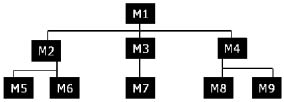
Рис. 16. Структура пакета из 9 модулей
Для рассматриваемого примера модули-драйверы нужны для всех модулей, кроме модуля М1, а модули-заглушки нужны для всех модулей, кроме М5, М6, М7, М8, М9 (т.е. модулей самого низшего уровня).
Таким образом, при монолитной сборке необходимо разработать восемь модулей-драйверов и минимум девять модулей-заглушек.
Пошаговый метод предполагает, что модули тестируются не автономно, а последовательно подключаются к набору уже оттестированных ранее модулей.
Предположим, что тестируем сверху-вниз. Тогда для модуля М1 нужно разработать три заглушки. Далее подключается модуль М2, для которого нужно предварительно разработать две заглушки, и тестируются модули М1-М2. Затем заглушка М5 заменяется модулем М5 и тестируется цепочка М1-М2-М5.
Процесс продолжается до тех пор, пока не будет собран весь комплекс. Есть возможность некоторого распараллеливания работ и автономного тестирования цепочек М1-М2-М5 (М6), М1-М3-М7, М1-М4-М8 (М9).
Оказывается, что при пошаговой сборке сверху-вниз нужно разработать девять заглушек, но не нужны драйверы.
При тестировании снизу-вверх процесс организуется следующим образом: тестируются модули низшего уровня — М5, М6, М7, М8, М9. Для каждого из них нужен драйвер.
Далее параллельно проводится тестирование М5-М2, М6-М2, М7-М3, М8-М4, М9-М4. Затем подключается модуль М1 и проводится комплексное тестирование всего пакета.
Таким образом, при восходящем тестировании нужно будет разработать максимум восемь драйверов, но заглушки не потребуются.
Сравнивая монолитную и пошаговую сборки программ, можно отметить ряд достоинств и недостатков каждого из них.
Монолитная сборка требует больших затрат, так как предполагает дополнительно разработку драйверов и заглушек, в то время как при пошаговой сборке разрабатываются либо только заглушки, либо только драйверы.
При пошаговом тестировании раньше обнаруживаются ошибки в интерфейсах между модулями, поскольку раньше начинается сборка программы. При монолитном методе модули «не видят друг друга» до последней фазы. Но безусловным его преимуществом является большая возможность распараллеливания работ.
Системное тестирование (или испытание программного комплекса) предназначено в основном для проверки соответствия пакета прикладных программ техническому заданию и для оценки его пригодности к регулярной эксплуатации и сопровождению.
Для этого проверяются полнота и точность технической документации, качество функционирования пакета прикладных программ по всем требованиям технического задания.
Проверка пригодности к сопровождению включает тестирование настройки версий на условия конкретного применения и анализ удобства модифицирования версий пакета прикладных программ.
Если речь идет о заказном пакете прикладных программ, то при положительных результатах испытаний оформляется акт приемки пакета прикладных программ в опытную или промышленную эксплуатацию, и работа считается завершенной.
Несколько иначе организуются испытания коммерческих пакетов прикладных программ, создаваемых по инициативе разработчиков для широкого круга пользователей при отсутствии конкретного заказчика.
Для таких коммерческих прикладных программ принято проводить испытания в два последовательных этапа, называемых альфа- и бета-тестированием.
Эти испытания заключаются в нормальной и форсированной (стрессовой) опытной эксплуатации конечными пользователями программного продукта, в соответствии с сопроводительной документацией, и различаются количеством участвующих пользователей.
При альфа-тестировании привлекаются конечные пользователи, работающие в той же компании, но не участвовавшие непосредственно в разработке комплекса программ.
Для бета-тестирования привлекаются добровольные пользователи (потенциальные покупатели), которым бесплатно передается версия пакета прикладных программ для опытной эксплуатации. При этом особое значение имеет выделение компетентных и доброжелательных пользователей, способных своими рекомендациями улучшить качество испытываемых (например, пяти) программ. Их деятельность стимулируется бесплатным и ранним получением и освоением нового программного продукта, собственной оценкой его качества. Эти пользователи обязуются сообщать разработчикам сведения обо всех выявленных дефектах и ошибках, а также вносить изменения в программы и данные или заменять версии по указаниям разработчиков.
Только после успешной эксплуатации и бета-тестирования ограниченным контингентом пользователей, руководителем проекта или фирмы-разработчика принимается решение о передаче пакета прикладных программ в продажу для широкого круга пользователей.
В последнее время фирмы-разработчики стали выкладывать бета-версии программ на свои Web-сайты, позволяя всем желающим скачивать их, тем самым, увеличивая контингент добровольных тестировщиков. Обратная связь организуется либо через систему конференций на сайте разработчика, либо посредством электронной почты. Отладка программного средства. Основные понятия
Лишь та ошибка, что не исправляется.
Конфуций
Отладка программного средства (ПС) — это деятельность, направленная на обнаружение и исправление ошибок в ПС с использованием процессов выполнения его программ. Отладку можно представить в виде многократного повторения трех процессов: тестирования, в результате которого может быть констатировано наличие в ПС ошибки, поиска места ошибки в программах и документации ПС и редактирования программ и документации с целью устранения обнаруженной ошибки. Другими словами: Отладка = Тестирование + Поиск ошибок + Редактирование.
Иногда тестирование и отладку считают синонимами.
Принципы и виды отладки программного средства
Успех отладки ПС в значительной степени предопределяет рациональная организация тестирования. При отладке ПС отыскиваются и устраняются, в основном, те ошибки, наличие которых в ПС устанавливается при тестировании. Тестирование не может доказать правильность ПС, в лучшем случае оно может продемонстрировать наличие в нем ошибки. Другими словами, нельзя гарантировать, что тестированием ПС практически выполнимым набором тестов можно установить наличие каждой имеющейся в ПС ошибки. Поэтому возникает две задачи. Первая задача: подготовить такой набор тестов и применить к ним ПС, чтобы обнаружить в нем по возможности большее число ошибок. Однако чем дольше продолжается процесс тестирования (и отладки в целом), тем большей становится стоимость ПС. Вторая задача: определить момент окончания отладки ПС (или отдельной его компоненты). Признаком возможности окончания отладки является полнота охвата, пропущенными через ПС, тестами множества различных ситуаций, возникающих при выполнении программ ПС, и относительно редкое проявление ошибок в ПС на последнем отрезке процесса тестирования. Последнее определяется в соответствии с требуемой степенью надежности ПС, указанной в спецификации его качества.
Для оптимизации набора тестов, т.е. для подготовки такого набора тестов, который позволял бы при заданном их числе (или при заданном интервале времени, отведенном на тестирование) обнаруживать большее число ошибок в ПС, необходимо, во-первых, заранее планировать этот набор и, во-вторых, использовать рациональную стратегию планирования (проектирования) тестов. Проектирование тестов можно начинать сразу же после завершения этапа внешнего описания ПС. Возможны разные подходы к выработке стратегии проектирования тестов, которые можно условно графически разместить (рис. 17) между следующими двумя крайними подходами.
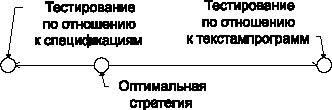
Рис. 17. Подходы к проектированию тестов
Левый крайний подход заключается в том, что тесты проектируются только на основании изучения спецификаций ПС (внешнего описания, описания архитектуры и спецификации модулей). Строение модулей при этом никак не учитывается, т.е. они рассматриваются как черные ящики. Фактически такой подход требует полного перебора всех наборов входных данных, так как в противном случае некоторые участки программ ПС могут не работать при пропуске любого теста, а это значит, что содержащиеся в них ошибки не будут проявляться. Однако тестирование ПС полным множеством наборов входных данных практически неосуществимо. Правый крайний подход заключается в том, что тесты проектируются на основании изучения текстов программ с целью протестировать все пути выполнения каждой программ ПС. Если принять во внимание наличие в программах циклов с переменным числом повторений, то различных путей выполнения программ ПС может оказаться много, так что их тестирование будет практически неосуществимо.
Оптимальная стратегия проектирования тестов расположена внутри интервала между этими крайними подходами, но ближе к левому краю. Она включает проектирование значительной части тестов по спецификациям, но требует также проектирования некоторых тестов и по текстам программ. При этом в первом случае стратегия базируется на принципах:
на каждую используемую функцию или возможность — хотя бы один тест;
на каждую область и на каждую границу изменения какой-либо входной величины — хотя бы один тест;
на каждую особую (исключительную) ситуацию, указанную в спецификациях — хотя бы один тест.
Во втором случае стратегия базируется на принципе: каждая команда каждой программы ПС должна проработать хотя бы на одном тесте.
Оптимальную стратегию проектирования тестов можно конкретизировать на основании следующего принципа: для каждого программного документа (включая тексты программ), входящего в состав ПС, должны проектироваться свои тесты с целью выявления в нем ошибок. Во всяком случае, этот принцип необходимо соблюдать в соответствии с определением ПС и содержанием понятия технологии программирования как технологии разработки надежных ПС. Различают два основных вида отладки (включая тестирование): автономную и комплексную отладку ПС.
Автономная отладка ПС означает последовательное раздельное тестирование различных частей программ, входящих в ПС, с поиском и исправлением в них фиксируемых при тестировании ошибок. Она фактически включает отладку каждого программного модуля и отладку сопряжения модулей.
Комплексная отладка означает тестирование ПС в целом с поиском и исправлением фиксируемых при тестировании ошибок во всех документах (включая тексты программ ПС), относящихся к ПС в целом. К таким документам относятся определение требований к ПС, спецификация качества ПС, функциональная спецификация ПС, описание архитектуры ПС и тексты программ ПС.
Заповеди отладки программного средства
Приводятся общие рекомендации по организации отладки ПС. Но сначала следует отметить некоторый феномен, который подтверждает важность предупреждения ошибок на предыдущих этапах разработки: по мере роста числа обнаруженных и исправленных ошибок в ПС растет также относительная вероятность существования в нем необнаруженных ошибок. Это объясняется тем, что при росте числа ошибок, обнаруженных в ПС, уточняется и наше представление об общем числе допущенных в нем ошибок, а значит, в какой-то мере, и о числе необнаруженных еще ошибок.
Ниже приведены рекомендации по организации отладки в форме заповедей.
Заповедь 1. Считайте тестирование ключевой задачей разработки ПС, поручайте его самым квалифицированным и одаренным программистам; нежелательно тестировать свою собственную программу.
Заповедь 2. Хорош тот тест, для которого высока вероятность обнаружить ошибку, а не тот, который демонстрирует правильную работу программы.
Заповедь 3. Готовьте тесты, как для правильных, так и для неправильных данных.
Заповедь 4. Документируйте пропуск тестов через компьютер; детально изучайте результаты каждого теста; избегайте тестов, пропуск которых нельзя повторить.
Заповедь 5. Каждый модуль подключайте к программе только один раз; никогда не изменяйте программу, чтобы облегчить ее тестирование.
Заповедь 6. Пропускайте заново все тесты, связанные с проверкой работы какой-либо программы ПС или ее взаимодействия с другими программами, если в нее были внесены изменения (например, в результате устранения ошибки).
Автономная отладка программного средства
При автономной отладке ПС каждый модуль на самом деле тестируется в некотором программном окружении, кроме случая, когда отлаживаемая программа состоит только из одного модуля. Это окружение состоит из других модулей, часть которых является модулями отлаживаемой программы, которые уже отлажены, а часть — модулями, управляющими отладкой (отладочными модулями). Таким образом, при автономной отладке всегда тестируется некоторая программа (тестируемая программа), построенная специально для тестирования отлаживаемого модуля. Эта программа лишь частично совпадает с отлаживаемой программой, кроме случая, когда отлаживается последний модуль отлаживаемой программы. В процессе автономной отладки ПС производится наращивание тестируемой программы отлаженными модулями: при переходе к отладке следующего модуля в его программное окружение добавляется последний отлаженный модуль. Такой процесс наращивания программного окружения отлаженными модулями называется интеграцией программы. Отладочные модули, входящие в окружение отлаживаемого модуля, зависят от порядка, в каком отлаживаются модули этой программы, от того, какой модуль отлаживается и, возможно, от того, какой тест будет пропускаться.
При восходящем тестировании это окружение будет содержать только один отладочный модуль (кроме случая, когда отлаживается последний модуль отлаживаемой программы), который будет головным в тестируемой программе. Такой отладочный модуль называют ведущим (или драйвером). Ведущий отладочный модуль подготавливает информационную среду для тестирования отлаживаемого модуля (т.е. формирует ее состояние, требуемое для тестирования этого модуля, в частности путем ввода некоторых тестовых данных), осуществляет обращение к отлаживаемому модулю и после окончания его работы выдает необходимые сообщения. При отладке одного модуля для разных тестов могут составляться разные ведущие отладочные модули.
При нисходящем тестировании окружение отлаживаемого модуля в качестве отладочных модулей содержит отладочные имитаторы (заглушки) некоторых еще не отлаженных модулей. К таким модулям относятся, прежде всего, все модули, к которым может обращаться отлаживаемый модуль, а также еще не отлаженные модули, к которым могут обращаться уже отлаженные модули (включенные в это окружение). Некоторые из этих имитаторов при отладке одного модуля могут изменяться для разных тестов.
На практике в окружении отлаживаемого модуля могут содержаться отладочные модули обоих типов, если используется смешанная стратегия тестирования. Это связано с тем, что как восходящее, так и нисходящее тестирование имеет свои достоинства и свои недостатки.
К достоинствам восходящего тестирования относятся:
простота подготовки тестов;
возможность полной реализации плана тестирования модуля.
Это связано с тем, что тестовое состояние информационной среды готовится непосредственно перед обращением к отлаживаемому модулю (ведущим отладочным модулем).
Недостатками восходящего тестирования являются следующие его особенности:
тестовые данные готовятся, как правило, не в той форме, которая рассчитана на пользователя (кроме случая, когда отлаживается последний, головной, модуль отлаживаемой программы);
большой объем отладочного программирования (при отладке одного модуля приходится составлять много ведущих отладочных модулей, формирующих подходящее состояние информационной среды для разных тестов);
необходимость специального тестирования сопряжения модулей.
К достоинствам нисходящего тестирования относятся следующие его особенности:
большинство тестов готовится в форме, рассчитанной на пользователя;
во многих случаях относительно небольшой объем отладочного программирования (имитаторы модулей, как правило, весьма просты и каждый пригоден для большого числа, нередко — для всех, тестов);
отпадает необходимость тестирования сопряжения модулей.
Недостатком нисходящего тестирования является то, что тестовое состояние информационной среды перед обращением к отлаживаемому модулю готовится косвенно, оно является результатом применения уже отлаженных модулей к тестовым данным или данным, выдаваемым имитаторами. Это, во-первых, затрудняет подготовку тестов и требует высокой квалификации тестовика (разработчика тестов), а во-вторых, делает затруднительным или даже невозможным реализацию полного плана тестирования отлаживаемого модуля. Указанный недостаток иногда вынуждает разработчиков применять восходящее тестирование даже в случае нисходящей разработки. Однако чаще применяют некоторые модификации нисходящего тестирования, либо некоторую комбинацию нисходящего и восходящего тестирования. Исходя из того, что нисходящее тестирование, в принципе, является предпочтительным, остановимся на приемах, позволяющих в какой-то мере преодолеть указанные трудности.
Прежде всего, необходимо организовать отладку программы таким образом, чтобы как можно раньше были отлажены модули, осуществляющие ввод данных, тогда тестовые данные можно готовить в форме, рассчитанной на пользователя, что существенно упростит подготовку последующих тестов. Далеко не всегда этот ввод осуществляется в головном модуле, поэтому приходится в первую очередь отлаживать цепочки модулей, ведущие к модулям, осуществляющим указанный ввод. Пока модули, осуществляющие ввод данных, не отлажены, тестовые данные поставляются некоторыми имитаторами: они либо включаются в имитатор как его часть, либо вводятся этим имитатором.
При нисходящем тестировании некоторые состояния информационной среды, при которых требуется тестировать отлаживаемый модуль, могут не возникать при выполнении отлаживаемой программы ни при каких входных данных. В этих случаях можно было бы вообще не тестировать отлаживаемый модуль, так как обнаруживаемые при этом ошибки не будут проявляться при выполнении отлаживаемой программы ни при каких входных данных. Однако так поступать не рекомендуется, так как при изменениях отлаживаемой программы (например, при сопровождении ПС) не использованные для тестирования отлаживаемого модуля состояния информационной среды могут уже возникать, что требует дополнительного тестирования этого модуля (а этого при рациональной организации отладки можно было бы не делать, если сам данный модуль не изменялся). Для осуществления тестирования отлаживаемого модуля в указанных ситуациях иногда используют подходящие имитаторы, чтобы создать требуемое состояние информационной среды. Чаще же пользуются модифицированным вариантом нисходящего тестирования, при котором отлаживаемые модули перед их интеграцией предварительно тестируются отдельно (в этом случае в окружении отлаживаемого модуля появляется ведущий отладочный модуль, наряду с имитаторами модулей, к которым может обращаться отлаживаемый модуль). Однако представляется более целесообразной другая модификация нисходящего тестирования: после завершения нисходящего тестирования отлаживаемого модуля для достижимых тестовых состояний информационной среды следует его отдельно протестировать для остальных требуемых состояний информационной среды.
Часто применяют также комбинацию восходящего и нисходящего тестирования, которую называют методом сандвича. Сущность этого метода заключается в одновременном осуществлении как восходящего, так и нисходящего тестирования, пока эти два процесса тестирования не встретятся на каком-либо модуле где-то в середине структуры отлаживаемой программы. Этот метод при разумном порядке тестирования позволяет воспользоваться достоинствами как восходящего, так и нисходящего тестирования, а также в значительной степени нейтрализовать их недостатки.
Весьма важным при автономной отладке является тестирование сопряжения модулей. Дело в том, что спецификация каждого модуля программы, кроме головного, используется в этой программы в двух ситуациях: во-первых, при разработке текста этого модуля и, во-вторых, при написании обращения к этому модулю в других модулях программы. И в том, и в другом случае в результате ошибки может быть нарушено требуемое соответствие заданной спецификации модуля. Такие ошибки требуется обнаруживать и устранять. Для этого и предназначено тестирование сопряжения модулей. При нисходящем тестировании тестирование сопряжения осуществляется попутно каждым пропускаемым тестом, что считают достоинством нисходящего тестирования. При восходящем тестировании обращение к отлаживаемому модулю производится не из модулей отлаживаемой программы, а из ведущего отладочного модуля. В связи с этим существует опасность, что последний модуль может приспособиться к некоторым «заблуждениям» отлаживаемого модуля. Поэтому, приступая (в процессе интеграции программы) к отладке нового модуля, приходится тестировать каждое обращение к ранее отлаженному модулю с целью обнаружения несогласованности этого обращения с телом соответствующего модуля (и не исключено, что виноват в этом ранее отлаженный модуль). Таким образом, приходится частично повторять в новых условиях тестирование ранее отлаженного модуля, при этом возникают те же трудности, что и при нисходящем тестировании.
Автономное тестирование модуля целесообразно осуществлять в четыре последовательно выполняемых шага.
1. На основании спецификации отлаживаемого модуля подготовьте тесты для каждой возможности и каждой ситуации, для каждой границы областей допустимых значений всех входных данных, для каждой области изменения данных, для каждой области недопустимых значений всех входных данных и каждого недопустимого условия.
2. Проверьте текст модуля, чтобы убедиться, что каждое направление любого разветвления будет пройдено хотя бы на одном тесте. Добавьте недостающие тесты.
3. Проверьте текст модуля, чтобы убедиться, что для каждого цикла существуют тесты, обеспечивающие, по крайней мере, три следующие ситуации: тело цикла не выполняется ни разу, тело цикла выполняется один раз и тело цикла выполняется максимальное число раз. Добавьте недостающие тесты.
4. Проверьте текст модуля, чтобы убедиться, что существуют тесты, проверяющие чувствительность к отдельным особым значениям входных данных. Добавьте недостающие тесты.
Комплексная отладка программного средства
При комплексной отладке тестируется ПС в целом, причем тесты готовятся по каждому из документов ПС. Тестирование этих документов производится, как правило, в порядке, обратном их разработке. Исключение составляет лишь тестирование документации по применению, которая разрабатывается по внешнему описанию параллельно с разработкой текстов программ — это тестирование лучше производить после завершения тестирования внешнего описания. Тестирование при комплексной отладке представляет собой применение ПС к конкретным данным, которые могут возникнуть у пользователя (в частности, все тесты готовятся в форме, рассчитанной на пользователя), но, возможно, в моделируемой (а не в реальной) среде. Например, некоторые недоступные при комплексной отладке устройства ввода и вывода могут быть заменены их программными имитаторами.
Тестирование архитектуры ПС. Целью тестирования является поиск несоответствия между описанием архитектуры и совокупностью программ ПС. К моменту начала тестирования архитектуры ПС должна быть уже закончена автономная отладка каждой подсистемы. Ошибки реализации архитектуры могут быть связаны, прежде всего, с взаимодействием этих подсистем, в частности, с реализацией архитектурных функций (если они есть). Поэтому хотелось бы проверить все пути взаимодействия между подсистемами ПС. При этом желательно хотя бы протестировать все цепочки выполнения подсистем без повторного вхождения последних. Если заданная архитектура представляет ПС в качестве малой системы из выделенных подсистем, то число таких цепочек будет вполне обозримо.
Тестирование внешних функций. Целью тестирования является поиск расхождений между функциональной спецификацией и совокупностью программ ПС. Несмотря на то, что все эти программы автономно уже отлажены, указанные расхождения могут быть, например, из-за несоответствия внутренних спецификаций программ и их модулей (на основании которых производилось автономное тестирование) функциональной спецификации ПС. Как правило, тестирование внешних функций производится так же, как и тестирование модулей на первом шаге, т.е. как черного ящика.
Тестирование качества ПС. Целью тестирования является поиск нарушений требований качества, сформулированных в спецификации качества ПС. Это наиболее трудный и наименее изученный вид тестирования. Далеко не каждый примитив качества ПС может быть испытан тестированием. Завершенность ПС проверяется уже при тестировании внешних функций. На данном этапе тестирование этого примитива качества может быть продолжено, если требуется получить какую-либо вероятностную оценку степени надежности ПС. Однако методика такого тестирования еще требует своей разработки. Могут тестироваться такие примитивы качества, как точность, устойчивость, защищенность, временная эффективность, в какой-то мере эффективность по памяти, эффективность по устройствам, расширяемость и, частично, независимость от устройств. Каждый из этих видов тестирования имеет свою специфику и заслуживает отдельного рассмотрения. Легкость применения ПС (критерий качества, включающий несколько примитивов качества) оценивается при тестировании документации по применению ПС.
Тестирование документации по применению ПС. Целью тестирования является поиск несогласованности документации по применению и совокупностью программ ПС, а также выявление неудобств, возникающих при применении ПС. Этот этап непосредственно предшествует подключению пользователя к завершению разработки ПС (тестированию определения требований к ПС и аттестации ПС), поэтому разработчикам важно, сначала самим воспользоваться ПС так, как это будет делать пользователь. Все тесты на этом этапе готовятся на основании только документации по применению ПС. Прежде всего, должны тестироваться возможности ПС, как это делалось при тестировании внешних функций, но только на основании документации по применению. Должны быть протестированы все неясные места в документации, а также все примеры, использованные в документации. Далее тестируются наиболее трудные случаи применения ПС с целью обнаружить нарушение требований относительности легкости применения ПС.
Тестирование определения требований к ПС. Целью тестирования является выяснение, в какой мере ПС не соответствует предъявленному определению требований к нему. Особенность этого вида тестирования заключается в том, что его осуществляет организация-покупатель или организация-пользователь ПС как один из путей преодоления барьера между разработчиком и пользователем. Обычно это тестирование производится с помощью контрольных (типовых) задач, для которых известен результат решения. В тех случаях, когда разрабатываемое ПС должно придти на смену другой версии ПС, которая решает хотя бы часть задач разрабатываемого ПС, тестирование производится путем решения общих задач с помощью, как старого, так и нового ПС (с последующим сопоставлением полученных результатов). Иногда в качестве формы такого тестирования используют опытную эксплуатацию ПС — ограниченное применение нового ПС с анализом использования результатов в практической деятельности. По существу, этот вид тестирования во многом перекликается с испытанием ПС при его аттестации, но выполняется до аттестации, а иногда и вместо аттестации.
Испытание программных продуктов Под испытанием программной продукции следует понимать экспериментальное определение количественных и/или качественных характеристик свойств продукции при ее функционировании в реальной среде и/или моделировании среды функционирования.
Целью испытания является экспериментальное определение фактических характеристик свойств испытываемого программного изделия (ПИ). Эти характеристики могут быть как количественными, так и качественными. Важно, чтобы на их основе можно было сделать вывод о пригодности ПИ к использованию по своему назначению. Если вывод отрицательный, то образец ПИ возвращается на доработку.
Испытание является завершающим этапом разработки. Ему предшествует этап статической и динамической отладки программ. Основным методом динамической отладки является тестирование. В узком смысле цель тестирования состоит в обнаружении ошибок, цель же отладки — не только в обнаружении, но и в устранении ошибок. Однако ограничиться только отладкой программы, если есть уверенность в том, что все ошибки в ней устранены, нельзя. Цели у отладки и испытания разные. Полностью отлаженная программа может не обладать определенными потребительскими свойствами и тем самым быть непригодной к использованию. Не может служить альтернативой испытанию и проверка работоспособности программы на контрольном примере, так как программа, работоспособная в условиях контрольного примера, может оказаться неработоспособной в других условиях применения.
В соответствии с ГОСТ 19.004-80 под испытанием программ понимают установление соответствия программы заданным требованиям и программным документам. Это определение построено на предположении, что в техническом задании на разработку программы определены все требования (характеристики), обеспечение которых гарантирует пригодность программы к использованию по своему назначению.
При отсутствии технического задания (ТЗ) на разработку программного средства (ПС) или полного и обоснованного перечня требований к характеристикам разрабатываемого ПС задача испытания ПС становится неопределенной и неконструктивной.
Длительность испытания зависит от типа, конфигурации (сложности) программного средства, а также от целей и степени автоматизации рассматриваемого технологического процесса (например, при испытании операционных систем от одного до шести месяцев). Сложные программные комплексы после интеграции могут испытываться и более длительное время.
Основными видами испытания программных продуктов (ПП) являются:
предварительные;
приемочные;
эксплуатационные испытания, включая опытную эксплуатацию.
В зависимости от места проведения различают стендовые и полигонные испытания.
Под испытательным стендом понимают совокупность технических устройств и математических моделей, обеспечивающих в автоматическом режиме имитацию среды функционирования; поступление входных данных, искажающие воздействия; регистрацию информации о функционировании ПС, а также управление процессом испытания и объектом испытания.
Если в основу стендовых испытаний положен принцип моделирования, то соответствующие испытательные стенды называют моделирующими.
Испытательным полигоном называют место, предназначенное для испытаний в условиях, близких к условиям эксплуатации, и обеспеченное необходимыми средствами испытания.
Полигонным испытаниям подвергают системы, работающие в реальном масштабе времени. В полигонных условиях обычно сочетают натурные испытания с использованием реальных объектов автоматизируемых систем и моделирование некоторых объектов и процессов их функционирования.
По степени зависимости испытателей от разработчиков различают зависимые и независимые испытания.
При зависимых испытаниях основные операции с испытываемыми ПС (подготовка к работе, подготовка и ввод исходных данных, регистрация и анализ результатов) выполняют разработчики программ.
Оценку результатов испытания производит комиссия при активном участии разработчиков.
Независимые испытания проводят специальные подразделения, не несущие ответственности за разработку программ и непосредственно не подчиняющиеся руководителям разработки.
Технологическая схема испытания
Цель повышения эффективности испытания, его ускорения и удешевления может быть достигнута путем разработки технологической схемы испытаний, предусматривающей:
знание назначения испытываемого ПС, условий его функционирования и требований к нему со стороны пользователей;
автоматизацию наиболее трудоемких процессов и, прежде всего, моделирование среды функционирования, включая искажающие воздействия;
ясное представление цели и последовательности испытания;
целенаправленность и неизбыточность испытания, исключающая или минимизирующая повторение однородных процедур при одних и тех же условиях функционирования испытываемого ПС;
систематический контроль, регулярное ведение протокола и журнала испытания;
последовательное определение и выполнение плана испытания;
сопоставление имеющихся ресурсов с предполагаемым объемом испытания;
возможность обеспечения объективной количественной оценки полноты и достоверности результатов испытания на всех этапах.
Любому виду испытаний должна предшествовать тщательная подготовка.
В подготовку испытаний ПС входят следующие мероприятия:
составление и согласование плана-графика проведения испытания;
разработка, комплектование, испытание и паспортизация программно-технических средств, используемых при испытаниях;
анализ пригодности испытательных средств, используемых во время предварительных испытаний, для проведения приемочных испытаний;
анализ пригодности накопленных данных о качестве ПС для использования при окончательном определении значений показателей качества испытываемого ПС;
проверка и согласование с представителем заказчика конструкторской документации на ПС, предъявляемой при испытаниях;
разработка, согласование и утверждение программ и методик испытаний;
аттестация специалистов на допуск к проведению испытаний;
приемка испытываемого опытного образца ПС на носителе данных и документации;
проведение мероприятий, направленных на обеспечение достоверности испытаний.
Следует подчеркнуть необходимость заблаговременной разработки и испытания программно-технических средств, которые будут использоваться при проведении испытаний.
При этом следует иметь в виду, что уровень точности и надежности измерительной аппаратуры должен быть значительно выше соответствующих показателей испытываемого объекта.
На основании изложенного можно определить следующие пять этапов испытания:
1. Обследование проектируемого ПС, анализ проектной документации.
2. Определение наиболее важных подсистем и функций проектируемого ПС, подлежащих испытанию.
3. Анализ показателей качества ПС и методов определения их значений. Разработка программ и методик испытания.
4. Разработка (освоение) испытательных программно-технических средств, библиотек тестов и баз данных (если они требуются).
5. Непосредственное проведение испытаний, анализ результатов, принятие решения.
В зависимости от специфики, условий применения, требований к качеству испытываемых ПС, испытания могут проводиться либо путем тестирования, либо путем статистического моделирования среды функционирования, либо на основе натурных и смешанных экспериментов. Часто полезно использование всех этих методов. Значения некоторых показателей качества могут быть получены экспертным путем.
На рис. 18 изображена технологическая схема в виде этапов подготовки и проведения испытания и их связи с этапами разработки ПС.
Планирование и оценка испытаний
План проведения испытаний должен быть ориентирован на обеспечение всесторонней проверки ПС и заданной достоверности полученных результатов при использовании ограниченных ресурсов, выделенных на испытания. Возможны следующие подходы для решения этой задачи:
1) анализируют диапазон входных данных. На основе анализа готовят множество комбинаций тестовых наборов данных, охватывающее наиболее характерные подмножества входных данных. Программу рассматривают как черный ящик. Испытания сводятся к последовательному вводу тестовых наборов данных и анализу получаемых результатов;
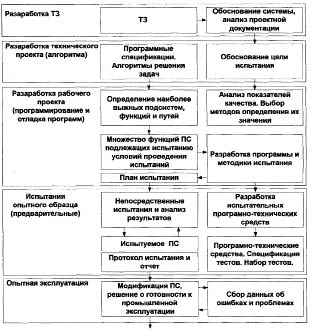
Рис. 18. Технологическая схема испытания ПС
2) анализируют множество ситуаций, которые могут возникнуть при функционировании ПС. Выбирают наиболее характерные. Каждую из них выражают через тестовый набор входных данных. Далее процесс испытания и анализа результатов сводится к п. 1;
3) с помощью граф-схемы анализируют микроструктуру ПС. Выбирают множество путей, которое полностью покрывает граф-схему, и такую последовательность тестовых наборов исходных данных, выполнение которой будет проходить по выделенным путям. Организация испытаний аналогична пунктам 1 и 2;
4) ПС испытывают в реальной среде функционирования;
5) ПС испытывают в статистически моделируемой среде функционирования, адекватной реальной среде.
Ни один из этих подходов не является универсальным. Каждый имеет свои преимущества и недостатки в зависимости от специфики испытываемого ПС. Например, подход 1 может оказаться предпочтительным, если диапазон входных данных обозрим, сравнительно легко анализируется и систематизируется, и неприемлемым — в противном случае. Наиболее достоверные результаты получаются при испытаниях в реальной среде функционирования. Но такие испытания редко удается осуществить. Поэтому на практике используют комбинации всех видов. Например, смешанный метод, когда среда функционирования ПС моделируется, а достоверность результатов проверяется сравнением с результатами, полученными при функционировании ПС в реальной среде.
Методика решения задачи планирования испытания включает в себя следующие этапы:
нахождение всех путей реализации;
выделение минимального подмножества путей, обеспечивающих проверку всех участков программы;
разработка тестов для проверки выделенных путей.
Критерий интенсивности обнаружения ошибок. Если считать, что во время одного эксперимента обнаруживаются не более одной ошибки и каждая ошибка до начала следующего эксперимента устраняется, то можно предположить, что при благоприятном ходе отладки и испытания значение критерия интенсивности обнаружения ошибок N можно вычислить по формуле
N = 1 — n/К,
|
где n — |
количество обнаруженных и устраненных ошибок; |
|
К -
|
количество экспериментов. |
С возрастанием количества экспериментов критерий интенсивности обнаружения ошибок будет асимптотически стремиться к единице.
Тогда в качестве критерия прекращения испытаний можно принять, например, следующее условие: N > 0,95 при обнаружении в последних двухстах экспериментах не более трех несущественных ошибок. Идея выбора такого критерия основана на том, что частота обнаружения ошибок, выраженная отношением n/К, по мере увеличения количества экспериментов должна уменьшаться и к моменту завершения испытаний принять значение, близкое к нулю. Следует иметь в виду, что оценка уровня завершенности испытаний будет достоверной лишь в случае, если каждый эксперимент проводится в новых условиях и испытатели стремятся обнаружить ошибки, а не доказать их отсутствие.
Критерий заданного значения средней наработки на отказ (критерий Дж.Д. Муса). Предположим, что суммарное количество обнаруженных и устраненных дефектов в программе n (под дефектом понимается любая причина неудовлетворенности свойствами программы) описывается показательной функцией времени функционирования t
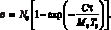
|
где N0 — |
исходное количество дефектов в программе; ъ |
|
М0 —
|
общее количество дефектов, которое может проявиться за время эксплуатации ПС; |
|
Т0 —
|
средняя наработка на отказ в начале испытаний; |
|
С —
|
коэффициент сжатия тестов. |
Коэффициент С 1 тогда, когда абсолютная реактивность программы при прогоне тестов или статистических испытаниях отличается от абсолютной реактивности при работе программы в реальных условиях.
Если, например, за один час испытаний моделируется управляемый процесс, происходящий в реальных условиях в течение десяти часов, то коэффициент сжатия С принимается равным 10. Скорость обнаружения и устранения дефектов, измеряемая относительно времени функционирования программы, пропорциональна интенсивности отказов. Количество зарегистрированных отказов m зависит от суммарного времени функционирования программы следующим образом:
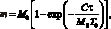
Коэффициент пропорциональности В = n/m называется коэффициентом уменьшения дефектов.
Если в ходе испытания обнаруженные ошибки устраняются, то текущее значение средней наработки на отказ будет увеличиваться.
В качестве критерия завершенности испытания можно принять достижение требуемого (заданного) значения средней наработки на отказ Т0.
При планировании отладки и испытания программного обеспечения следует учитывать влияние следующих факторов:
скорость выявления дефектов;
скорость устранения дефектов;
удовлетворенность машинным временем.
Первый фактор зависит от укомплектованности и квалификации испытателей, второй — от укомплектованности и квалификации группы программистов отладчиков, третий — от технической оснащенности разрабатывающей (испытывающей) организации.
Software testing is the act of examining the artifacts and the behavior of the software under test by validation and verification. Software testing can also provide an objective, independent view of the software to allow the business to appreciate and understand the risks of software implementation. Test techniques include, but are not necessarily limited to:
- analyzing the product requirements for completeness and correctness in various contexts like industry perspective, business perspective, feasibility and viability of implementation, usability, performance, security, infrastructure considerations, etc.
- reviewing the product architecture and the overall design of the product
- working with product developers on improvement in coding techniques, design patterns, tests that can be written as part of code based on various techniques like boundary conditions, etc.
- executing a program or application with the intent of examining behavior
- reviewing the deployment infrastructure and associated scripts and automation
- take part in production activities by using monitoring and observability techniques
Software testing can provide objective, independent information about the quality of software and risk of its failure to users or sponsors.[1]
Software testing can determine the correctness of software under the assumption of some specific hypotheses (see the hierarchy of testing difficulty below), testing cannot identify all the failures within the software.[2] Instead, it furnishes a criticism or comparison that compares the state and behavior of the product against test oracles — principles or mechanisms by which someone might recognize a problem. These oracles may include (but are not limited to) specifications, contracts,[3] comparable products, past versions of the same product, inferences about intended or expected purpose, user or customer expectations, relevant standards, applicable laws, or other criteria.
A primary purpose of testing is to detect software failures so that defects may be discovered and corrected. Testing cannot establish that a product functions properly under all conditions, but only that it does not function properly under specific conditions.[4] The scope of software testing may include the examination of code as well as the execution of that code in various environments and conditions as well as examining the aspects of code: does it do what it is supposed to do and do what it needs to do. In the current culture of software development, a testing organization may be separate from the development team. There are various roles for testing team members. Information derived from software testing may be used to correct the process by which software is developed.[5]: 41–43
Every software product has a target audience. For example, the audience for video game software is completely different from banking software. Therefore, when an organization develops or otherwise invests in a software product, it can assess whether the software product will be acceptable to its end users, its target audience, its purchasers, and other stakeholders. Software testing assists in making this assessment.
Faults and failures[edit]
Software faults occur through the following process: A programmer makes an error (mistake), which results in a fault (defect, bug) in the software source code. If this fault is executed, in certain situations the system will produce wrong results, causing a failure.[6]: 31
Not all faults will necessarily result in failures. For example, faults in the dead code will never result in failures. A fault that did not reveal failures may result in a failure when the environment is changed. Examples of these changes in environment include the software being run on a new computer hardware platform, alterations in source data, or interacting with different software.[7] A single fault may result in a wide range of failure symptoms.
Not all software faults are caused by coding errors. One common source of expensive defects is requirement gaps, that is, unrecognized requirements that result in errors of omission by the program designer.[5]: 426 Requirement gaps can often be non-functional requirements such as testability, scalability, maintainability, performance, and security.
Input combinations and preconditions[edit]
A fundamental problem with software testing is that testing under all combinations of inputs and preconditions (initial state) is not feasible, even with a simple product.[4]: 17–18 [8] This means that the number of faults in a software product can be very large and defects that occur infrequently are difficult to find in testing and debugging. More significantly, non-functional dimensions of quality (how it is supposed to be versus what it is supposed to do) — usability, scalability, performance, compatibility, and reliability — can be highly subjective; something that constitutes sufficient value to one person may be intolerable to another.
Software developers can’t test everything, but they can use combinatorial test design to identify the minimum number of tests needed to get the coverage they want. Combinatorial test design enables users to get greater test coverage with fewer tests. Whether they are looking for speed or test depth, they can use combinatorial test design methods to build structured variation into their test cases.[9]
Economics[edit]
A study conducted by NIST in 2002 reports that software bugs cost the U.S. economy $59.5 billion annually. More than a third of this cost could be avoided, if better software testing was performed.[10][dubious – discuss]
Outsourcing software testing because of costs is very common, with China, the Philippines, and India, being preferred destinations.[11]
Roles[edit]
Software testing can be done by dedicated software testers; until the 1980s, the term «software tester» was used generally, but later it was also seen as a separate profession. Regarding the periods and the different goals in software testing,[12] different roles have been established, such as test manager, test lead, test analyst, test designer, tester, automation developer, and test administrator. Software testing can also be performed by non-dedicated software testers.[13]
History[edit]
Glenford J. Myers initially introduced the separation of debugging from testing in 1979.[14] Although his attention was on breakage testing («A successful test case is one that detects an as-yet undiscovered error.»[14]: 16 ), it illustrated the desire of the software engineering community to separate fundamental development activities, such as debugging, from that of verification.
Testing approach[edit]
Static, dynamic, and passive testing[edit]
There are many approaches available in software testing. Reviews, walkthroughs, or inspections are referred to as static testing, whereas executing programmed code with a given set of test cases is referred to as dynamic testing.[15][16]
Static testing is often implicit, like proofreading, plus when programming tools/text editors check source code structure or compilers (pre-compilers) check syntax and data flow as static program analysis. Dynamic testing takes place when the program itself is run. Dynamic testing may begin before the program is 100% complete in order to test particular sections of code and are applied to discrete functions or modules.[15][16] Typical techniques for these are either using stubs/drivers or execution from a debugger environment.[16]
Static testing involves verification, whereas dynamic testing also involves validation.[16]
Passive testing means verifying the system behavior without any interaction with the software product. Contrary to active testing, testers do not provide any test data but look at system logs and traces. They mine for patterns and specific behavior in order to make some kind of decisions.[17] This is related to offline runtime verification and log analysis.
Exploratory approach[edit]
Exploratory testing is an approach to software testing that is concisely described as simultaneous learning, test design, and test execution. Cem Kaner, who coined the term in 1984,[18]: 2 defines exploratory testing as «a style of software testing that emphasizes the personal freedom and responsibility of the individual tester to continually optimize the quality of his/her work by treating test-related learning, test design, test execution, and test result interpretation as mutually supportive activities that run in parallel throughout the project.»[18]: 36
The «box» approach[edit]
Software testing methods are traditionally divided into white- and black-box testing. These two approaches are used to describe the point of view that the tester takes when designing test cases. A hybrid approach called grey-box testing may also be applied to software testing methodology.[19][20] With the concept of grey-box testing—which develops tests from specific design elements—gaining prominence, this «arbitrary distinction» between black- and white-box testing has faded somewhat.[21]
White-box testing[edit]
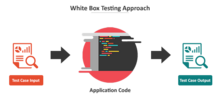
White Box Testing Diagram
White-box testing (also known as clear box testing, glass box testing, transparent box testing, and structural testing) verifies the internal structures or workings of a program, as opposed to the functionality exposed to the end-user. In white-box testing, an internal perspective of the system (the source code), as well as programming skills, are used to design test cases. The tester chooses inputs to exercise paths through the code and determine the appropriate outputs.[19][20] This is analogous to testing nodes in a circuit, e.g., in-circuit testing (ICT).
While white-box testing can be applied at the unit, integration, and system levels of the software testing process, it is usually done at the unit level.[21] It can test paths within a unit, paths between units during integration, and between subsystems during a system–level test. Though this method of test design can uncover many errors or problems, it might not detect unimplemented parts of the specification or missing requirements.
Techniques used in white-box testing include:[20][22]
- API testing – testing of the application using public and private APIs (application programming interfaces)
- Code coverage – creating tests to satisfy some criteria of code coverage (for example, the test designer can create tests to cause all statements in the program to be executed at least once)
- Fault injection methods – intentionally introducing faults to gauge the efficacy of testing strategies
- Mutation testing methods
- Static testing methods
Code coverage tools can evaluate the completeness of a test suite that was created with any method, including black-box testing. This allows the software team to examine parts of a system that are rarely tested and ensures that the most important function points have been tested.[23] Code coverage as a software metric can be reported as a percentage for:[19][23][24]
-
- Function coverage, which reports on functions executed
- Statement coverage, which reports on the number of lines executed to complete the test
- Decision coverage, which reports on whether both the True and the False branch of a given test has been executed
100% statement coverage ensures that all code paths or branches (in terms of control flow) are executed at least once. This is helpful in ensuring correct functionality, but not sufficient since the same code may process different inputs correctly or incorrectly.[25]
Black-box testing[edit]

Black-box testing (also known as functional testing) treats the software as a «black box,» examining functionality without any knowledge of internal implementation, without seeing the source code. The testers are only aware of what the software is supposed to do, not how it does it.[26] Black-box testing methods include: equivalence partitioning, boundary value analysis, all-pairs testing, state transition tables, decision table testing, fuzz testing, model-based testing, use case testing, exploratory testing, and specification-based testing.[19][20][24]
Specification-based testing aims to test the functionality of software according to the applicable requirements.[27] This level of testing usually requires thorough test cases to be provided to the tester, who then can simply verify that for a given input, the output value (or behavior), either «is» or «is not» the same as the expected value specified in the test case.
Test cases are built around specifications and requirements, i.e., what the application is supposed to do. It uses external descriptions of the software, including specifications, requirements, and designs to derive test cases. These tests can be functional or non-functional, though usually functional.
Specification-based testing may be necessary to assure correct functionality, but it is insufficient to guard against complex or high-risk situations.[28]
One advantage of the black box technique is that no programming knowledge is required. Whatever biases the programmers may have had, the tester likely has a different set and may emphasize different areas of functionality. On the other hand, black-box testing has been said to be «like a walk in a dark labyrinth without a flashlight.»[29] Because they do not examine the source code, there are situations when a tester writes many test cases to check something that could have been tested by only one test case or leaves some parts of the program untested.
This method of test can be applied to all levels of software testing: unit, integration, system and acceptance.[21] It typically comprises most if not all testing at higher levels, but can also dominate unit testing as well.
Component interface testing
Component interface testing is a variation of black-box testing, with the focus on the data values beyond just the related actions of a subsystem component.[30] The practice of component interface testing can be used to check the handling of data passed between various units, or subsystem components, beyond full integration testing between those units.[31][32] The data being passed can be considered as «message packets» and the range or data types can be checked, for data generated from one unit, and tested for validity before being passed into another unit. One option for interface testing is to keep a separate log file of data items being passed, often with a timestamp logged to allow analysis of thousands of cases of data passed between units for days or weeks. Tests can include checking the handling of some extreme data values while other interface variables are passed as normal values.[31] Unusual data values in an interface can help explain unexpected performance in the next unit.
Visual testing[edit]
The aim of visual testing is to provide developers with the ability to examine what was happening at the point of software failure by presenting the data in such a way that the developer can easily find the information she or he requires, and the information is expressed clearly.[33][34]
At the core of visual testing is the idea that showing someone a problem (or a test failure), rather than just describing it, greatly increases clarity and understanding. Visual testing, therefore, requires the recording of the entire test process – capturing everything that occurs on the test system in video format. Output videos are supplemented by real-time tester input via picture-in-a-picture webcam and audio commentary from microphones.
Visual testing provides a number of advantages. The quality of communication is increased drastically because testers can show the problem (and the events leading up to it) to the developer as opposed to just describing it and the need to replicate test failures will cease to exist in many cases. The developer will have all the evidence she or he requires of a test failure and can instead focus on the cause of the fault and how it should be fixed.
Ad hoc testing and exploratory testing are important methodologies for checking software integrity, because they require less preparation time to implement, while the important bugs can be found quickly.[35] In ad hoc testing, where testing takes place in an improvised, impromptu way, the ability of the tester(s) to base testing off documented methods and then improvise variations of those tests can result in more rigorous examination of defect fixes.[35] However, unless strict documentation of the procedures are maintained, one of the limits of ad hoc testing is lack of repeatability.[35]
Grey-box testing[edit]
Grey-box testing (American spelling: gray-box testing) involves having knowledge of internal data structures and algorithms for purposes of designing tests while executing those tests at the user, or black-box level. The tester will often have access to both «the source code and the executable binary.»[36] Grey-box testing may also include reverse engineering (using dynamic code analysis) to determine, for instance, boundary values or error messages.[36] Manipulating input data and formatting output do not qualify as grey-box, as the input and output are clearly outside of the «black box» that we are calling the system under test. This distinction is particularly important when conducting integration testing between two modules of code written by two different developers, where only the interfaces are exposed for the test.
By knowing the underlying concepts of how the software works, the tester makes better-informed testing choices while testing the software from outside. Typically, a grey-box tester will be permitted to set up an isolated testing environment with activities such as seeding a database. The tester can observe the state of the product being tested after performing certain actions such as executing SQL statements against the database and then executing queries to ensure that the expected changes have been reflected. Grey-box testing implements intelligent test scenarios, based on limited information. This will particularly apply to data type handling, exception handling, and so on.[37]
Testing levels[edit]
Broadly speaking, there are at least three levels of testing: unit testing, integration testing, and system testing.[38][39][40][41] However, a fourth level, acceptance testing, may be included by developers. This may be in the form of operational acceptance testing or be simple end-user (beta) testing, testing to ensure the software meets functional expectations.[42][43][44] Based on the ISTQB Certified Test Foundation Level syllabus, test levels includes those four levels, and the fourth level is named acceptance testing.[45] Tests are frequently grouped into one of these levels by where they are added in the software development process, or by the level of specificity of the test.
Unit testing[edit]
Unit testing refers to tests that verify the functionality of a specific section of code, usually at the function level. In an object-oriented environment, this is usually at the class level, and the minimal unit tests include the constructors and destructors.[46]
These types of tests are usually written by developers as they work on code (white-box style), to ensure that the specific function is working as expected. One function might have multiple tests, to catch corner cases or other branches in the code. Unit testing alone cannot verify the functionality of a piece of software, but rather is used to ensure that the building blocks of the software work independently from each other.
Unit testing is a software development process that involves a synchronized application of a broad spectrum of defect prevention and detection strategies in order to reduce software development risks, time, and costs. It is performed by the software developer or engineer during the construction phase of the software development life cycle. Unit testing aims to eliminate construction errors before code is promoted to additional testing; this strategy is intended to increase the quality of the resulting software as well as the efficiency of the overall development process.
Depending on the organization’s expectations for software development, unit testing might include static code analysis, data-flow analysis, metrics analysis, peer code reviews, code coverage analysis and other software testing practices.
Integration testing[edit]
Integration testing is any type of software testing that seeks to verify the interfaces between components against a software design. Software components may be integrated in an iterative way or all together («big bang»). Normally the former is considered a better practice since it allows interface issues to be located more quickly and fixed.
Integration testing works to expose defects in the interfaces and interaction between integrated components (modules). Progressively larger groups of tested software components corresponding to elements of the architectural design are integrated and tested until the software works as a system.[47]
System testing[edit]
System testing tests a completely integrated system to verify that the system meets its requirements.[6]: 74 For example, a system test might involve testing a login interface, then creating and editing an entry, plus sending or printing results, followed by summary processing or deletion (or archiving) of entries, then logoff.
Acceptance testing[edit]
Acceptance testing commonly includes the following four types:[45]
- User acceptance testing (UAT)
- Operational acceptance testing (OAT)
- Contractual and regulatory acceptance testing
- Alpha and beta testing
UAT as well as alpha and beta testing are described in the next testing types section.
Operational acceptance is used to conduct operational readiness (pre-release) of a product, service or system as part of a quality management system. OAT is a common type of non-functional software testing, used mainly in software development and software maintenance projects. This type of testing focuses on the operational readiness of the system to be supported, or to become part of the production environment. Hence, it is also known as operational readiness testing (ORT) or Operations readiness and assurance (OR&A) testing. Functional testing within OAT is limited to those tests that are required to verify the non-functional aspects of the system.
In addition, the software testing should ensure that the portability of the system, as well as working as expected, does not also damage or partially corrupt its operating environment or cause other processes within that environment to become inoperative.[48]
Contractual acceptance testing is performed based on the contract’s acceptance criteria defined during the agreement of the contract, while regulatory acceptance testing is performed based on the relevant regulations to the software product. Both of these two testings can be performed by users or independent testers. Regulation acceptance testing sometimes involves the regulatory agencies auditing the test results.[45]
Testing types, techniques and tactics[edit]
Different labels and ways of grouping testing may be testing types, software testing tactics or techniques.[49]

TestingCup — Polish Championship in Software Testing, Katowice, May 2016
Installation testing[edit]
Most software systems have installation procedures that are needed before they can be used for their main purpose. Testing these procedures to achieve an installed software system that may be used is known as installation testing.
Compatibility testing[edit]
A common cause of software failure (real or perceived) is a lack of its compatibility with other application software, operating systems (or operating system versions, old or new), or target environments that differ greatly from the original (such as a terminal or GUI application intended to be run on the desktop now being required to become a Web application, which must render in a Web browser). For example, in the case of a lack of backward compatibility, this can occur because the programmers develop and test software only on the latest version of the target environment, which not all users may be running. This results in the unintended consequence that the latest work may not function on earlier versions of the target environment, or on older hardware that earlier versions of the target environment were capable of using. Sometimes such issues can be fixed by proactively abstracting operating system functionality into a separate program module or library.
Smoke and sanity testing[edit]
Sanity testing determines whether it is reasonable to proceed with further testing.
Smoke testing consists of minimal attempts to operate the software, designed to determine whether there are any basic problems that will prevent it from working at all. Such tests can be used as build verification test.
Regression testing[edit]
Regression testing focuses on finding defects after a major code change has occurred. Specifically, it seeks to uncover software regressions, as degraded or lost features, including old bugs that have come back. Such regressions occur whenever software functionality that was previously working correctly, stops working as intended. Typically, regressions occur as an unintended consequence of program changes, when the newly developed part of the software collides with the previously existing code. Regression testing is typically the largest test effort in commercial software development,[50] due to checking numerous details in prior software features, and even new software can be developed while using some old test cases to test parts of the new design to ensure prior functionality is still supported.
Common methods of regression testing include re-running previous sets of test cases and checking whether previously fixed faults have re-emerged. The depth of testing depends on the phase in the release process and the risk of the added features. They can either be complete, for changes added late in the release or deemed to be risky, or be very shallow, consisting of positive tests on each feature, if the changes are early in the release or deemed to be of low risk.
Acceptance testing[edit]
Acceptance testing can mean one of two things:
- A smoke test is used as a build acceptance test prior to further testing, e.g., before integration or regression.
- Acceptance testing performed by the customer, often in their lab environment on their own hardware, is known as user acceptance testing (UAT). Acceptance testing may be performed as part of the hand-off process between any two phases of development.[citation needed]
Alpha testing[edit]
Alpha testing is simulated or actual operational testing by potential users/customers or an independent test team at the developers’ site. Alpha testing is often employed for off-the-shelf software as a form of internal acceptance testing before the software goes to beta testing.[51]
Beta testing[edit]
Beta testing comes after alpha testing and can be considered a form of external user acceptance testing. Versions of the software, known as beta versions, are released to a limited audience outside of the programming team known as beta testers. The software is released to groups of people so that further testing can ensure the product has few faults or bugs. Beta versions can be made available to the open public to increase the feedback field to a maximal number of future users and to deliver value earlier, for an extended or even indefinite period of time (perpetual beta).[52]
Functional vs non-functional testing[edit]
Functional testing refers to activities that verify a specific action or function of the code. These are usually found in the code requirements documentation, although some development methodologies work from use cases or user stories. Functional tests tend to answer the question of «can the user do this» or «does this particular feature work.»
Non-functional testing refers to aspects of the software that may not be related to a specific function or user action, such as scalability or other performance, behavior under certain constraints, or security. Testing will determine the breaking point, the point at which extremes of scalability or performance leads to unstable execution. Non-functional requirements tend to be those that reflect the quality of the product, particularly in the context of the suitability perspective of its users.
Continuous testing[edit]
Continuous testing is the process of executing automated tests as part of the software delivery pipeline to obtain immediate feedback on the business risks associated with a software release candidate.[53][54] Continuous testing includes the validation of both functional requirements and non-functional requirements; the scope of testing extends from validating bottom-up requirements or user stories to assessing the system requirements associated with overarching business goals.[55][56]
Destructive testing[edit]
Destructive testing attempts to cause the software or a sub-system to fail. It verifies that the software functions properly even when it receives invalid or unexpected inputs, thereby establishing the robustness of input validation and error-management routines.[citation needed] Software fault injection, in the form of fuzzing, is an example of failure testing. Various commercial non-functional testing tools are linked from the software fault injection page; there are also numerous open-source and free software tools available that perform destructive testing.
Software performance testing[edit]
Performance testing is generally executed to determine how a system or sub-system performs in terms of responsiveness and stability under a particular workload. It can also serve to investigate, measure, validate or verify other quality attributes of the system, such as scalability, reliability and resource usage.
Load testing is primarily concerned with testing that the system can continue to operate under a specific load, whether that be large quantities of data or a large number of users. This is generally referred to as software scalability. The related load testing activity of when performed as a non-functional activity is often referred to as endurance testing. Volume testing is a way to test software functions even when certain components (for example a file or database) increase radically in size. Stress testing is a way to test reliability under unexpected or rare workloads. Stability testing (often referred to as load or endurance testing) checks to see if the software can continuously function well in or above an acceptable period.
There is little agreement on what the specific goals of performance testing are. The terms load testing, performance testing, scalability testing, and volume testing, are often used interchangeably.
Real-time software systems have strict timing constraints. To test if timing constraints are met, real-time testing is used.
Usability testing[edit]
Usability testing is to check if the user interface is easy to use and understand. It is concerned mainly with the use of the application. This is not a kind of testing that can be automated; actual human users are needed, being monitored by skilled UI designers.
Accessibility testing[edit]
Accessibility testing is done to ensure that the software is accessible to persons with disabilities. Some of the common web accessibility tests are
- Ensuring that the color contrast between the font and the background color is appropriate
- Font Size
- Alternate Texts for multimedia content
- Ability to use the system using the computer keyboard in addition to the mouse.
Common Standards for compliance
- Americans with Disabilities Act of 1990
- Section 508 Amendment to the Rehabilitation Act of 1973
- Web Accessibility Initiative (WAI) of the World Wide Web Consortium (W3C)
Security testing[edit]
Security testing is essential for software that processes confidential data to prevent system intrusion by hackers.
The International Organization for Standardization (ISO) defines this as a «type of testing conducted to evaluate the degree to which a test item, and associated data and information, are protected so that unauthorised persons or systems cannot use, read or modify them, and authorized persons or systems are not denied access to them.»[57]
Internationalization and localization[edit]
Testing for internationalization and localization validates that the software can be used with different languages and geographic regions. The process of pseudolocalization is used to test the ability of an application to be translated to another language, and make it easier to identify when the localization process may introduce new bugs into the product.
Globalization testing verifies that the software is adapted for a new culture (such as different currencies or time zones).[58]
Actual translation to human languages must be tested, too. Possible localization and globalization failures include:
- Software is often localized by translating a list of strings out of context, and the translator may choose the wrong translation for an ambiguous source string.
- Technical terminology may become inconsistent, if the project is translated by several people without proper coordination or if the translator is imprudent.
- Literal word-for-word translations may sound inappropriate, artificial or too technical in the target language.
- Untranslated messages in the original language may be left hard coded in the source code.
- Some messages may be created automatically at run time and the resulting string may be ungrammatical, functionally incorrect, misleading or confusing.
- Software may use a keyboard shortcut that has no function on the source language’s keyboard layout, but is used for typing characters in the layout of the target language.
- Software may lack support for the character encoding of the target language.
- Fonts and font sizes that are appropriate in the source language may be inappropriate in the target language; for example, CJK characters may become unreadable, if the font is too small.
- A string in the target language may be longer than the software can handle. This may make the string partly invisible to the user or cause the software to crash or malfunction.
- Software may lack proper support for reading or writing bi-directional text.
- Software may display images with text that was not localized.
- Localized operating systems may have differently named system configuration files and environment variables and different formats for date and currency.
Development testing[edit]
Development Testing is a software development process that involves the synchronized application of a broad spectrum of defect prevention and detection strategies in order to reduce software development risks, time, and costs. It is performed by the software developer or engineer during the construction phase of the software development lifecycle. Development Testing aims to eliminate construction errors before code is promoted to other testing; this strategy is intended to increase the quality of the resulting software as well as the efficiency of the overall development process.
Depending on the organization’s expectations for software development, Development Testing might include static code analysis, data flow analysis, metrics analysis, peer code reviews, unit testing, code coverage analysis, traceability, and other software testing practices.
A/B testing[edit]
A/B testing is a method of running a controlled experiment to determine if a proposed change is more effective than the current approach. Customers are routed to either a current version (control) of a feature, or to a modified version (treatment) and data is collected to determine which version is better at achieving the desired outcome.
Concurrent testing[edit]
Concurrent or concurrency testing assesses the behaviour and performance of software and systems that use concurrent computing, generally under normal usage conditions. Typical problems this type of testing will expose are deadlocks, race conditions and problems with shared memory/resource handling.
Conformance testing or type testing[edit]
In software testing, conformance testing verifies that a product performs according to its specified standards. Compilers, for instance, are extensively tested to determine whether they meet the recognized standard for that language.
Output comparison testing[edit]
Creating a display expected output, whether as data comparison of text or screenshots of the UI,[4]: 195 is sometimes called snapshot testing or Golden Master Testing unlike many other forms of testing, this cannot detect failures automatically and instead requires that a human evaluate the output for inconsistencies.
Property testing[edit]
Property testing is a testing technique where, instead of asserting that specific inputs produce specific expected outputs, the practitioner randomly generates many inputs, runs the program on all of them, and asserts the truth of some «property» that should be true for every pair of input and output. For example, every input to a sort function should have the same length as its output. Every output from a sort function should be a monotonically increasing list.
Property testing libraries allow the user to control the strategy by which random inputs are constructed, to ensure coverage of degenerate cases, or inputs featuring specific patterns that are needed to fully exercise aspects of the implementation under test.
Property testing is also sometimes known as «generative testing» or «QuickCheck testing» since it was introduced and popularized by the Haskell library QuickCheck.[59]
Metamorphic testing[edit]
Metamorphic testing (MT) is a property-based software testing technique, which can be an effective approach for addressing the test oracle problem and test case generation problem. The test oracle problem is the difficulty of determining the expected outcomes of selected test cases or to determine whether the actual outputs agree with the expected outcomes.
VCR testing[edit]
VCR testing, also known as «playback testing» or «record/replay» testing, is a testing technique for increasing the reliability and speed of regression tests that involve a component that is slow or unreliable to communicate with, often a third-party API outside of the tester’s control. It involves making a recording («cassette») of the system’s interactions with the external component, and then replaying the recorded interactions as a substitute for communicating with the external system on subsequent runs of the test.
The technique was popularized in web development by the Ruby library vcr.
Testing process[edit]
Traditional waterfall development model[edit]
A common practice in waterfall development is that testing is performed by an independent group of testers. This can happen:
- after the functionality is developed, but before it is shipped to the customer.[60] This practice often results in the testing phase being used as a project buffer to compensate for project delays, thereby compromising the time devoted to testing.[14]: 145–146
- at the same moment the development project starts, as a continuous process until the project finishes.[61]
However, even in the waterfall development model, unit testing is often done by the software development team even when further testing is done by a separate team.[62]
Agile or XP development model[edit]
In contrast, some emerging software disciplines such as extreme programming and the agile software development movement, adhere to a «test-driven software development» model. In this process, unit tests are written first, by the software engineers (often with pair programming in the extreme programming methodology). The tests are expected to fail initially. Each failing test is followed by writing just enough code to make it pass.[63] This means the test suites are continuously updated as new failure conditions and corner cases are discovered, and they are integrated with any regression tests that are developed. Unit tests are maintained along with the rest of the software source code and generally integrated into the build process (with inherently interactive tests being relegated to a partially manual build acceptance process).
The ultimate goals of this test process are to support continuous integration and to reduce defect rates.[64][63]
This methodology increases the testing effort done by development, before reaching any formal testing team. In some other development models, most of the test execution occurs after the requirements have been defined and the coding process has been completed.
A sample testing cycle[edit]
Although variations exist between organizations, there is a typical cycle for testing.[2] The sample below is common among organizations employing the Waterfall development model. The same practices are commonly found in other development models, but might not be as clear or explicit.
- Requirements analysis: Testing should begin in the requirements phase of the software development life cycle. During the design phase, testers work to determine what aspects of a design are testable and with what parameters those tests work.
- Test planning: Test strategy, test plan, testbed creation. Since many activities will be carried out during testing, a plan is needed.
- Test development: Test procedures, test scenarios, test cases, test datasets, test scripts to use in testing software.
- Test execution: Testers execute the software based on the plans and test documents then report any errors found to the development team. This part could be complex when running tests with a lack of programming knowledge.
- Test reporting: Once testing is completed, testers generate metrics and make final reports on their test effort and whether or not the software tested is ready for release.
- Test result analysis: Or Defect Analysis, is done by the development team usually along with the client, in order to decide what defects should be assigned, fixed, rejected (i.e. found software working properly) or deferred to be dealt with later.
- Defect Retesting: Once a defect has been dealt with by the development team, it is retested by the testing team.
- Regression testing: It is common to have a small test program built of a subset of tests, for each integration of new, modified, or fixed software, in order to ensure that the latest delivery has not ruined anything and that the software product as a whole is still working correctly.
- Test Closure: Once the test meets the exit criteria, the activities such as capturing the key outputs, lessons learned, results, logs, documents related to the project are archived and used as a reference for future projects.
Automated testing[edit]
Many programming groups[like whom?] are relying more and more[vague] on automated testing, especially groups that use test-driven development. There are many frameworks[specify] to write tests in, and continuous integration software will run tests automatically every time code is checked into a version control system.
While automation cannot reproduce everything that a human can do (and all the ways they think of doing it), it can be very useful for regression testing. However, it does require a well-developed test suite of testing scripts in order to be truly useful.
Testing tools[edit]
Program testing and fault detection can be aided significantly by testing tools and debuggers.
Testing/debug tools include features such as:
- Program monitors, permitting full or partial monitoring of program code, including:
- Instruction set simulator, permitting complete instruction level monitoring and trace facilities
- Hypervisor, permitting complete control of the execution of program code including:-
- Program animation, permitting step-by-step execution and conditional breakpoint at source level or in machine code
- Code coverage reports
- Formatted dump or symbolic debugging, tools allowing inspection of program variables on error or at chosen points
- Automated functional Graphical User Interface (GUI) testing tools are used to repeat system-level tests through the GUI
- Benchmarks, allowing run-time performance comparisons to be made
- Performance analysis (or profiling tools) that can help to highlight hot spots and resource usage
Some of these features may be incorporated into a single composite tool or an Integrated Development Environment (IDE).
Capture and replay[edit]
Capture and replay testing consists in collecting end-to-end usage scenario while interacting with an application and in turning these scenarios into test cases. Possible applications of capture and replay include the generation of regression tests. The SCARPE tool [65] selectively captures a subset of the application under study as it executes. JRapture captures the sequence of interactions between an executing Java program and components on the host system such as files, or events on graphical user interfaces. These sequences can then be replayed for observation-based testing.[66]
Saieva et al. propose to generate ad-hoc tests that replay recorded user execution traces in order to test candidate patches for critical security bugs.[67]
Measurement in software testing[edit]
Quality measures include such topics as correctness, completeness, security and ISO/IEC 9126 requirements such as capability, reliability, efficiency, portability, maintainability, compatibility, and usability.
There are a number of frequently used software metrics, or measures, which are used to assist in determining the state of the software or the adequacy of the testing.
Hierarchy of testing difficulty[edit]
Based on the number of test cases required to construct a complete test suite in each context (i.e. a test suite such that, if it is applied to the implementation under test, then we collect enough information to precisely determine whether the system is correct or incorrect according to some specification), a hierarchy of testing difficulty has been proposed.[68]
[69] It includes the following testability classes:
- Class I: there exists a finite complete test suite.
- Class II: any partial distinguishing rate (i.e., any incomplete capability to distinguish correct systems from incorrect systems) can be reached with a finite test suite.
- Class III: there exists a countable complete test suite.
- Class IV: there exists a complete test suite.
- Class V: all cases.
It has been proved that each class is strictly included in the next. For instance, testing when we assume that the behavior of the implementation under test can be denoted by a deterministic finite-state machine for some known finite sets of inputs and outputs and with some known number of states belongs to Class I (and all subsequent classes). However, if the number of states is not known, then it only belongs to all classes from Class II on. If the implementation under test must be a deterministic finite-state machine failing the specification for a single trace (and its continuations), and its number of states is unknown, then it only belongs to classes from Class III on. Testing temporal machines where transitions are triggered if inputs are produced within some real-bounded interval only belongs to classes from Class IV on, whereas testing many non-deterministic systems only belongs to Class V (but not all, and some even belong to Class I). The inclusion into Class I does not require the simplicity of the assumed computation model, as some testing cases involving implementations written in any programming language, and testing implementations defined as machines depending on continuous magnitudes, have been proved to be in Class I. Other elaborated cases, such as the testing framework by Matthew Hennessy under must semantics, and temporal machines with rational timeouts, belong to Class II.
Testing artifacts[edit]
A software testing process can produce several artifacts. The actual artifacts produced are a factor of the software development model used, stakeholder and organisational needs.
- Test plan
- A test plan is a document detailing the approach that will be taken for intended test activities. The plan may include aspects such as objectives, scope, processes and procedures, personnel requirements, and contingency plans.[42] The test plan could come in the form of a single plan that includes all test types (like an acceptance or system test plan) and planning considerations, or it may be issued as a master test plan that provides an overview of more than one detailed test plan (a plan of a plan).[42] A test plan can be, in some cases, part of a wide «test strategy» which documents overall testing approaches, which may itself be a master test plan or even a separate artifact.
- Traceability matrix
- A traceability matrix is a table that correlates requirements or design documents to test documents. It is used to change tests when related source documents are changed, to select test cases for execution when planning for regression tests by considering requirement coverage.
- Test case
- A test case normally consists of a unique identifier, requirement references from a design specification, preconditions, events, a series of steps (also known as actions) to follow, input, output, expected result, and the actual result. Clinically defined, a test case is an input and an expected result.[70] This can be as terse as ‘for condition x your derived result is y’, although normally test cases describe in more detail the input scenario and what results might be expected. It can occasionally be a series of steps (but often steps are contained in a separate test procedure that can be exercised against multiple test cases, as a matter of economy) but with one expected result or expected outcome. The optional fields are a test case ID, test step, or order of execution number, related requirement(s), depth, test category, author, and check boxes for whether the test is automatable and has been automated. Larger test cases may also contain prerequisite states or steps, and descriptions. A test case should also contain a place for the actual result. These steps can be stored in a word processor document, spreadsheet, database, or other common repositories. In a database system, you may also be able to see past test results, who generated the results, and what system configuration was used to generate those results. These past results would usually be stored in a separate table.
- Test script
- A test script is a procedure or programming code that replicates user actions. Initially, the term was derived from the product of work created by automated regression test tools. A test case will be a baseline to create test scripts using a tool or a program.
- Test suite
- The most common term for a collection of test cases is a test suite. The test suite often also contains more detailed instructions or goals for each collection of test cases. It definitely contains a section where the tester identifies the system configuration used during testing. A group of test cases may also contain prerequisite states or steps, and descriptions of the following tests.
- Test fixture or test data
- In most cases, multiple sets of values or data are used to test the same functionality of a particular feature. All the test values and changeable environmental components are collected in separate files and stored as test data. It is also useful to provide this data to the client and with the product or a project. There are techniques to generate test data.
- Test harness
- The software, tools, samples of data input and output, and configurations are all referred to collectively as a test harness.
- Test run
- A report of the results from running a test case or a test suite
Certifications[edit]
Several certification programs exist to support the professional aspirations of software testers and quality assurance specialists. Note that a few practitioners argue that the testing field is not ready for certification, as mentioned in the controversy section.
Controversy[edit]
Some of the major software testing controversies include:
- Agile vs. traditional
- Should testers learn to work under conditions of uncertainty and constant change or should they aim at process «maturity»? The agile testing movement has received growing popularity since 2006 mainly in commercial circles,[71][72] whereas government and military[73] software providers use this methodology but also the traditional test-last models (e.g., in the Waterfall model).[citation needed]
- Manual vs. automated testing
- Some writers believe that test automation is so expensive relative to its value that it should be used sparingly.[74] The test automation then can be considered as a way to capture and implement the requirements. As a general rule, the larger the system and the greater the complexity, the greater the ROI in test automation. Also, the investment in tools and expertise can be amortized over multiple projects with the right level of knowledge sharing within an organization.
- Is the existence of the ISO 29119 software testing standard justified?
- Significant opposition has formed out of the ranks of the context-driven school of software testing about the ISO 29119 standard. Professional testing associations, such as the International Society for Software Testing, have attempted to have the standard withdrawn.[75][76]
- Some practitioners declare that the testing field is not ready for certification
- [77] No certification now offered actually requires the applicant to show their ability to test software. No certification is based on a widely accepted body of knowledge. Certification itself cannot measure an individual’s productivity, their skill, or practical knowledge, and cannot guarantee their competence, or professionalism as a tester.[78]
- Studies used to show the relative expense of fixing defects
- There are opposing views on the applicability of studies used to show the relative expense of fixing defects depending on their introduction and detection. For example:
It is commonly believed that the earlier a defect is found, the cheaper it is to fix it. The following table shows the cost of fixing the defect depending on the stage it was found.[79] For example, if a problem in the requirements is found only post-release, then it would cost 10–100 times more to fix than if it had already been found by the requirements review. With the advent of modern continuous deployment practices and cloud-based services, the cost of re-deployment and maintenance may lessen over time.
Cost to fix a defect Time detected Requirements Architecture Construction System test Post-release Time introduced Requirements 1× 3× 5–10× 10× 10–100× Architecture – 1× 10× 15× 25–100× Construction – – 1× 10× 10–25×
The data from which this table is extrapolated is scant. Laurent Bossavit says in his analysis:
The «smaller projects» curve turns out to be from only two teams of first-year students, a sample size so small that extrapolating to «smaller projects in general» is totally indefensible. The GTE study does not explain its data, other than to say it came from two projects, one large and one small. The paper cited for the Bell Labs «Safeguard» project specifically disclaims having collected the fine-grained data that Boehm’s data points suggest. The IBM study (Fagan’s paper) contains claims that seem to contradict Boehm’s graph and no numerical results that clearly correspond to his data points.
Boehm doesn’t even cite a paper for the TRW data, except when writing for «Making Software» in 2010, and there he cited the original 1976 article. There exists a large study conducted at TRW at the right time for Boehm to cite it, but that paper doesn’t contain the sort of data that would support Boehm’s claims.[80]
[edit]
Software verification and validation[edit]
Software testing is used in association with verification and validation:[81]
- Verification: Have we built the software right? (i.e., does it implement the requirements).
- Validation: Have we built the right software? (i.e., do the deliverables satisfy the customer).
The terms verification and validation are commonly used interchangeably in the industry; it is also common to see these two terms defined with contradictory definitions. According to the IEEE Standard Glossary of Software Engineering Terminology:[6]: 80–81
- Verification is the process of evaluating a system or component to determine whether the products of a given development phase satisfy the conditions imposed at the start of that phase.
- Validation is the process of evaluating a system or component during or at the end of the development process to determine whether it satisfies specified requirements.
And, according to the ISO 9000 standard:
- Verification is confirmation by examination and through provision of objective evidence that specified requirements have been fulfilled.
- Validation is confirmation by examination and through provision of objective evidence that the requirements for a specific intended use or application have been fulfilled.
The contradiction is caused by the use of the concepts of requirements and specified requirements but with different meanings.
In the case of IEEE standards, the specified requirements, mentioned in the definition of validation, are the set of problems, needs and wants of the stakeholders that the software must solve and satisfy. Such requirements are documented in a Software Requirements Specification (SRS). And, the products mentioned in the definition of verification, are the output artifacts of every phase of the software development process. These products are, in fact, specifications such as Architectural Design Specification, Detailed Design Specification, etc. The SRS is also a specification, but it cannot be verified (at least not in the sense used here, more on this subject below).
But, for the ISO 9000, the specified requirements are the set of specifications, as just mentioned above, that must be verified. A specification, as previously explained, is the product of a software development process phase that receives another specification as input. A specification is verified successfully when it correctly implements its input specification. All the specifications can be verified except the SRS because it is the first one (it can be validated, though). Examples: The Design Specification must implement the SRS; and, the Construction phase artifacts must implement the Design Specification.
So, when these words are defined in common terms, the apparent contradiction disappears.
Both the SRS and the software must be validated. The SRS can be validated statically by consulting with the stakeholders. Nevertheless, running some partial implementation of the software or a prototype of any kind (dynamic testing) and obtaining positive feedback from them, can further increase the certainty that the SRS is correctly formulated. On the other hand, the software, as a final and running product (not its artifacts and documents, including the source code) must be validated dynamically with the stakeholders by executing the software and having them to try it.
Some might argue that, for SRS, the input is the words of stakeholders and, therefore, SRS validation is the same as SRS verification. Thinking this way is not advisable as it only causes more confusion. It is better to think of verification as a process involving a formal and technical input document.
Software quality assurance[edit]
Software testing may be considered a part of a software quality assurance (SQA) process.[4]: 347 In SQA, software process specialists and auditors are concerned with the software development process rather than just the artifacts such as documentation, code and systems. They examine and change the software engineering process itself to reduce the number of faults that end up in the delivered software: the so-called defect rate. What constitutes an acceptable defect rate depends on the nature of the software; a flight simulator video game would have much higher defect tolerance than software for an actual airplane. Although there are close links with SQA, testing departments often exist independently, and there may be no SQA function in some companies.[citation needed]
Software testing is an activity to investigate software under test in order to provide quality-related information to stakeholders. By contrast, QA (quality assurance) is the implementation of policies and procedures intended to prevent defects from reaching customers.
See also[edit]
- Data validation – The process of ensuring computer data is both correct and useful
- Dynamic program analysis – Analysis of computer software that is performed by executing the program
- Formal verification – Proving or disproving the correctness of certain intended algorithms
- Graphical user interface testing – Term in software engineering
- Independent test organization – Organization that tests according to agreed requirements
- Manual testing – Testing software without the use of special tools to automate the process
- Orthogonal array testing – Software testing technique
- Pair testing – Software testing technique
- Reverse semantic traceability – Quality control technique
- Software testing tactics – Overview of several notable tactics useful in software testing
- Test management tool – Stores test steps, test planing and reporting
- Trace table – Software testing technique
- Web testing – Software testing that focuses on web applications
References[edit]
- ^ Kaner, Cem (November 17, 2006). Exploratory Testing (PDF). Quality Assurance Institute Worldwide Annual Software Testing Conference. Orlando, FL. Retrieved November 22, 2014.
- ^ a b Pan, Jiantao (Spring 1999). «Software Testing» (coursework). Carnegie Mellon University. Retrieved November 21, 2017.
- ^ Leitner, Andreas; Ciupa, Ilinca; Oriol, Manuel; Meyer, Bertrand; Fiva, Arno (September 2007). Contract Driven Development = Test Driven Development – Writing Test Cases (PDF). ESEC/FSE’07: European Software Engineering Conference and the ACM SIGSOFT Symposium on the Foundations of Software Engineering 2007. Dubrovnik, Croatia. Retrieved December 8, 2017.
- ^ a b c d Kaner, Cem; Falk, Jack; Nguyen, Hung Quoc (1999). Testing Computer Software (2nd ed.). New York: John Wiley and Sons. ISBN 978-0-471-35846-6.
- ^ a b Kolawa, Adam; Huizinga, Dorota (2007). Automated Defect Prevention: Best Practices in Software Management. Wiley-IEEE Computer Society Press. ISBN 978-0-470-04212-0.
- ^ a b c 610.12-1990 — IEEE Standard Glossary of Software Engineering Terminology, IEEE, 1990, doi:10.1109/IEEESTD.1990.101064, ISBN 978-1-55937-067-7
- ^ «Certified Tester Foundation Level Syllabus» (pdf). International Software Testing Qualifications Board. March 31, 2011. Section 1.1.2. Retrieved December 15, 2017.
- ^ «Certified Tester Foundation Level Syllabus» (PDF). International Software Testing Qualifications Board. July 1, 2005. Principle 2, Section 1.3. Archived from the original (PDF) on December 17, 2008. Retrieved December 15, 2017.
- ^ Ramler, Rudolf; Kopetzky, Theodorich; Platz, Wolfgang (April 17, 2012). Combinatorial Test Design in the TOSCA Testsuite: Lessons Learned and Practical Implications. IEEE Fifth International Conference on Software Testing and Validation (ICST). Montreal, QC, Canada. doi:10.1109/ICST.2012.142.
- ^ «The Economic Impacts of Inadequate Infrastructure for Software Testing» (PDF). National Institute of Standards and Technology. May 2002. Retrieved December 19, 2017.
- ^ Sharma, Bharadwaj (April 2016). «Ardentia Technologies: Providing Cutting Edge Software Solutions and Comprehensive Testing Services». CIO Review (India ed.). Retrieved December 20, 2017.
- ^ Gelperin, David; Hetzel, Bill (June 1, 1988). «The growth of software testing». Communications of the ACM. 31 (6): 687–695. doi:10.1145/62959.62965. S2CID 14731341.
- ^ Gregory, Janet; Crispin, Lisa (2014). More Agile Testing. Addison-Wesley Professional. pp. 23–39. ISBN 978-0-13-374956-4.
- ^ a b c Myers, Glenford J. (1979). The Art of Software Testing. John Wiley and Sons. ISBN 978-0-471-04328-7.
- ^ a b Graham, D.; Van Veenendaal, E.; Evans, I. (2008). Foundations of Software Testing. Cengage Learning. pp. 57–58. ISBN 978-1-84480-989-9.
- ^ a b c d Oberkampf, W.L.; Roy, C.J. (2010). Verification and Validation in Scientific Computing. Cambridge University Press. pp. 154–5. ISBN 978-1-139-49176-1.
- ^ Lee, D.; Netravali, A.N.; Sabnani, K.K.; Sugla, B.; John, A. (1997). «Passive testing and applications to network management». Proceedings 1997 International Conference on Network Protocols. IEEE Comput. Soc: 113–122. doi:10.1109/icnp.1997.643699. ISBN 978-0-8186-8061-8. S2CID 42596126.
- ^ a b Cem Kaner (2008), A Tutorial in Exploratory Testing (PDF)
- ^ a b c d Limaye, M.G. (2009). Software Testing. Tata McGraw-Hill Education. pp. 108–11. ISBN 978-0-07-013990-9.
- ^ a b c d Saleh, K.A. (2009). Software Engineering. J. Ross Publishing. pp. 224–41. ISBN 978-1-932159-94-3.
- ^ a b c Ammann, P.; Offutt, J. (2016). Introduction to Software Testing. Cambridge University Press. p. 26. ISBN 978-1-316-77312-3.
- ^ Everatt, G.D.; McLeod Jr., R. (2007). «Chapter 7: Functional Testing». Software Testing: Testing Across the Entire Software Development Life Cycle. John Wiley & Sons. pp. 99–121. ISBN 978-0-470-14634-7.
- ^ a b Cornett, Steve (c. 1996). «Code Coverage Analysis». Bullseye Testing Technology. Introduction. Retrieved November 21, 2017.
- ^ a b Black, R. (2011). Pragmatic Software Testing: Becoming an Effective and Efficient Test Professional. John Wiley & Sons. pp. 44–6. ISBN 978-1-118-07938-6.
- ^ As a simple example, the C function
int f(int x){return x*x-6*x+8;}consists of only one statement. All tests against a specificationf(x)>=0will succeed, except ifx=3happens to be chosen. - ^ Patton, Ron (2005). Software Testing (2nd ed.). Indianapolis: Sams Publishing. ISBN 978-0-672-32798-8.
- ^ Laycock, Gilbert T. (1993). The Theory and Practice of Specification Based Software Testing (PDF) (dissertation thesis). Department of Computer Science, University of Sheffield. Retrieved January 2, 2018.
- ^ Bach, James (June 1999). «Risk and Requirements-Based Testing» (PDF). Computer. 32 (6): 113–114. Retrieved August 19, 2008.
- ^ Savenkov, Roman (2008). How to Become a Software Tester. Roman Savenkov Consulting. p. 159. ISBN 978-0-615-23372-7.
- ^ Mathur, A.P. (2011). Foundations of Software Testing. Pearson Education India. p. 63. ISBN 978-81-317-5908-0.
- ^ a b Clapp, Judith A. (1995). Software Quality Control, Error Analysis, and Testing. p. 313. ISBN 978-0-8155-1363-6. Retrieved January 5, 2018.
- ^ Mathur, Aditya P. (2007). Foundations of Software Testing. Pearson Education India. p. 18. ISBN 978-81-317-1660-1.
- ^ Lönnberg, Jan (October 7, 2003). Visual testing of software (PDF) (MSc thesis). Helsinki University of Technology. Retrieved January 13, 2012.
- ^ Chima, Raspal. «Visual testing». TEST Magazine. Archived from the original on July 24, 2012. Retrieved January 13, 2012.
- ^ a b c Lewis, W.E. (2016). Software Testing and Continuous Quality Improvement (3rd ed.). CRC Press. pp. 68–73. ISBN 978-1-4398-3436-7.
- ^ a b Ransome, J.; Misra, A. (2013). Core Software Security: Security at the Source. CRC Press. pp. 140–3. ISBN 978-1-4665-6095-6.
- ^ «SOA Testing Tools for Black, White and Gray Box» (white paper). Crosscheck Networks. Archived from the original on October 1, 2018. Retrieved December 10, 2012.
- ^ Bourque, Pierre; Fairley, Richard E., eds. (2014). «Chapter 5». Guide to the Software Engineering Body of Knowledge. 3.0. IEEE Computer Society. ISBN 978-0-7695-5166-1. Retrieved January 2, 2018.
- ^ Bourque, P.; Fairley, R.D., eds. (2014). «Chapter 4: Software Testing» (PDF). SWEBOK v3.0: Guide to the Software Engineering Body of Knowledge. IEEE. pp. 4–1–4–17. ISBN 978-0-7695-5166-1. Archived from the original (PDF) on June 19, 2018. Retrieved July 13, 2018.
- ^ Dooley, J. (2011). Software Development and Professional Practice. APress. pp. 193–4. ISBN 978-1-4302-3801-0.
- ^ Wiegers, K. (2013). Creating a Software Engineering Culture. Addison-Wesley. pp. 211–2. ISBN 978-0-13-348929-3.
- ^ a b c Lewis, W.E. (2016). Software Testing and Continuous Quality Improvement (3rd ed.). CRC Press. pp. 92–6. ISBN 978-1-4398-3436-7.
- ^ Machado, P.; Vincenzi, A.; Maldonado, J.C. (2010). «Chapter 1: Software Testing: An Overview». In Borba, P.; Cavalcanti, A.; Sampaio, A.; Woodcook, J. (eds.). Testing Techniques in Software Engineering. Springer Science & Business Media. pp. 13–14. ISBN 978-3-642-14334-2.
- ^ Clapp, J.A.; Stanten, S.F.; Peng, W.W.; et al. (1995). Software Quality Control, Error Analysis, and Testing. Nova Data Corporation. p. 254. ISBN 978-0-8155-1363-6.
- ^ a b c «ISTQB CTFL Syllabus 2018» (PDF). ISTQB — International Software Testing Qualifications Board. Archived (PDF) from the original on March 24, 2022. Retrieved April 11, 2022.
- ^ Binder, Robert V. (1999). Testing Object-Oriented Systems: Objects, Patterns, and Tools. Addison-Wesley Professional. p. 45. ISBN 978-0-201-80938-1.
- ^ Beizer, Boris (1990). Software Testing Techniques (Second ed.). New York: Van Nostrand Reinhold. pp. 21, 430. ISBN 978-0-442-20672-7.
- ^ Woods, Anthony J. (June 5, 2015). «Operational Acceptance – an application of the ISO 29119 Software Testing standard» (Whitepaper). Capgemini Australia. Retrieved January 9, 2018.
- ^ Kaner, Cem; Bach, James; Pettichord, Bret (2001). Lessons Learned in Software Testing: A Context-Driven Approach. Wiley. pp. 31–43. ISBN 978-0-471-08112-8.
- ^ Ammann, Paul; Offutt, Jeff (January 28, 2008). Introduction to Software Testing. Cambridge University Press. p. 215. ISBN 978-0-521-88038-1. Retrieved November 29, 2017.
- ^ «Standard Glossary of Terms used in Software Testing» (PDF). Version 3.1. International Software Testing Qualifications Board. Retrieved January 9, 2018.
- ^ O’Reilly, Tim (September 30, 2005). «What is Web 2.0». O’Reilly Media. Section 4. End of the Software Release Cycle. Retrieved January 11, 2018.
- ^ Auerbach, Adam (August 3, 2015). «Part of the Pipeline: Why Continuous Testing Is Essential». TechWell Insights. TechWell Corp. Retrieved January 12, 2018.
- ^ Philipp-Edmonds, Cameron (December 5, 2014). «The Relationship between Risk and Continuous Testing: An Interview with Wayne Ariola». Stickyminds. Retrieved January 16, 2018.
- ^ Ariola, Wayne; Dunlop, Cynthia (October 2015). DevOps: Are You Pushing Bugs to Clients Faster? (PDF). Pacific Northwest Software Quality Conference. Retrieved January 16, 2018.
- ^ Auerbach, Adam (October 2, 2014). «Shift Left and Put Quality First». TechWell Insights. TechWell Corp. Retrieved January 16, 2018.
- ^ «Section 4.38». ISO/IEC/IEEE 29119-1:2013 – Software and Systems Engineering – Software Testing – Part 1 – Concepts and Definitions. International Organization for Standardization. Retrieved January 17, 2018.
- ^ «Globalization Step-by-Step: The World-Ready Approach to Testing. Microsoft Developer Network». Msdn.microsoft.com. Archived from the original on June 23, 2012. Retrieved January 13, 2012.
- ^ ««QuickCheck: a lightweight tool for random testing of Haskell programs»«. Proceedings of the Fifth ACM SIGPLAN International Conference on Functional Programming. Icfp ’00: 268–279. 2000. doi:10.1145/351240.351266. ISBN 978-1-58113-202-1. S2CID 5668071.
- ^ «Software Testing Lifecycle». etestinghub. Testing Phase in Software Testing. Retrieved January 13, 2012.
- ^ Dustin, Elfriede (2002). Effective Software Testing. Addison-Wesley Professional. p. 3. ISBN 978-0-201-79429-8.
- ^ Brown, Chris; Cobb, Gary; Culbertson, Robert (April 12, 2002). Introduction to Rapid Software Testing.
- ^ a b «What is Test Driven Development (TDD)?». Agile Alliance. December 5, 2015. Retrieved March 17, 2018.
- ^ «Test-Driven Development and Continuous Integration for Mobile Applications». msdn.microsoft.com. Retrieved March 17, 2018.
- ^ Joshi, Shrinivas; Orso, Alessandro (October 2007). «SCARPE: A Technique and Tool for Selective Capture and Replay of Program Executions». 2007 IEEE International Conference on Software Maintenance: 234–243. doi:10.1109/ICSM.2007.4362636. ISBN 978-1-4244-1255-6. S2CID 17718313.
- ^ Steven, John; Chandra, Pravir; Fleck, Bob; Podgurski, Andy (September 2000). «jRapture: A Capture/Replay tool for observation-based testing». ACM SIGSOFT Software Engineering Notes. 25 (5): 158–167. doi:10.1145/347636.348993. ISSN 0163-5948.
- ^ Saieva, Anthony; Singh, Shirish; Kaiser, Gail (September 2020). «Ad hoc Test Generation Through Binary Rewriting». 2020 IEEE 20th International Working Conference on Source Code Analysis and Manipulation (SCAM). Adelaide, Australia: IEEE: 115–126. doi:10.1109/SCAM51674.2020.00018. ISBN 978-1-7281-9248-2. S2CID 219618921.
- ^ Rodríguez, Ismael; Llana, Luis; Rabanal, Pablo (2014). «A General Testability Theory: Classes, properties, complexity, and testing reductions». IEEE Transactions on Software Engineering. 40 (9): 862–894. doi:10.1109/TSE.2014.2331690. ISSN 0098-5589. S2CID 6015996.
- ^ Rodríguez, Ismael (2009). «A General Testability Theory». CONCUR 2009 — Concurrency Theory, 20th International Conference, CONCUR 2009, Bologna, Italy, September 1–4, 2009. Proceedings. pp. 572–586. doi:10.1007/978-3-642-04081-8_38. ISBN 978-3-642-04080-1.
- ^ IEEE (1998). IEEE standard for software test documentation. New York: IEEE. ISBN 978-0-7381-1443-9.
- ^ Strom, David (July 1, 2009). «We’re All Part of the Story». Software Test & Performance Collaborative. Archived from the original on August 31, 2009.
- ^ Griffiths, M. (2005). «Teaching agile project management to the PMI». Agile Development Conference (ADC’05). ieee.org. pp. 318–322. doi:10.1109/ADC.2005.45. ISBN 978-0-7695-2487-0. S2CID 30322339.
- ^ Willison, John S. (April 2004). «Agile Software Development for an Agile Force». CrossTalk. STSC (April 2004). Archived from the original on October 29, 2005.
- ^ An example is Mark Fewster, Dorothy Graham: Software Test Automation. Addison Wesley, 1999, ISBN 978-0-201-33140-0.
- ^ «stop29119». commonsensetesting.org. Archived from the original on October 2, 2014.
- ^ Paul Krill (August 22, 2014). «Software testers balk at ISO 29119 standards proposal». InfoWorld.
- ^ Kaner, Cem (2001). «NSF grant proposal to ‘lay a foundation for significant improvements in the quality of academic and commercial courses in software testing’» (PDF). Archived from the original (PDF) on November 27, 2009. Retrieved October 13, 2006.
- ^ Kaner, Cem (2003). Measuring the Effectiveness of Software Testers (PDF). STAR East. Archived from the original (PDF) on March 26, 2010. Retrieved January 18, 2018.
- ^ McConnell, Steve (2004). Code Complete (2nd ed.). Microsoft Press. p. 29. ISBN 978-0-7356-1967-8.
- ^ Bossavit, Laurent (November 20, 2013). «The cost of defects: an illustrated history». The Leprechauns of Software Engineering: How folklore turns into fact and what to do about it. leanpub.
- ^ Tran, Eushiuan (1999). «Verification/Validation/Certification» (coursework). Carnegie Mellon University. Retrieved August 13, 2008.
Further reading[edit]
- Meyer, Bertrand (August 2008). «Seven Principles of Software Testing» (PDF). Computer. Vol. 41, no. 8. pp. 99–101. doi:10.1109/MC.2008.306. Retrieved November 21, 2017.
External links[edit]
- Software testing tools and products at Curlie
- «Software that makes Software better» Economist.com
Software testing is the act of examining the artifacts and the behavior of the software under test by validation and verification. Software testing can also provide an objective, independent view of the software to allow the business to appreciate and understand the risks of software implementation. Test techniques include, but are not necessarily limited to:
- analyzing the product requirements for completeness and correctness in various contexts like industry perspective, business perspective, feasibility and viability of implementation, usability, performance, security, infrastructure considerations, etc.
- reviewing the product architecture and the overall design of the product
- working with product developers on improvement in coding techniques, design patterns, tests that can be written as part of code based on various techniques like boundary conditions, etc.
- executing a program or application with the intent of examining behavior
- reviewing the deployment infrastructure and associated scripts and automation
- take part in production activities by using monitoring and observability techniques
Software testing can provide objective, independent information about the quality of software and risk of its failure to users or sponsors.[1]
Software testing can determine the correctness of software under the assumption of some specific hypotheses (see the hierarchy of testing difficulty below), testing cannot identify all the failures within the software.[2] Instead, it furnishes a criticism or comparison that compares the state and behavior of the product against test oracles — principles or mechanisms by which someone might recognize a problem. These oracles may include (but are not limited to) specifications, contracts,[3] comparable products, past versions of the same product, inferences about intended or expected purpose, user or customer expectations, relevant standards, applicable laws, or other criteria.
A primary purpose of testing is to detect software failures so that defects may be discovered and corrected. Testing cannot establish that a product functions properly under all conditions, but only that it does not function properly under specific conditions.[4] The scope of software testing may include the examination of code as well as the execution of that code in various environments and conditions as well as examining the aspects of code: does it do what it is supposed to do and do what it needs to do. In the current culture of software development, a testing organization may be separate from the development team. There are various roles for testing team members. Information derived from software testing may be used to correct the process by which software is developed.[5]: 41–43
Every software product has a target audience. For example, the audience for video game software is completely different from banking software. Therefore, when an organization develops or otherwise invests in a software product, it can assess whether the software product will be acceptable to its end users, its target audience, its purchasers, and other stakeholders. Software testing assists in making this assessment.
Faults and failures[edit]
Software faults occur through the following process: A programmer makes an error (mistake), which results in a fault (defect, bug) in the software source code. If this fault is executed, in certain situations the system will produce wrong results, causing a failure.[6]: 31
Not all faults will necessarily result in failures. For example, faults in the dead code will never result in failures. A fault that did not reveal failures may result in a failure when the environment is changed. Examples of these changes in environment include the software being run on a new computer hardware platform, alterations in source data, or interacting with different software.[7] A single fault may result in a wide range of failure symptoms.
Not all software faults are caused by coding errors. One common source of expensive defects is requirement gaps, that is, unrecognized requirements that result in errors of omission by the program designer.[5]: 426 Requirement gaps can often be non-functional requirements such as testability, scalability, maintainability, performance, and security.
Input combinations and preconditions[edit]
A fundamental problem with software testing is that testing under all combinations of inputs and preconditions (initial state) is not feasible, even with a simple product.[4]: 17–18 [8] This means that the number of faults in a software product can be very large and defects that occur infrequently are difficult to find in testing and debugging. More significantly, non-functional dimensions of quality (how it is supposed to be versus what it is supposed to do) — usability, scalability, performance, compatibility, and reliability — can be highly subjective; something that constitutes sufficient value to one person may be intolerable to another.
Software developers can’t test everything, but they can use combinatorial test design to identify the minimum number of tests needed to get the coverage they want. Combinatorial test design enables users to get greater test coverage with fewer tests. Whether they are looking for speed or test depth, they can use combinatorial test design methods to build structured variation into their test cases.[9]
Economics[edit]
A study conducted by NIST in 2002 reports that software bugs cost the U.S. economy $59.5 billion annually. More than a third of this cost could be avoided, if better software testing was performed.[10][dubious – discuss]
Outsourcing software testing because of costs is very common, with China, the Philippines, and India, being preferred destinations.[11]
Roles[edit]
Software testing can be done by dedicated software testers; until the 1980s, the term «software tester» was used generally, but later it was also seen as a separate profession. Regarding the periods and the different goals in software testing,[12] different roles have been established, such as test manager, test lead, test analyst, test designer, tester, automation developer, and test administrator. Software testing can also be performed by non-dedicated software testers.[13]
History[edit]
Glenford J. Myers initially introduced the separation of debugging from testing in 1979.[14] Although his attention was on breakage testing («A successful test case is one that detects an as-yet undiscovered error.»[14]: 16 ), it illustrated the desire of the software engineering community to separate fundamental development activities, such as debugging, from that of verification.
Testing approach[edit]
Static, dynamic, and passive testing[edit]
There are many approaches available in software testing. Reviews, walkthroughs, or inspections are referred to as static testing, whereas executing programmed code with a given set of test cases is referred to as dynamic testing.[15][16]
Static testing is often implicit, like proofreading, plus when programming tools/text editors check source code structure or compilers (pre-compilers) check syntax and data flow as static program analysis. Dynamic testing takes place when the program itself is run. Dynamic testing may begin before the program is 100% complete in order to test particular sections of code and are applied to discrete functions or modules.[15][16] Typical techniques for these are either using stubs/drivers or execution from a debugger environment.[16]
Static testing involves verification, whereas dynamic testing also involves validation.[16]
Passive testing means verifying the system behavior without any interaction with the software product. Contrary to active testing, testers do not provide any test data but look at system logs and traces. They mine for patterns and specific behavior in order to make some kind of decisions.[17] This is related to offline runtime verification and log analysis.
Exploratory approach[edit]
Exploratory testing is an approach to software testing that is concisely described as simultaneous learning, test design, and test execution. Cem Kaner, who coined the term in 1984,[18]: 2 defines exploratory testing as «a style of software testing that emphasizes the personal freedom and responsibility of the individual tester to continually optimize the quality of his/her work by treating test-related learning, test design, test execution, and test result interpretation as mutually supportive activities that run in parallel throughout the project.»[18]: 36
The «box» approach[edit]
Software testing methods are traditionally divided into white- and black-box testing. These two approaches are used to describe the point of view that the tester takes when designing test cases. A hybrid approach called grey-box testing may also be applied to software testing methodology.[19][20] With the concept of grey-box testing—which develops tests from specific design elements—gaining prominence, this «arbitrary distinction» between black- and white-box testing has faded somewhat.[21]
White-box testing[edit]
White Box Testing Diagram
White-box testing (also known as clear box testing, glass box testing, transparent box testing, and structural testing) verifies the internal structures or workings of a program, as opposed to the functionality exposed to the end-user. In white-box testing, an internal perspective of the system (the source code), as well as programming skills, are used to design test cases. The tester chooses inputs to exercise paths through the code and determine the appropriate outputs.[19][20] This is analogous to testing nodes in a circuit, e.g., in-circuit testing (ICT).
While white-box testing can be applied at the unit, integration, and system levels of the software testing process, it is usually done at the unit level.[21] It can test paths within a unit, paths between units during integration, and between subsystems during a system–level test. Though this method of test design can uncover many errors or problems, it might not detect unimplemented parts of the specification or missing requirements.
Techniques used in white-box testing include:[20][22]
- API testing – testing of the application using public and private APIs (application programming interfaces)
- Code coverage – creating tests to satisfy some criteria of code coverage (for example, the test designer can create tests to cause all statements in the program to be executed at least once)
- Fault injection methods – intentionally introducing faults to gauge the efficacy of testing strategies
- Mutation testing methods
- Static testing methods
Code coverage tools can evaluate the completeness of a test suite that was created with any method, including black-box testing. This allows the software team to examine parts of a system that are rarely tested and ensures that the most important function points have been tested.[23] Code coverage as a software metric can be reported as a percentage for:[19][23][24]
-
- Function coverage, which reports on functions executed
- Statement coverage, which reports on the number of lines executed to complete the test
- Decision coverage, which reports on whether both the True and the False branch of a given test has been executed
100% statement coverage ensures that all code paths or branches (in terms of control flow) are executed at least once. This is helpful in ensuring correct functionality, but not sufficient since the same code may process different inputs correctly or incorrectly.[25]
Black-box testing[edit]
Black-box testing (also known as functional testing) treats the software as a «black box,» examining functionality without any knowledge of internal implementation, without seeing the source code. The testers are only aware of what the software is supposed to do, not how it does it.[26] Black-box testing methods include: equivalence partitioning, boundary value analysis, all-pairs testing, state transition tables, decision table testing, fuzz testing, model-based testing, use case testing, exploratory testing, and specification-based testing.[19][20][24]
Specification-based testing aims to test the functionality of software according to the applicable requirements.[27] This level of testing usually requires thorough test cases to be provided to the tester, who then can simply verify that for a given input, the output value (or behavior), either «is» or «is not» the same as the expected value specified in the test case.
Test cases are built around specifications and requirements, i.e., what the application is supposed to do. It uses external descriptions of the software, including specifications, requirements, and designs to derive test cases. These tests can be functional or non-functional, though usually functional.
Specification-based testing may be necessary to assure correct functionality, but it is insufficient to guard against complex or high-risk situations.[28]
One advantage of the black box technique is that no programming knowledge is required. Whatever biases the programmers may have had, the tester likely has a different set and may emphasize different areas of functionality. On the other hand, black-box testing has been said to be «like a walk in a dark labyrinth without a flashlight.»[29] Because they do not examine the source code, there are situations when a tester writes many test cases to check something that could have been tested by only one test case or leaves some parts of the program untested.
This method of test can be applied to all levels of software testing: unit, integration, system and acceptance.[21] It typically comprises most if not all testing at higher levels, but can also dominate unit testing as well.
Component interface testing
Component interface testing is a variation of black-box testing, with the focus on the data values beyond just the related actions of a subsystem component.[30] The practice of component interface testing can be used to check the handling of data passed between various units, or subsystem components, beyond full integration testing between those units.[31][32] The data being passed can be considered as «message packets» and the range or data types can be checked, for data generated from one unit, and tested for validity before being passed into another unit. One option for interface testing is to keep a separate log file of data items being passed, often with a timestamp logged to allow analysis of thousands of cases of data passed between units for days or weeks. Tests can include checking the handling of some extreme data values while other interface variables are passed as normal values.[31] Unusual data values in an interface can help explain unexpected performance in the next unit.
Visual testing[edit]
The aim of visual testing is to provide developers with the ability to examine what was happening at the point of software failure by presenting the data in such a way that the developer can easily find the information she or he requires, and the information is expressed clearly.[33][34]
At the core of visual testing is the idea that showing someone a problem (or a test failure), rather than just describing it, greatly increases clarity and understanding. Visual testing, therefore, requires the recording of the entire test process – capturing everything that occurs on the test system in video format. Output videos are supplemented by real-time tester input via picture-in-a-picture webcam and audio commentary from microphones.
Visual testing provides a number of advantages. The quality of communication is increased drastically because testers can show the problem (and the events leading up to it) to the developer as opposed to just describing it and the need to replicate test failures will cease to exist in many cases. The developer will have all the evidence she or he requires of a test failure and can instead focus on the cause of the fault and how it should be fixed.
Ad hoc testing and exploratory testing are important methodologies for checking software integrity, because they require less preparation time to implement, while the important bugs can be found quickly.[35] In ad hoc testing, where testing takes place in an improvised, impromptu way, the ability of the tester(s) to base testing off documented methods and then improvise variations of those tests can result in more rigorous examination of defect fixes.[35] However, unless strict documentation of the procedures are maintained, one of the limits of ad hoc testing is lack of repeatability.[35]
Grey-box testing[edit]
Grey-box testing (American spelling: gray-box testing) involves having knowledge of internal data structures and algorithms for purposes of designing tests while executing those tests at the user, or black-box level. The tester will often have access to both «the source code and the executable binary.»[36] Grey-box testing may also include reverse engineering (using dynamic code analysis) to determine, for instance, boundary values or error messages.[36] Manipulating input data and formatting output do not qualify as grey-box, as the input and output are clearly outside of the «black box» that we are calling the system under test. This distinction is particularly important when conducting integration testing between two modules of code written by two different developers, where only the interfaces are exposed for the test.
By knowing the underlying concepts of how the software works, the tester makes better-informed testing choices while testing the software from outside. Typically, a grey-box tester will be permitted to set up an isolated testing environment with activities such as seeding a database. The tester can observe the state of the product being tested after performing certain actions such as executing SQL statements against the database and then executing queries to ensure that the expected changes have been reflected. Grey-box testing implements intelligent test scenarios, based on limited information. This will particularly apply to data type handling, exception handling, and so on.[37]
Testing levels[edit]
Broadly speaking, there are at least three levels of testing: unit testing, integration testing, and system testing.[38][39][40][41] However, a fourth level, acceptance testing, may be included by developers. This may be in the form of operational acceptance testing or be simple end-user (beta) testing, testing to ensure the software meets functional expectations.[42][43][44] Based on the ISTQB Certified Test Foundation Level syllabus, test levels includes those four levels, and the fourth level is named acceptance testing.[45] Tests are frequently grouped into one of these levels by where they are added in the software development process, or by the level of specificity of the test.
Unit testing[edit]
Unit testing refers to tests that verify the functionality of a specific section of code, usually at the function level. In an object-oriented environment, this is usually at the class level, and the minimal unit tests include the constructors and destructors.[46]
These types of tests are usually written by developers as they work on code (white-box style), to ensure that the specific function is working as expected. One function might have multiple tests, to catch corner cases or other branches in the code. Unit testing alone cannot verify the functionality of a piece of software, but rather is used to ensure that the building blocks of the software work independently from each other.
Unit testing is a software development process that involves a synchronized application of a broad spectrum of defect prevention and detection strategies in order to reduce software development risks, time, and costs. It is performed by the software developer or engineer during the construction phase of the software development life cycle. Unit testing aims to eliminate construction errors before code is promoted to additional testing; this strategy is intended to increase the quality of the resulting software as well as the efficiency of the overall development process.
Depending on the organization’s expectations for software development, unit testing might include static code analysis, data-flow analysis, metrics analysis, peer code reviews, code coverage analysis and other software testing practices.
Integration testing[edit]
Integration testing is any type of software testing that seeks to verify the interfaces between components against a software design. Software components may be integrated in an iterative way or all together («big bang»). Normally the former is considered a better practice since it allows interface issues to be located more quickly and fixed.
Integration testing works to expose defects in the interfaces and interaction between integrated components (modules). Progressively larger groups of tested software components corresponding to elements of the architectural design are integrated and tested until the software works as a system.[47]
System testing[edit]
System testing tests a completely integrated system to verify that the system meets its requirements.[6]: 74 For example, a system test might involve testing a login interface, then creating and editing an entry, plus sending or printing results, followed by summary processing or deletion (or archiving) of entries, then logoff.
Acceptance testing[edit]
Acceptance testing commonly includes the following four types:[45]
- User acceptance testing (UAT)
- Operational acceptance testing (OAT)
- Contractual and regulatory acceptance testing
- Alpha and beta testing
UAT as well as alpha and beta testing are described in the next testing types section.
Operational acceptance is used to conduct operational readiness (pre-release) of a product, service or system as part of a quality management system. OAT is a common type of non-functional software testing, used mainly in software development and software maintenance projects. This type of testing focuses on the operational readiness of the system to be supported, or to become part of the production environment. Hence, it is also known as operational readiness testing (ORT) or Operations readiness and assurance (OR&A) testing. Functional testing within OAT is limited to those tests that are required to verify the non-functional aspects of the system.
In addition, the software testing should ensure that the portability of the system, as well as working as expected, does not also damage or partially corrupt its operating environment or cause other processes within that environment to become inoperative.[48]
Contractual acceptance testing is performed based on the contract’s acceptance criteria defined during the agreement of the contract, while regulatory acceptance testing is performed based on the relevant regulations to the software product. Both of these two testings can be performed by users or independent testers. Regulation acceptance testing sometimes involves the regulatory agencies auditing the test results.[45]
Testing types, techniques and tactics[edit]
Different labels and ways of grouping testing may be testing types, software testing tactics or techniques.[49]
TestingCup — Polish Championship in Software Testing, Katowice, May 2016
Installation testing[edit]
Most software systems have installation procedures that are needed before they can be used for their main purpose. Testing these procedures to achieve an installed software system that may be used is known as installation testing.
Compatibility testing[edit]
A common cause of software failure (real or perceived) is a lack of its compatibility with other application software, operating systems (or operating system versions, old or new), or target environments that differ greatly from the original (such as a terminal or GUI application intended to be run on the desktop now being required to become a Web application, which must render in a Web browser). For example, in the case of a lack of backward compatibility, this can occur because the programmers develop and test software only on the latest version of the target environment, which not all users may be running. This results in the unintended consequence that the latest work may not function on earlier versions of the target environment, or on older hardware that earlier versions of the target environment were capable of using. Sometimes such issues can be fixed by proactively abstracting operating system functionality into a separate program module or library.
Smoke and sanity testing[edit]
Sanity testing determines whether it is reasonable to proceed with further testing.
Smoke testing consists of minimal attempts to operate the software, designed to determine whether there are any basic problems that will prevent it from working at all. Such tests can be used as build verification test.
Regression testing[edit]
Regression testing focuses on finding defects after a major code change has occurred. Specifically, it seeks to uncover software regressions, as degraded or lost features, including old bugs that have come back. Such regressions occur whenever software functionality that was previously working correctly, stops working as intended. Typically, regressions occur as an unintended consequence of program changes, when the newly developed part of the software collides with the previously existing code. Regression testing is typically the largest test effort in commercial software development,[50] due to checking numerous details in prior software features, and even new software can be developed while using some old test cases to test parts of the new design to ensure prior functionality is still supported.
Common methods of regression testing include re-running previous sets of test cases and checking whether previously fixed faults have re-emerged. The depth of testing depends on the phase in the release process and the risk of the added features. They can either be complete, for changes added late in the release or deemed to be risky, or be very shallow, consisting of positive tests on each feature, if the changes are early in the release or deemed to be of low risk.
Acceptance testing[edit]
Acceptance testing can mean one of two things:
- A smoke test is used as a build acceptance test prior to further testing, e.g., before integration or regression.
- Acceptance testing performed by the customer, often in their lab environment on their own hardware, is known as user acceptance testing (UAT). Acceptance testing may be performed as part of the hand-off process between any two phases of development.[citation needed]
Alpha testing[edit]
Alpha testing is simulated or actual operational testing by potential users/customers or an independent test team at the developers’ site. Alpha testing is often employed for off-the-shelf software as a form of internal acceptance testing before the software goes to beta testing.[51]
Beta testing[edit]
Beta testing comes after alpha testing and can be considered a form of external user acceptance testing. Versions of the software, known as beta versions, are released to a limited audience outside of the programming team known as beta testers. The software is released to groups of people so that further testing can ensure the product has few faults or bugs. Beta versions can be made available to the open public to increase the feedback field to a maximal number of future users and to deliver value earlier, for an extended or even indefinite period of time (perpetual beta).[52]
Functional vs non-functional testing[edit]
Functional testing refers to activities that verify a specific action or function of the code. These are usually found in the code requirements documentation, although some development methodologies work from use cases or user stories. Functional tests tend to answer the question of «can the user do this» or «does this particular feature work.»
Non-functional testing refers to aspects of the software that may not be related to a specific function or user action, such as scalability or other performance, behavior under certain constraints, or security. Testing will determine the breaking point, the point at which extremes of scalability or performance leads to unstable execution. Non-functional requirements tend to be those that reflect the quality of the product, particularly in the context of the suitability perspective of its users.
Continuous testing[edit]
Continuous testing is the process of executing automated tests as part of the software delivery pipeline to obtain immediate feedback on the business risks associated with a software release candidate.[53][54] Continuous testing includes the validation of both functional requirements and non-functional requirements; the scope of testing extends from validating bottom-up requirements or user stories to assessing the system requirements associated with overarching business goals.[55][56]
Destructive testing[edit]
Destructive testing attempts to cause the software or a sub-system to fail. It verifies that the software functions properly even when it receives invalid or unexpected inputs, thereby establishing the robustness of input validation and error-management routines.[citation needed] Software fault injection, in the form of fuzzing, is an example of failure testing. Various commercial non-functional testing tools are linked from the software fault injection page; there are also numerous open-source and free software tools available that perform destructive testing.
Software performance testing[edit]
Performance testing is generally executed to determine how a system or sub-system performs in terms of responsiveness and stability under a particular workload. It can also serve to investigate, measure, validate or verify other quality attributes of the system, such as scalability, reliability and resource usage.
Load testing is primarily concerned with testing that the system can continue to operate under a specific load, whether that be large quantities of data or a large number of users. This is generally referred to as software scalability. The related load testing activity of when performed as a non-functional activity is often referred to as endurance testing. Volume testing is a way to test software functions even when certain components (for example a file or database) increase radically in size. Stress testing is a way to test reliability under unexpected or rare workloads. Stability testing (often referred to as load or endurance testing) checks to see if the software can continuously function well in or above an acceptable period.
There is little agreement on what the specific goals of performance testing are. The terms load testing, performance testing, scalability testing, and volume testing, are often used interchangeably.
Real-time software systems have strict timing constraints. To test if timing constraints are met, real-time testing is used.
Usability testing[edit]
Usability testing is to check if the user interface is easy to use and understand. It is concerned mainly with the use of the application. This is not a kind of testing that can be automated; actual human users are needed, being monitored by skilled UI designers.
Accessibility testing[edit]
Accessibility testing is done to ensure that the software is accessible to persons with disabilities. Some of the common web accessibility tests are
- Ensuring that the color contrast between the font and the background color is appropriate
- Font Size
- Alternate Texts for multimedia content
- Ability to use the system using the computer keyboard in addition to the mouse.
Common Standards for compliance
- Americans with Disabilities Act of 1990
- Section 508 Amendment to the Rehabilitation Act of 1973
- Web Accessibility Initiative (WAI) of the World Wide Web Consortium (W3C)
Security testing[edit]
Security testing is essential for software that processes confidential data to prevent system intrusion by hackers.
The International Organization for Standardization (ISO) defines this as a «type of testing conducted to evaluate the degree to which a test item, and associated data and information, are protected so that unauthorised persons or systems cannot use, read or modify them, and authorized persons or systems are not denied access to them.»[57]
Internationalization and localization[edit]
Testing for internationalization and localization validates that the software can be used with different languages and geographic regions. The process of pseudolocalization is used to test the ability of an application to be translated to another language, and make it easier to identify when the localization process may introduce new bugs into the product.
Globalization testing verifies that the software is adapted for a new culture (such as different currencies or time zones).[58]
Actual translation to human languages must be tested, too. Possible localization and globalization failures include:
- Software is often localized by translating a list of strings out of context, and the translator may choose the wrong translation for an ambiguous source string.
- Technical terminology may become inconsistent, if the project is translated by several people without proper coordination or if the translator is imprudent.
- Literal word-for-word translations may sound inappropriate, artificial or too technical in the target language.
- Untranslated messages in the original language may be left hard coded in the source code.
- Some messages may be created automatically at run time and the resulting string may be ungrammatical, functionally incorrect, misleading or confusing.
- Software may use a keyboard shortcut that has no function on the source language’s keyboard layout, but is used for typing characters in the layout of the target language.
- Software may lack support for the character encoding of the target language.
- Fonts and font sizes that are appropriate in the source language may be inappropriate in the target language; for example, CJK characters may become unreadable, if the font is too small.
- A string in the target language may be longer than the software can handle. This may make the string partly invisible to the user or cause the software to crash or malfunction.
- Software may lack proper support for reading or writing bi-directional text.
- Software may display images with text that was not localized.
- Localized operating systems may have differently named system configuration files and environment variables and different formats for date and currency.
Development testing[edit]
Development Testing is a software development process that involves the synchronized application of a broad spectrum of defect prevention and detection strategies in order to reduce software development risks, time, and costs. It is performed by the software developer or engineer during the construction phase of the software development lifecycle. Development Testing aims to eliminate construction errors before code is promoted to other testing; this strategy is intended to increase the quality of the resulting software as well as the efficiency of the overall development process.
Depending on the organization’s expectations for software development, Development Testing might include static code analysis, data flow analysis, metrics analysis, peer code reviews, unit testing, code coverage analysis, traceability, and other software testing practices.
A/B testing[edit]
A/B testing is a method of running a controlled experiment to determine if a proposed change is more effective than the current approach. Customers are routed to either a current version (control) of a feature, or to a modified version (treatment) and data is collected to determine which version is better at achieving the desired outcome.
Concurrent testing[edit]
Concurrent or concurrency testing assesses the behaviour and performance of software and systems that use concurrent computing, generally under normal usage conditions. Typical problems this type of testing will expose are deadlocks, race conditions and problems with shared memory/resource handling.
Conformance testing or type testing[edit]
In software testing, conformance testing verifies that a product performs according to its specified standards. Compilers, for instance, are extensively tested to determine whether they meet the recognized standard for that language.
Output comparison testing[edit]
Creating a display expected output, whether as data comparison of text or screenshots of the UI,[4]: 195 is sometimes called snapshot testing or Golden Master Testing unlike many other forms of testing, this cannot detect failures automatically and instead requires that a human evaluate the output for inconsistencies.
Property testing[edit]
Property testing is a testing technique where, instead of asserting that specific inputs produce specific expected outputs, the practitioner randomly generates many inputs, runs the program on all of them, and asserts the truth of some «property» that should be true for every pair of input and output. For example, every input to a sort function should have the same length as its output. Every output from a sort function should be a monotonically increasing list.
Property testing libraries allow the user to control the strategy by which random inputs are constructed, to ensure coverage of degenerate cases, or inputs featuring specific patterns that are needed to fully exercise aspects of the implementation under test.
Property testing is also sometimes known as «generative testing» or «QuickCheck testing» since it was introduced and popularized by the Haskell library QuickCheck.[59]
Metamorphic testing[edit]
Metamorphic testing (MT) is a property-based software testing technique, which can be an effective approach for addressing the test oracle problem and test case generation problem. The test oracle problem is the difficulty of determining the expected outcomes of selected test cases or to determine whether the actual outputs agree with the expected outcomes.
VCR testing[edit]
VCR testing, also known as «playback testing» or «record/replay» testing, is a testing technique for increasing the reliability and speed of regression tests that involve a component that is slow or unreliable to communicate with, often a third-party API outside of the tester’s control. It involves making a recording («cassette») of the system’s interactions with the external component, and then replaying the recorded interactions as a substitute for communicating with the external system on subsequent runs of the test.
The technique was popularized in web development by the Ruby library vcr.
Testing process[edit]
Traditional waterfall development model[edit]
A common practice in waterfall development is that testing is performed by an independent group of testers. This can happen:
- after the functionality is developed, but before it is shipped to the customer.[60] This practice often results in the testing phase being used as a project buffer to compensate for project delays, thereby compromising the time devoted to testing.[14]: 145–146
- at the same moment the development project starts, as a continuous process until the project finishes.[61]
However, even in the waterfall development model, unit testing is often done by the software development team even when further testing is done by a separate team.[62]
Agile or XP development model[edit]
In contrast, some emerging software disciplines such as extreme programming and the agile software development movement, adhere to a «test-driven software development» model. In this process, unit tests are written first, by the software engineers (often with pair programming in the extreme programming methodology). The tests are expected to fail initially. Each failing test is followed by writing just enough code to make it pass.[63] This means the test suites are continuously updated as new failure conditions and corner cases are discovered, and they are integrated with any regression tests that are developed. Unit tests are maintained along with the rest of the software source code and generally integrated into the build process (with inherently interactive tests being relegated to a partially manual build acceptance process).
The ultimate goals of this test process are to support continuous integration and to reduce defect rates.[64][63]
This methodology increases the testing effort done by development, before reaching any formal testing team. In some other development models, most of the test execution occurs after the requirements have been defined and the coding process has been completed.
A sample testing cycle[edit]
Although variations exist between organizations, there is a typical cycle for testing.[2] The sample below is common among organizations employing the Waterfall development model. The same practices are commonly found in other development models, but might not be as clear or explicit.
- Requirements analysis: Testing should begin in the requirements phase of the software development life cycle. During the design phase, testers work to determine what aspects of a design are testable and with what parameters those tests work.
- Test planning: Test strategy, test plan, testbed creation. Since many activities will be carried out during testing, a plan is needed.
- Test development: Test procedures, test scenarios, test cases, test datasets, test scripts to use in testing software.
- Test execution: Testers execute the software based on the plans and test documents then report any errors found to the development team. This part could be complex when running tests with a lack of programming knowledge.
- Test reporting: Once testing is completed, testers generate metrics and make final reports on their test effort and whether or not the software tested is ready for release.
- Test result analysis: Or Defect Analysis, is done by the development team usually along with the client, in order to decide what defects should be assigned, fixed, rejected (i.e. found software working properly) or deferred to be dealt with later.
- Defect Retesting: Once a defect has been dealt with by the development team, it is retested by the testing team.
- Regression testing: It is common to have a small test program built of a subset of tests, for each integration of new, modified, or fixed software, in order to ensure that the latest delivery has not ruined anything and that the software product as a whole is still working correctly.
- Test Closure: Once the test meets the exit criteria, the activities such as capturing the key outputs, lessons learned, results, logs, documents related to the project are archived and used as a reference for future projects.
Automated testing[edit]
Many programming groups[like whom?] are relying more and more[vague] on automated testing, especially groups that use test-driven development. There are many frameworks[specify] to write tests in, and continuous integration software will run tests automatically every time code is checked into a version control system.
While automation cannot reproduce everything that a human can do (and all the ways they think of doing it), it can be very useful for regression testing. However, it does require a well-developed test suite of testing scripts in order to be truly useful.
Testing tools[edit]
Program testing and fault detection can be aided significantly by testing tools and debuggers.
Testing/debug tools include features such as:
- Program monitors, permitting full or partial monitoring of program code, including:
- Instruction set simulator, permitting complete instruction level monitoring and trace facilities
- Hypervisor, permitting complete control of the execution of program code including:-
- Program animation, permitting step-by-step execution and conditional breakpoint at source level or in machine code
- Code coverage reports
- Formatted dump or symbolic debugging, tools allowing inspection of program variables on error or at chosen points
- Automated functional Graphical User Interface (GUI) testing tools are used to repeat system-level tests through the GUI
- Benchmarks, allowing run-time performance comparisons to be made
- Performance analysis (or profiling tools) that can help to highlight hot spots and resource usage
Some of these features may be incorporated into a single composite tool or an Integrated Development Environment (IDE).
Capture and replay[edit]
Capture and replay testing consists in collecting end-to-end usage scenario while interacting with an application and in turning these scenarios into test cases. Possible applications of capture and replay include the generation of regression tests. The SCARPE tool [65] selectively captures a subset of the application under study as it executes. JRapture captures the sequence of interactions between an executing Java program and components on the host system such as files, or events on graphical user interfaces. These sequences can then be replayed for observation-based testing.[66]
Saieva et al. propose to generate ad-hoc tests that replay recorded user execution traces in order to test candidate patches for critical security bugs.[67]
Measurement in software testing[edit]
Quality measures include such topics as correctness, completeness, security and ISO/IEC 9126 requirements such as capability, reliability, efficiency, portability, maintainability, compatibility, and usability.
There are a number of frequently used software metrics, or measures, which are used to assist in determining the state of the software or the adequacy of the testing.
Hierarchy of testing difficulty[edit]
Based on the number of test cases required to construct a complete test suite in each context (i.e. a test suite such that, if it is applied to the implementation under test, then we collect enough information to precisely determine whether the system is correct or incorrect according to some specification), a hierarchy of testing difficulty has been proposed.[68]
[69] It includes the following testability classes:
- Class I: there exists a finite complete test suite.
- Class II: any partial distinguishing rate (i.e., any incomplete capability to distinguish correct systems from incorrect systems) can be reached with a finite test suite.
- Class III: there exists a countable complete test suite.
- Class IV: there exists a complete test suite.
- Class V: all cases.
It has been proved that each class is strictly included in the next. For instance, testing when we assume that the behavior of the implementation under test can be denoted by a deterministic finite-state machine for some known finite sets of inputs and outputs and with some known number of states belongs to Class I (and all subsequent classes). However, if the number of states is not known, then it only belongs to all classes from Class II on. If the implementation under test must be a deterministic finite-state machine failing the specification for a single trace (and its continuations), and its number of states is unknown, then it only belongs to classes from Class III on. Testing temporal machines where transitions are triggered if inputs are produced within some real-bounded interval only belongs to classes from Class IV on, whereas testing many non-deterministic systems only belongs to Class V (but not all, and some even belong to Class I). The inclusion into Class I does not require the simplicity of the assumed computation model, as some testing cases involving implementations written in any programming language, and testing implementations defined as machines depending on continuous magnitudes, have been proved to be in Class I. Other elaborated cases, such as the testing framework by Matthew Hennessy under must semantics, and temporal machines with rational timeouts, belong to Class II.
Testing artifacts[edit]
A software testing process can produce several artifacts. The actual artifacts produced are a factor of the software development model used, stakeholder and organisational needs.
- Test plan
- A test plan is a document detailing the approach that will be taken for intended test activities. The plan may include aspects such as objectives, scope, processes and procedures, personnel requirements, and contingency plans.[42] The test plan could come in the form of a single plan that includes all test types (like an acceptance or system test plan) and planning considerations, or it may be issued as a master test plan that provides an overview of more than one detailed test plan (a plan of a plan).[42] A test plan can be, in some cases, part of a wide «test strategy» which documents overall testing approaches, which may itself be a master test plan or even a separate artifact.
- Traceability matrix
- A traceability matrix is a table that correlates requirements or design documents to test documents. It is used to change tests when related source documents are changed, to select test cases for execution when planning for regression tests by considering requirement coverage.
- Test case
- A test case normally consists of a unique identifier, requirement references from a design specification, preconditions, events, a series of steps (also known as actions) to follow, input, output, expected result, and the actual result. Clinically defined, a test case is an input and an expected result.[70] This can be as terse as ‘for condition x your derived result is y’, although normally test cases describe in more detail the input scenario and what results might be expected. It can occasionally be a series of steps (but often steps are contained in a separate test procedure that can be exercised against multiple test cases, as a matter of economy) but with one expected result or expected outcome. The optional fields are a test case ID, test step, or order of execution number, related requirement(s), depth, test category, author, and check boxes for whether the test is automatable and has been automated. Larger test cases may also contain prerequisite states or steps, and descriptions. A test case should also contain a place for the actual result. These steps can be stored in a word processor document, spreadsheet, database, or other common repositories. In a database system, you may also be able to see past test results, who generated the results, and what system configuration was used to generate those results. These past results would usually be stored in a separate table.
- Test script
- A test script is a procedure or programming code that replicates user actions. Initially, the term was derived from the product of work created by automated regression test tools. A test case will be a baseline to create test scripts using a tool or a program.
- Test suite
- The most common term for a collection of test cases is a test suite. The test suite often also contains more detailed instructions or goals for each collection of test cases. It definitely contains a section where the tester identifies the system configuration used during testing. A group of test cases may also contain prerequisite states or steps, and descriptions of the following tests.
- Test fixture or test data
- In most cases, multiple sets of values or data are used to test the same functionality of a particular feature. All the test values and changeable environmental components are collected in separate files and stored as test data. It is also useful to provide this data to the client and with the product or a project. There are techniques to generate test data.
- Test harness
- The software, tools, samples of data input and output, and configurations are all referred to collectively as a test harness.
- Test run
- A report of the results from running a test case or a test suite
Certifications[edit]
Several certification programs exist to support the professional aspirations of software testers and quality assurance specialists. Note that a few practitioners argue that the testing field is not ready for certification, as mentioned in the controversy section.
Controversy[edit]
Some of the major software testing controversies include:
- Agile vs. traditional
- Should testers learn to work under conditions of uncertainty and constant change or should they aim at process «maturity»? The agile testing movement has received growing popularity since 2006 mainly in commercial circles,[71][72] whereas government and military[73] software providers use this methodology but also the traditional test-last models (e.g., in the Waterfall model).[citation needed]
- Manual vs. automated testing
- Some writers believe that test automation is so expensive relative to its value that it should be used sparingly.[74] The test automation then can be considered as a way to capture and implement the requirements. As a general rule, the larger the system and the greater the complexity, the greater the ROI in test automation. Also, the investment in tools and expertise can be amortized over multiple projects with the right level of knowledge sharing within an organization.
- Is the existence of the ISO 29119 software testing standard justified?
- Significant opposition has formed out of the ranks of the context-driven school of software testing about the ISO 29119 standard. Professional testing associations, such as the International Society for Software Testing, have attempted to have the standard withdrawn.[75][76]
- Some practitioners declare that the testing field is not ready for certification
- [77] No certification now offered actually requires the applicant to show their ability to test software. No certification is based on a widely accepted body of knowledge. Certification itself cannot measure an individual’s productivity, their skill, or practical knowledge, and cannot guarantee their competence, or professionalism as a tester.[78]
- Studies used to show the relative expense of fixing defects
- There are opposing views on the applicability of studies used to show the relative expense of fixing defects depending on their introduction and detection. For example:
It is commonly believed that the earlier a defect is found, the cheaper it is to fix it. The following table shows the cost of fixing the defect depending on the stage it was found.[79] For example, if a problem in the requirements is found only post-release, then it would cost 10–100 times more to fix than if it had already been found by the requirements review. With the advent of modern continuous deployment practices and cloud-based services, the cost of re-deployment and maintenance may lessen over time.
Cost to fix a defect Time detected Requirements Architecture Construction System test Post-release Time introduced Requirements 1× 3× 5–10× 10× 10–100× Architecture – 1× 10× 15× 25–100× Construction – – 1× 10× 10–25×
The data from which this table is extrapolated is scant. Laurent Bossavit says in his analysis:
The «smaller projects» curve turns out to be from only two teams of first-year students, a sample size so small that extrapolating to «smaller projects in general» is totally indefensible. The GTE study does not explain its data, other than to say it came from two projects, one large and one small. The paper cited for the Bell Labs «Safeguard» project specifically disclaims having collected the fine-grained data that Boehm’s data points suggest. The IBM study (Fagan’s paper) contains claims that seem to contradict Boehm’s graph and no numerical results that clearly correspond to his data points.
Boehm doesn’t even cite a paper for the TRW data, except when writing for «Making Software» in 2010, and there he cited the original 1976 article. There exists a large study conducted at TRW at the right time for Boehm to cite it, but that paper doesn’t contain the sort of data that would support Boehm’s claims.[80]
[edit]
Software verification and validation[edit]
Software testing is used in association with verification and validation:[81]
- Verification: Have we built the software right? (i.e., does it implement the requirements).
- Validation: Have we built the right software? (i.e., do the deliverables satisfy the customer).
The terms verification and validation are commonly used interchangeably in the industry; it is also common to see these two terms defined with contradictory definitions. According to the IEEE Standard Glossary of Software Engineering Terminology:[6]: 80–81
- Verification is the process of evaluating a system or component to determine whether the products of a given development phase satisfy the conditions imposed at the start of that phase.
- Validation is the process of evaluating a system or component during or at the end of the development process to determine whether it satisfies specified requirements.
And, according to the ISO 9000 standard:
- Verification is confirmation by examination and through provision of objective evidence that specified requirements have been fulfilled.
- Validation is confirmation by examination and through provision of objective evidence that the requirements for a specific intended use or application have been fulfilled.
The contradiction is caused by the use of the concepts of requirements and specified requirements but with different meanings.
In the case of IEEE standards, the specified requirements, mentioned in the definition of validation, are the set of problems, needs and wants of the stakeholders that the software must solve and satisfy. Such requirements are documented in a Software Requirements Specification (SRS). And, the products mentioned in the definition of verification, are the output artifacts of every phase of the software development process. These products are, in fact, specifications such as Architectural Design Specification, Detailed Design Specification, etc. The SRS is also a specification, but it cannot be verified (at least not in the sense used here, more on this subject below).
But, for the ISO 9000, the specified requirements are the set of specifications, as just mentioned above, that must be verified. A specification, as previously explained, is the product of a software development process phase that receives another specification as input. A specification is verified successfully when it correctly implements its input specification. All the specifications can be verified except the SRS because it is the first one (it can be validated, though). Examples: The Design Specification must implement the SRS; and, the Construction phase artifacts must implement the Design Specification.
So, when these words are defined in common terms, the apparent contradiction disappears.
Both the SRS and the software must be validated. The SRS can be validated statically by consulting with the stakeholders. Nevertheless, running some partial implementation of the software or a prototype of any kind (dynamic testing) and obtaining positive feedback from them, can further increase the certainty that the SRS is correctly formulated. On the other hand, the software, as a final and running product (not its artifacts and documents, including the source code) must be validated dynamically with the stakeholders by executing the software and having them to try it.
Some might argue that, for SRS, the input is the words of stakeholders and, therefore, SRS validation is the same as SRS verification. Thinking this way is not advisable as it only causes more confusion. It is better to think of verification as a process involving a formal and technical input document.
Software quality assurance[edit]
Software testing may be considered a part of a software quality assurance (SQA) process.[4]: 347 In SQA, software process specialists and auditors are concerned with the software development process rather than just the artifacts such as documentation, code and systems. They examine and change the software engineering process itself to reduce the number of faults that end up in the delivered software: the so-called defect rate. What constitutes an acceptable defect rate depends on the nature of the software; a flight simulator video game would have much higher defect tolerance than software for an actual airplane. Although there are close links with SQA, testing departments often exist independently, and there may be no SQA function in some companies.[citation needed]
Software testing is an activity to investigate software under test in order to provide quality-related information to stakeholders. By contrast, QA (quality assurance) is the implementation of policies and procedures intended to prevent defects from reaching customers.
See also[edit]
- Data validation – The process of ensuring computer data is both correct and useful
- Dynamic program analysis – Analysis of computer software that is performed by executing the program
- Formal verification – Proving or disproving the correctness of certain intended algorithms
- Graphical user interface testing – Term in software engineering
- Independent test organization – Organization that tests according to agreed requirements
- Manual testing – Testing software without the use of special tools to automate the process
- Orthogonal array testing – Software testing technique
- Pair testing – Software testing technique
- Reverse semantic traceability – Quality control technique
- Software testing tactics – Overview of several notable tactics useful in software testing
- Test management tool – Stores test steps, test planing and reporting
- Trace table – Software testing technique
- Web testing – Software testing that focuses on web applications
References[edit]
- ^ Kaner, Cem (November 17, 2006). Exploratory Testing (PDF). Quality Assurance Institute Worldwide Annual Software Testing Conference. Orlando, FL. Retrieved November 22, 2014.
- ^ a b Pan, Jiantao (Spring 1999). «Software Testing» (coursework). Carnegie Mellon University. Retrieved November 21, 2017.
- ^ Leitner, Andreas; Ciupa, Ilinca; Oriol, Manuel; Meyer, Bertrand; Fiva, Arno (September 2007). Contract Driven Development = Test Driven Development – Writing Test Cases (PDF). ESEC/FSE’07: European Software Engineering Conference and the ACM SIGSOFT Symposium on the Foundations of Software Engineering 2007. Dubrovnik, Croatia. Retrieved December 8, 2017.
- ^ a b c d Kaner, Cem; Falk, Jack; Nguyen, Hung Quoc (1999). Testing Computer Software (2nd ed.). New York: John Wiley and Sons. ISBN 978-0-471-35846-6.
- ^ a b Kolawa, Adam; Huizinga, Dorota (2007). Automated Defect Prevention: Best Practices in Software Management. Wiley-IEEE Computer Society Press. ISBN 978-0-470-04212-0.
- ^ a b c 610.12-1990 — IEEE Standard Glossary of Software Engineering Terminology, IEEE, 1990, doi:10.1109/IEEESTD.1990.101064, ISBN 978-1-55937-067-7
- ^ «Certified Tester Foundation Level Syllabus» (pdf). International Software Testing Qualifications Board. March 31, 2011. Section 1.1.2. Retrieved December 15, 2017.
- ^ «Certified Tester Foundation Level Syllabus» (PDF). International Software Testing Qualifications Board. July 1, 2005. Principle 2, Section 1.3. Archived from the original (PDF) on December 17, 2008. Retrieved December 15, 2017.
- ^ Ramler, Rudolf; Kopetzky, Theodorich; Platz, Wolfgang (April 17, 2012). Combinatorial Test Design in the TOSCA Testsuite: Lessons Learned and Practical Implications. IEEE Fifth International Conference on Software Testing and Validation (ICST). Montreal, QC, Canada. doi:10.1109/ICST.2012.142.
- ^ «The Economic Impacts of Inadequate Infrastructure for Software Testing» (PDF). National Institute of Standards and Technology. May 2002. Retrieved December 19, 2017.
- ^ Sharma, Bharadwaj (April 2016). «Ardentia Technologies: Providing Cutting Edge Software Solutions and Comprehensive Testing Services». CIO Review (India ed.). Retrieved December 20, 2017.
- ^ Gelperin, David; Hetzel, Bill (June 1, 1988). «The growth of software testing». Communications of the ACM. 31 (6): 687–695. doi:10.1145/62959.62965. S2CID 14731341.
- ^ Gregory, Janet; Crispin, Lisa (2014). More Agile Testing. Addison-Wesley Professional. pp. 23–39. ISBN 978-0-13-374956-4.
- ^ a b c Myers, Glenford J. (1979). The Art of Software Testing. John Wiley and Sons. ISBN 978-0-471-04328-7.
- ^ a b Graham, D.; Van Veenendaal, E.; Evans, I. (2008). Foundations of Software Testing. Cengage Learning. pp. 57–58. ISBN 978-1-84480-989-9.
- ^ a b c d Oberkampf, W.L.; Roy, C.J. (2010). Verification and Validation in Scientific Computing. Cambridge University Press. pp. 154–5. ISBN 978-1-139-49176-1.
- ^ Lee, D.; Netravali, A.N.; Sabnani, K.K.; Sugla, B.; John, A. (1997). «Passive testing and applications to network management». Proceedings 1997 International Conference on Network Protocols. IEEE Comput. Soc: 113–122. doi:10.1109/icnp.1997.643699. ISBN 978-0-8186-8061-8. S2CID 42596126.
- ^ a b Cem Kaner (2008), A Tutorial in Exploratory Testing (PDF)
- ^ a b c d Limaye, M.G. (2009). Software Testing. Tata McGraw-Hill Education. pp. 108–11. ISBN 978-0-07-013990-9.
- ^ a b c d Saleh, K.A. (2009). Software Engineering. J. Ross Publishing. pp. 224–41. ISBN 978-1-932159-94-3.
- ^ a b c Ammann, P.; Offutt, J. (2016). Introduction to Software Testing. Cambridge University Press. p. 26. ISBN 978-1-316-77312-3.
- ^ Everatt, G.D.; McLeod Jr., R. (2007). «Chapter 7: Functional Testing». Software Testing: Testing Across the Entire Software Development Life Cycle. John Wiley & Sons. pp. 99–121. ISBN 978-0-470-14634-7.
- ^ a b Cornett, Steve (c. 1996). «Code Coverage Analysis». Bullseye Testing Technology. Introduction. Retrieved November 21, 2017.
- ^ a b Black, R. (2011). Pragmatic Software Testing: Becoming an Effective and Efficient Test Professional. John Wiley & Sons. pp. 44–6. ISBN 978-1-118-07938-6.
- ^ As a simple example, the C function
int f(int x){return x*x-6*x+8;}consists of only one statement. All tests against a specificationf(x)>=0will succeed, except ifx=3happens to be chosen. - ^ Patton, Ron (2005). Software Testing (2nd ed.). Indianapolis: Sams Publishing. ISBN 978-0-672-32798-8.
- ^ Laycock, Gilbert T. (1993). The Theory and Practice of Specification Based Software Testing (PDF) (dissertation thesis). Department of Computer Science, University of Sheffield. Retrieved January 2, 2018.
- ^ Bach, James (June 1999). «Risk and Requirements-Based Testing» (PDF). Computer. 32 (6): 113–114. Retrieved August 19, 2008.
- ^ Savenkov, Roman (2008). How to Become a Software Tester. Roman Savenkov Consulting. p. 159. ISBN 978-0-615-23372-7.
- ^ Mathur, A.P. (2011). Foundations of Software Testing. Pearson Education India. p. 63. ISBN 978-81-317-5908-0.
- ^ a b Clapp, Judith A. (1995). Software Quality Control, Error Analysis, and Testing. p. 313. ISBN 978-0-8155-1363-6. Retrieved January 5, 2018.
- ^ Mathur, Aditya P. (2007). Foundations of Software Testing. Pearson Education India. p. 18. ISBN 978-81-317-1660-1.
- ^ Lönnberg, Jan (October 7, 2003). Visual testing of software (PDF) (MSc thesis). Helsinki University of Technology. Retrieved January 13, 2012.
- ^ Chima, Raspal. «Visual testing». TEST Magazine. Archived from the original on July 24, 2012. Retrieved January 13, 2012.
- ^ a b c Lewis, W.E. (2016). Software Testing and Continuous Quality Improvement (3rd ed.). CRC Press. pp. 68–73. ISBN 978-1-4398-3436-7.
- ^ a b Ransome, J.; Misra, A. (2013). Core Software Security: Security at the Source. CRC Press. pp. 140–3. ISBN 978-1-4665-6095-6.
- ^ «SOA Testing Tools for Black, White and Gray Box» (white paper). Crosscheck Networks. Archived from the original on October 1, 2018. Retrieved December 10, 2012.
- ^ Bourque, Pierre; Fairley, Richard E., eds. (2014). «Chapter 5». Guide to the Software Engineering Body of Knowledge. 3.0. IEEE Computer Society. ISBN 978-0-7695-5166-1. Retrieved January 2, 2018.
- ^ Bourque, P.; Fairley, R.D., eds. (2014). «Chapter 4: Software Testing» (PDF). SWEBOK v3.0: Guide to the Software Engineering Body of Knowledge. IEEE. pp. 4–1–4–17. ISBN 978-0-7695-5166-1. Archived from the original (PDF) on June 19, 2018. Retrieved July 13, 2018.
- ^ Dooley, J. (2011). Software Development and Professional Practice. APress. pp. 193–4. ISBN 978-1-4302-3801-0.
- ^ Wiegers, K. (2013). Creating a Software Engineering Culture. Addison-Wesley. pp. 211–2. ISBN 978-0-13-348929-3.
- ^ a b c Lewis, W.E. (2016). Software Testing and Continuous Quality Improvement (3rd ed.). CRC Press. pp. 92–6. ISBN 978-1-4398-3436-7.
- ^ Machado, P.; Vincenzi, A.; Maldonado, J.C. (2010). «Chapter 1: Software Testing: An Overview». In Borba, P.; Cavalcanti, A.; Sampaio, A.; Woodcook, J. (eds.). Testing Techniques in Software Engineering. Springer Science & Business Media. pp. 13–14. ISBN 978-3-642-14334-2.
- ^ Clapp, J.A.; Stanten, S.F.; Peng, W.W.; et al. (1995). Software Quality Control, Error Analysis, and Testing. Nova Data Corporation. p. 254. ISBN 978-0-8155-1363-6.
- ^ a b c «ISTQB CTFL Syllabus 2018» (PDF). ISTQB — International Software Testing Qualifications Board. Archived (PDF) from the original on March 24, 2022. Retrieved April 11, 2022.
- ^ Binder, Robert V. (1999). Testing Object-Oriented Systems: Objects, Patterns, and Tools. Addison-Wesley Professional. p. 45. ISBN 978-0-201-80938-1.
- ^ Beizer, Boris (1990). Software Testing Techniques (Second ed.). New York: Van Nostrand Reinhold. pp. 21, 430. ISBN 978-0-442-20672-7.
- ^ Woods, Anthony J. (June 5, 2015). «Operational Acceptance – an application of the ISO 29119 Software Testing standard» (Whitepaper). Capgemini Australia. Retrieved January 9, 2018.
- ^ Kaner, Cem; Bach, James; Pettichord, Bret (2001). Lessons Learned in Software Testing: A Context-Driven Approach. Wiley. pp. 31–43. ISBN 978-0-471-08112-8.
- ^ Ammann, Paul; Offutt, Jeff (January 28, 2008). Introduction to Software Testing. Cambridge University Press. p. 215. ISBN 978-0-521-88038-1. Retrieved November 29, 2017.
- ^ «Standard Glossary of Terms used in Software Testing» (PDF). Version 3.1. International Software Testing Qualifications Board. Retrieved January 9, 2018.
- ^ O’Reilly, Tim (September 30, 2005). «What is Web 2.0». O’Reilly Media. Section 4. End of the Software Release Cycle. Retrieved January 11, 2018.
- ^ Auerbach, Adam (August 3, 2015). «Part of the Pipeline: Why Continuous Testing Is Essential». TechWell Insights. TechWell Corp. Retrieved January 12, 2018.
- ^ Philipp-Edmonds, Cameron (December 5, 2014). «The Relationship between Risk and Continuous Testing: An Interview with Wayne Ariola». Stickyminds. Retrieved January 16, 2018.
- ^ Ariola, Wayne; Dunlop, Cynthia (October 2015). DevOps: Are You Pushing Bugs to Clients Faster? (PDF). Pacific Northwest Software Quality Conference. Retrieved January 16, 2018.
- ^ Auerbach, Adam (October 2, 2014). «Shift Left and Put Quality First». TechWell Insights. TechWell Corp. Retrieved January 16, 2018.
- ^ «Section 4.38». ISO/IEC/IEEE 29119-1:2013 – Software and Systems Engineering – Software Testing – Part 1 – Concepts and Definitions. International Organization for Standardization. Retrieved January 17, 2018.
- ^ «Globalization Step-by-Step: The World-Ready Approach to Testing. Microsoft Developer Network». Msdn.microsoft.com. Archived from the original on June 23, 2012. Retrieved January 13, 2012.
- ^ ««QuickCheck: a lightweight tool for random testing of Haskell programs»«. Proceedings of the Fifth ACM SIGPLAN International Conference on Functional Programming. Icfp ’00: 268–279. 2000. doi:10.1145/351240.351266. ISBN 978-1-58113-202-1. S2CID 5668071.
- ^ «Software Testing Lifecycle». etestinghub. Testing Phase in Software Testing. Retrieved January 13, 2012.
- ^ Dustin, Elfriede (2002). Effective Software Testing. Addison-Wesley Professional. p. 3. ISBN 978-0-201-79429-8.
- ^ Brown, Chris; Cobb, Gary; Culbertson, Robert (April 12, 2002). Introduction to Rapid Software Testing.
- ^ a b «What is Test Driven Development (TDD)?». Agile Alliance. December 5, 2015. Retrieved March 17, 2018.
- ^ «Test-Driven Development and Continuous Integration for Mobile Applications». msdn.microsoft.com. Retrieved March 17, 2018.
- ^ Joshi, Shrinivas; Orso, Alessandro (October 2007). «SCARPE: A Technique and Tool for Selective Capture and Replay of Program Executions». 2007 IEEE International Conference on Software Maintenance: 234–243. doi:10.1109/ICSM.2007.4362636. ISBN 978-1-4244-1255-6. S2CID 17718313.
- ^ Steven, John; Chandra, Pravir; Fleck, Bob; Podgurski, Andy (September 2000). «jRapture: A Capture/Replay tool for observation-based testing». ACM SIGSOFT Software Engineering Notes. 25 (5): 158–167. doi:10.1145/347636.348993. ISSN 0163-5948.
- ^ Saieva, Anthony; Singh, Shirish; Kaiser, Gail (September 2020). «Ad hoc Test Generation Through Binary Rewriting». 2020 IEEE 20th International Working Conference on Source Code Analysis and Manipulation (SCAM). Adelaide, Australia: IEEE: 115–126. doi:10.1109/SCAM51674.2020.00018. ISBN 978-1-7281-9248-2. S2CID 219618921.
- ^ Rodríguez, Ismael; Llana, Luis; Rabanal, Pablo (2014). «A General Testability Theory: Classes, properties, complexity, and testing reductions». IEEE Transactions on Software Engineering. 40 (9): 862–894. doi:10.1109/TSE.2014.2331690. ISSN 0098-5589. S2CID 6015996.
- ^ Rodríguez, Ismael (2009). «A General Testability Theory». CONCUR 2009 — Concurrency Theory, 20th International Conference, CONCUR 2009, Bologna, Italy, September 1–4, 2009. Proceedings. pp. 572–586. doi:10.1007/978-3-642-04081-8_38. ISBN 978-3-642-04080-1.
- ^ IEEE (1998). IEEE standard for software test documentation. New York: IEEE. ISBN 978-0-7381-1443-9.
- ^ Strom, David (July 1, 2009). «We’re All Part of the Story». Software Test & Performance Collaborative. Archived from the original on August 31, 2009.
- ^ Griffiths, M. (2005). «Teaching agile project management to the PMI». Agile Development Conference (ADC’05). ieee.org. pp. 318–322. doi:10.1109/ADC.2005.45. ISBN 978-0-7695-2487-0. S2CID 30322339.
- ^ Willison, John S. (April 2004). «Agile Software Development for an Agile Force». CrossTalk. STSC (April 2004). Archived from the original on October 29, 2005.
- ^ An example is Mark Fewster, Dorothy Graham: Software Test Automation. Addison Wesley, 1999, ISBN 978-0-201-33140-0.
- ^ «stop29119». commonsensetesting.org. Archived from the original on October 2, 2014.
- ^ Paul Krill (August 22, 2014). «Software testers balk at ISO 29119 standards proposal». InfoWorld.
- ^ Kaner, Cem (2001). «NSF grant proposal to ‘lay a foundation for significant improvements in the quality of academic and commercial courses in software testing’» (PDF). Archived from the original (PDF) on November 27, 2009. Retrieved October 13, 2006.
- ^ Kaner, Cem (2003). Measuring the Effectiveness of Software Testers (PDF). STAR East. Archived from the original (PDF) on March 26, 2010. Retrieved January 18, 2018.
- ^ McConnell, Steve (2004). Code Complete (2nd ed.). Microsoft Press. p. 29. ISBN 978-0-7356-1967-8.
- ^ Bossavit, Laurent (November 20, 2013). «The cost of defects: an illustrated history». The Leprechauns of Software Engineering: How folklore turns into fact and what to do about it. leanpub.
- ^ Tran, Eushiuan (1999). «Verification/Validation/Certification» (coursework). Carnegie Mellon University. Retrieved August 13, 2008.
Further reading[edit]
- Meyer, Bertrand (August 2008). «Seven Principles of Software Testing» (PDF). Computer. Vol. 41, no. 8. pp. 99–101. doi:10.1109/MC.2008.306. Retrieved November 21, 2017.
External links[edit]
- Software testing tools and products at Curlie
- «Software that makes Software better» Economist.com