Подборка по базе: Лабораторная работа 2 Физика 1 Данилов.docx, Практическая работа 2 экономика.docx, Курсовая работа.Заварзина.docx, Белобородов Курсовая работа.docx, курсовая работа.docx, Лабораторная работа.docx, кр работа по психологии.docx, Разгоняева Практическая №5 (1).rtf, контрольная работа.docx, Практическая работа по МДК 04.docx
Практическая работа по математике
Выполнила студентка гр. ПНОз-181
Юненко А.С.
Стр. 45 п.13 №1-6.
№1
Начертите три геометрические фигуры, принадлежащие объёму понятий:
А) параллелограмм


 Б) трапеция


 В) окружность


№2
Назовите пять существенных свойств понятия:
А) Треугольник.
1) Против большей стороны лежит больший угол, и наоборот.
2) Против равных сторон лежат равные углы, и наоборот.
3)Сумма углов треугольника равно 180° (можно сказать, что каждый угол равностороннем треугольнике равна 60°).
4)Продолжая одну из сторон треугольника, получаем внешний угол.
5) Любая сторона треугольника меньше суммы двух других сторон и больше из разности.
Б) Круг
1) Круг является выпуклой фигурой.
2) При вращении плоскости относительно центра круг переходит сам в себя.
3) Круг является фигурой, имеющей наибольшую площадь при заданном периметре. Или что тоже самое, образующей наименьшим периметром при заданной S.
4) Площадь круга радиуса R, обозначаемая S, равна S=πR², где π=3,14.
5) Периметр круга (длина граничной окружности): L=2πR.
№3
Каков объём понятия:
А) однозначное число – всегда записано одной цифрой;
Б) натуральное число – начинается с 1 и по порядку до бесконечности;
В) луч – имеет начало, но не имеет конца.
№4
Назовите несколько свойств, общих для прямоугольника и квадрата. Какое из утверждений верное:
А) Всякое свойство квадрата присуще прямоугольнику. (Неверно)
Б) Всякое свойство прямоугольника присуще квадрату. (Верно)
Свойства:
- У прямоугольника и квадрата прямые углы;
- Противоположные стороны равны;
- Диагонали равны и точкой пересечения делятся пополам.
№5
Находятся ли в отношении рода и вида следующие пары понятий:
А) многоугольник и треугольник – отношение рода и вида.
Б) угол и острый угол – отношение рода и вида
В) луч и прямая – отношение «часть и целое»
Г) ромб и квадрат — – отношение рода и вида
Д) круг и окружность — – отношение «часть и целое»
№6
Изобрази при помощи кругов Эйлера отношения между объёмами понятий a, b, c, если:

А
А)


В
С
A – «четырёхугольник»,
B – «трапеция»,
c – «прямоугольник»


В
Б)

А
A – «натуральное число, кратное 3»,
B – «натуральное число, кратное 4»,
c – «натуральное число» С


В)

С
A – «треугольник», А В
B – «равнобедренный треугольник»,
c – «равносторонний треугольник»
Стр. 51 п.14 № 1,2,3,6
№1
Переформулируйте следующие определения, используя слова «тогда и только тогда, когда»:
А) Чётным называется число тогда и только тогда, когда оно делится на 2.
Б) Множество А называется подмножеством В тогда и только тогда, когда каждый элемент множества А принадлежит множеству В.
В) Множества А и В называется равными тогда и только тогда, когда А ⸦ В и В ⸦ А.
Г) Треугольником называется фигура тогда и только тогда, когда состоит из трех точек, не лежавших на одной прямой, и трех попарно соединяющих их отрезков.
№2
В следующих определениях выделите определяемое и определяющие понятие, родовое понятие (по отношению к определяемому) и видовое отличие:
А) Параллелограммом называют четырёхугольник, у которого противоположные стороны попарно параллельны.
Определяемое понятие – параллелограммом
Определяющие понятие – четырёхугольник, у которого противоположные стороны попарно параллельны
Родовое понятие (по отношению к определяемому) – четырёхугольник
Видовое отличие — у которого противоположные стороны попарно параллельны
Б) Отрезок, соединяющий середины двух сторон треугольника, называется средней линией.
Определяемое понятие – средней линией
Определяющие понятие – отрезок, соединяющий середины двух сторон треугольника
Родовое понятие (по отношению к определяемому) – отрезок
Видовое отличие — соединяющий середины двух сторон треугольника
№3
Назовите все свойства, которые содержатся в видовом отличие из следующих определений:
А) Биссектрисой угла называется луч, входящий из вершины угла делящий угол пополам.
Ответ: это геометрическое место точек, равноудалённых от сторон этого угла.
Б) Прямые называются параллельными, если они лежат в одной плоскости и не пересекаются.
Ответ: если две параллельные прямые пересечены третьей прямой, то внутренние накрест лежащие углы равны.
№6
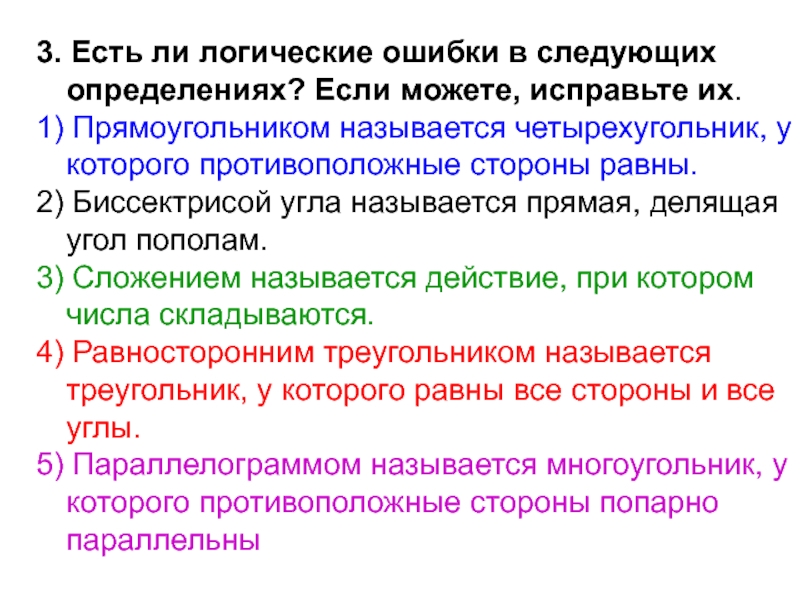
Есть ли логические ошибки в следующих определениях? Если можете, исправьте их.
А) Прямоугольником называется четырёхугольник, у которого противоположные стороны равны и все четыре угла равны.
Б) Биссектрисой угла называется прямая, делящая угол пополам.
В) Сложением называется действие, при котором числа складываются: если все числа положительные или отрицательные, либо вычитаются: если все числа положительные или отрицательные.
Г) Равносторонним треугольником называется треугольник, у которого равны все стороны или углы.
Д) Параллелограммом называется многоугольник, у которого противоположные стороны попарно параллельны.
From Wikipedia, the free encyclopedia
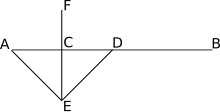
Line DE bisects line AB at D, line EF is a perpendicular bisector of segment AD at C, and line EF is the interior bisector of right angle AED
In geometry, bisection is the division of something into two equal or congruent parts, usually by a line, which is then called a bisector. The most often considered types of bisectors are the segment bisector (a line that passes through the midpoint of a given segment) and the angle bisector (a line that passes through the apex of an angle, that divides it into two equal angles).
In three-dimensional space, bisection is usually done by a plane,and called the bisector or bisecting plane.
Perpendicular line segment bisector[edit]
Definition[edit]

Perpendicular bisector of a line segment
- The perpendicular bisector of a line segment is a line, which meets the segment at its midpoint perpendicularly.
The Horizontal intersector of a segment  also has the property that each of its points
  is equidistant from the segment’s endpoints:
(D) .
.
The proof follows from  and Pythagoras’ theorem:

Property (D) is usually used for the construction of a perpendicular bisector:
Construction by straight edge and compass[edit]

Construction by straight edge and compass
In classical geometry, the bisection is a simple compass and straightedge construction, whose possibility depends on the ability to draw arcs of equal radii and different centers:
The segment is bisected by drawing intersecting circles of equal radius  , whose centers are the endpoints of the segment. The line determined by the points of intersection of the two circles is the perpendicular bisector of the segment.
Because the construction of the bisector is done without the knowledge of the segment’s midpoint  , the construction is used for determining as the intersection of the bisector and the line segment.
This construction is in fact used when constructing a line perpendicular to a given line  at a given point
  : drawing a circle whose center is such that it intersects the line in two points
  , and the perpendicular to be constructed is the one bisecting segment .
Equations[edit]
If  are the position vectors of two points , then its midpoint is
 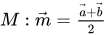 and vector
  is a normal vector of the perpendicular line segment bisector. Hence its vector equation is
  . Inserting
  and expanding the equation leads to the vector equation
(V) 
With  one gets the equation in coordinate form:
(C) 
Or explicitly:
(E) ,
,
where 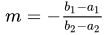 ,
, 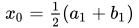 , and
, and 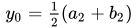 .
.
Applications[edit]
Perpendicular line segment bisectors were used solving various geometric problems:
- Construction of the center of a Thales’ circle,
- Construction of the center of the Excircle of a triangle,
- Voronoi diagram boundaries consist of segments of such lines or planes.

Perpendicular line segment bisectors in space[edit]
- The perpendicular bisector of a line segment is a plane, which meets the segment at its midpoint perpendicularly.
Its vector equation is literally the same as in the plane case:
(V)
With  one gets the equation in coordinate form:
(C3) 
Property (D) (see above) is literally true in space, too:
(D) The perpendicular bisector plane of a segment has for any point the property: 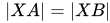 .
.
Angle bisector[edit]

Bisection of an angle using a compass and straightedge
An angle bisector divides the angle into two angles with equal measures. An angle only has one bisector. Each point of an angle bisector is equidistant from the sides of the angle.
The interior or internal bisector of an angle is the line, half-line, or line segment that divides an angle of less than 180° into two equal angles. The exterior or external bisector is the line that divides the supplementary angle (of 180° minus the original angle), formed by one side forming the original angle and the extension of the other side, into two equal angles.[1]
To bisect an angle with straightedge and compass, one draws a circle whose center is the vertex. The circle meets the angle at two points: one on each leg. Using each of these points as a center, draw two circles of the same size. The intersection of the circles (two points) determines a line that is the angle bisector.
The proof of the correctness of this construction is fairly intuitive, relying on the symmetry of the problem. The trisection of an angle (dividing it into three equal parts) cannot be achieved with the compass and ruler alone (this was first proved by Pierre Wantzel).
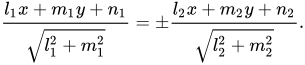
The internal and external bisectors of an angle are perpendicular. If the angle is formed by the two lines given algebraically as  and
and  then the internal and external bisectors are given by the two equations[2]: p.15
Triangle[edit]
Concurrencies and collinearities[edit]

The bisectors of two exterior angles and the bisector of the other interior angle are concurrent.[3]: p.149
Three intersection points, each of an external angle bisector with the opposite extended side, are collinear (fall on the same line as each other).[3]: p. 149
Three intersection points, two of them between an interior angle bisector and the opposite side, and the third between the other exterior angle bisector and the opposite side extended, are collinear.[3]: p. 149
Angle bisector theorem[edit]

In this diagram, BD:DC = AB:AC.
The angle bisector theorem is concerned with the relative lengths of the two segments that a triangle’s side is divided into by a line that bisects the opposite angle. It equates their relative lengths to the relative lengths of the other two sides of the triangle.
Lengths[edit]
If the side lengths of a triangle are  , the semiperimeter
  and A is the angle opposite side
  , then the length of the internal bisector of angle A is[3]: p. 70
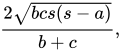
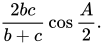
or in trigonometric terms,[4]
If the internal bisector of angle A in triangle ABC has length  and if this bisector divides the side opposite A into segments of lengths m and n, then[3]: p.70
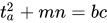
where b and c are the side lengths opposite vertices B and C; and the side opposite A is divided in the proportion b:c.
If the internal bisectors of angles A, B, and C have lengths  and
and  , then[5]

No two non-congruent triangles share the same set of three internal angle bisector lengths.[6][7]
Integer triangles[edit]
There exist integer triangles with a rational angle bisector.
Quadrilateral[edit]
The internal angle bisectors of a convex quadrilateral either form a cyclic quadrilateral (that is, the four intersection points of adjacent angle bisectors are concyclic),[8] or they are concurrent. In the latter case the quadrilateral is a tangential quadrilateral.
Rhombus[edit]
Each diagonal of a rhombus bisects opposite angles.
Ex-tangential quadrilateral[edit]
The excenter of an ex-tangential quadrilateral lies at the intersection of six angle bisectors. These are the internal angle bisectors at two opposite vertex angles, the external angle bisectors (supplementary angle bisectors) at the other two vertex angles, and the external angle bisectors at the angles formed where the extensions of opposite sides intersect.
Parabola[edit]
The tangent to a parabola at any point bisects the angle between the line joining the point to the focus and the line from the point and perpendicular to the directrix.
Bisectors of the sides of a polygon[edit]
Triangle[edit]
Medians[edit]
Each of the three medians of a triangle is a line segment going through one vertex and the midpoint of the opposite side, so it bisects that side (though not in general perpendicularly). The three medians intersect each other at a point which is called the centroid of the triangle, which is its center of mass if it has uniform density; thus any line through a triangle’s centroid and one of its vertices bisects the opposite side. The centroid is twice as close to the midpoint of any one side as it is to the opposite vertex.
Perpendicular bisectors[edit]
The interior perpendicular bisector of a side of a triangle is the segment, falling entirely on and inside the triangle, of the line that perpendicularly bisects that side. The three perpendicular bisectors of a triangle’s three sides intersect at the circumcenter (the center of the circle through the three vertices). Thus any line through a triangle’s circumcenter and perpendicular to a side bisects that side.
In an acute triangle the circumcenter divides the interior perpendicular bisectors of the two shortest sides in equal proportions. In an obtuse triangle the two shortest sides’ perpendicular bisectors (extended beyond their opposite triangle sides to the circumcenter) are divided by their respective intersecting triangle sides in equal proportions.[9]: Corollaries 5 and 6
For any triangle the interior perpendicular bisectors are given by 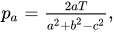
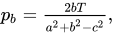 and
and 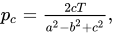 where the sides are
  and the area is
  [9]: Thm 2
Quadrilateral[edit]
The two bimedians of a convex quadrilateral are the line segments that connect the midpoints of opposite sides, hence each bisecting two sides. The two bimedians and the line segment joining the midpoints of the diagonals are concurrent at a point called the «vertex centroid» and are all bisected by this point.[10]: p.125
The four «maltitudes» of a convex quadrilateral are the perpendiculars to a side through the midpoint of the opposite side, hence bisecting the latter side. If the quadrilateral is cyclic (inscribed in a circle), these maltitudes are concurrent at (all meet at) a common point called the «anticenter».
Brahmagupta’s theorem states that if a cyclic quadrilateral is orthodiagonal (that is, has perpendicular diagonals), then the perpendicular to a side from the point of intersection of the diagonals always bisects the opposite side.
The perpendicular bisector construction forms a quadrilateral from the perpendicular bisectors of the sides of another quadrilateral.
Area bisectors and perimeter bisectors[edit]
Triangle[edit]
There are an infinitude of lines that bisect the area of a triangle. Three of them are the medians of the triangle (which connect the sides’ midpoints with the opposite vertices), and these are concurrent at the triangle’s centroid; indeed, they are the only area bisectors that go through the centroid. Three other area bisectors are parallel to the triangle’s sides; each of these intersects the other two sides so as to divide them into segments with the proportions  .[11] These six lines are concurrent three at a time: in addition to the three medians being concurrent, any one median is concurrent with two of the side-parallel area bisectors.
The envelope of the infinitude of area bisectors is a deltoid (broadly defined as a figure with three vertices connected by curves that are concave to the exterior of the deltoid, making the interior points a non-convex set).[11] The vertices of the deltoid are at the midpoints of the medians; all points inside the deltoid are on three different area bisectors, while all points outside it are on just one. [1]
The sides of the deltoid are arcs of hyperbolas that are asymptotic to the extended sides of the triangle.[11] The ratio of the area of the envelope of area bisectors to the area of the triangle is invariant for all triangles, and equals 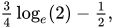 i.e. 0.019860… or less than 2%.
A cleaver of a triangle is a line segment that bisects the perimeter of the triangle and has one endpoint at the midpoint of one of the three sides. The three cleavers concur at (all pass through) the center of the Spieker circle, which is the incircle of the medial triangle. The cleavers are parallel to the angle bisectors.
A splitter of a triangle is a line segment having one endpoint at one of the three vertices of the triangle and bisecting the perimeter. The three splitters concur at the Nagel point of the triangle.
Any line through a triangle that splits both the triangle’s area and its perimeter in half goes through the triangle’s incenter (the center of its incircle). There are either one, two, or three of these for any given triangle. A line through the incenter bisects one of the area or perimeter if and only if it also bisects the other.[12]
Parallelogram[edit]
Any line through the midpoint of a parallelogram bisects the area[11] and the perimeter.
Circle and ellipse[edit]
All area bisectors and perimeter bisectors of a circle or other ellipse go through the center, and any chords through the center bisect the area and perimeter. In the case of a circle they are the diameters of the circle.
Bisectors of diagonals[edit]
Parallelogram[edit]
The diagonals of a parallelogram bisect each other.
Quadrilateral[edit]
If a line segment connecting the diagonals of a quadrilateral bisects both diagonals, then this line segment (the Newton Line) is itself bisected by the vertex centroid.
Volume bisectors[edit]
A plane that divides two opposite edges of a tetrahedron in a given ratio also divides the volume of the tetrahedron in the same ratio. Thus any plane containing a bimedian (connector of opposite edges’ midpoints) of a tetrahedron bisects the volume of the tetrahedron[13][14]: pp.89–90
References[edit]
- ^ Weisstein, Eric W. «Exterior Angle Bisector.» From MathWorld—A Wolfram Web Resource.
- ^ Spain, Barry. Analytical Conics, Dover Publications, 2007 (orig. 1957).
- ^ a b c d e Johnson, Roger A., Advanced Euclidean Geometry, Dover Publ., 2007 (orig. 1929).
- ^ Oxman, Victor. «On the existence of triangles with given lengths of one side and two adjacent angle bisectors», Forum Geometricorum 4, 2004, 215–218. http://forumgeom.fau.edu/FG2004volume4/FG200425.pdf
- ^ Simons, Stuart. Mathematical Gazette 93, March 2009, 115-116.
- ^ Mironescu, P., and Panaitopol, L., «The existence of a triangle with prescribed angle bisector lengths», American Mathematical Monthly 101 (1994): 58–60.
- ^ Oxman, Victor, «A purely geometric proof of the uniqueness of a triangle with prescribed angle bisectors», Forum Geometricorum 8 (2008): 197–200.
- ^
Weisstein, Eric W. «Quadrilateral.» From MathWorld—A Wolfram Web Resource. http://mathworld.wolfram.com/Quadrilateral.html
- ^ a b Mitchell, Douglas W. (2013), «Perpendicular Bisectors of Triangle Sides», Forum Geometricorum 13, 53-59. http://forumgeom.fau.edu/FG2013volume13/FG201307.pdf
- ^ Altshiller-Court, Nathan, College Geometry, Dover Publ., 2007.
- ^ a b c d Dunn, Jas. A.; Pretty, Jas. E. (May 1972). «Halving a triangle». The Mathematical Gazette. 56 (396): 105–108. doi:10.2307/3615256. JSTOR 3615256.
- ^ Kodokostas, Dimitrios, «Triangle Equalizers,» Mathematics Magazine 83, April 2010, pp. 141-146.
- ^ Weisstein, Eric W. «Tetrahedron.» From MathWorld—A Wolfram Web Resource. http://mathworld.wolfram.com/Tetrahedron.html
- ^ Altshiller-Court, N. «The tetrahedron.» Ch. 4 in Modern Pure Solid Geometry: Chelsea, 1979.
External links[edit]
- The Angle Bisector at cut-the-knot
- Angle Bisector definition. Math Open Reference With interactive applet
- Line Bisector definition. Math Open Reference With interactive applet
- Perpendicular Line Bisector. With interactive applet
- Animated instructions for bisecting an angle and bisecting a line Using a compass and straightedge
- Weisstein, Eric W. «Line Bisector». MathWorld.
This article incorporates material from Angle bisector on PlanetMath, which is licensed under the Creative Commons Attribution/Share-Alike License.
From Wikipedia, the free encyclopedia
Line DE bisects line AB at D, line EF is a perpendicular bisector of segment AD at C, and line EF is the interior bisector of right angle AED
In geometry, bisection is the division of something into two equal or congruent parts, usually by a line, which is then called a bisector. The most often considered types of bisectors are the segment bisector (a line that passes through the midpoint of a given segment) and the angle bisector (a line that passes through the apex of an angle, that divides it into two equal angles).
In three-dimensional space, bisection is usually done by a plane,and called the bisector or bisecting plane.
Perpendicular line segment bisector[edit]
Definition[edit]
Perpendicular bisector of a line segment
- The perpendicular bisector of a line segment is a line, which meets the segment at its midpoint perpendicularly.
The Horizontal intersector of a segment also has the property that each of its points is equidistant from the segment’s endpoints:
(D).
The proof follows from and Pythagoras’ theorem:
Property (D) is usually used for the construction of a perpendicular bisector:
Construction by straight edge and compass[edit]
Construction by straight edge and compass
In classical geometry, the bisection is a simple compass and straightedge construction, whose possibility depends on the ability to draw arcs of equal radii and different centers:
The segment is bisected by drawing intersecting circles of equal radius , whose centers are the endpoints of the segment. The line determined by the points of intersection of the two circles is the perpendicular bisector of the segment.
Because the construction of the bisector is done without the knowledge of the segment’s midpoint , the construction is used for determining as the intersection of the bisector and the line segment.
This construction is in fact used when constructing a line perpendicular to a given line at a given point : drawing a circle whose center is such that it intersects the line in two points , and the perpendicular to be constructed is the one bisecting segment .
Equations[edit]
If are the position vectors of two points , then its midpoint is and vector is a normal vector of the perpendicular line segment bisector. Hence its vector equation is . Inserting and expanding the equation leads to the vector equation
(V)
With one gets the equation in coordinate form:
(C)
Or explicitly:
(E),
where , , and .
Applications[edit]
Perpendicular line segment bisectors were used solving various geometric problems:
- Construction of the center of a Thales’ circle,
- Construction of the center of the Excircle of a triangle,
- Voronoi diagram boundaries consist of segments of such lines or planes.
Perpendicular line segment bisectors in space[edit]
- The perpendicular bisector of a line segment is a plane, which meets the segment at its midpoint perpendicularly.
Its vector equation is literally the same as in the plane case:
(V)
With one gets the equation in coordinate form:
(C3)
Property (D) (see above) is literally true in space, too:
(D) The perpendicular bisector plane of a segment has for any point the property: .
Angle bisector[edit]
Bisection of an angle using a compass and straightedge
An angle bisector divides the angle into two angles with equal measures. An angle only has one bisector. Each point of an angle bisector is equidistant from the sides of the angle.
The interior or internal bisector of an angle is the line, half-line, or line segment that divides an angle of less than 180° into two equal angles. The exterior or external bisector is the line that divides the supplementary angle (of 180° minus the original angle), formed by one side forming the original angle and the extension of the other side, into two equal angles.[1]
To bisect an angle with straightedge and compass, one draws a circle whose center is the vertex. The circle meets the angle at two points: one on each leg. Using each of these points as a center, draw two circles of the same size. The intersection of the circles (two points) determines a line that is the angle bisector.
The proof of the correctness of this construction is fairly intuitive, relying on the symmetry of the problem. The trisection of an angle (dividing it into three equal parts) cannot be achieved with the compass and ruler alone (this was first proved by Pierre Wantzel).
The internal and external bisectors of an angle are perpendicular. If the angle is formed by the two lines given algebraically as and then the internal and external bisectors are given by the two equations[2]: p.15
Triangle[edit]
Concurrencies and collinearities[edit]
The bisectors of two exterior angles and the bisector of the other interior angle are concurrent.[3]: p.149
Three intersection points, each of an external angle bisector with the opposite extended side, are collinear (fall on the same line as each other).[3]: p. 149
Three intersection points, two of them between an interior angle bisector and the opposite side, and the third between the other exterior angle bisector and the opposite side extended, are collinear.[3]: p. 149
Angle bisector theorem[edit]
In this diagram, BD:DC = AB:AC.
The angle bisector theorem is concerned with the relative lengths of the two segments that a triangle’s side is divided into by a line that bisects the opposite angle. It equates their relative lengths to the relative lengths of the other two sides of the triangle.
Lengths[edit]
If the side lengths of a triangle are , the semiperimeter and A is the angle opposite side , then the length of the internal bisector of angle A is[3]: p. 70
or in trigonometric terms,[4]
If the internal bisector of angle A in triangle ABC has length and if this bisector divides the side opposite A into segments of lengths m and n, then[3]: p.70
where b and c are the side lengths opposite vertices B and C; and the side opposite A is divided in the proportion b:c.
If the internal bisectors of angles A, B, and C have lengths and , then[5]
No two non-congruent triangles share the same set of three internal angle bisector lengths.[6][7]
Integer triangles[edit]
There exist integer triangles with a rational angle bisector.
Quadrilateral[edit]
The internal angle bisectors of a convex quadrilateral either form a cyclic quadrilateral (that is, the four intersection points of adjacent angle bisectors are concyclic),[8] or they are concurrent. In the latter case the quadrilateral is a tangential quadrilateral.
Rhombus[edit]
Each diagonal of a rhombus bisects opposite angles.
Ex-tangential quadrilateral[edit]
The excenter of an ex-tangential quadrilateral lies at the intersection of six angle bisectors. These are the internal angle bisectors at two opposite vertex angles, the external angle bisectors (supplementary angle bisectors) at the other two vertex angles, and the external angle bisectors at the angles formed where the extensions of opposite sides intersect.
Parabola[edit]
The tangent to a parabola at any point bisects the angle between the line joining the point to the focus and the line from the point and perpendicular to the directrix.
Bisectors of the sides of a polygon[edit]
Triangle[edit]
Medians[edit]
Each of the three medians of a triangle is a line segment going through one vertex and the midpoint of the opposite side, so it bisects that side (though not in general perpendicularly). The three medians intersect each other at a point which is called the centroid of the triangle, which is its center of mass if it has uniform density; thus any line through a triangle’s centroid and one of its vertices bisects the opposite side. The centroid is twice as close to the midpoint of any one side as it is to the opposite vertex.
Perpendicular bisectors[edit]
The interior perpendicular bisector of a side of a triangle is the segment, falling entirely on and inside the triangle, of the line that perpendicularly bisects that side. The three perpendicular bisectors of a triangle’s three sides intersect at the circumcenter (the center of the circle through the three vertices). Thus any line through a triangle’s circumcenter and perpendicular to a side bisects that side.
In an acute triangle the circumcenter divides the interior perpendicular bisectors of the two shortest sides in equal proportions. In an obtuse triangle the two shortest sides’ perpendicular bisectors (extended beyond their opposite triangle sides to the circumcenter) are divided by their respective intersecting triangle sides in equal proportions.[9]: Corollaries 5 and 6
For any triangle the interior perpendicular bisectors are given by and where the sides are and the area is [9]: Thm 2
Quadrilateral[edit]
The two bimedians of a convex quadrilateral are the line segments that connect the midpoints of opposite sides, hence each bisecting two sides. The two bimedians and the line segment joining the midpoints of the diagonals are concurrent at a point called the «vertex centroid» and are all bisected by this point.[10]: p.125
The four «maltitudes» of a convex quadrilateral are the perpendiculars to a side through the midpoint of the opposite side, hence bisecting the latter side. If the quadrilateral is cyclic (inscribed in a circle), these maltitudes are concurrent at (all meet at) a common point called the «anticenter».
Brahmagupta’s theorem states that if a cyclic quadrilateral is orthodiagonal (that is, has perpendicular diagonals), then the perpendicular to a side from the point of intersection of the diagonals always bisects the opposite side.
The perpendicular bisector construction forms a quadrilateral from the perpendicular bisectors of the sides of another quadrilateral.
Area bisectors and perimeter bisectors[edit]
Triangle[edit]
There are an infinitude of lines that bisect the area of a triangle. Three of them are the medians of the triangle (which connect the sides’ midpoints with the opposite vertices), and these are concurrent at the triangle’s centroid; indeed, they are the only area bisectors that go through the centroid. Three other area bisectors are parallel to the triangle’s sides; each of these intersects the other two sides so as to divide them into segments with the proportions .[11] These six lines are concurrent three at a time: in addition to the three medians being concurrent, any one median is concurrent with two of the side-parallel area bisectors.
The envelope of the infinitude of area bisectors is a deltoid (broadly defined as a figure with three vertices connected by curves that are concave to the exterior of the deltoid, making the interior points a non-convex set).[11] The vertices of the deltoid are at the midpoints of the medians; all points inside the deltoid are on three different area bisectors, while all points outside it are on just one. [1]
The sides of the deltoid are arcs of hyperbolas that are asymptotic to the extended sides of the triangle.[11] The ratio of the area of the envelope of area bisectors to the area of the triangle is invariant for all triangles, and equals i.e. 0.019860… or less than 2%.
A cleaver of a triangle is a line segment that bisects the perimeter of the triangle and has one endpoint at the midpoint of one of the three sides. The three cleavers concur at (all pass through) the center of the Spieker circle, which is the incircle of the medial triangle. The cleavers are parallel to the angle bisectors.
A splitter of a triangle is a line segment having one endpoint at one of the three vertices of the triangle and bisecting the perimeter. The three splitters concur at the Nagel point of the triangle.
Any line through a triangle that splits both the triangle’s area and its perimeter in half goes through the triangle’s incenter (the center of its incircle). There are either one, two, or three of these for any given triangle. A line through the incenter bisects one of the area or perimeter if and only if it also bisects the other.[12]
Parallelogram[edit]
Any line through the midpoint of a parallelogram bisects the area[11] and the perimeter.
Circle and ellipse[edit]
All area bisectors and perimeter bisectors of a circle or other ellipse go through the center, and any chords through the center bisect the area and perimeter. In the case of a circle they are the diameters of the circle.
Bisectors of diagonals[edit]
Parallelogram[edit]
The diagonals of a parallelogram bisect each other.
Quadrilateral[edit]
If a line segment connecting the diagonals of a quadrilateral bisects both diagonals, then this line segment (the Newton Line) is itself bisected by the vertex centroid.
Volume bisectors[edit]
A plane that divides two opposite edges of a tetrahedron in a given ratio also divides the volume of the tetrahedron in the same ratio. Thus any plane containing a bimedian (connector of opposite edges’ midpoints) of a tetrahedron bisects the volume of the tetrahedron[13][14]: pp.89–90
References[edit]
- ^ Weisstein, Eric W. «Exterior Angle Bisector.» From MathWorld—A Wolfram Web Resource.
- ^ Spain, Barry. Analytical Conics, Dover Publications, 2007 (orig. 1957).
- ^ a b c d e Johnson, Roger A., Advanced Euclidean Geometry, Dover Publ., 2007 (orig. 1929).
- ^ Oxman, Victor. «On the existence of triangles with given lengths of one side and two adjacent angle bisectors», Forum Geometricorum 4, 2004, 215–218. http://forumgeom.fau.edu/FG2004volume4/FG200425.pdf
- ^ Simons, Stuart. Mathematical Gazette 93, March 2009, 115-116.
- ^ Mironescu, P., and Panaitopol, L., «The existence of a triangle with prescribed angle bisector lengths», American Mathematical Monthly 101 (1994): 58–60.
- ^ Oxman, Victor, «A purely geometric proof of the uniqueness of a triangle with prescribed angle bisectors», Forum Geometricorum 8 (2008): 197–200.
- ^
Weisstein, Eric W. «Quadrilateral.» From MathWorld—A Wolfram Web Resource. http://mathworld.wolfram.com/Quadrilateral.html
- ^ a b Mitchell, Douglas W. (2013), «Perpendicular Bisectors of Triangle Sides», Forum Geometricorum 13, 53-59. http://forumgeom.fau.edu/FG2013volume13/FG201307.pdf
- ^ Altshiller-Court, Nathan, College Geometry, Dover Publ., 2007.
- ^ a b c d Dunn, Jas. A.; Pretty, Jas. E. (May 1972). «Halving a triangle». The Mathematical Gazette. 56 (396): 105–108. doi:10.2307/3615256. JSTOR 3615256.
- ^ Kodokostas, Dimitrios, «Triangle Equalizers,» Mathematics Magazine 83, April 2010, pp. 141-146.
- ^ Weisstein, Eric W. «Tetrahedron.» From MathWorld—A Wolfram Web Resource. http://mathworld.wolfram.com/Tetrahedron.html
- ^ Altshiller-Court, N. «The tetrahedron.» Ch. 4 in Modern Pure Solid Geometry: Chelsea, 1979.
External links[edit]
- The Angle Bisector at cut-the-knot
- Angle Bisector definition. Math Open Reference With interactive applet
- Line Bisector definition. Math Open Reference With interactive applet
- Perpendicular Line Bisector. With interactive applet
- Animated instructions for bisecting an angle and bisecting a line Using a compass and straightedge
- Weisstein, Eric W. «Line Bisector». MathWorld.
This article incorporates material from Angle bisector on PlanetMath, which is licensed under the Creative Commons Attribution/Share-Alike License.
Слайд 1
Математические утверждения и их структура
1. Понятия
2. Высказывания и предикаты
3. Умозаключения
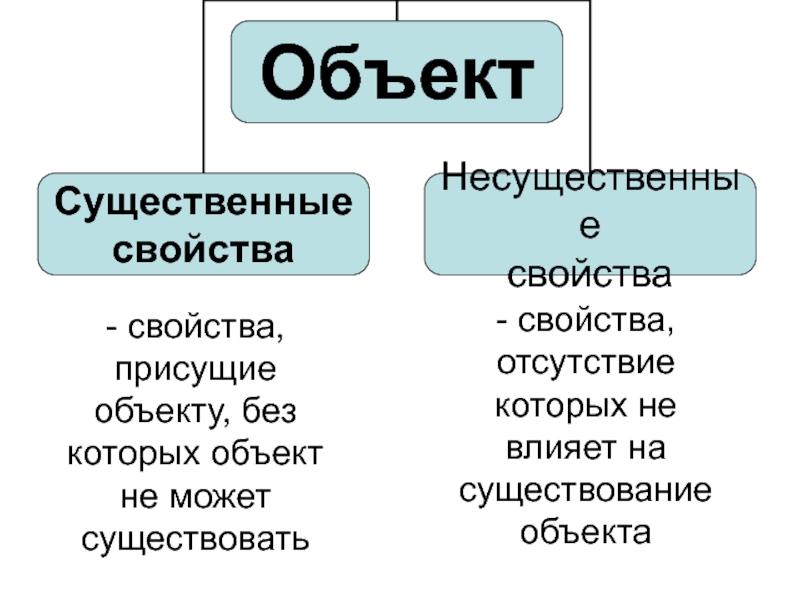
Слайд 3- свойства, присущие объекту, без которых объект не может существовать
— свойства,
отсутствие которых не влияет на существование объекта
Слайд 4Толковый словарь русского языка:
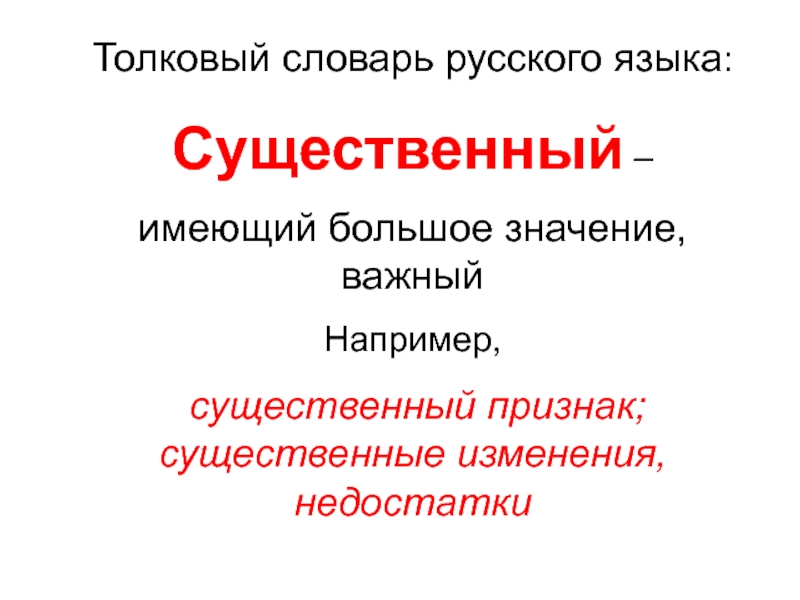
Существенный –
имеющий большое значение, важный
Например,
существенный признак; существенные
Слайд 5
иметь:
4 стороны
4 прямых угла
равные диагонали
цвет
размеры
расположение

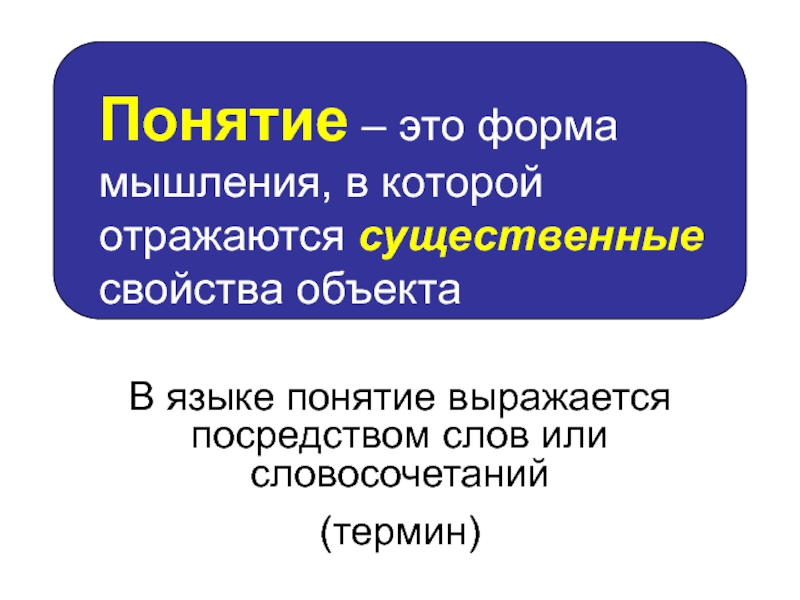
Слайд 6В языке понятие выражается посредством слов или словосочетаний
(термин)
Слайд 8Объем и содержание понятия
Содержание понятия – совокупность всех взаимосвязанных существенных
свойств объекта
Объем понятия – совокупность всех объектов, обозначаемых одним и тем же термином

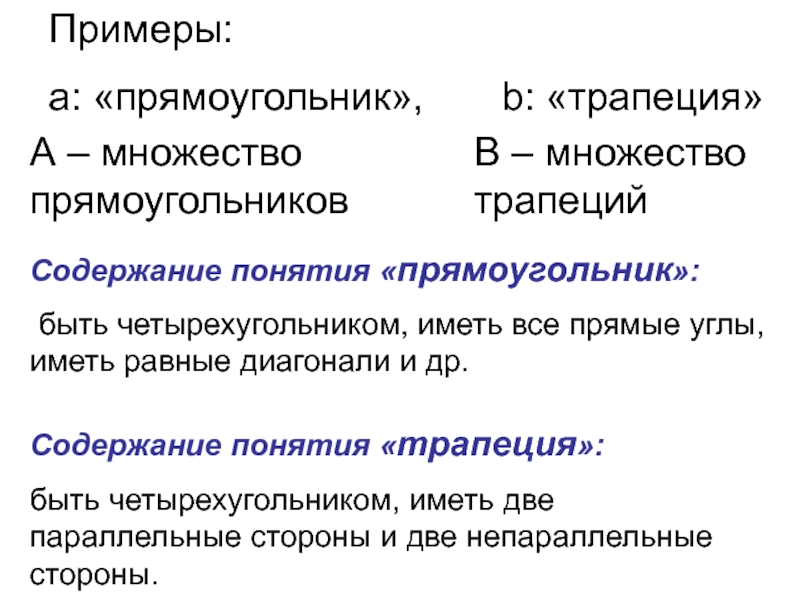
Слайд 9Примеры:
а: «прямоугольник», b: «трапеция»
А – множество прямоугольников
В –
множество трапеций
Содержание понятия «прямоугольник»:
быть четырехугольником, иметь все прямые углы, иметь равные диагонали и др.
Содержание понятия «трапеция»:
быть четырехугольником, иметь две параллельные стороны и две непараллельные стороны.
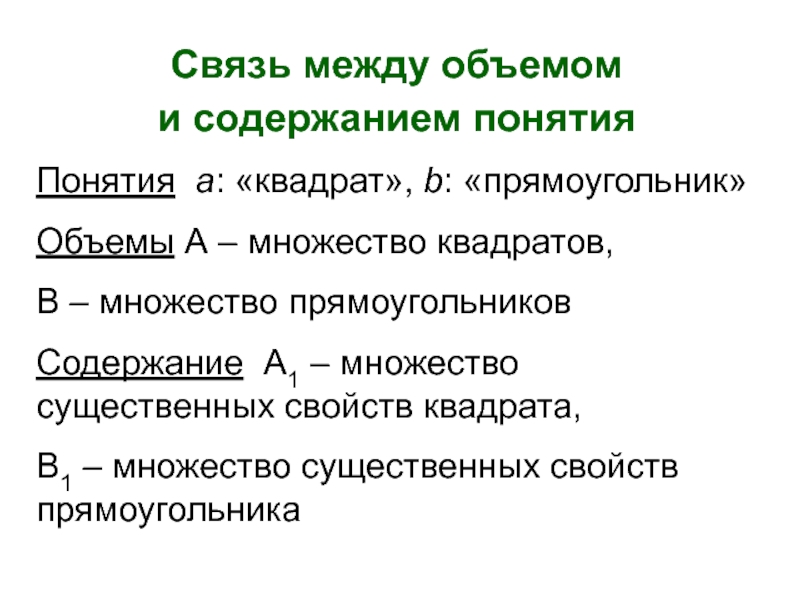
Слайд 10Связь между объемом
и содержанием понятия
Понятия а: «квадрат», b: «прямоугольник»
Объемы А –
множество квадратов,
В – множество прямоугольников
Содержание А1 – множество существенных свойств квадрата,
В1 – множество существенных свойств прямоугольника
Слайд 11
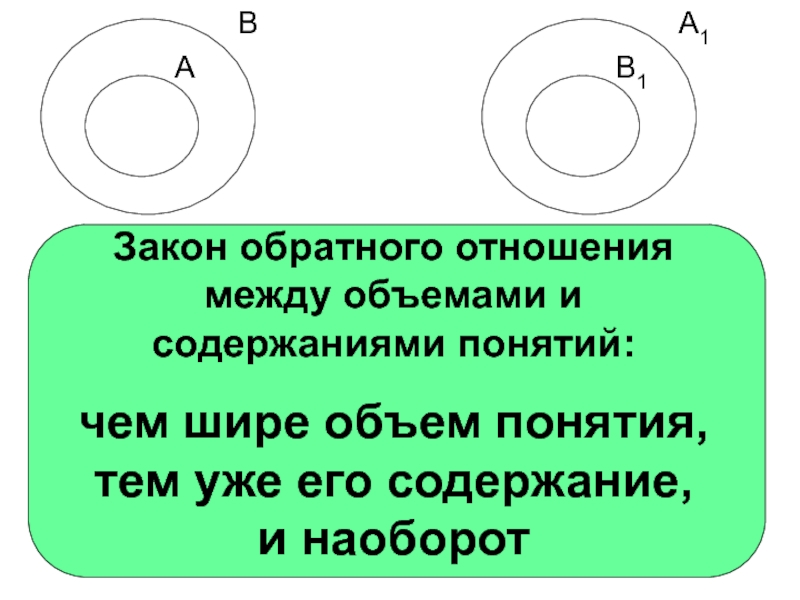
Закон обратного отношения между объемами и содержаниями понятий:
чем шире объем
понятия, тем уже его содержание, и наоборот
Слайд 12Упражнения:
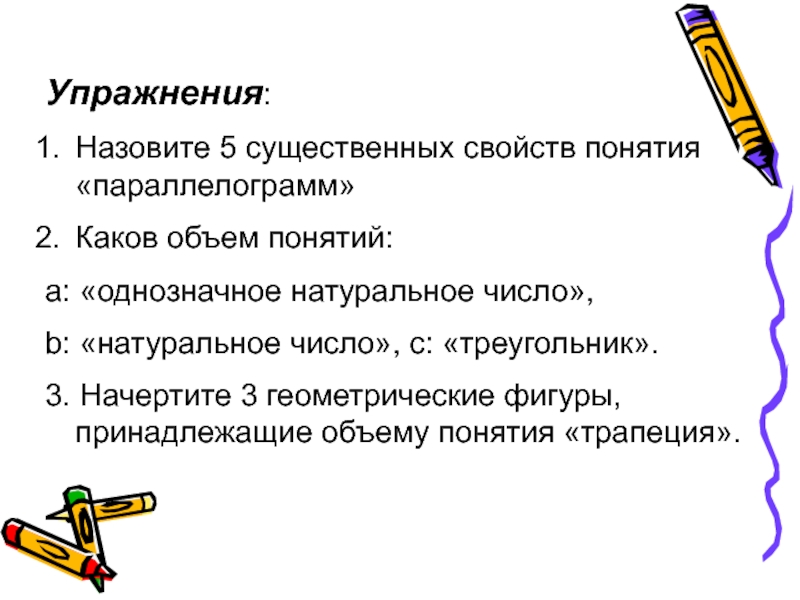
Назовите 5 существенных свойств понятия «параллелограмм»
Каков объем понятий:
а: «однозначное натуральное
число»,
b: «натуральное число», с: «треугольник».
3. Начертите 3 геометрические фигуры, принадлежащие объему понятия «трапеция».
Слайд 13Отношения между понятиями
А ∩ В ≠ ∅
А ∩ В =
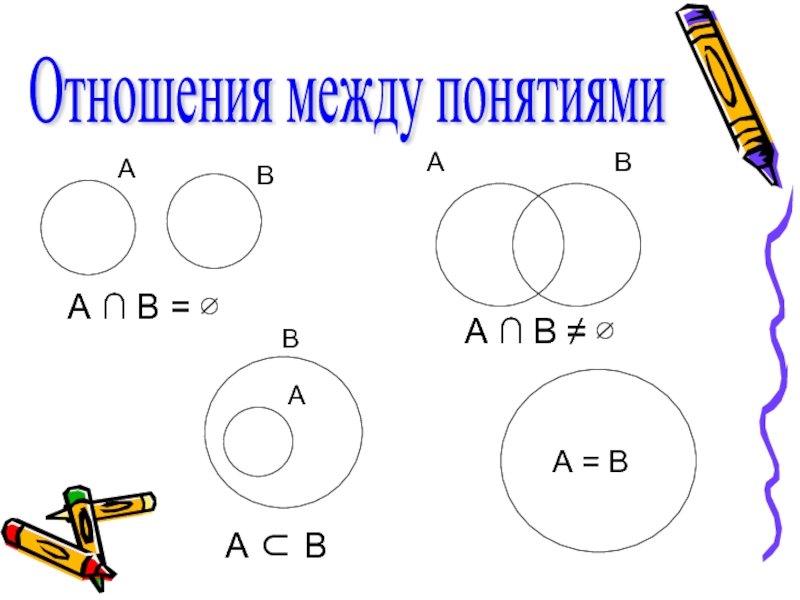
Слайд 14Пусть а и b – понятия, А и В – их
объемы.
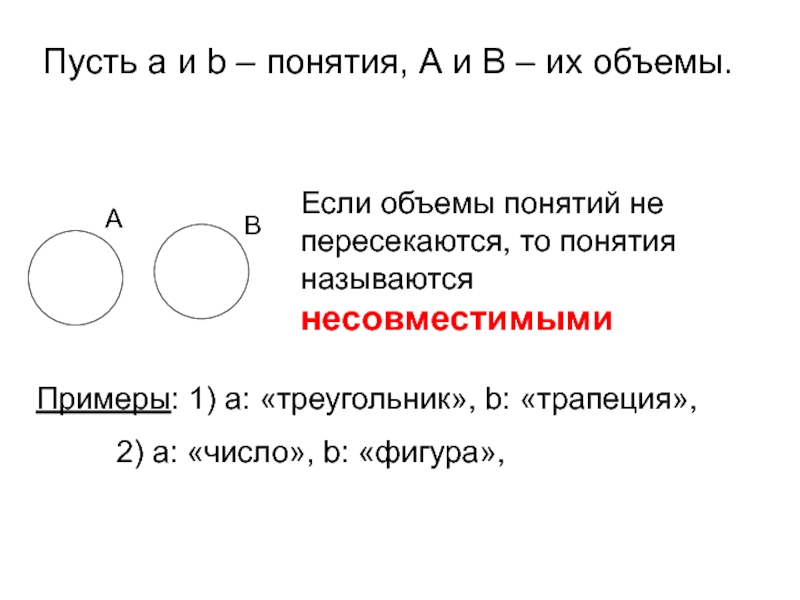
Если объемы понятий не пересекаются, то понятия называются несовместимыми
Примеры: 1) а: «треугольник», b: «трапеция»,
2) а: «число», b: «фигура»,
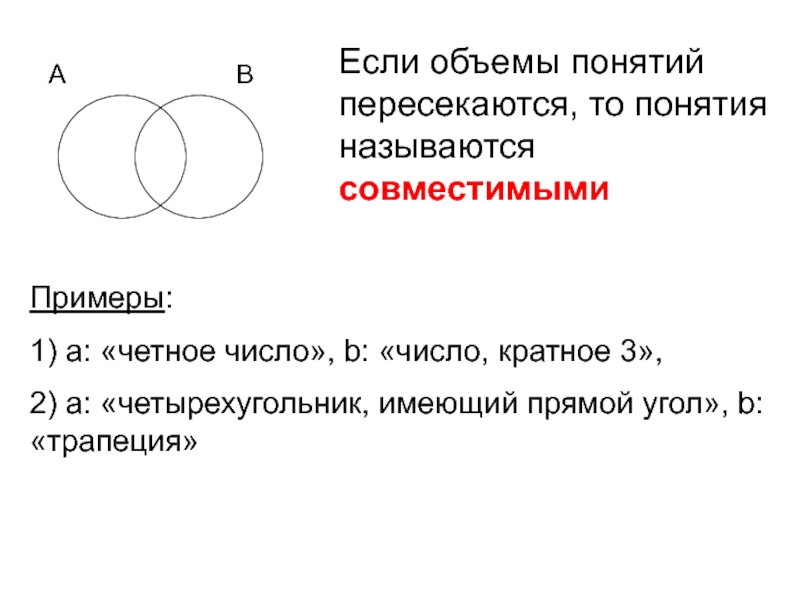
Слайд 15Если объемы понятий пересекаются, то понятия называются совместимыми
Примеры:
1) а: «четное число»,
b: «число, кратное 3»,
2) а: «четырехугольник, имеющий прямой угол», b: «трапеция»
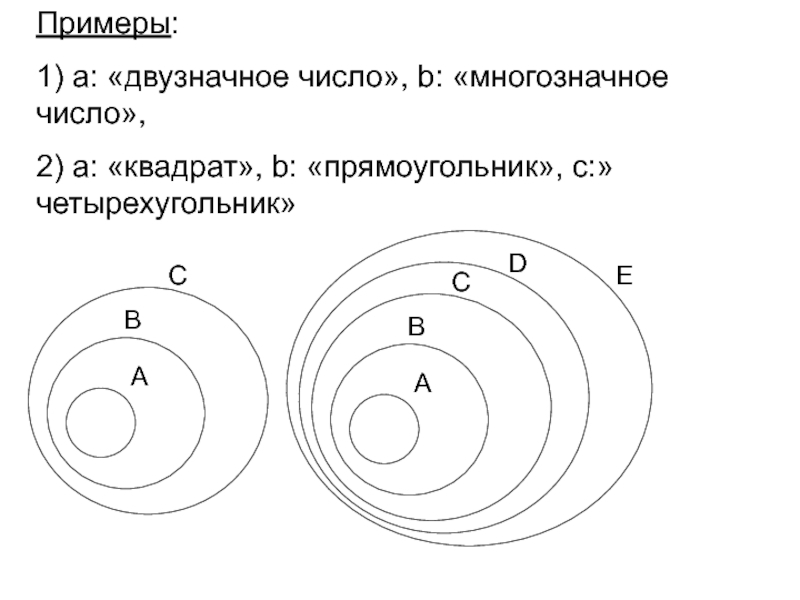
Слайд 16Если А ⊂ В (А ≠ В), то
а) понятие а
– видовое по отношению к понятию b, а понятие b – родовое по отношению к понятию а,
б) понятие а ỳже, чем понятие b, а понятие b шире, чем понятие а,
в) понятие а есть частный случай понятия b, а понятие b есть обобщение понятия а.

Слайд 17Примеры:
1) а: «двузначное число», b: «многозначное число»,
2) а: «квадрат», b: «прямоугольник»,
с:»четырехугольник»
Слайд 18Утверждения:
Для данного понятия часто можно указать несколько родовых понятий.
Понятия
рода и вида относительны: одно и то же понятие может быть родовым по отношению к одному понятию и видовым по отношению к другому.
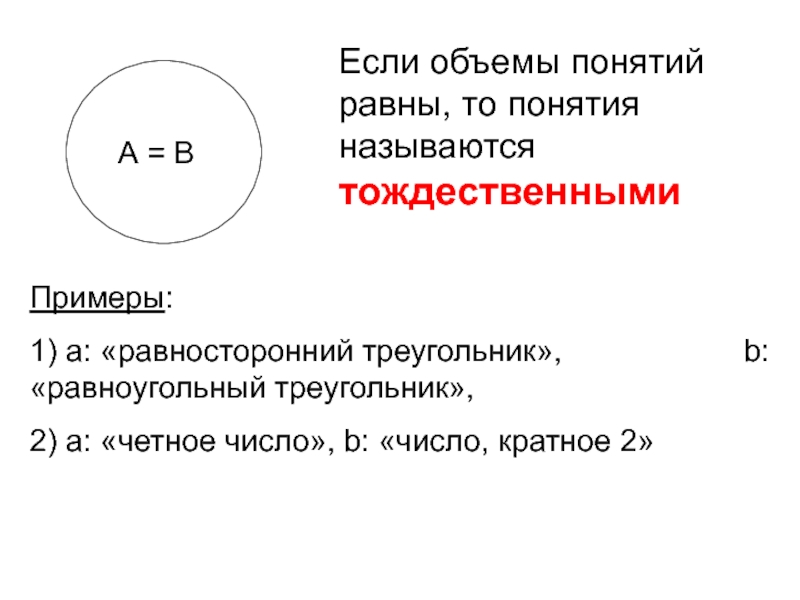
Слайд 19Если объемы понятий равны, то понятия называются тождественными
Примеры:
1) а: «равносторонний треугольник»,
b: «равноугольный треугольник»,
2) а: «четное число», b: «число, кратное 2»
Слайд 20Чтобы установить отношения между понятиями а и b нужно:
1. Найти объемы
этих понятий – множества А и В.
2. Установить отношения между множествами А и В.
3. Сделать вывод об отношении между понятиями а и b.

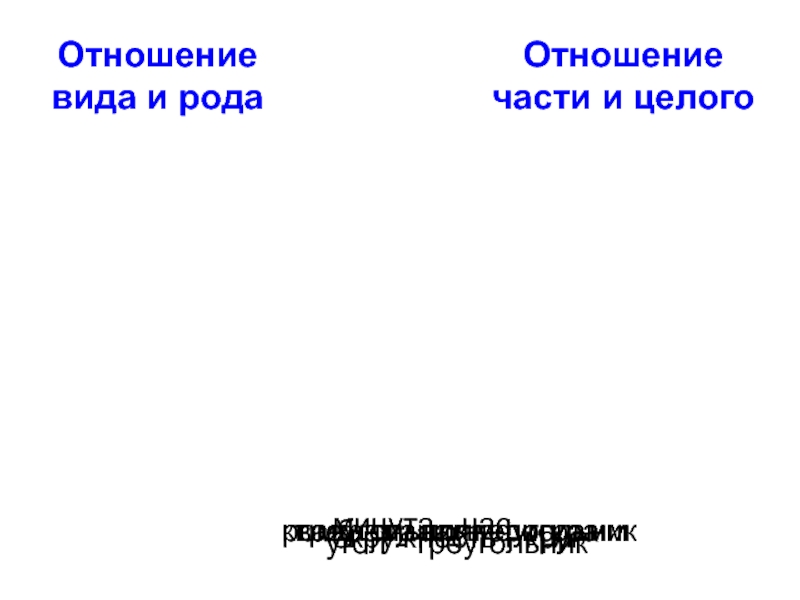
Слайд 21Отношение вида и рода
Отношение части и целого
ромб — параллелограмм
минута — час
квадрат
— прямоугольник
треугольник — фигура
окружность — круг
угол — треугольник
Слайд 23Схема определения
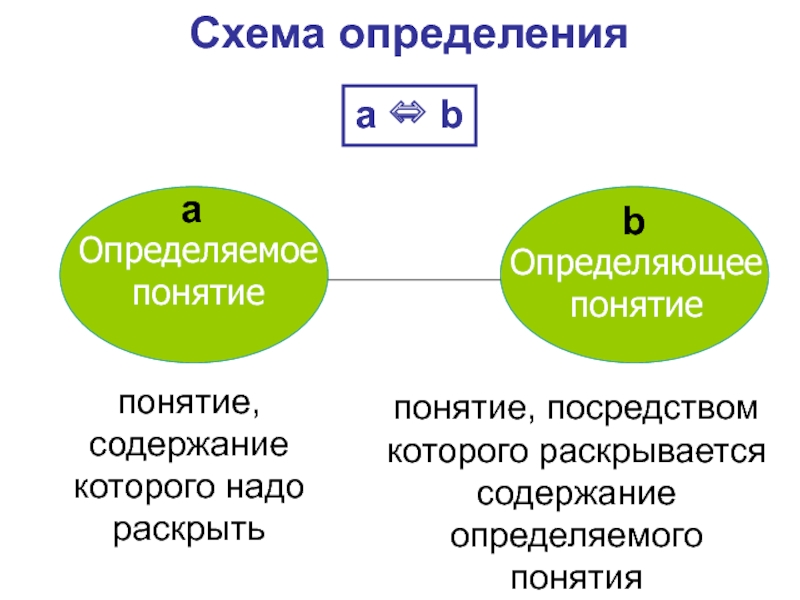
а ⇔ b
понятие, содержание которого надо раскрыть
понятие, посредством которого раскрывается
содержание определяемого понятия
Слайд 24Примеры:
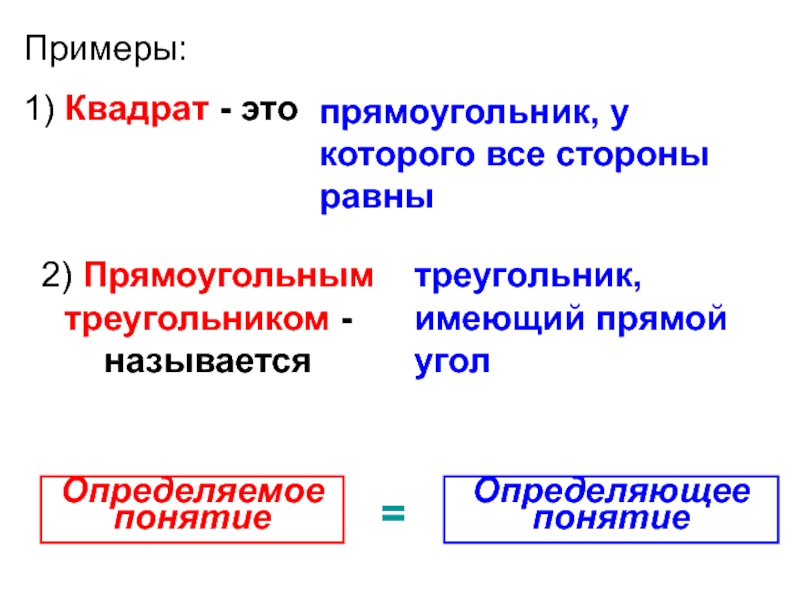
1) Квадрат — это
прямоугольник, у которого все стороны равны
2) Прямоугольным треугольником
— называется
треугольник, имеющий прямой угол
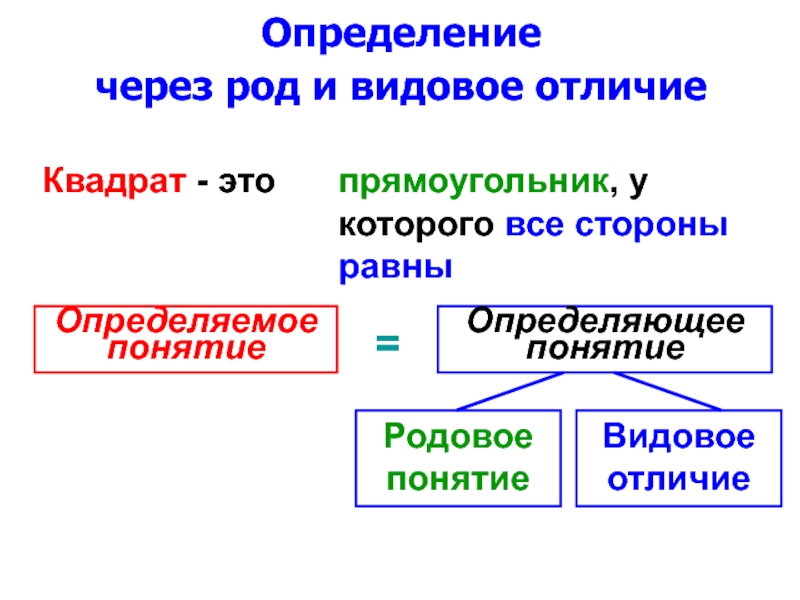
Слайд 26Определение
через род и видовое отличие
Квадрат — это
прямоугольник, у которого все стороны
равны
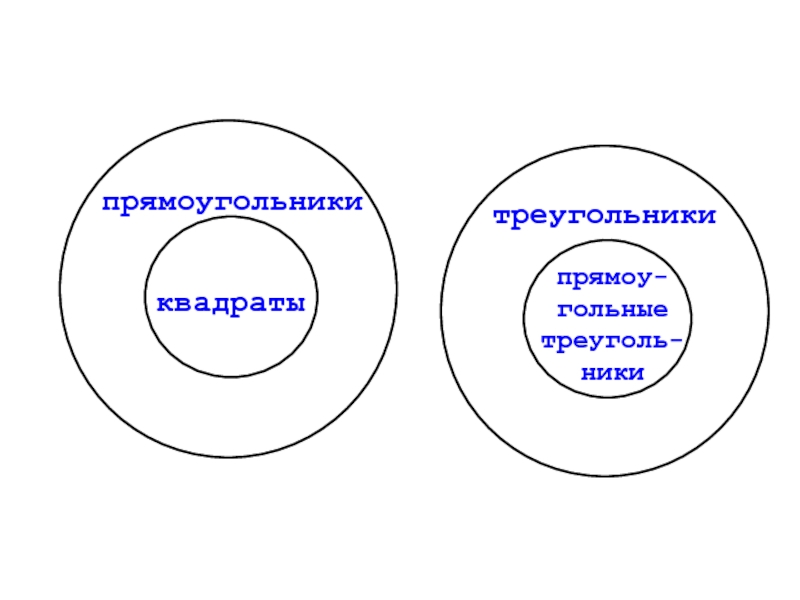
Слайд 27прямоугольники
квадраты
треугольники
прямоу-
гольные треуголь-
ники
Слайд 28В любом определении понятия есть элемент произвола:
в выборе термина
в
выборе свойств, включаемых в определение
Слайд 29Генетическое определение
(от слова «генезис» – происхождение)
— определение, в котором
указывается способ образования определяемого объекта
Слайд 30Примеры:
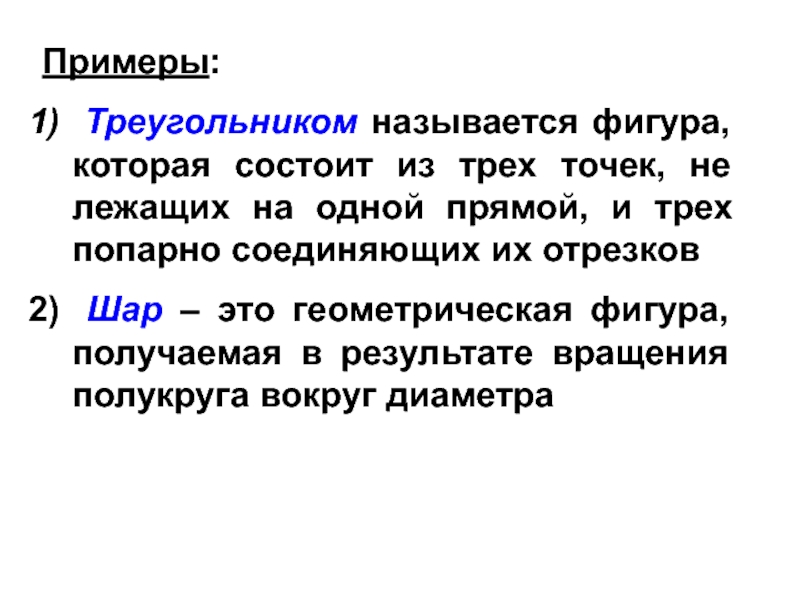
Треугольником называется фигура, которая состоит из трех точек, не лежащих
на одной прямой, и трех попарно соединяющих их отрезков
Шар – это геометрическая фигура, получаемая в результате вращения полукруга вокруг диаметра
Слайд 32
Требования к определению
Соразмерность
Отсутствие круга
Четкость, ясность

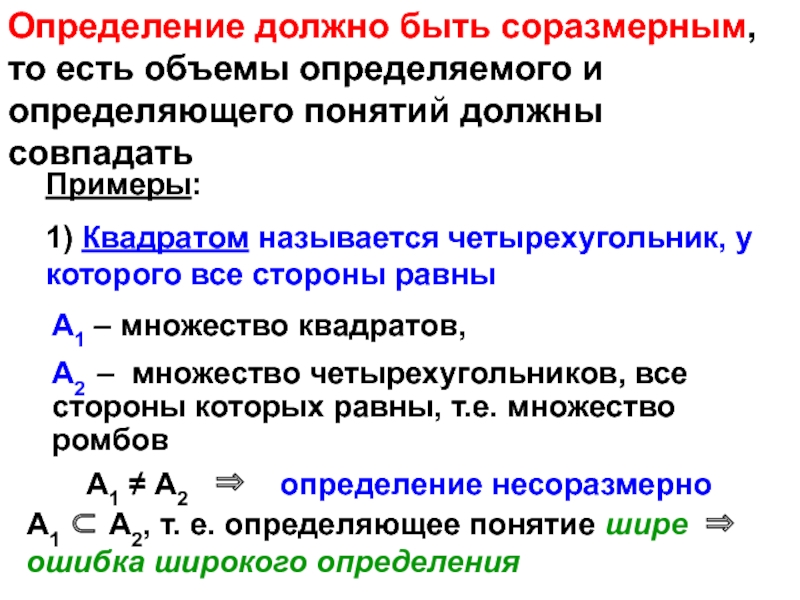
Слайд 33Определение должно быть соразмерным, то есть объемы определяемого и определяющего понятий
должны совпадать
Примеры:
1) Квадратом называется четырехугольник, у которого все стороны равны
А1 – множество квадратов,
А2 – множество четырехугольников, все стороны которых равны, т.е. множество ромбов
А1 ≠ А2 ⇒ определение несоразмерно
А1 ⊂ А2, т. е. определяющее понятие шире ⇒ ошибка широкого определения
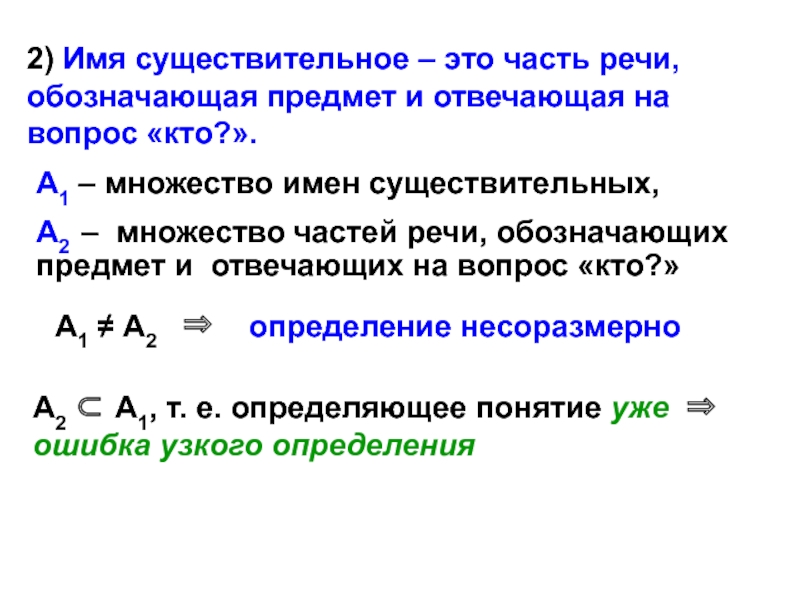
Слайд 342) Имя существительное – это часть речи, обозначающая предмет и отвечающая
на вопрос «кто?».
А1 – множество имен существительных,
А2 – множество частей речи, обозначающих предмет и отвечающих на вопрос «кто?»
А1 ≠ А2 ⇒ определение несоразмерно
А2 ⊂ А1, т. е. определяющее понятие уже ⇒ ошибка узкого определения
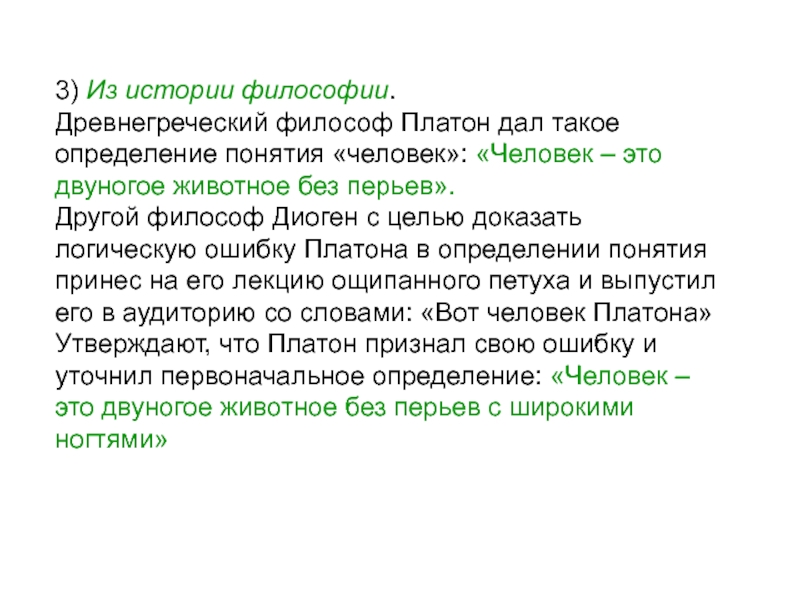
Слайд 353) Из истории философии.
Древнегреческий философ Платон дал такое определение понятия «человек»:
«Человек – это двуногое животное без перьев».
Другой философ Диоген с целью доказать логическую ошибку Платона в определении понятия принес на его лекцию ощипанного петуха и выпустил его в аудиторию со словами: «Вот человек Платона» Утверждают, что Платон признал свою ошибку и уточнил первоначальное определение: «Человек – это двуногое животное без перьев с широкими ногтями»
Слайд 36Определение не должно содержать круга.
Круг возникает тогда, когда определяемое и
определяющее понятия выражаются одно через другое, или понятие определяется само через себя.
Примеры:
1) Касательная к окружности – это прямая, которая касается окружности.
Правильно:
Касательная к окружности – это прямая, имеющая с окружностью только одну общую точку.
Слайд 372) Умножение чисел – это действие, при помощи которого находят произведение
этих чисел. Произведение чисел – это результат их умножения
Правильно:
Произведением натуральных чисел а и b называется натуральное число а · b, равное сумме b слагаемых, каждое из которых равно а.
Слайд 38Определение должно быть
четким, ясным
Это значит:
а) значения терминов, входящих в
определяющее понятие, должны быть известны к моменту введения определения

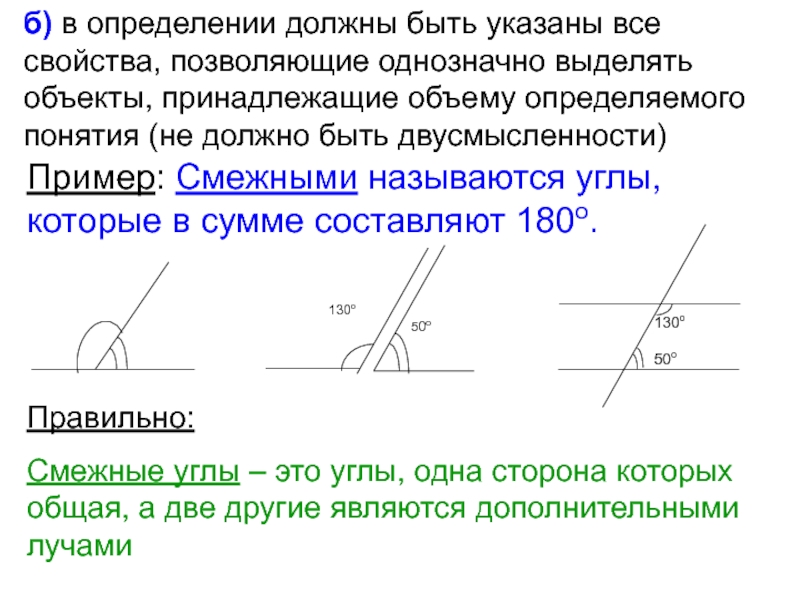
Слайд 39б) в определении должны быть указаны все свойства, позволяющие однозначно выделять
объекты, принадлежащие объему определяемого понятия (не должно быть двусмысленности)
Пример: Смежными называются углы, которые в сумме составляют 180о.
Правильно:
Смежные углы – это углы, одна сторона которых общая, а две другие являются дополнительными лучами
Слайд 40в) определение не должно содержать избыточных свойств в определяющей части
Пример: Прямоугольником
называется четырехугольник, у которого противоположные стороны равны и все углы прямые.
Правильно:
Прямоугольник — это четырехугольник, у которого все углы прямые.
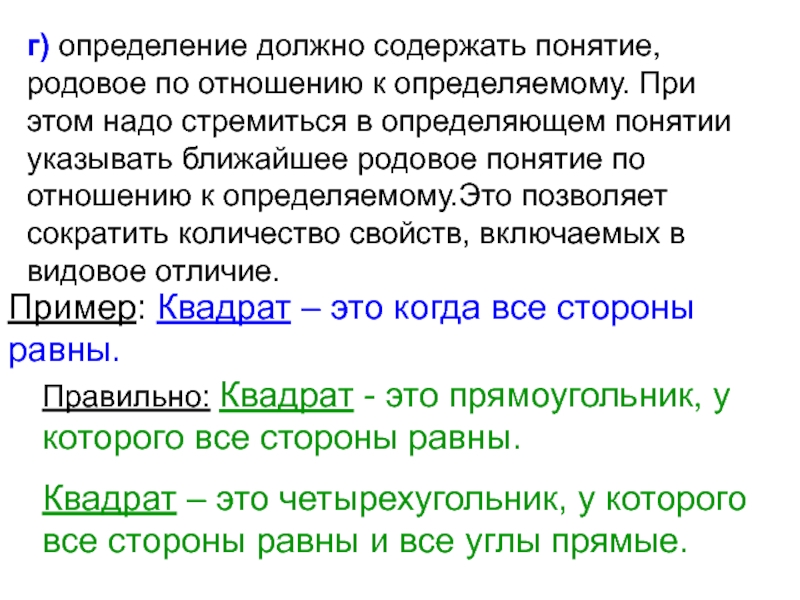
Слайд 41г) определение должно содержать понятие, родовое по отношению к определяемому. При
этом надо стремиться в определяющем понятии указывать ближайшее родовое понятие по отношению к определяемому.Это позволяет сократить количество свойств, включаемых в видовое отличие.
Пример: Квадрат – это когда все стороны равны.
Правильно: Квадрат — это прямоугольник, у которого все стороны равны.
Квадрат – это четырехугольник, у которого все стороны равны и все углы прямые.
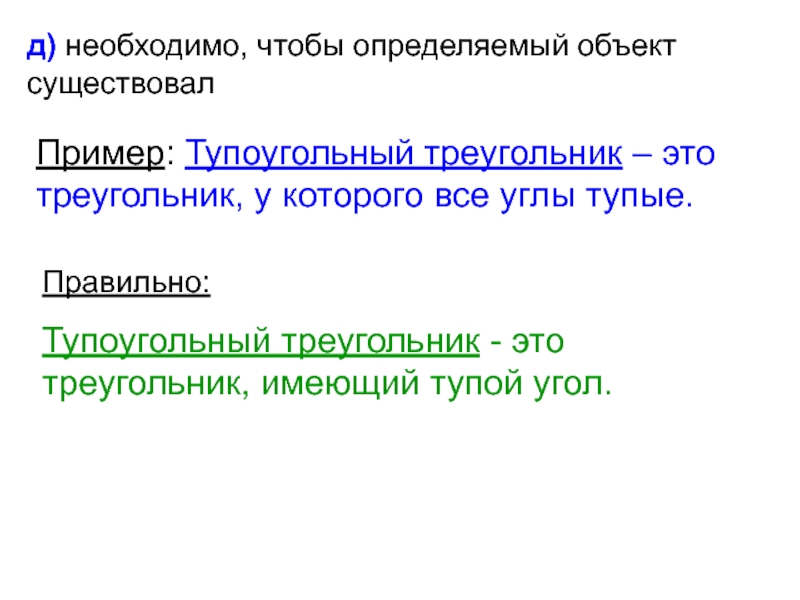
Слайд 42д) необходимо, чтобы определяемый объект существовал
Пример: Тупоугольный треугольник – это треугольник,
у которого все углы тупые.
Правильно:
Тупоугольный треугольник — это треугольник, имеющий тупой угол.
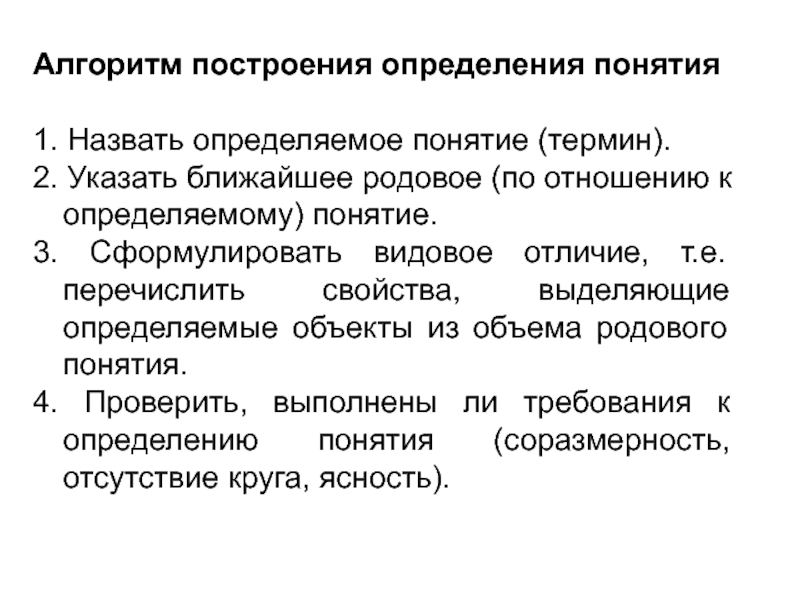
Слайд 43Алгоритм построения определения понятия
1. Назвать определяемое понятие (термин).
2. Указать ближайшее родовое
(по отношению к определяемому) понятие.
3. Сформулировать видовое отличие, т.е. перечислить свойства, выделяющие определяемые объекты из объема родового понятия.
4. Проверить, выполнены ли требования к определению понятия (соразмерность, отсутствие круга, ясность).
Слайд 44Контекстуальное определение
— определение, в котором содержание нового понятия раскрывается
через контекст, через анализ конкретной ситуации, описывающей смысл вводимого понятия
Слайд 46Остенсивное определение
– определение путем показа.

Слайд 49Упражнения
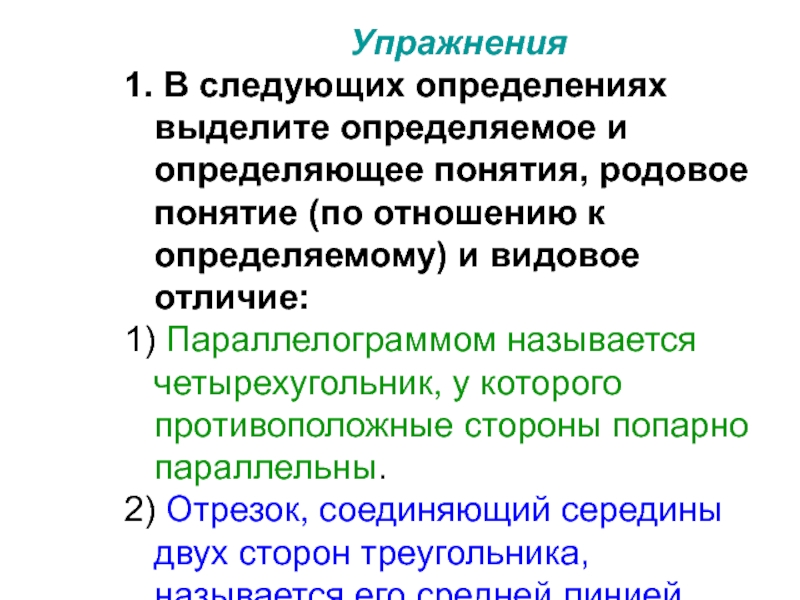
1. В следующих определениях выделите определяемое и определяющее понятия, родовое понятие
(по отношению к определяемому) и видовое отличие:
1) Параллелограммом называется четырехугольник, у которого противоположные стороны попарно параллельны.
2) Отрезок, соединяющий середины двух сторон треугольника, называется его средней линией.
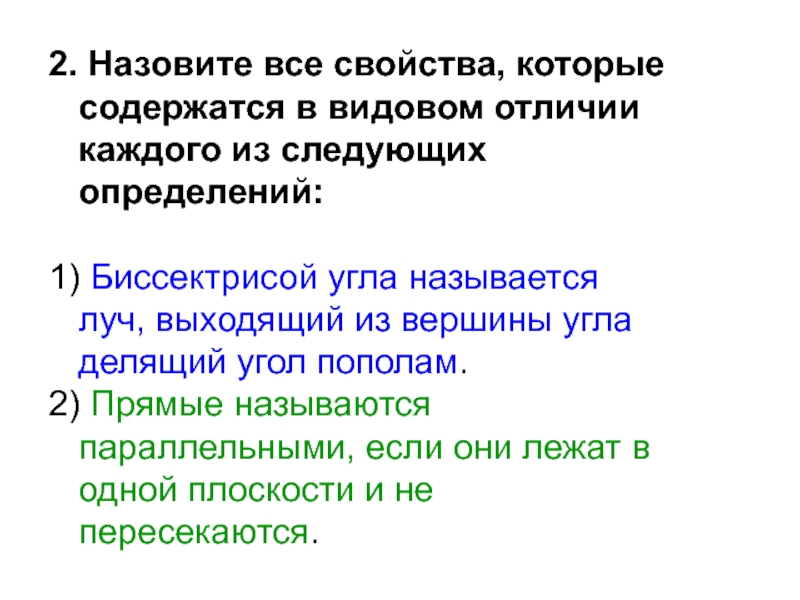
Слайд 502. Назовите все свойства, которые содержатся в видовом отличии каждого из
следующих определений:
1) Биссектрисой угла называется луч, выходящий из вершины угла делящий угол пополам.
2) Прямые называются параллельными, если они лежат в одной плоскости и не пересекаются.
Слайд 513. Есть ли логические ошибки в следующих определениях? Если можете, исправьте
их.
1) Прямоугольником называется четырехугольник, у которого противоположные стороны равны.
2) Биссектрисой угла называется прямая, делящая угол пополам.
3) Сложением называется действие, при котором числа складываются.
4) Равносторонним треугольником называется треугольник, у которого равны все стороны и все углы.
5) Параллелограммом называется многоугольник, у которого противоположные стороны попарно параллельны