
Текст работы размещён без изображений и формул.
Полная версия работы доступна во вкладке «Файлы работы» в формате PDF
Главный источник энергии на Земле — солнечное излучение — представляется нам постоянным и неизменным. Действительно, даже с помощью наиболее совершенных современных инструментов не удалось обнаружить каких-либо значительных изменений солнечной постоянной. Так называется количество лучистой энергии Солнца, поступающее к верхней границе земной атмосферы. Выражается оно в калориях за минуту на площадь 1 см2 и равняется приближенно 2кал/мин*см2[1]
Однако уже тысячи лет назад люди невооруженным глазом наблюдали изменения на Солнце — появление темных пятен. Об этом, например, свидетельствует русская летопись 1371 г., когда сквозь дым лесных пожаров были видны «на Солнце места черные акы гвозди». Еще во времена Галилея, в средние века, после первых наблюдений Солнца в телескоп, была высказана мысль о том, что солнечные пятна — это охладители и поэтому при увеличении количества пятен на Солнце температура на Земле должна падать. [1]
Однако тогда же было обнаружено, что если солнечные пятна и влияют на погоду и климат, то неодинаково на различных географических широтах. В одних районах при увеличении числа солнечных пятен становится теплее, в других — холоднее. [1]
Количество атмосферных осадков изменяется также по-разному. Даже в одной и той же местности солнечная активность в разные годы оказывает различное влияние на климат. Эти расхождения и даже противоречия породили сомнения: влияют ли вообще на климат и погоду процессы, происходящие на Солнце? [1]
Уже в наше время благодаря исследованиям физики Солнца, изучению межпланетной среды и высоких слоев земной атмосферы, а также многочисленным специальным исследованиям климата и погоды этот вопрос несколько прояснился. Наука, которая изучает влияние солнечной активности на атмосферу Земли, погоду и климат, называется гелиогеофизикой, а под солнечной активностью подразумеваются совокупность доступных нашим наблюдениям изменений на Солнце, не считая самых мелких, не отражающихся на обычном состоянии светила. [1]
Особое внимание ученые уделяют двум видам солнечной активности: волновому (электромагнитному) излучению Солнца и распространению в окружающем пространстве корпускул — частиц солнечного газа, находящегося в плазменном состоянии. [1]
Суммарная величина электромагнитного излучения характеризуется солнечной постоянной — одной из важнейших величин в метеорологии. Подсчитано, что изменение солнечной постоянной только на 1% повлекло бы за собой заметное изменение в распределении температуры и воздушных течений на земном шаре. Современные приборы улавливают колебания солнечной постоянной до 2%. Но нет полной уверенности в достоверности этих величин, потому что все измерения производятся в условиях земной атмосферы, самое большее на высотах 50—60 км над уровнем моря (не считая все еще очень редких наблюдений с космических кораблей). Величины же излучения Солнца за пределами атмосферы получают путем расчетов. [1]
Эти расчеты необходимо проверить наблюдениями вне атмосферы. Хорошим плацдармом для них могла бы служить Луна, лишенная атмосферы, но и там не исключены помехи: пыль, поднятая с поверхности нашего спутника, может затемнить Солнце, толчки от падения метеоритов могут вызвать отдельные скачки в показаниях приборов и т. д. [1]
Наиболее надежный путь — устройство обсерваторий на долговременных орбитальных станциях, важные шаги к созданию которых предприняты в нашей стране. Помимо суммарной величины солнечного излучения изучаются качественные и количественные характеристики отдельных областей его спектра: рентгеновская, ультрафиолетовая, видимая, инфракрасная, радиоизлучение. Особенный интерес для ге-лиогеофизики представляет ультрафиолетовая область спектра. [1]
Ультрафиолетовые лучи поглощаются почти полностью в высоких слоях атмосферы. Одно из важнейших их свойств — фотохимический эффект. Он и вызывает образование озона на высотах 30—40 км. Ультрафиолетовые лучи — непостоянная часть солнечного излучения (что, однако, практически не сказывается на солнечной постоянной). Резко увеличивается ультрафиолетовое излучение при хромосфер-ных вспышках на Солнце — одном из самых ярких проявлений солнечной активности. Усиленный приток ультрафиолетовых лучей вызывает и интенсивное образование озона. Озон, хорошо поглощающий солнечные лучи, нагревается. Это отражается и на воздушных течениях в более низких слоях атмосферы, следовательно, и на погоде. Очевидно, это одна из форм влияния изменений волнового излучения Солнца на атмосферу Земли [1].
Ионосфера — это верхняя часть атмосферы, главным образом ионизированная облучением Солнца [2]. Ионосфера вносит существенно большие искажения в результаты геодезических измерений, структура ионосферы более сложная и трудно учитывается. Она характеризуется электронной плотностью (количеством электронов в одном кубическом метре), которая может меняться в больших пределах даже в течение суток, так как зависит от солнечного излучения, солнечной активности (количества пятен на Солнце), космического излучения и некоторых других факторов. За состоянием ионосферы ведут постоянные наблюдения, и ее обобщенные характеристики передают в навигационном сообщении спутника [3].
Литература:
-
Качурин Л. Г. Физические основы воздействия на атмосферные процессы. – Л.: Гидрометеоиздат, 1989. — http://www.twirpx.com/
-
Ионосфера — https://ru.wikipedia.org/wiki/Ионосфера/
-
Ерухимов Л. М. Ионосфера Земли как космическая плазменная лаборатория — СОЖ, 1998 — http://www.kosmofizika.ru/

Solar irradiance (yellow) plotted with temperature (red) since 1880.
Patterns of solar irradiance and solar variation have been a main driver of climate change over the millions to billions of years of the geologic time scale, but their role in recent warming is insignificant.[1] Evidence that this is the case comes from analysis on many timescales and from many sources, including: direct observations; composites from baskets of different proxy observations; and numerical climate models. On millennial timescales, paleoclimate indicators have been compared to cosmogenic isotope abundances as the latter are a proxy for solar activity. These have also been used on century times scales but, in addition, instrumental data are increasingly available (mainly telescopic observations of sunspots and thermometer measurements of air temperature) and show that, for example, the temperature fluctuations do not match the solar activity variations and that the commonly-invoked association of the Little Ice Age with the Maunder minimum is far too simplistic as, although solar variations may have played a minor role, a much bigger factor is known to be Little Ice Age volcanism.[2] In recent decades observations of unprecedented accuracy, sensitivity and scope (of both solar activity and terrestrial climate) have become available from spacecraft and show unequivocally that recent global warming is not caused by changes in the Sun.
Geologic time[edit]
Earth formed around 4.54 billion years ago[3][4][5] by accretion from the solar nebula. Volcanic outgassing probably created the primordial atmosphere, which contained almost no oxygen and would have been toxic to humans and most modern life. Much of the Earth was molten because of frequent collisions with other bodies which led to extreme volcanism. Over time, the planet cooled and formed a solid crust, eventually allowing liquid water to exist on the surface.
Three to four billion years ago the Sun emitted only 70% of its current power.[6] Under the present atmospheric composition, this past solar luminosity would have been insufficient to prevent water from uniformly freezing. There is nonetheless evidence that liquid water was already present in the Hadean[7][8] and Archean[9][7] eons, leading to what is known as the faint young Sun paradox.[10] Hypothesized solutions to this paradox include a vastly different atmosphere, with much higher concentrations of greenhouse gases than currently exist.[11]
Over the following approximately 4 billion years, the Sun’s energy output increased and the composition of the Earth atmosphere changed. The Great Oxygenation Event around 2.4 billion years ago was the most notable alteration of the atmosphere. Over the next five billion years, the Sun’s ultimate death as it becomes a very bright red giant and then a very faint white dwarf will have dramatic effects on climate, with the red giant phase likely already ending any life on Earth.
Measurement[edit]
Since 1978, solar irradiance has been directly measured by satellites with very good accuracy.[12]: 6 These measurements indicate that the Sun’s total solar irradiance fluctuates by +-0.1% over the ~11 years of the solar cycle, but that its average value has been stable since the measurements started in 1978. Solar irradiance before the 1970s is estimated using proxy variables, such as tree rings, the number of sunspots, and the abundances of cosmogenic isotopes such as 10Be,[13] all of which are calibrated to the post-1978 direct measurements.[14]

Modelled simulation of the effect of various factors (including GHGs, Solar irradiance) singly and in combination, showing in particular that solar activity produces a small and nearly uniform warming, unlike what is observed.
Solar activity has been on a declining trend since the 1960s, as indicated by solar cycles 19-24, in which the maximum number of sunspots were 201, 111, 165, 159, 121 and 82, respectively.[15] In the three decades following 1978, the combination of solar and volcanic activity is estimated to have had a slight cooling influence.[16] A 2010 study found that the composition of solar radiation might have changed slightly, with in an increase of ultraviolet radiation and a decrease in other wavelengths.»[17]
Modern era[edit]
In the modern era, the Sun has operated within a sufficiently narrow band that climate has been little affected. Models indicate that the combination of solar variations and volcanic activity can explain periods of relative warmth and cold between A.D. 1000 and 1900.
The Holocene[edit]
Numerous paleoenvironmental reconstructions have looked for relationships between solar variability and climate. Arctic paleoclimate, in particular, has linked total solar irradiance variations and climate variability. A 2001 paper identified a ~1500 year solar cycle that was a significant influence on North Atlantic climate throughout the Holocene.[18]
Little Ice Age[edit]
One historical long-term correlation between solar activity and climate change is the 1645–1715 Maunder minimum, a period of little or no sunspot activity which partially overlapped the «Little Ice Age» during which cold weather prevailed in Europe. The Little Ice Age encompassed roughly the 16th to the 19th centuries.[19][20][21] Whether the low solar activity or other factors caused the cooling is debated.
The Spörer Minimum between 1460 and 1550 was matched to a significant cooling period.[22]
A 2012 paper instead linked the Little Ice Age to volcanism, through an «unusual 50-year-long episode with four large sulfur-rich explosive eruptions,» and claimed «large changes in solar irradiance are not required» to explain the phenomenon.[23]
A 2010 paper suggested that a new 90-year period of low solar activity would reduce global average temperatures by about 0.3 °C, which would be far from enough to offset the increased forcing from greenhouse gases.[24]
Fossil fuel era[edit]

1979–2009: Over the past 3 decades, terrestrial temperature has not correlated with sunspot trends. The top plot is of sunspots, while below is the global atmospheric temperature trend. El Chichón and Pinatubo were volcanoes, while El Niño is part of ocean variability. The effect of greenhouse gas emissions is on top of those fluctuations.
The link between recent solar activity and climate has been quantified and is not a major driver of the warming that has occurred since early in the twentieth century.[25] Human-induced forcings are needed to reproduce the late-20th century warming.[26] Some studies associate solar cycle-driven irradiation increases with part of twentieth century warming.[27][28]
Three mechanisms are proposed by which solar activity affects climate:
- Solar irradiance changes directly affecting the climate («radiative forcing»). This is generally considered to be a minor effect, as the measured amplitudes of the variations are too small to have significant effect, absent some amplification process.[29]
- Variations in the ultraviolet component. The UV component varies by more than the total, so if UV were for some (as yet unknown) reason to have a disproportionate effect, this might explain a larger solar signal.
- Effects mediated by changes in galactic cosmic rays (which are affected by the solar wind) such as changes in cloud cover.
Climate models have been unable to reproduce the rapid warming observed in recent decades when they only consider variations in total solar irradiance and volcanic activity. Hegerl et al. (2007) concluded that greenhouse gas forcing had «very likely» caused most of the observed global warming since the mid-20th century. In making this conclusion, they allowed for the possibility that climate models had been underestimating the effect of solar forcing.[1]
Another line of evidence comes from looking at how temperatures at different levels in the Earth’s atmosphere have changed.[30] Models and observations show that greenhouse gas results in warming of the troposphere, but cooling of the stratosphere.[31] Depletion of the ozone layer by chemical refrigerants stimulated a stratospheric cooling effect. If the Sun was responsible for observed warming, warming of the troposphere at the surface and warming at the top of the stratosphere would be expected as the increased solar activity would replenish ozone and oxides of nitrogen.[32]
Lines of evidence[edit]
The assessment of the solar activity/climate relationship involves multiple, independent lines of evidence.
Sunspots[edit]

CO2, temperature, and sunspot activity since 1850
Early research attempted to find a correlation between weather and sunspot activity, mostly without notable success.[33][34] Later research has concentrated more on correlating solar activity with global temperature.
Irradiation[edit]
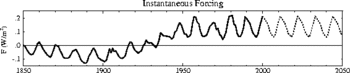
Solar forcing 1850–2050 used in a NASA GISS climate model. Recent variation pattern used after 2000.
Accurate measurement of solar forcing is crucial to understanding possible solar impact on terrestrial climate. Accurate measurements only became available during the satellite era, starting in the late 1970s, and even that is open to some residual disputes: different teams find different values, due to different methods of cross-calibrating measurements taken by instruments with different spectral sensitivity.[35] Scafetta and Willson argue for significant variations of solar luminosity between 1980 and 2000,[36] but Lockwood and Frohlich[37] find that solar forcing declined after 1987.
The 2001 Intergovernmental Panel on Climate Change (IPCC) Third Assessment Report (TAR) concluded that the measured impact of recent solar variation is much smaller than the amplification effect due to greenhouse gases, but acknowledged that scientific understanding is poor with respect to solar variation.[38][39]
Estimates of long-term solar irradiance changes have decreased since the TAR. However, empirical results of detectable tropospheric changes have strengthened the evidence for solar forcing of climate change. The most likely mechanism is considered to be some combination of direct forcing by TSI changes and indirect effects of ultraviolet (UV) radiation on the stratosphere. Least certain are indirect effects induced by galactic cosmic rays.[40]
In 2002, Lean et al.[41] stated that while «There is … growing empirical evidence for the Sun’s role in climate change on multiple time scales including the 11-year cycle», «changes in terrestrial proxies of solar activity (such as the 14C and 10Be cosmogenic isotopes and the aa geomagnetic index) can occur in the absence of long-term (i.e., secular) solar irradiance changes … because the stochastic response increases with the cycle amplitude, not because there is an actual secular irradiance change.» They conclude that because of this, «long-term climate change may appear to track the amplitude of the solar activity cycles,» but that «Solar radiative forcing of climate is reduced by a factor of 5 when the background component is omitted from historical reconstructions of total solar irradiance …This suggests that general circulation model (GCM) simulations of twentieth century warming may overestimate the role of solar irradiance variability.» A 2006 review suggested that solar brightness had relatively little effect on global climate, with little likelihood of significant shifts in solar output over long periods of time.[29][42] Lockwood and Fröhlich, 2007, found «considerable evidence for solar influence on the Earth’s pre-industrial climate and the Sun may well have been a factor in post-industrial climate change in the first half of the last century», but that «over the past 20 years, all the trends in the Sun that could have had an influence on the Earth’s climate have been in the opposite direction to that required to explain the observed rise in global mean temperatures.»[43] In a study that considered geomagnetic activity as a measure of known solar-terrestrial interaction, Love et al. found a statistically significant correlation between sunspots and geomagnetic activity, but not between global surface temperature and either sunspot number or geomagnetic activity.[44]
Benestad and Schmidt[45] concluded that «the most likely contribution from solar forcing a global warming is 7 ± 1% for the 20th century and is negligible for warming since 1980.» This paper disagreed with Scafetta and West,[46] who claimed that solar variability has a significant effect on climate forcing. Based on correlations between specific climate and solar forcing reconstructions, they argued that a «realistic climate scenario is the one described by a large preindustrial secular variability (e.g., the paleoclimate temperature reconstruction by Moberg et al.)[47] with TSI experiencing low secular variability (as the one shown by Wang et al.).[48] Under this scenario, they claimed the Sun might have contributed 50% of the observed global warming since 1900.[49] Stott et al. estimated that the residual effects of the prolonged high solar activity during the last 30 years account for between 16% and 36% of warming from 1950 to 1999.[50]
Direct measurement and time series[edit]

Neither direct measurements nor proxies of solar variation correlate well with Earth global temperature,[57] particularly in recent decades when both quantities are best known.[51][58]
The oppositely-directed trends highlighted by Lockwood and Fröhlich[51] in 2007, with global mean temperatures continuing to rise while solar activity fell, have continued and become even more pronounced since then. In 2007 the difference in the trends was apparent after about 1987 and that difference has grown and accelerated in subsequent years. The updated figure (right) shows the variations and contrasts solar cycles 14 and 24, a century apart, that are quite similar in all solar activity measures (in fact cycle 24 is slightly less active than cycle 14 on average), yet the global mean air surface temperature is more than 1 degree Celsius higher for cycle 24 than cycle 14, showing the rise is not associated with solar activity. The total solar irradiance (TSI) panel shows the PMOD composite of observations [59] with a modelled variation from the SATIRE-T2 model of the effect of sunspots and faculae [53] with the addition of a quiet -Sun variation (due to sub-resolution photospheric features and any solar radius changes) derived from correlations with comic ray fluxes and cosmogenic isotopes.[54] The finding that solar activity was approximately the same in cycles 14 and 24 applies to all solar outputs that have, in the past, been proposed as a potential cause of terrestrial climate change and includes total solar irradiance, cosmic ray fluxes, spectral UV irradiance, solar wind speed and/or density, heliospheric magnetic field and its distribution of orientations and the consequent level of geomagnetic activity.
Daytime/nighttime[edit]
Global average diurnal temperature range has decreased.[60][61][62] Daytime temperatures have not risen as fast as nighttime temperatures. This is the opposite of the expected warming if solar energy (falling primarily or wholly during daylight, depending on energy regime) were the principal means of forcing. It is, however, the expected pattern if greenhouse gases were preventing radiative escape, which is more prevalent at night.[63]
Hemisphere and latitude[edit]
The Northern Hemisphere is warming faster than the Southern Hemisphere.[64][65] This is the opposite of the expected pattern if the Sun, currently closer to the Earth during austral summer, were the principal climate forcing. In particular, the Southern Hemisphere, with more ocean area and less land area, has a lower albedo («whiteness») and absorbs more light. The Northern Hemisphere, however, has higher population, industry and emissions.[citation needed]
Furthermore, the Arctic region is warming faster than the Antarctic and faster than northern mid-latitudes and subtropics, despite polar regions receiving less sun than lower latitudes.[citation needed]
Altitude[edit]
Solar forcing should warm Earth’s atmosphere roughly evenly by altitude, with some variation by wavelength/energy regime. However, the atmosphere is warming at lower altitudes while cooling higher up. This is the expected pattern if greenhouse gases drive temperature,[66][67] as on Venus.[68]
Solar variation theory[edit]
A 1994 study of the US National Research Council concluded that TSI variations were the most likely cause of significant climate change in the pre-industrial era, before significant human-generated carbon dioxide entered the atmosphere.[69]
Scafetta and West correlated solar proxy data and lower tropospheric temperature for the preindustrial era, before significant anthropogenic greenhouse forcing, suggesting that TSI variations may have contributed 50% of the warming observed between 1900 and 2000 (although they conclude «our estimates about the solar effect on climate might be overestimated and should be considered as an upper limit.»)[46] If interpreted as a detection rather than an upper limit, this would contrast with global climate models predicting that solar forcing of climate through direct radiative forcing makes an insignificant contribution.[70]
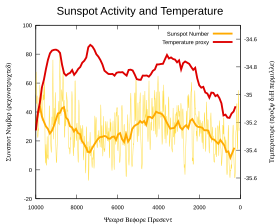
Sunspot and temperature reconstructions from proxy data
In 2000, Stott and others[71] reported on the most comprehensive model simulations of 20th century climate to that date. Their study looked at both «natural forcing agents» (solar variations and volcanic emissions) as well as «anthropogenic forcing» (greenhouse gases and sulphate aerosols). They found that «solar effects may have contributed significantly to the warming in the first half of the century although this result is dependent on the reconstruction of total solar irradiance that is used. In the latter half of the century, we find that anthropogenic increases in greenhouses gases are largely responsible for the observed warming, balanced by some cooling due to anthropogenic sulphate aerosols, with no evidence for significant solar effects.» Stott’s group found that combining these factors enabled them to closely simulate global temperature changes throughout the 20th century. They predicted that continued greenhouse gas emissions would cause additional future temperature increases «at a rate similar to that observed in recent decades».[72] In addition, the study notes «uncertainties in historical forcing» — in other words, past natural forcing may still be having a delayed warming effect, most likely due to the oceans.[71]
Stott’s 2003 work largely revised his assessment, and found a significant solar contribution to recent warming, although still smaller (between 16 and 36%) than that of greenhouse gases.[50]
A study in 2004 concluded that solar activity affects the climate — based on sunspot activity, yet plays only a small role in the current global warming.[73]
Correlations to solar cycle length[edit]
In 1991, Friis-Christensen and Lassen claimed a strong correlation of the length of the solar cycle with northern hemispheric temperature changes.[74] They initially used sunspot and temperature measurements from 1861 to 1989 and later extended the period using four centuries of climate records. Their reported relationship appeared to account for nearly 80 per cent of measured temperature changes over this period. The mechanism behind these claimed correlations was a matter of speculation.
In a 2003 paper[75] Laut identified problems with some of these correlation analyses. Damon and Laut claimed:[76]
the apparent strong correlations displayed on these graphs have been obtained by incorrect handling of the physical data. The graphs are still widely referred to in the literature, and their misleading character has not yet been generally recognized.
Damon and Laut stated that when the graphs are corrected for filtering errors, the sensational agreement with the recent global warming, which drew worldwide attention, totally disappeared.[76]
In 2000, Lassen and Thejll updated their 1991 research and concluded that while the solar cycle accounted for about half the temperature rise since 1900, it failed to explain a rise of 0.4 °C since 1980.[77] Benestad’s 2005 review[78] found that the solar cycle did not follow Earth’s global mean surface temperature.
In 2022, Chatzistergos updated the cycle length series with recent sunspot and solar plages data, extending them to more recent periods than previous studies, and also considering the various available time series.[79][80][81][82][83] This is important because of the plentiful updates and corrections that have been applied to the sunspot data over the last decade. He showed that cycle lengths significantly diverge from Earth’s temperatures and concluded that the strong correlation reported by Friis-Christensen and Lassen was an artefact of their analysis. Owing largely to their guess of next extrema times, arbitrarily restricting the analysis over a specific time period, along with other arbitrarities in their methodology.[84][85]
Weather[edit]
Solar activity may also impact regional climates, such as for the rivers Paraná[86] and Po.[87] Measurements from NASA’s Solar Radiation and Climate Experiment show that solar UV output is more variable than total solar irradiance. Climate modelling suggests that low solar activity may result in, for example, colder winters in the US and northern Europe and milder winters in Canada and southern Europe, with little change in global averages.[88] More broadly, links have been suggested between solar cycles, global climate and regional events such as El Niño.[89] Hancock and Yarger found «statistically significant relationships between the double [~21-year] sunspot cycle and the ‘January thaw’ phenomenon along the East Coast and between the double sunspot cycle and ‘drought’ (June temperature and precipitation) in the Midwest.»[90]
Cloud condensation[edit]
Recent research at CERN’s CLOUD facility examined links between cosmic rays and cloud condensation nuclei, demonstrating the effect of high-energy particulate radiation in nucleating aerosol particles that are precursors to cloud condensation nuclei.[91] Kirkby (CLOUD team leader) said, «At the moment, it [the experiment] actually says nothing about a possible cosmic-ray effect on clouds and climate.»[92][93] After further investigation, the team concluded that «variations in cosmic ray intensity do not appreciably affect climate through nucleation.»[94]
1983–1994 global low cloud formation data from the International Satellite Cloud Climatology Project (ISCCP) was highly correlated with galactic cosmic ray (GCR) flux; subsequent to this period, the correlation broke down.[76] Changes of 3–4% in cloudiness and concurrent changes in cloud top temperatures correlated to the 11 and 22-year solar (sunspot) cycles, with increased GCR levels during «antiparallel» cycles.[95] Global average cloud cover change was measured at 1.5–2%. Several GCR and cloud cover studies found positive correlation at latitudes greater than 50° and negative correlation at lower latitudes.[96] However, not all scientists accept this correlation as statistically significant, and some who do attribute it to other solar variability (e.g. UV or total irradiance variations) rather than directly to GCR changes.[97][98] Difficulties in interpreting such correlations include the fact that many aspects of solar variability change at similar times, and some climate systems have delayed responses.
Historical perspective[edit]
Physicist and historian Spencer R. Weart in The Discovery of Global Warming (2003) wrote:
The study of [sun spot] cycles was generally popular through the first half of the century. Governments had collected a lot of weather data to play with and inevitably people found correlations between sun spot cycles and select weather patterns. If rainfall in England didn’t fit the cycle, maybe storminess in New England would. Respected scientists and enthusiastic amateurs insisted they had found patterns reliable enough to make predictions. Sooner or later though every prediction failed. An example was a highly credible forecast of a dry spell in Africa during the sunspot minimum of the early 1930s. When the period turned out to be wet, a meteorologist later recalled «the subject of sunspots and weather relationships fell into dispute, especially among British meteorologists who witnessed the discomfiture of some of their most respected superiors.» Even in the 1960s he said, «For a young [climate] researcher to entertain any statement of sun-weather relationships was to brand oneself a crank.»[33]
See also[edit]
- Radiative forcing
- Solar phenomena
- Solar cycle
- Solar observation
- Space climate
- Space weather
References[edit]
- ^ a b Hegerl, Gabriele C.; Zwiers, Francis W.; Braconnot, Pascale; Gillett, Nathan P.; Luo, Yong; Marengo Orsini, Jose A.; Nicholls, Neville; Penner, Joyce E.; Stott, Peter A. (2007). «Understanding and Attributing Climate Change». In Solomon, Susan; Qin, Dahe; Manning, Martin; Marquis, Melinda; Averyt, Kristen; Tignor, Melinda M.B.; Miller Jr., Henry LeRoy; Chen, Zhenlin (eds.). Climate Change 2007: The Physical Science Basis. Contribution of Working Group I to the Fourth Assessment Report of the Intergovernmental Panel on Climate Change (PDF). Cambridge, U.K. and New York, N.Y.: Cambridge University Press. Retrieved November 10, 2020.
- ^ Owens, M.J.; et al. (October 2017). «The Maunder Minimum and the Little Ice Age: An update from recent reconstructions and climate simulations». J. Space Weather and Space Climate. 7: A25. doi:10.1051/swsc/2017019. ISSN 2115-7251. S2CID 37433045.
- ^ «Age of the Earth». U.S. Geological Survey. 1997. Archived from the original on 23 December 2005. Retrieved 2006-01-10.
- ^ Dalrymple, G. Brent (2001). «The age of the Earth in the twentieth century: a problem (mostly) solved». Special Publications, Geological Society of London. 190 (1): 205–221. Bibcode:2001GSLSP.190..205D. doi:10.1144/GSL.SP.2001.190.01.14. S2CID 130092094.
- ^ Manhesa, Gérard; Allègre, Claude J.; Dupréa, Bernard & Hamelin, Bruno (1980). «Lead isotope study of basic-ultrabasic layered complexes: Speculations about the age of the earth and primitive mantle characteristics». Earth and Planetary Science Letters. 47 (3): 370–382. Bibcode:1980E&PSL..47..370M. doi:10.1016/0012-821X(80)90024-2.
- ^ «The Sun’s Evolution».
- ^ a b Marty, B. (2006). «Water in the Early Earth». Reviews in Mineralogy and Geochemistry. 62 (1): 421–450. Bibcode:2006RvMG…62..421M. doi:10.2138/rmg.2006.62.18.
- ^ Watson, E. B.; Harrison, TM (2005). «Zircon Thermometer Reveals Minimum Melting Conditions on Earliest Earth». Science. 308 (5723): 841–844. Bibcode:2005Sci…308..841W. doi:10.1126/science.1110873. PMID 15879213. S2CID 11114317.
- ^ Hagemann, Steffen G.; Gebre-Mariam, Musie; Groves, David I. (1994). «Surface-water influx in shallow-level Archean lode-gold deposits in Western, Australia». Geology. 22 (12): 1067. Bibcode:1994Geo….22.1067H. doi:10.1130/0091-7613(1994)022<1067:SWIISL>2.3.CO;2.
- ^ Sagan, C.; G. Mullen (1972). «Earth and Mars: Evolution of Atmospheres and Surface Temperatures». Science. 177 (4043): 52–56. Bibcode:1972Sci…177…52S. doi:10.1126/science.177.4043.52. PMID 17756316. S2CID 12566286.
- ^ Sagan, C.; Chyba, C (1997). «The Early Faint Sun Paradox: Organic Shielding of Ultraviolet-Labile Greenhouse Gases». Science. 276 (5316): 1217–1221. Bibcode:1997Sci…276.1217S. doi:10.1126/science.276.5316.1217. PMID 11536805.
- ^ US National Research Council (2008). Understanding and responding to climate change: Highlights of National Academies Reports (PDF) (2008 ed.). 500 Fifth St. N.W., Washington, D.C. 20001: National Academy of Sciences. Archived from the original (PDF) on July 17, 2011. Retrieved 2011-05-20.
{{cite book}}: CS1 maint: location (link) - ^ «Beryllium: Isotopes and Hydrology». University of Arizona, Tucson. Retrieved 10 April 2011.
- ^ Simmon, R. & D. Herring (November 2009). «Notes for slide number 5 titled «Over 100 years of total solar irradiance data,» in presentation, «Human contributions to global climate change»«. Presentation library on the U.S. National Oceanic and Atmospheric Administration’s Climate Services website. Archived from the original on 3 July 2011. Retrieved 2011-06-23.
- ^ «Sunspot numbers». SILSO Data Files. Royal Observatory of Belgium, Brussels. Retrieved 29 July 2014.
- ^ Karl, Melillo & Peterson 2009, p. 15–16.
- ^ Haigh, Joanna D.; Winning, Ann R.; Toumi, Ralf; Harder, Jerald W. (2010-10-07). «An influence of solar spectral variations on radiative forcing of climate». Nature. 467 (7316): 696–699. Bibcode:2010Natur.467..696H. doi:10.1038/nature09426. hdl:10044/1/18858. ISSN 0028-0836. PMID 20930841. S2CID 4320984.
Currently there is insufficient observational evidence to validate the spectral variations observed by SIM, or to fully characterize other solar cycles, but our findings raise the possibility that the effects of solar variability on temperature throughout the atmosphere may be contrary to current expectations.
- ^ Bond; et al. (2001-12-07). «Persistent Solar Influence on North Atlantic Climate During the Holocene». Science. 294 (5549): 2130–2136. Bibcode:2001Sci…294.2130B. doi:10.1126/science.1065680. PMID 11739949. S2CID 38179371.
- ^ H. H. Lamb, «The cold Little Ice Age climate of about 1550 to 1800,» in H. H. Lamb (1972). Fundamentals and Climate Now. Psychology Press. p. 107. ISBN 978-0-416-11530-7.
- ^ Emmanuel Le Roy Ladurie (1971). Times of Feast, Times of Famine: a History of Climate Since the Year 1000. Barbara Bray. Garden City, NY: Doubleday. ISBN 978-0-374-52122-6. OCLC 164590.
- ^ «Environment». solarstorms.org. 2017-04-16.
- ^ Parker, Geoffrey; Smith, Lesley M. (1997). The general crisis of the seventeenth century. Routledge. pp. 287, 288. ISBN 978-0-415-16518-1.
- ^ Miller; et al. (January 31, 2012). «Abrupt onset of the Little Ice Age triggered by volcanism and sustained by sea-ice/ocean feedbacks». Geophysical Research Letters. 39 (2): L02708. Bibcode:2012GeoRL..39.2708M. doi:10.1029/2011GL050168. S2CID 15313398.
- ^ «A quiet sun won’t save us from global warming». New Scientist. 26 February 2010. Retrieved 7 June 2011.
- ^ Joanna D. Haigh «The Sun and the Earth’s Climate», Living Reviews in Solar Physics (access date 31 January 2012
- ^ Committee on Surface Temperature Reconstructions for the Last 2, 000 Years, US National Research Council (2006). «10. Climate Forcings and Climate Models». Surface Temperature Reconstructions for the Last 2,000 Years. Washington, D.C., USA: National Academies of Sciences, Engineering, and Medicine. p. 109. doi:10.17226/11676. ISBN 978-0-309-66144-7. Retrieved 2011-06-23.
- ^ «NASA Study Finds Increasing Solar Trend That Can Change Climate». 2003.
- ^ Svensmark, Henrik; Bondo, Torsten; Svensmark, Jacob (2009). «Cosmic ray decreases affect atmospheric aerosols and clouds». Geophysical Research Letters. 36 (15): n/a. Bibcode:2009GeoRL..3615101S. CiteSeerX 10.1.1.394.9780. doi:10.1029/2009GL038429. S2CID 15963013.
- ^ a b «Changes in Solar Brightness Too Weak To Explain Global Warming» (Press release). UCAR. 13 September 2006. Archived from the original on 21 November 2011. Retrieved 18 April 2007.
- ^ Simmon, R. & D. Herring (November 2009). «Notes for slide number 7, titled «Satellite evidence also suggests greenhouse gas warming,» in presentation, «Human contributions to global climate change»«. Presentation library on the U.S. National Oceanic and Atmospheric Administration’s Climate Services website. Archived from the original on 3 July 2011. Retrieved 2011-06-23.
- ^ Hegerl et al., Chapter 9: Understanding and Attributing Climate Change, Frequently Asked Question 9.2: Can the Warming of the 20th century be Explained by Natural Variability?
- ^ Karl, Melillo & Peterson 2009, p. 20.
- ^ a b Weart, Spencer (2003). «Changing Sun, Changing Climate?». The Discovery of Global Warming. Harvard University Press. ISBN 978-0-674-01157-1. Retrieved 17 April 2008.
- ^ Fritts, Harold C. (1976). Tree rings and climate. Boston: Academic Press. ISBN 978-0-12-268450-0.
- ^ http://www.ipcc.ch/publications_and_data/ar4/wg1/en/ch2s2-7-1-1.html[dead link]
- ^ Scafetta, Nicola; Willson, Richard (2009). «ACRIM-gap and Total Solar Irradiance (TSI) trend issue resolved using a surface magnetic flux TSI proxy model». Geophysical Research Letters. 36 (5): L05701. Bibcode:2009GeoRL..3605701S. doi:10.1029/2008GL036307. S2CID 7160875.
- ^ Lockwood, Mike; Fröhlich, Claus (8 June 2008). «Recent oppositely directed trends in solar climate forcings and the global mean surface air temperature. II. Different reconstructions of the total solar irradiance variation and dependence on response time scale». Proceedings of the Royal Society A. 464 (2094): 1367–1385. Bibcode:2008RSPSA.464.1367L. doi:10.1098/rspa.2007.0347. S2CID 131159896.
- ^ Forster, Piers; Ramaswamy, Venkatachalam; Artaxo, Paulo; Berntsen, Terje; Betts, Richard; Fahey, David W.; Haywood, James; Lean, Judith; Lowe, David C.; Myhre, Gunnar; Nganga, John; Prinn, Ronald; Raga, Graciela; Schulz, Michael & Van Dorland, Robert (2007). «2.9.1 Uncertainties in Radiative Forcing». In Solomon, Susan; Qin, Dahe; Manning, Martin; Marquis, Melinda; Averyt, Kristen; Tignor, Melinda M.B.; Miller Jr., Henry LeRoy & Chen, Zhenlin (eds.). Chapter 2: Changes in Atmospheric Constituents and Radiative Forcing, in Climate Change 2007 – The Physical Science Basis. Cambridge, U.K. and New York, N.Y.: Cambridge University Press. p. 199. ISBN 978-0-521-88009-1. Retrieved November 10, 2020.
- ^ Houghton, J.T.; Ding, Y.; Griggs, D.J.; et al., eds. (2001). «6.11 Total Solar Irradiance—Figure 6.6: Global, annual mean radiative forcings (1750 to present)». Climate Change 2001: Working Group I: The Scientific Basis. Intergovernmental Panel on Climate Change. Archived from the original on 14 June 2006. Retrieved 15 April 2007.
- ^ «2.7 Natural Forcings». ipcc.ch.
- ^ Lean, J.L.; Wang, Y.-M.; Sheeley Jr., N.R. (2002). «The effect of increasing solar activity on the Sun’s total and open magnetic flux during multiple cycles: Implications for solar forcing of climate». Geophysical Research Letters. 29 (24): 77–1 to 77–4. Bibcode:2002GeoRL..29x..77L. doi:10.1029/2002GL015880. S2CID 31369370.
- ^ Foukal, P.; Fröhlich, C.; Spruit, H.; Wigley, T. M. L. (2006). «Variations in solar luminosity and their effect on the Earth’s climate» (PDF). Nature. 443 (7108): 161–166. Bibcode:2006Natur.443..161F. doi:10.1038/nature05072. PMID 16971941. S2CID 205211006. Archived from the original (PDF) on 2007-06-23.
- ^ Lockwood, Mike; Claus Fröhlich (2007). «Recent oppositely directed trends in solar climate forcings and the global mean surface air temperature» (PDF). Proceedings of the Royal Society A. 463 (2086): 2447–2460. Bibcode:2007RSPSA.463.2447L. doi:10.1098/rspa.2007.1880. S2CID 14580351.
Our results show that the observed rapid rise in global mean temperatures seen after 1985 cannot be ascribed to solar variability, whichever of the mechanisms is invoked and no matter how much the solar variation is amplified.
- ^ Love, J. J.; Mursula, K.; Tsai, V. C.; Perkins, D. M. (2011). «Are secular correlations between sunspots, geomagnetic activity, and global temperature significant?». Geophysical Research Letters. 38 (21): n/a. Bibcode:2011GeoRL..3821703L. doi:10.1029/2011GL049380. S2CID 11218724.
- ^ Benestad, R. E.; G. A. Schmidt (21 July 2009). «Solar trends and global warming» (PDF). Journal of Geophysical Research: Atmospheres. 114 (D14): D14101. Bibcode:2009JGRD..11414101B. doi:10.1029/2008JD011639. Archived from the original (PDF) on 21 October 2011.
the most likely contribution from solar forcing a global warming is 7 ± 1% for the 20th century and is negligible for warming since 1980.
- ^ a b Scafetta, N.; West, B. J. (2007). «Phenomenological reconstructions of the solar signature in the Northern Hemisphere, surface temperature records since 1600» (PDF). J. Geophys. Res. 112 (D24): D24S03. Bibcode:2007JGRD..11224S03S. doi:10.1029/2007JD008437. Archived from the original (PDF) on 2008-03-08. (access date 2012-1-31)
- ^ Moberg, A; Sonechkin, DM; Holmgren, K; Datsenko, NM; Karlén, W; Lauritzen, SE (2005). «Highly variable Northern Hemisphere temperatures reconstructed from low- and high-resolution proxy data». Nature. 433 (7026): 613–617. Bibcode:2005Natur.433..613M. doi:10.1038/nature03265. PMID 15703742. S2CID 4359264.
- ^ Wang, Y.‐M.; Lean, J. L.; Sheeley, N. R. (May 2005). «Modeling the Sun’s Magnetic Field and Irradiance since 1713». The Astrophysical Journal. 625 (1): 522–538. Bibcode:2005ApJ…625..522W. doi:10.1086/429689.)
- ^ Scafetta, N.; West, B. J. (2006). «Phenomenological solar signature in 400 years of reconstructed Northern Hemisphere temperature record». Geophys. Res. Lett. 33 (17): L17718. Bibcode:2006GeoRL..3317718S. doi:10.1029/2006GL027142.
- ^ a b Stott, Peter A.; Gareth S. Jones; John F. B. Mitchell (2003). «Do Models Underestimate the Solar Contribution to Recent Climate Change» (PDF). Journal of Climate. 16 (24): 4079–4093. Bibcode:2003JCli…16.4079S. CiteSeerX 10.1.1.177.6737. doi:10.1175/1520-0442(2003)016<4079:DMUTSC>2.0.CO;2. ISSN 1520-0442. Retrieved 5 October 2005.
- ^ a b c Lockwood, L.; Fröhlich, C. (October 2007). «Recent oppositely directed trends in solar climate forcings and the global mean surface air temperature». Proceedings of the Royal Society A. 463 (2086): 2447–2460. Bibcode:2007RSPSA.463.2447L. doi:10.1098/rspa.2007.1880. S2CID 14580351.
- ^ «TSIcomposite». Observatorium Davos PMOD and World Radiation Center WRC.
- ^ a b Dasi-Espuig, M.; Jiang, J.; Krivova, N.A.; Solanki, S.K. (2014). «Modelling total solar irradiance since 1878 from simulated magnetograms». Astron. Astrophys. 570: A23. arXiv:1409.1941. Bibcode:2014A&A…570A..23D. doi:10.1051/0004-6361/201424290. S2CID 119288896.
- ^ a b Lockwood, M.; Ball, W. (May 2020). «Placing limits on long-term variations in quiet-Sun irradiance and their contribution to total solar irradiance and solar radiative forcing of climate». Proceedings of the Royal Society A. 476 (2238): 20200077. Bibcode:2020RSPSA.47600077L. doi:10.1098/rspa.2020.0077. ISSN 1364-5021. PMC 7428030. PMID 32831591.
- ^ Lockwood, Mike; Nevanlinna, Heikki; Barnard, Luke; Owens, Mat; Harrison, R. Giles; Rouillard, Alexis; Scott, Chris S. (2014). «Reconstruction of Geomagnetic Activity and Near‐Earth Interplanetary Conditions over the Past 167 Years: 4. Near‐Earth Solar Wind Speed, IMF, and Open Solar Flux». Annales Geophysicae. 32 (4): 383–399. Bibcode:2014AnGeo..32..383L. doi:10.5194/angeo-32-383-2014.
- ^ Usoskin, I.G. (March 2017). «A history of solar activity over millennia». Living Reviews in Solar Physics. 15 (3): 3. Bibcode:2017LRSP…14….3U. doi:10.1007/s41116-017-0006-9. S2CID 195340740.
- ^ Schurer, A.; et al. (December 2013). «Small influence of solar variability on climate over the past millennium» (PDF). Nature Geoscience. 7 (2): 104–108. Bibcode:2014NatGe…7..104S. doi:10.1038/ngeo2040. hdl:20.500.11820/6f8f8e9d-28d2-40bb-9176-ffc10b07a365.
- ^ Foukal, P.; et al. (September 2006). «Variations in solar luminosity and their effect on the Earth’s climate». Nature. 443 (7108): 161–166. Bibcode:2006Natur.443..161F. doi:10.1038/nature05072. PMID 16971941. S2CID 205211006.
- ^ «TSIcomposite». Observatorium Davos, PMOD and World Radiation Center WRC.
- ^ Karl, Thomas; et al. (1993). «A New Perspective on Recent Global Warming: Asymmetric Trends of Daily Maximum and Minimum Temperature». Bulletin of the American Meteorological Society. 74 (6): 1007–1023. Bibcode:1993BAMS…74.1007K. doi:10.1175/1520-0477(1993)074<1007:anporg>2.0.co;2. S2CID 67795894.
- ^ Braganza, K; et al. (July 2004). «Diurnal temperature range as an index of global climate change during the twentieth century». Geophysical Research Letters. 31 (13): L13217. Bibcode:2004GeoRL..3113217B. doi:10.1029/2004gl019998. hdl:11343/32780. S2CID 55358506.
- ^ Zhou, L.; et al. (August 2009). «Detection and attribution of anthropogenic forcing to diurnal temperature range changes from 1950 to 1999: comparing multi-model simulations with observations». Climate Dynamics. 35 (7–8): 1289–1307. doi:10.1007/s00382-009-0644-2.
- ^ Peng, S.; et al. (June 2004). «Rice yields decline with higher night temperature from global warming». Proceedings of the National Academy of Sciences. 101 (27): 9971–9975. Bibcode:2004PNAS..101.9971P. doi:10.1073/pnas.0403720101. PMC 454199. PMID 15226500.
- ^ Armstrong, A. (February 2013). «Northern warming». Nature Geoscience. 6 (3): 158. doi:10.1038/ngeo1763.
- ^ Jones, P. D.; Parker, D. E.; Osborn, T. J.; Briffa, K. R. (2009). «Global and Hemispheric Temperature Anomalies — Land and Marine Instrumental Records». doi:10.3334/CDIAC/cli.002. OSTI 1389299. Retrieved 17 Oct 2014.
- ^ Lewis, H.; et al. (April 2005). «Response of the Space Debris Environment to Greenhouse Cooling». Proceedings of the 4th European Conference on Space Debris. 587: 243. Bibcode:2005ESASP.587..243L.
- ^ Ford, Matt (Feb 20, 2008). «Unpacking interplay of solar variability and climate change: A trio of researchers discuss the current understanding of the effect solar». Retrieved 17 Oct 2014.
- ^ Picone, J.; Lean, J.; et al. (2005). «Global Change in the Thermosphere: Compelling Evidence of a Secular Decrease in Density». 2005 NRL Review: 225–227.
- ^ Board on Global Change, Commission on Geosciences, Environment, and Resources, National Research Council (1994). Solar Influences on Global Change. Washington, D.C: National Academy Press. p. 36. doi:10.17226/4778. hdl:2060/19950005971. ISBN 978-0-309-05148-4.
- ^ Hansen, J (2005). «Efficacy of climate forcings». J. Geophys. Res. 110 (D18): D18104. Bibcode:2005JGRD..11018104H. doi:10.1029/2005JD005776. S2CID 53957314.
- ^ a b Stott, Peter A.; et al. (2000). «External Control of 20th Century Temperature by Natural and Anthropogenic Forcings». Science. 290 (5499): 2133–2137. Bibcode:2000Sci…290.2133S. doi:10.1126/science.290.5499.2133. PMID 11118145. S2CID 9771224.
- ^ Carslaw, K.S.; Harrison, R. G.; Kirkby, J. (2002). «Cosmic Rays, Clouds, and Climate». Science. 298 (5599): 1732–1737. Bibcode:2002Sci…298.1732C. doi:10.1126/science.1076964. PMID 12459578. S2CID 12917901.
- ^ «How Strongly Does the Sun Influence the Global Climate? — Studies at the Max Planck Institute for Solar System Research reveal: solar activity affects the climate but plays only a minor role in the current global warming» (Press release). Max Planck Society. 2 August 2004. Retrieved 16 August 2015.
- ^ Friis-Christensen, E.; Lassen, K. (1 November 1991). «Length of the Solar Cycle: An Indicator of Solar Activity Closely Associated with Climate». Science. 254 (5032): 698–700. Bibcode:1991Sci…254..698F. doi:10.1126/science.254.5032.698. PMID 17774798. S2CID 31048860. [1]
- ^ Laut, Peter (May 2003). «Solar activity and terrestrial climate: an analysis of some purported correlations». J Atmos Sol-Terr Phys. 65 (7): 801–812. Bibcode:2003JASTP..65..801L. CiteSeerX 10.1.1.539.8293. doi:10.1016/S1364-6826(03)00041-5.
- ^ a b c Damon, Paul E.; Paul Laut (September 28, 2004). «Pattern of Strange Errors Plagues Solar Activity and Terrestrial Climate Data» (PDF). Eos, Transactions, American Geophysical Union. 85 (39): 370–374. Bibcode:2004EOSTr..85..370D. doi:10.1029/2004EO390005. Retrieved 5 October 2005.; see also discussion and references at skeptical science
- ^ Adler, Robert (6 May 2000). «Don’t blame the Sun». New Scientist. No. 2237. Retrieved 2007-04-19.
- ^ Benestad, R.E. (13 August 2005). «A review of the solar cycle length estimates». Geophys. Res. Lett. 32 (15): L15714. Bibcode:2005GeoRL..3215714B. doi:10.1029/2005GL023621.
- ^ Chatzistergos, Theodosios (2022-12-27). «Is there a link between the length of the solar cycle and Earth’s temperature?». Rendiconti Lincei. Scienze Fisiche e Naturali. doi:10.1007/s12210-022-01127-z. ISSN 2037-4631.
- ^ Clette, Frédéric; Lefèvre, Laure (November 2016). «The New Sunspot Number: Assembling All Corrections». Solar Physics. 291 (9–10): 2629–2651. arXiv:1510.06928. doi:10.1007/s11207-016-1014-y. ISSN 0038-0938.
- ^ Usoskin, Ilya; Kovaltsov, Gennady; Kiviaho, Wilma (January 2021). «Robustness of Solar-Cycle Empirical Rules Across Different Series Including an Updated Active-Day Fraction (ADF) Sunspot Group Series». Solar Physics. 296 (1): 13. doi:10.1007/s11207-020-01750-9. ISSN 0038-0938.
- ^ Chatzistergos, Theodosios; Usoskin, Ilya G.; Kovaltsov, Gennady A.; Krivova, Natalie A.; Solanki, Sami K. (June 2017). «New reconstruction of the sunspot group numbers since 1739 using direct calibration and «backbone» methods». Astronomy & Astrophysics. 602: A69. doi:10.1051/0004-6361/201630045. ISSN 0004-6361.
- ^ Chatzistergos, Theodosios; Ermolli, Ilaria; Krivova, Natalie A.; Solanki, Sami K.; Banerjee, Dipankar; Barata, Teresa; Belik, Marcel; Gafeira, Ricardo; Garcia, Adriana; Hanaoka, Yoichiro; Hegde, Manjunath; Klimeš, Jan; Korokhin, Viktor V.; Lourenço, Ana; Malherbe, Jean-Marie (July 2020). «Analysis of full-disc Ca II K spectroheliograms: III. Plage area composite series covering 1892–2019». Astronomy & Astrophysics. 639: A88. doi:10.1051/0004-6361/202037746. ISSN 0004-6361.
- ^ Usoskin, I. G.; Kovaltsov, G. A.; Chatzistergos, T. (December 2016). «Dependence of the Sunspot-Group Size on the Level of Solar Activity and its Influence on the Calibration of Solar Observers». Solar Physics. 291 (12): 3793–3805. arXiv:1609.00569. doi:10.1007/s11207-016-0993-z. ISSN 0038-0938.
- ^ Vaquero, J. M.; Svalgaard, L.; Carrasco, V. M. S.; Clette, F.; Lefèvre, L.; Gallego, M. C.; Arlt, R.; Aparicio, A. J. P.; Richard, J.-G.; Howe, R. (November 2016). «A Revised Collection of Sunspot Group Numbers». Solar Physics. 291 (9–10): 3061–3074. arXiv:1609.04882. doi:10.1007/s11207-016-0982-2. ISSN 0038-0938.
- ^ Pablo J.D. Mauas & Andrea P. Buccino. «Long-term solar activity influences on South American rivers» page 5. Journal of Atmospheric and Solar-Terrestrial Physics on Space Climate, March 2010. Accessed: 20 September 2014.
- ^ Zanchettin, D.; Rubino, A.; Traverso, P.; Tomasino, M. (2008). «[Impact of variations in solar activity on hydrological decadal patterns in northern Italy]». Journal of Geophysical Research. 113 (D12). Bibcode:2008JGRD..11312102Z. doi:10.1029/2007JD009157.
- ^ Ineson S.; Scaife A.A.; Knight J.R.; Manners J.C.; Dunstone N.J.; Gray L.J.; Haigh J.D. (9 October 2011). «Solar forcing of winter climate variability in the Northern Hemisphere». Nature Geoscience. 4 (11): 753–757. Bibcode:2011NatGe…4..753I. doi:10.1038/ngeo1282. hdl:10044/1/18859.
- ^ «National Science Foundation (NSF) News — Solar Cycle Linked to Global Climate — NSF — National Science Foundation». nsf.gov.
- ^ Hancock DJ, Yarger DN (1979). «Cross-Spectral Analysis of Sunspots and Monthly Mean Temperature and Precipitation for the Contiguous United States». Journal of the Atmospheric Sciences. 36 (4): 746–753. Bibcode:1979JAtS…36..746H. doi:10.1175/1520-0469(1979)036<0746:CSAOSA>2.0.CO;2. ISSN 1520-0469.
- ^ «CERN’s CLOUD experiment provides unprecedented insight into cloud formation» (Press release). CERN. 25 August 2011. Retrieved 20 November 2016.
- ^ «Cloud formation may be linked to cosmic rays» (Press release). Nature News. 24 August 2011. Retrieved 19 October 2011.
- ^ Kirkby J; Curtius J; Almeida J; Dunne E; Duplissy J; et al. (25 August 2011). «Role of sulphuric acid, ammonia and galactic cosmic rays in atmospheric aerosol nucleation» (PDF). Nature. 476 (7361): 429–433. Bibcode:2011Natur.476..429K. doi:10.1038/nature10343. PMID 21866156. S2CID 4326159.
- ^ Dunne, E. M.; et al. (2016). «Global atmospheric particle formation from CERN CLOUD measurements». Science. 354 (6316): 1119–1124. Bibcode:2016Sci…354.1119D. doi:10.1126/science.aaf2649. PMID 27789796.
- ^ Svensmark, Henrik (1998). «Influence of Cosmic Rays on Earth’s Climate» (PDF). Physical Review Letters. 81 (22): 5027–5030. Bibcode:1998PhRvL..81.5027S. CiteSeerX 10.1.1.522.585. doi:10.1103/PhysRevLett.81.5027. Retrieved 17 June 2011.
- ^ Tinsley, Brian A.; Yu, Fangqun (2004). «Atmospheric Ionization and Clouds as Links Between Solar Activity and Climate» (PDF). In Pap, Judit M.; Fox, Peter (eds.). Solar Variability and its Effects on Climate. Geophysical monograph series. Vol. 141. American Geophysical Union. pp. 321–339. ISBN 978-0-87590-406-1. Retrieved 19 April 2007.[dead link]
- ^ E. Pallé; C.J. Butler; K. O’Brien (2004). «The possible connection between ionization in the atmosphere by cosmic rays and low level clouds» (PDF). Journal of Atmospheric and Solar-Terrestrial Physics. 66 (18): 1779–1790. Bibcode:2004JASTP..66.1779P. doi:10.1016/j.jastp.2004.07.041. Archived from the original (PDF) on 2007-09-27. Retrieved 2015-08-11.
- ^ Pallé, E. (2005). «Possible satellite perspective effects on the reported correlations between solar activity and clouds» (PDF). Geophysical Research Letters. 32 (3): L03802.1–4. Bibcode:2005GeoRL..32.3802P. doi:10.1029/2004GL021167. S2CID 10052196.
General references[edit]
- «The Sun’s role in Climate Changes» (PDF). Proc. of The International Conference on Global Warming and The Next Ice Age, 19–24 August 2001, Halifax, Nova Scotia. Archived from the original (PDF) on 22 October 2004. Retrieved 2005-02-21.
- White, Warren B.; Lean, Judith; Cayan, Daniel R.; Dettinger, Michael D. (1997). «Response of global upper ocean temperature to changing solar irradiance». Journal of Geophysical Research. 102 (C2): 3255–3266. Bibcode:1997JGR…102.3255W. doi:10.1029/96JC03549.
- A graphical representation[1] of the relationship between natural and anthropogenic factors contributing to climate change appears in «Climate Change 2001: The Scientific Basis», a report by the Intergovernmental Panel on Climate Change (IPCC).[2]
External links[edit]
- Gerrit Lohmann; Norel Rimbu; Mihai Dima (2004). «Climate signature of solar irradiance variations: analysis of long-term instrumental, historical, and proxy data» (PDF). International Journal of Climatology. 24 (8): 1045–1056. Bibcode:2004IJCli..24.1045L. doi:10.1002/joc.1054. S2CID 53698312.
- ^ «graphical representation». Archived from the original on 2012-02-04. Retrieved 2005-10-05.
- ^ Houghton, J.T.; Ding, Y.; Griggs, D.J.; et al. (eds.). «Climate Change 2001: The Scientific Basis». Retrieved 2005-10-05.
Solar irradiance (yellow) plotted with temperature (red) since 1880.
Patterns of solar irradiance and solar variation have been a main driver of climate change over the millions to billions of years of the geologic time scale, but their role in recent warming is insignificant.[1] Evidence that this is the case comes from analysis on many timescales and from many sources, including: direct observations; composites from baskets of different proxy observations; and numerical climate models. On millennial timescales, paleoclimate indicators have been compared to cosmogenic isotope abundances as the latter are a proxy for solar activity. These have also been used on century times scales but, in addition, instrumental data are increasingly available (mainly telescopic observations of sunspots and thermometer measurements of air temperature) and show that, for example, the temperature fluctuations do not match the solar activity variations and that the commonly-invoked association of the Little Ice Age with the Maunder minimum is far too simplistic as, although solar variations may have played a minor role, a much bigger factor is known to be Little Ice Age volcanism.[2] In recent decades observations of unprecedented accuracy, sensitivity and scope (of both solar activity and terrestrial climate) have become available from spacecraft and show unequivocally that recent global warming is not caused by changes in the Sun.
Geologic time[edit]
Earth formed around 4.54 billion years ago[3][4][5] by accretion from the solar nebula. Volcanic outgassing probably created the primordial atmosphere, which contained almost no oxygen and would have been toxic to humans and most modern life. Much of the Earth was molten because of frequent collisions with other bodies which led to extreme volcanism. Over time, the planet cooled and formed a solid crust, eventually allowing liquid water to exist on the surface.
Three to four billion years ago the Sun emitted only 70% of its current power.[6] Under the present atmospheric composition, this past solar luminosity would have been insufficient to prevent water from uniformly freezing. There is nonetheless evidence that liquid water was already present in the Hadean[7][8] and Archean[9][7] eons, leading to what is known as the faint young Sun paradox.[10] Hypothesized solutions to this paradox include a vastly different atmosphere, with much higher concentrations of greenhouse gases than currently exist.[11]
Over the following approximately 4 billion years, the Sun’s energy output increased and the composition of the Earth atmosphere changed. The Great Oxygenation Event around 2.4 billion years ago was the most notable alteration of the atmosphere. Over the next five billion years, the Sun’s ultimate death as it becomes a very bright red giant and then a very faint white dwarf will have dramatic effects on climate, with the red giant phase likely already ending any life on Earth.
Measurement[edit]
Since 1978, solar irradiance has been directly measured by satellites with very good accuracy.[12]: 6 These measurements indicate that the Sun’s total solar irradiance fluctuates by +-0.1% over the ~11 years of the solar cycle, but that its average value has been stable since the measurements started in 1978. Solar irradiance before the 1970s is estimated using proxy variables, such as tree rings, the number of sunspots, and the abundances of cosmogenic isotopes such as 10Be,[13] all of which are calibrated to the post-1978 direct measurements.[14]
Modelled simulation of the effect of various factors (including GHGs, Solar irradiance) singly and in combination, showing in particular that solar activity produces a small and nearly uniform warming, unlike what is observed.
Solar activity has been on a declining trend since the 1960s, as indicated by solar cycles 19-24, in which the maximum number of sunspots were 201, 111, 165, 159, 121 and 82, respectively.[15] In the three decades following 1978, the combination of solar and volcanic activity is estimated to have had a slight cooling influence.[16] A 2010 study found that the composition of solar radiation might have changed slightly, with in an increase of ultraviolet radiation and a decrease in other wavelengths.»[17]
Modern era[edit]
In the modern era, the Sun has operated within a sufficiently narrow band that climate has been little affected. Models indicate that the combination of solar variations and volcanic activity can explain periods of relative warmth and cold between A.D. 1000 and 1900.
The Holocene[edit]
Numerous paleoenvironmental reconstructions have looked for relationships between solar variability and climate. Arctic paleoclimate, in particular, has linked total solar irradiance variations and climate variability. A 2001 paper identified a ~1500 year solar cycle that was a significant influence on North Atlantic climate throughout the Holocene.[18]
Little Ice Age[edit]
One historical long-term correlation between solar activity and climate change is the 1645–1715 Maunder minimum, a period of little or no sunspot activity which partially overlapped the «Little Ice Age» during which cold weather prevailed in Europe. The Little Ice Age encompassed roughly the 16th to the 19th centuries.[19][20][21] Whether the low solar activity or other factors caused the cooling is debated.
The Spörer Minimum between 1460 and 1550 was matched to a significant cooling period.[22]
A 2012 paper instead linked the Little Ice Age to volcanism, through an «unusual 50-year-long episode with four large sulfur-rich explosive eruptions,» and claimed «large changes in solar irradiance are not required» to explain the phenomenon.[23]
A 2010 paper suggested that a new 90-year period of low solar activity would reduce global average temperatures by about 0.3 °C, which would be far from enough to offset the increased forcing from greenhouse gases.[24]
Fossil fuel era[edit]
1979–2009: Over the past 3 decades, terrestrial temperature has not correlated with sunspot trends. The top plot is of sunspots, while below is the global atmospheric temperature trend. El Chichón and Pinatubo were volcanoes, while El Niño is part of ocean variability. The effect of greenhouse gas emissions is on top of those fluctuations.
The link between recent solar activity and climate has been quantified and is not a major driver of the warming that has occurred since early in the twentieth century.[25] Human-induced forcings are needed to reproduce the late-20th century warming.[26] Some studies associate solar cycle-driven irradiation increases with part of twentieth century warming.[27][28]
Three mechanisms are proposed by which solar activity affects climate:
- Solar irradiance changes directly affecting the climate («radiative forcing»). This is generally considered to be a minor effect, as the measured amplitudes of the variations are too small to have significant effect, absent some amplification process.[29]
- Variations in the ultraviolet component. The UV component varies by more than the total, so if UV were for some (as yet unknown) reason to have a disproportionate effect, this might explain a larger solar signal.
- Effects mediated by changes in galactic cosmic rays (which are affected by the solar wind) such as changes in cloud cover.
Climate models have been unable to reproduce the rapid warming observed in recent decades when they only consider variations in total solar irradiance and volcanic activity. Hegerl et al. (2007) concluded that greenhouse gas forcing had «very likely» caused most of the observed global warming since the mid-20th century. In making this conclusion, they allowed for the possibility that climate models had been underestimating the effect of solar forcing.[1]
Another line of evidence comes from looking at how temperatures at different levels in the Earth’s atmosphere have changed.[30] Models and observations show that greenhouse gas results in warming of the troposphere, but cooling of the stratosphere.[31] Depletion of the ozone layer by chemical refrigerants stimulated a stratospheric cooling effect. If the Sun was responsible for observed warming, warming of the troposphere at the surface and warming at the top of the stratosphere would be expected as the increased solar activity would replenish ozone and oxides of nitrogen.[32]
Lines of evidence[edit]
The assessment of the solar activity/climate relationship involves multiple, independent lines of evidence.
Sunspots[edit]
CO2, temperature, and sunspot activity since 1850
Early research attempted to find a correlation between weather and sunspot activity, mostly without notable success.[33][34] Later research has concentrated more on correlating solar activity with global temperature.
Irradiation[edit]
Solar forcing 1850–2050 used in a NASA GISS climate model. Recent variation pattern used after 2000.
Accurate measurement of solar forcing is crucial to understanding possible solar impact on terrestrial climate. Accurate measurements only became available during the satellite era, starting in the late 1970s, and even that is open to some residual disputes: different teams find different values, due to different methods of cross-calibrating measurements taken by instruments with different spectral sensitivity.[35] Scafetta and Willson argue for significant variations of solar luminosity between 1980 and 2000,[36] but Lockwood and Frohlich[37] find that solar forcing declined after 1987.
The 2001 Intergovernmental Panel on Climate Change (IPCC) Third Assessment Report (TAR) concluded that the measured impact of recent solar variation is much smaller than the amplification effect due to greenhouse gases, but acknowledged that scientific understanding is poor with respect to solar variation.[38][39]
Estimates of long-term solar irradiance changes have decreased since the TAR. However, empirical results of detectable tropospheric changes have strengthened the evidence for solar forcing of climate change. The most likely mechanism is considered to be some combination of direct forcing by TSI changes and indirect effects of ultraviolet (UV) radiation on the stratosphere. Least certain are indirect effects induced by galactic cosmic rays.[40]
In 2002, Lean et al.[41] stated that while «There is … growing empirical evidence for the Sun’s role in climate change on multiple time scales including the 11-year cycle», «changes in terrestrial proxies of solar activity (such as the 14C and 10Be cosmogenic isotopes and the aa geomagnetic index) can occur in the absence of long-term (i.e., secular) solar irradiance changes … because the stochastic response increases with the cycle amplitude, not because there is an actual secular irradiance change.» They conclude that because of this, «long-term climate change may appear to track the amplitude of the solar activity cycles,» but that «Solar radiative forcing of climate is reduced by a factor of 5 when the background component is omitted from historical reconstructions of total solar irradiance …This suggests that general circulation model (GCM) simulations of twentieth century warming may overestimate the role of solar irradiance variability.» A 2006 review suggested that solar brightness had relatively little effect on global climate, with little likelihood of significant shifts in solar output over long periods of time.[29][42] Lockwood and Fröhlich, 2007, found «considerable evidence for solar influence on the Earth’s pre-industrial climate and the Sun may well have been a factor in post-industrial climate change in the first half of the last century», but that «over the past 20 years, all the trends in the Sun that could have had an influence on the Earth’s climate have been in the opposite direction to that required to explain the observed rise in global mean temperatures.»[43] In a study that considered geomagnetic activity as a measure of known solar-terrestrial interaction, Love et al. found a statistically significant correlation between sunspots and geomagnetic activity, but not between global surface temperature and either sunspot number or geomagnetic activity.[44]
Benestad and Schmidt[45] concluded that «the most likely contribution from solar forcing a global warming is 7 ± 1% for the 20th century and is negligible for warming since 1980.» This paper disagreed with Scafetta and West,[46] who claimed that solar variability has a significant effect on climate forcing. Based on correlations between specific climate and solar forcing reconstructions, they argued that a «realistic climate scenario is the one described by a large preindustrial secular variability (e.g., the paleoclimate temperature reconstruction by Moberg et al.)[47] with TSI experiencing low secular variability (as the one shown by Wang et al.).[48] Under this scenario, they claimed the Sun might have contributed 50% of the observed global warming since 1900.[49] Stott et al. estimated that the residual effects of the prolonged high solar activity during the last 30 years account for between 16% and 36% of warming from 1950 to 1999.[50]
Direct measurement and time series[edit]
Neither direct measurements nor proxies of solar variation correlate well with Earth global temperature,[57] particularly in recent decades when both quantities are best known.[51][58]
The oppositely-directed trends highlighted by Lockwood and Fröhlich[51] in 2007, with global mean temperatures continuing to rise while solar activity fell, have continued and become even more pronounced since then. In 2007 the difference in the trends was apparent after about 1987 and that difference has grown and accelerated in subsequent years. The updated figure (right) shows the variations and contrasts solar cycles 14 and 24, a century apart, that are quite similar in all solar activity measures (in fact cycle 24 is slightly less active than cycle 14 on average), yet the global mean air surface temperature is more than 1 degree Celsius higher for cycle 24 than cycle 14, showing the rise is not associated with solar activity. The total solar irradiance (TSI) panel shows the PMOD composite of observations [59] with a modelled variation from the SATIRE-T2 model of the effect of sunspots and faculae [53] with the addition of a quiet -Sun variation (due to sub-resolution photospheric features and any solar radius changes) derived from correlations with comic ray fluxes and cosmogenic isotopes.[54] The finding that solar activity was approximately the same in cycles 14 and 24 applies to all solar outputs that have, in the past, been proposed as a potential cause of terrestrial climate change and includes total solar irradiance, cosmic ray fluxes, spectral UV irradiance, solar wind speed and/or density, heliospheric magnetic field and its distribution of orientations and the consequent level of geomagnetic activity.
Daytime/nighttime[edit]
Global average diurnal temperature range has decreased.[60][61][62] Daytime temperatures have not risen as fast as nighttime temperatures. This is the opposite of the expected warming if solar energy (falling primarily or wholly during daylight, depending on energy regime) were the principal means of forcing. It is, however, the expected pattern if greenhouse gases were preventing radiative escape, which is more prevalent at night.[63]
Hemisphere and latitude[edit]
The Northern Hemisphere is warming faster than the Southern Hemisphere.[64][65] This is the opposite of the expected pattern if the Sun, currently closer to the Earth during austral summer, were the principal climate forcing. In particular, the Southern Hemisphere, with more ocean area and less land area, has a lower albedo («whiteness») and absorbs more light. The Northern Hemisphere, however, has higher population, industry and emissions.[citation needed]
Furthermore, the Arctic region is warming faster than the Antarctic and faster than northern mid-latitudes and subtropics, despite polar regions receiving less sun than lower latitudes.[citation needed]
Altitude[edit]
Solar forcing should warm Earth’s atmosphere roughly evenly by altitude, with some variation by wavelength/energy regime. However, the atmosphere is warming at lower altitudes while cooling higher up. This is the expected pattern if greenhouse gases drive temperature,[66][67] as on Venus.[68]
Solar variation theory[edit]
A 1994 study of the US National Research Council concluded that TSI variations were the most likely cause of significant climate change in the pre-industrial era, before significant human-generated carbon dioxide entered the atmosphere.[69]
Scafetta and West correlated solar proxy data and lower tropospheric temperature for the preindustrial era, before significant anthropogenic greenhouse forcing, suggesting that TSI variations may have contributed 50% of the warming observed between 1900 and 2000 (although they conclude «our estimates about the solar effect on climate might be overestimated and should be considered as an upper limit.»)[46] If interpreted as a detection rather than an upper limit, this would contrast with global climate models predicting that solar forcing of climate through direct radiative forcing makes an insignificant contribution.[70]
Sunspot and temperature reconstructions from proxy data
In 2000, Stott and others[71] reported on the most comprehensive model simulations of 20th century climate to that date. Their study looked at both «natural forcing agents» (solar variations and volcanic emissions) as well as «anthropogenic forcing» (greenhouse gases and sulphate aerosols). They found that «solar effects may have contributed significantly to the warming in the first half of the century although this result is dependent on the reconstruction of total solar irradiance that is used. In the latter half of the century, we find that anthropogenic increases in greenhouses gases are largely responsible for the observed warming, balanced by some cooling due to anthropogenic sulphate aerosols, with no evidence for significant solar effects.» Stott’s group found that combining these factors enabled them to closely simulate global temperature changes throughout the 20th century. They predicted that continued greenhouse gas emissions would cause additional future temperature increases «at a rate similar to that observed in recent decades».[72] In addition, the study notes «uncertainties in historical forcing» — in other words, past natural forcing may still be having a delayed warming effect, most likely due to the oceans.[71]
Stott’s 2003 work largely revised his assessment, and found a significant solar contribution to recent warming, although still smaller (between 16 and 36%) than that of greenhouse gases.[50]
A study in 2004 concluded that solar activity affects the climate — based on sunspot activity, yet plays only a small role in the current global warming.[73]
Correlations to solar cycle length[edit]
In 1991, Friis-Christensen and Lassen claimed a strong correlation of the length of the solar cycle with northern hemispheric temperature changes.[74] They initially used sunspot and temperature measurements from 1861 to 1989 and later extended the period using four centuries of climate records. Their reported relationship appeared to account for nearly 80 per cent of measured temperature changes over this period. The mechanism behind these claimed correlations was a matter of speculation.
In a 2003 paper[75] Laut identified problems with some of these correlation analyses. Damon and Laut claimed:[76]
the apparent strong correlations displayed on these graphs have been obtained by incorrect handling of the physical data. The graphs are still widely referred to in the literature, and their misleading character has not yet been generally recognized.
Damon and Laut stated that when the graphs are corrected for filtering errors, the sensational agreement with the recent global warming, which drew worldwide attention, totally disappeared.[76]
In 2000, Lassen and Thejll updated their 1991 research and concluded that while the solar cycle accounted for about half the temperature rise since 1900, it failed to explain a rise of 0.4 °C since 1980.[77] Benestad’s 2005 review[78] found that the solar cycle did not follow Earth’s global mean surface temperature.
In 2022, Chatzistergos updated the cycle length series with recent sunspot and solar plages data, extending them to more recent periods than previous studies, and also considering the various available time series.[79][80][81][82][83] This is important because of the plentiful updates and corrections that have been applied to the sunspot data over the last decade. He showed that cycle lengths significantly diverge from Earth’s temperatures and concluded that the strong correlation reported by Friis-Christensen and Lassen was an artefact of their analysis. Owing largely to their guess of next extrema times, arbitrarily restricting the analysis over a specific time period, along with other arbitrarities in their methodology.[84][85]
Weather[edit]
Solar activity may also impact regional climates, such as for the rivers Paraná[86] and Po.[87] Measurements from NASA’s Solar Radiation and Climate Experiment show that solar UV output is more variable than total solar irradiance. Climate modelling suggests that low solar activity may result in, for example, colder winters in the US and northern Europe and milder winters in Canada and southern Europe, with little change in global averages.[88] More broadly, links have been suggested between solar cycles, global climate and regional events such as El Niño.[89] Hancock and Yarger found «statistically significant relationships between the double [~21-year] sunspot cycle and the ‘January thaw’ phenomenon along the East Coast and between the double sunspot cycle and ‘drought’ (June temperature and precipitation) in the Midwest.»[90]
Cloud condensation[edit]
Recent research at CERN’s CLOUD facility examined links between cosmic rays and cloud condensation nuclei, demonstrating the effect of high-energy particulate radiation in nucleating aerosol particles that are precursors to cloud condensation nuclei.[91] Kirkby (CLOUD team leader) said, «At the moment, it [the experiment] actually says nothing about a possible cosmic-ray effect on clouds and climate.»[92][93] After further investigation, the team concluded that «variations in cosmic ray intensity do not appreciably affect climate through nucleation.»[94]
1983–1994 global low cloud formation data from the International Satellite Cloud Climatology Project (ISCCP) was highly correlated with galactic cosmic ray (GCR) flux; subsequent to this period, the correlation broke down.[76] Changes of 3–4% in cloudiness and concurrent changes in cloud top temperatures correlated to the 11 and 22-year solar (sunspot) cycles, with increased GCR levels during «antiparallel» cycles.[95] Global average cloud cover change was measured at 1.5–2%. Several GCR and cloud cover studies found positive correlation at latitudes greater than 50° and negative correlation at lower latitudes.[96] However, not all scientists accept this correlation as statistically significant, and some who do attribute it to other solar variability (e.g. UV or total irradiance variations) rather than directly to GCR changes.[97][98] Difficulties in interpreting such correlations include the fact that many aspects of solar variability change at similar times, and some climate systems have delayed responses.
Historical perspective[edit]
Physicist and historian Spencer R. Weart in The Discovery of Global Warming (2003) wrote:
The study of [sun spot] cycles was generally popular through the first half of the century. Governments had collected a lot of weather data to play with and inevitably people found correlations between sun spot cycles and select weather patterns. If rainfall in England didn’t fit the cycle, maybe storminess in New England would. Respected scientists and enthusiastic amateurs insisted they had found patterns reliable enough to make predictions. Sooner or later though every prediction failed. An example was a highly credible forecast of a dry spell in Africa during the sunspot minimum of the early 1930s. When the period turned out to be wet, a meteorologist later recalled «the subject of sunspots and weather relationships fell into dispute, especially among British meteorologists who witnessed the discomfiture of some of their most respected superiors.» Even in the 1960s he said, «For a young [climate] researcher to entertain any statement of sun-weather relationships was to brand oneself a crank.»[33]
See also[edit]
- Radiative forcing
- Solar phenomena
- Solar cycle
- Solar observation
- Space climate
- Space weather
References[edit]
- ^ a b Hegerl, Gabriele C.; Zwiers, Francis W.; Braconnot, Pascale; Gillett, Nathan P.; Luo, Yong; Marengo Orsini, Jose A.; Nicholls, Neville; Penner, Joyce E.; Stott, Peter A. (2007). «Understanding and Attributing Climate Change». In Solomon, Susan; Qin, Dahe; Manning, Martin; Marquis, Melinda; Averyt, Kristen; Tignor, Melinda M.B.; Miller Jr., Henry LeRoy; Chen, Zhenlin (eds.). Climate Change 2007: The Physical Science Basis. Contribution of Working Group I to the Fourth Assessment Report of the Intergovernmental Panel on Climate Change (PDF). Cambridge, U.K. and New York, N.Y.: Cambridge University Press. Retrieved November 10, 2020.
- ^ Owens, M.J.; et al. (October 2017). «The Maunder Minimum and the Little Ice Age: An update from recent reconstructions and climate simulations». J. Space Weather and Space Climate. 7: A25. doi:10.1051/swsc/2017019. ISSN 2115-7251. S2CID 37433045.
- ^ «Age of the Earth». U.S. Geological Survey. 1997. Archived from the original on 23 December 2005. Retrieved 2006-01-10.
- ^ Dalrymple, G. Brent (2001). «The age of the Earth in the twentieth century: a problem (mostly) solved». Special Publications, Geological Society of London. 190 (1): 205–221. Bibcode:2001GSLSP.190..205D. doi:10.1144/GSL.SP.2001.190.01.14. S2CID 130092094.
- ^ Manhesa, Gérard; Allègre, Claude J.; Dupréa, Bernard & Hamelin, Bruno (1980). «Lead isotope study of basic-ultrabasic layered complexes: Speculations about the age of the earth and primitive mantle characteristics». Earth and Planetary Science Letters. 47 (3): 370–382. Bibcode:1980E&PSL..47..370M. doi:10.1016/0012-821X(80)90024-2.
- ^ «The Sun’s Evolution».
- ^ a b Marty, B. (2006). «Water in the Early Earth». Reviews in Mineralogy and Geochemistry. 62 (1): 421–450. Bibcode:2006RvMG…62..421M. doi:10.2138/rmg.2006.62.18.
- ^ Watson, E. B.; Harrison, TM (2005). «Zircon Thermometer Reveals Minimum Melting Conditions on Earliest Earth». Science. 308 (5723): 841–844. Bibcode:2005Sci…308..841W. doi:10.1126/science.1110873. PMID 15879213. S2CID 11114317.
- ^ Hagemann, Steffen G.; Gebre-Mariam, Musie; Groves, David I. (1994). «Surface-water influx in shallow-level Archean lode-gold deposits in Western, Australia». Geology. 22 (12): 1067. Bibcode:1994Geo….22.1067H. doi:10.1130/0091-7613(1994)022<1067:SWIISL>2.3.CO;2.
- ^ Sagan, C.; G. Mullen (1972). «Earth and Mars: Evolution of Atmospheres and Surface Temperatures». Science. 177 (4043): 52–56. Bibcode:1972Sci…177…52S. doi:10.1126/science.177.4043.52. PMID 17756316. S2CID 12566286.
- ^ Sagan, C.; Chyba, C (1997). «The Early Faint Sun Paradox: Organic Shielding of Ultraviolet-Labile Greenhouse Gases». Science. 276 (5316): 1217–1221. Bibcode:1997Sci…276.1217S. doi:10.1126/science.276.5316.1217. PMID 11536805.
- ^ US National Research Council (2008). Understanding and responding to climate change: Highlights of National Academies Reports (PDF) (2008 ed.). 500 Fifth St. N.W., Washington, D.C. 20001: National Academy of Sciences. Archived from the original (PDF) on July 17, 2011. Retrieved 2011-05-20.
{{cite book}}: CS1 maint: location (link) - ^ «Beryllium: Isotopes and Hydrology». University of Arizona, Tucson. Retrieved 10 April 2011.
- ^ Simmon, R. & D. Herring (November 2009). «Notes for slide number 5 titled «Over 100 years of total solar irradiance data,» in presentation, «Human contributions to global climate change»«. Presentation library on the U.S. National Oceanic and Atmospheric Administration’s Climate Services website. Archived from the original on 3 July 2011. Retrieved 2011-06-23.
- ^ «Sunspot numbers». SILSO Data Files. Royal Observatory of Belgium, Brussels. Retrieved 29 July 2014.
- ^ Karl, Melillo & Peterson 2009, p. 15–16.
- ^ Haigh, Joanna D.; Winning, Ann R.; Toumi, Ralf; Harder, Jerald W. (2010-10-07). «An influence of solar spectral variations on radiative forcing of climate». Nature. 467 (7316): 696–699. Bibcode:2010Natur.467..696H. doi:10.1038/nature09426. hdl:10044/1/18858. ISSN 0028-0836. PMID 20930841. S2CID 4320984.
Currently there is insufficient observational evidence to validate the spectral variations observed by SIM, or to fully characterize other solar cycles, but our findings raise the possibility that the effects of solar variability on temperature throughout the atmosphere may be contrary to current expectations.
- ^ Bond; et al. (2001-12-07). «Persistent Solar Influence on North Atlantic Climate During the Holocene». Science. 294 (5549): 2130–2136. Bibcode:2001Sci…294.2130B. doi:10.1126/science.1065680. PMID 11739949. S2CID 38179371.
- ^ H. H. Lamb, «The cold Little Ice Age climate of about 1550 to 1800,» in H. H. Lamb (1972). Fundamentals and Climate Now. Psychology Press. p. 107. ISBN 978-0-416-11530-7.
- ^ Emmanuel Le Roy Ladurie (1971). Times of Feast, Times of Famine: a History of Climate Since the Year 1000. Barbara Bray. Garden City, NY: Doubleday. ISBN 978-0-374-52122-6. OCLC 164590.
- ^ «Environment». solarstorms.org. 2017-04-16.
- ^ Parker, Geoffrey; Smith, Lesley M. (1997). The general crisis of the seventeenth century. Routledge. pp. 287, 288. ISBN 978-0-415-16518-1.
- ^ Miller; et al. (January 31, 2012). «Abrupt onset of the Little Ice Age triggered by volcanism and sustained by sea-ice/ocean feedbacks». Geophysical Research Letters. 39 (2): L02708. Bibcode:2012GeoRL..39.2708M. doi:10.1029/2011GL050168. S2CID 15313398.
- ^ «A quiet sun won’t save us from global warming». New Scientist. 26 February 2010. Retrieved 7 June 2011.
- ^ Joanna D. Haigh «The Sun and the Earth’s Climate», Living Reviews in Solar Physics (access date 31 January 2012
- ^ Committee on Surface Temperature Reconstructions for the Last 2, 000 Years, US National Research Council (2006). «10. Climate Forcings and Climate Models». Surface Temperature Reconstructions for the Last 2,000 Years. Washington, D.C., USA: National Academies of Sciences, Engineering, and Medicine. p. 109. doi:10.17226/11676. ISBN 978-0-309-66144-7. Retrieved 2011-06-23.
- ^ «NASA Study Finds Increasing Solar Trend That Can Change Climate». 2003.
- ^ Svensmark, Henrik; Bondo, Torsten; Svensmark, Jacob (2009). «Cosmic ray decreases affect atmospheric aerosols and clouds». Geophysical Research Letters. 36 (15): n/a. Bibcode:2009GeoRL..3615101S. CiteSeerX 10.1.1.394.9780. doi:10.1029/2009GL038429. S2CID 15963013.
- ^ a b «Changes in Solar Brightness Too Weak To Explain Global Warming» (Press release). UCAR. 13 September 2006. Archived from the original on 21 November 2011. Retrieved 18 April 2007.
- ^ Simmon, R. & D. Herring (November 2009). «Notes for slide number 7, titled «Satellite evidence also suggests greenhouse gas warming,» in presentation, «Human contributions to global climate change»«. Presentation library on the U.S. National Oceanic and Atmospheric Administration’s Climate Services website. Archived from the original on 3 July 2011. Retrieved 2011-06-23.
- ^ Hegerl et al., Chapter 9: Understanding and Attributing Climate Change, Frequently Asked Question 9.2: Can the Warming of the 20th century be Explained by Natural Variability?
- ^ Karl, Melillo & Peterson 2009, p. 20.
- ^ a b Weart, Spencer (2003). «Changing Sun, Changing Climate?». The Discovery of Global Warming. Harvard University Press. ISBN 978-0-674-01157-1. Retrieved 17 April 2008.
- ^ Fritts, Harold C. (1976). Tree rings and climate. Boston: Academic Press. ISBN 978-0-12-268450-0.
- ^ http://www.ipcc.ch/publications_and_data/ar4/wg1/en/ch2s2-7-1-1.html[dead link]
- ^ Scafetta, Nicola; Willson, Richard (2009). «ACRIM-gap and Total Solar Irradiance (TSI) trend issue resolved using a surface magnetic flux TSI proxy model». Geophysical Research Letters. 36 (5): L05701. Bibcode:2009GeoRL..3605701S. doi:10.1029/2008GL036307. S2CID 7160875.
- ^ Lockwood, Mike; Fröhlich, Claus (8 June 2008). «Recent oppositely directed trends in solar climate forcings and the global mean surface air temperature. II. Different reconstructions of the total solar irradiance variation and dependence on response time scale». Proceedings of the Royal Society A. 464 (2094): 1367–1385. Bibcode:2008RSPSA.464.1367L. doi:10.1098/rspa.2007.0347. S2CID 131159896.
- ^ Forster, Piers; Ramaswamy, Venkatachalam; Artaxo, Paulo; Berntsen, Terje; Betts, Richard; Fahey, David W.; Haywood, James; Lean, Judith; Lowe, David C.; Myhre, Gunnar; Nganga, John; Prinn, Ronald; Raga, Graciela; Schulz, Michael & Van Dorland, Robert (2007). «2.9.1 Uncertainties in Radiative Forcing». In Solomon, Susan; Qin, Dahe; Manning, Martin; Marquis, Melinda; Averyt, Kristen; Tignor, Melinda M.B.; Miller Jr., Henry LeRoy & Chen, Zhenlin (eds.). Chapter 2: Changes in Atmospheric Constituents and Radiative Forcing, in Climate Change 2007 – The Physical Science Basis. Cambridge, U.K. and New York, N.Y.: Cambridge University Press. p. 199. ISBN 978-0-521-88009-1. Retrieved November 10, 2020.
- ^ Houghton, J.T.; Ding, Y.; Griggs, D.J.; et al., eds. (2001). «6.11 Total Solar Irradiance—Figure 6.6: Global, annual mean radiative forcings (1750 to present)». Climate Change 2001: Working Group I: The Scientific Basis. Intergovernmental Panel on Climate Change. Archived from the original on 14 June 2006. Retrieved 15 April 2007.
- ^ «2.7 Natural Forcings». ipcc.ch.
- ^ Lean, J.L.; Wang, Y.-M.; Sheeley Jr., N.R. (2002). «The effect of increasing solar activity on the Sun’s total and open magnetic flux during multiple cycles: Implications for solar forcing of climate». Geophysical Research Letters. 29 (24): 77–1 to 77–4. Bibcode:2002GeoRL..29x..77L. doi:10.1029/2002GL015880. S2CID 31369370.
- ^ Foukal, P.; Fröhlich, C.; Spruit, H.; Wigley, T. M. L. (2006). «Variations in solar luminosity and their effect on the Earth’s climate» (PDF). Nature. 443 (7108): 161–166. Bibcode:2006Natur.443..161F. doi:10.1038/nature05072. PMID 16971941. S2CID 205211006. Archived from the original (PDF) on 2007-06-23.
- ^ Lockwood, Mike; Claus Fröhlich (2007). «Recent oppositely directed trends in solar climate forcings and the global mean surface air temperature» (PDF). Proceedings of the Royal Society A. 463 (2086): 2447–2460. Bibcode:2007RSPSA.463.2447L. doi:10.1098/rspa.2007.1880. S2CID 14580351.
Our results show that the observed rapid rise in global mean temperatures seen after 1985 cannot be ascribed to solar variability, whichever of the mechanisms is invoked and no matter how much the solar variation is amplified.
- ^ Love, J. J.; Mursula, K.; Tsai, V. C.; Perkins, D. M. (2011). «Are secular correlations between sunspots, geomagnetic activity, and global temperature significant?». Geophysical Research Letters. 38 (21): n/a. Bibcode:2011GeoRL..3821703L. doi:10.1029/2011GL049380. S2CID 11218724.
- ^ Benestad, R. E.; G. A. Schmidt (21 July 2009). «Solar trends and global warming» (PDF). Journal of Geophysical Research: Atmospheres. 114 (D14): D14101. Bibcode:2009JGRD..11414101B. doi:10.1029/2008JD011639. Archived from the original (PDF) on 21 October 2011.
the most likely contribution from solar forcing a global warming is 7 ± 1% for the 20th century and is negligible for warming since 1980.
- ^ a b Scafetta, N.; West, B. J. (2007). «Phenomenological reconstructions of the solar signature in the Northern Hemisphere, surface temperature records since 1600» (PDF). J. Geophys. Res. 112 (D24): D24S03. Bibcode:2007JGRD..11224S03S. doi:10.1029/2007JD008437. Archived from the original (PDF) on 2008-03-08. (access date 2012-1-31)
- ^ Moberg, A; Sonechkin, DM; Holmgren, K; Datsenko, NM; Karlén, W; Lauritzen, SE (2005). «Highly variable Northern Hemisphere temperatures reconstructed from low- and high-resolution proxy data». Nature. 433 (7026): 613–617. Bibcode:2005Natur.433..613M. doi:10.1038/nature03265. PMID 15703742. S2CID 4359264.
- ^ Wang, Y.‐M.; Lean, J. L.; Sheeley, N. R. (May 2005). «Modeling the Sun’s Magnetic Field and Irradiance since 1713». The Astrophysical Journal. 625 (1): 522–538. Bibcode:2005ApJ…625..522W. doi:10.1086/429689.)
- ^ Scafetta, N.; West, B. J. (2006). «Phenomenological solar signature in 400 years of reconstructed Northern Hemisphere temperature record». Geophys. Res. Lett. 33 (17): L17718. Bibcode:2006GeoRL..3317718S. doi:10.1029/2006GL027142.
- ^ a b Stott, Peter A.; Gareth S. Jones; John F. B. Mitchell (2003). «Do Models Underestimate the Solar Contribution to Recent Climate Change» (PDF). Journal of Climate. 16 (24): 4079–4093. Bibcode:2003JCli…16.4079S. CiteSeerX 10.1.1.177.6737. doi:10.1175/1520-0442(2003)016<4079:DMUTSC>2.0.CO;2. ISSN 1520-0442. Retrieved 5 October 2005.
- ^ a b c Lockwood, L.; Fröhlich, C. (October 2007). «Recent oppositely directed trends in solar climate forcings and the global mean surface air temperature». Proceedings of the Royal Society A. 463 (2086): 2447–2460. Bibcode:2007RSPSA.463.2447L. doi:10.1098/rspa.2007.1880. S2CID 14580351.
- ^ «TSIcomposite». Observatorium Davos PMOD and World Radiation Center WRC.
- ^ a b Dasi-Espuig, M.; Jiang, J.; Krivova, N.A.; Solanki, S.K. (2014). «Modelling total solar irradiance since 1878 from simulated magnetograms». Astron. Astrophys. 570: A23. arXiv:1409.1941. Bibcode:2014A&A…570A..23D. doi:10.1051/0004-6361/201424290. S2CID 119288896.
- ^ a b Lockwood, M.; Ball, W. (May 2020). «Placing limits on long-term variations in quiet-Sun irradiance and their contribution to total solar irradiance and solar radiative forcing of climate». Proceedings of the Royal Society A. 476 (2238): 20200077. Bibcode:2020RSPSA.47600077L. doi:10.1098/rspa.2020.0077. ISSN 1364-5021. PMC 7428030. PMID 32831591.
- ^ Lockwood, Mike; Nevanlinna, Heikki; Barnard, Luke; Owens, Mat; Harrison, R. Giles; Rouillard, Alexis; Scott, Chris S. (2014). «Reconstruction of Geomagnetic Activity and Near‐Earth Interplanetary Conditions over the Past 167 Years: 4. Near‐Earth Solar Wind Speed, IMF, and Open Solar Flux». Annales Geophysicae. 32 (4): 383–399. Bibcode:2014AnGeo..32..383L. doi:10.5194/angeo-32-383-2014.
- ^ Usoskin, I.G. (March 2017). «A history of solar activity over millennia». Living Reviews in Solar Physics. 15 (3): 3. Bibcode:2017LRSP…14….3U. doi:10.1007/s41116-017-0006-9. S2CID 195340740.
- ^ Schurer, A.; et al. (December 2013). «Small influence of solar variability on climate over the past millennium» (PDF). Nature Geoscience. 7 (2): 104–108. Bibcode:2014NatGe…7..104S. doi:10.1038/ngeo2040. hdl:20.500.11820/6f8f8e9d-28d2-40bb-9176-ffc10b07a365.
- ^ Foukal, P.; et al. (September 2006). «Variations in solar luminosity and their effect on the Earth’s climate». Nature. 443 (7108): 161–166. Bibcode:2006Natur.443..161F. doi:10.1038/nature05072. PMID 16971941. S2CID 205211006.
- ^ «TSIcomposite». Observatorium Davos, PMOD and World Radiation Center WRC.
- ^ Karl, Thomas; et al. (1993). «A New Perspective on Recent Global Warming: Asymmetric Trends of Daily Maximum and Minimum Temperature». Bulletin of the American Meteorological Society. 74 (6): 1007–1023. Bibcode:1993BAMS…74.1007K. doi:10.1175/1520-0477(1993)074<1007:anporg>2.0.co;2. S2CID 67795894.
- ^ Braganza, K; et al. (July 2004). «Diurnal temperature range as an index of global climate change during the twentieth century». Geophysical Research Letters. 31 (13): L13217. Bibcode:2004GeoRL..3113217B. doi:10.1029/2004gl019998. hdl:11343/32780. S2CID 55358506.
- ^ Zhou, L.; et al. (August 2009). «Detection and attribution of anthropogenic forcing to diurnal temperature range changes from 1950 to 1999: comparing multi-model simulations with observations». Climate Dynamics. 35 (7–8): 1289–1307. doi:10.1007/s00382-009-0644-2.
- ^ Peng, S.; et al. (June 2004). «Rice yields decline with higher night temperature from global warming». Proceedings of the National Academy of Sciences. 101 (27): 9971–9975. Bibcode:2004PNAS..101.9971P. doi:10.1073/pnas.0403720101. PMC 454199. PMID 15226500.
- ^ Armstrong, A. (February 2013). «Northern warming». Nature Geoscience. 6 (3): 158. doi:10.1038/ngeo1763.
- ^ Jones, P. D.; Parker, D. E.; Osborn, T. J.; Briffa, K. R. (2009). «Global and Hemispheric Temperature Anomalies — Land and Marine Instrumental Records». doi:10.3334/CDIAC/cli.002. OSTI 1389299. Retrieved 17 Oct 2014.
- ^ Lewis, H.; et al. (April 2005). «Response of the Space Debris Environment to Greenhouse Cooling». Proceedings of the 4th European Conference on Space Debris. 587: 243. Bibcode:2005ESASP.587..243L.
- ^ Ford, Matt (Feb 20, 2008). «Unpacking interplay of solar variability and climate change: A trio of researchers discuss the current understanding of the effect solar». Retrieved 17 Oct 2014.
- ^ Picone, J.; Lean, J.; et al. (2005). «Global Change in the Thermosphere: Compelling Evidence of a Secular Decrease in Density». 2005 NRL Review: 225–227.
- ^ Board on Global Change, Commission on Geosciences, Environment, and Resources, National Research Council (1994). Solar Influences on Global Change. Washington, D.C: National Academy Press. p. 36. doi:10.17226/4778. hdl:2060/19950005971. ISBN 978-0-309-05148-4.
- ^ Hansen, J (2005). «Efficacy of climate forcings». J. Geophys. Res. 110 (D18): D18104. Bibcode:2005JGRD..11018104H. doi:10.1029/2005JD005776. S2CID 53957314.
- ^ a b Stott, Peter A.; et al. (2000). «External Control of 20th Century Temperature by Natural and Anthropogenic Forcings». Science. 290 (5499): 2133–2137. Bibcode:2000Sci…290.2133S. doi:10.1126/science.290.5499.2133. PMID 11118145. S2CID 9771224.
- ^ Carslaw, K.S.; Harrison, R. G.; Kirkby, J. (2002). «Cosmic Rays, Clouds, and Climate». Science. 298 (5599): 1732–1737. Bibcode:2002Sci…298.1732C. doi:10.1126/science.1076964. PMID 12459578. S2CID 12917901.
- ^ «How Strongly Does the Sun Influence the Global Climate? — Studies at the Max Planck Institute for Solar System Research reveal: solar activity affects the climate but plays only a minor role in the current global warming» (Press release). Max Planck Society. 2 August 2004. Retrieved 16 August 2015.
- ^ Friis-Christensen, E.; Lassen, K. (1 November 1991). «Length of the Solar Cycle: An Indicator of Solar Activity Closely Associated with Climate». Science. 254 (5032): 698–700. Bibcode:1991Sci…254..698F. doi:10.1126/science.254.5032.698. PMID 17774798. S2CID 31048860. [1]
- ^ Laut, Peter (May 2003). «Solar activity and terrestrial climate: an analysis of some purported correlations». J Atmos Sol-Terr Phys. 65 (7): 801–812. Bibcode:2003JASTP..65..801L. CiteSeerX 10.1.1.539.8293. doi:10.1016/S1364-6826(03)00041-5.
- ^ a b c Damon, Paul E.; Paul Laut (September 28, 2004). «Pattern of Strange Errors Plagues Solar Activity and Terrestrial Climate Data» (PDF). Eos, Transactions, American Geophysical Union. 85 (39): 370–374. Bibcode:2004EOSTr..85..370D. doi:10.1029/2004EO390005. Retrieved 5 October 2005.; see also discussion and references at skeptical science
- ^ Adler, Robert (6 May 2000). «Don’t blame the Sun». New Scientist. No. 2237. Retrieved 2007-04-19.
- ^ Benestad, R.E. (13 August 2005). «A review of the solar cycle length estimates». Geophys. Res. Lett. 32 (15): L15714. Bibcode:2005GeoRL..3215714B. doi:10.1029/2005GL023621.
- ^ Chatzistergos, Theodosios (2022-12-27). «Is there a link between the length of the solar cycle and Earth’s temperature?». Rendiconti Lincei. Scienze Fisiche e Naturali. doi:10.1007/s12210-022-01127-z. ISSN 2037-4631.
- ^ Clette, Frédéric; Lefèvre, Laure (November 2016). «The New Sunspot Number: Assembling All Corrections». Solar Physics. 291 (9–10): 2629–2651. arXiv:1510.06928. doi:10.1007/s11207-016-1014-y. ISSN 0038-0938.
- ^ Usoskin, Ilya; Kovaltsov, Gennady; Kiviaho, Wilma (January 2021). «Robustness of Solar-Cycle Empirical Rules Across Different Series Including an Updated Active-Day Fraction (ADF) Sunspot Group Series». Solar Physics. 296 (1): 13. doi:10.1007/s11207-020-01750-9. ISSN 0038-0938.
- ^ Chatzistergos, Theodosios; Usoskin, Ilya G.; Kovaltsov, Gennady A.; Krivova, Natalie A.; Solanki, Sami K. (June 2017). «New reconstruction of the sunspot group numbers since 1739 using direct calibration and «backbone» methods». Astronomy & Astrophysics. 602: A69. doi:10.1051/0004-6361/201630045. ISSN 0004-6361.
- ^ Chatzistergos, Theodosios; Ermolli, Ilaria; Krivova, Natalie A.; Solanki, Sami K.; Banerjee, Dipankar; Barata, Teresa; Belik, Marcel; Gafeira, Ricardo; Garcia, Adriana; Hanaoka, Yoichiro; Hegde, Manjunath; Klimeš, Jan; Korokhin, Viktor V.; Lourenço, Ana; Malherbe, Jean-Marie (July 2020). «Analysis of full-disc Ca II K spectroheliograms: III. Plage area composite series covering 1892–2019». Astronomy & Astrophysics. 639: A88. doi:10.1051/0004-6361/202037746. ISSN 0004-6361.
- ^ Usoskin, I. G.; Kovaltsov, G. A.; Chatzistergos, T. (December 2016). «Dependence of the Sunspot-Group Size on the Level of Solar Activity and its Influence on the Calibration of Solar Observers». Solar Physics. 291 (12): 3793–3805. arXiv:1609.00569. doi:10.1007/s11207-016-0993-z. ISSN 0038-0938.
- ^ Vaquero, J. M.; Svalgaard, L.; Carrasco, V. M. S.; Clette, F.; Lefèvre, L.; Gallego, M. C.; Arlt, R.; Aparicio, A. J. P.; Richard, J.-G.; Howe, R. (November 2016). «A Revised Collection of Sunspot Group Numbers». Solar Physics. 291 (9–10): 3061–3074. arXiv:1609.04882. doi:10.1007/s11207-016-0982-2. ISSN 0038-0938.
- ^ Pablo J.D. Mauas & Andrea P. Buccino. «Long-term solar activity influences on South American rivers» page 5. Journal of Atmospheric and Solar-Terrestrial Physics on Space Climate, March 2010. Accessed: 20 September 2014.
- ^ Zanchettin, D.; Rubino, A.; Traverso, P.; Tomasino, M. (2008). «[Impact of variations in solar activity on hydrological decadal patterns in northern Italy]». Journal of Geophysical Research. 113 (D12). Bibcode:2008JGRD..11312102Z. doi:10.1029/2007JD009157.
- ^ Ineson S.; Scaife A.A.; Knight J.R.; Manners J.C.; Dunstone N.J.; Gray L.J.; Haigh J.D. (9 October 2011). «Solar forcing of winter climate variability in the Northern Hemisphere». Nature Geoscience. 4 (11): 753–757. Bibcode:2011NatGe…4..753I. doi:10.1038/ngeo1282. hdl:10044/1/18859.
- ^ «National Science Foundation (NSF) News — Solar Cycle Linked to Global Climate — NSF — National Science Foundation». nsf.gov.
- ^ Hancock DJ, Yarger DN (1979). «Cross-Spectral Analysis of Sunspots and Monthly Mean Temperature and Precipitation for the Contiguous United States». Journal of the Atmospheric Sciences. 36 (4): 746–753. Bibcode:1979JAtS…36..746H. doi:10.1175/1520-0469(1979)036<0746:CSAOSA>2.0.CO;2. ISSN 1520-0469.
- ^ «CERN’s CLOUD experiment provides unprecedented insight into cloud formation» (Press release). CERN. 25 August 2011. Retrieved 20 November 2016.
- ^ «Cloud formation may be linked to cosmic rays» (Press release). Nature News. 24 August 2011. Retrieved 19 October 2011.
- ^ Kirkby J; Curtius J; Almeida J; Dunne E; Duplissy J; et al. (25 August 2011). «Role of sulphuric acid, ammonia and galactic cosmic rays in atmospheric aerosol nucleation» (PDF). Nature. 476 (7361): 429–433. Bibcode:2011Natur.476..429K. doi:10.1038/nature10343. PMID 21866156. S2CID 4326159.
- ^ Dunne, E. M.; et al. (2016). «Global atmospheric particle formation from CERN CLOUD measurements». Science. 354 (6316): 1119–1124. Bibcode:2016Sci…354.1119D. doi:10.1126/science.aaf2649. PMID 27789796.
- ^ Svensmark, Henrik (1998). «Influence of Cosmic Rays on Earth’s Climate» (PDF). Physical Review Letters. 81 (22): 5027–5030. Bibcode:1998PhRvL..81.5027S. CiteSeerX 10.1.1.522.585. doi:10.1103/PhysRevLett.81.5027. Retrieved 17 June 2011.
- ^ Tinsley, Brian A.; Yu, Fangqun (2004). «Atmospheric Ionization and Clouds as Links Between Solar Activity and Climate» (PDF). In Pap, Judit M.; Fox, Peter (eds.). Solar Variability and its Effects on Climate. Geophysical monograph series. Vol. 141. American Geophysical Union. pp. 321–339. ISBN 978-0-87590-406-1. Retrieved 19 April 2007.[dead link]
- ^ E. Pallé; C.J. Butler; K. O’Brien (2004). «The possible connection between ionization in the atmosphere by cosmic rays and low level clouds» (PDF). Journal of Atmospheric and Solar-Terrestrial Physics. 66 (18): 1779–1790. Bibcode:2004JASTP..66.1779P. doi:10.1016/j.jastp.2004.07.041. Archived from the original (PDF) on 2007-09-27. Retrieved 2015-08-11.
- ^ Pallé, E. (2005). «Possible satellite perspective effects on the reported correlations between solar activity and clouds» (PDF). Geophysical Research Letters. 32 (3): L03802.1–4. Bibcode:2005GeoRL..32.3802P. doi:10.1029/2004GL021167. S2CID 10052196.
General references[edit]
- «The Sun’s role in Climate Changes» (PDF). Proc. of The International Conference on Global Warming and The Next Ice Age, 19–24 August 2001, Halifax, Nova Scotia. Archived from the original (PDF) on 22 October 2004. Retrieved 2005-02-21.
- White, Warren B.; Lean, Judith; Cayan, Daniel R.; Dettinger, Michael D. (1997). «Response of global upper ocean temperature to changing solar irradiance». Journal of Geophysical Research. 102 (C2): 3255–3266. Bibcode:1997JGR…102.3255W. doi:10.1029/96JC03549.
- A graphical representation[1] of the relationship between natural and anthropogenic factors contributing to climate change appears in «Climate Change 2001: The Scientific Basis», a report by the Intergovernmental Panel on Climate Change (IPCC).[2]
External links[edit]
- Gerrit Lohmann; Norel Rimbu; Mihai Dima (2004). «Climate signature of solar irradiance variations: analysis of long-term instrumental, historical, and proxy data» (PDF). International Journal of Climatology. 24 (8): 1045–1056. Bibcode:2004IJCli..24.1045L. doi:10.1002/joc.1054. S2CID 53698312.
- ^ «graphical representation». Archived from the original on 2012-02-04. Retrieved 2005-10-05.
- ^ Houghton, J.T.; Ding, Y.; Griggs, D.J.; et al. (eds.). «Climate Change 2001: The Scientific Basis». Retrieved 2005-10-05.
Главным источником энергии на нашей планете является солнечное излучение, которое мы представляем как постоянное и неизменное. На самом деле, даже используя самые современные и совершенные инструменты, учёным не удалось обнаружить никаких существенных изменений в солнечной постоянной.
Солнечная постоянная – это количество лучистой энергии Солнца, которое поступает к верхней границе атмосферы Земли. Оно выражается калориями за минуту на площадь 1 см2 и приблизительно равно 2 кал/мин*см2 [1].
Уже несколько тысяч лет назад люди могли наблюдать изменения на Солнце невооружённым глазом, например, как формировались тёмные пятна на его поверхности. Такая информация содержится в русской летописи от 1371 года, когда люди сквозь дым лесных пожаров увидели «на Солнце места чёрные акы гвозди». Ещё в Средневековье Галилей, после первых наблюдений за Солнцем с использованием телескопа, высказал идею о том, что солнечные пятна выступают в роли охладителей, и поэтому с увеличением количества пятен на Солнце температура на Земле будет снижаться [1].
Примерно в этот же период времени обнаружили, что если пятна на Солнце и оказывают влияние на погодные условия и климат, то это происходит по-разному в зависимости от рассматриваемой географической широты. В некоторых районах с увеличением количества пятен на Солнце становится теплее, а в некоторых холоднее [1].
Количество атмосферных осадков тоже изменяется по-разному. Даже в одной и той же местности солнечная активность в разные годы может оказывать на климат разное влияние. Такие расхождения и, можно сказать, противоречия вызывали ряд сомнений: оказывают ли вообще изменения, происходящие на Солнце какое-либо воздействие на климат и погоду? [1]
Уже в наше время благодаря современным исследованиям физики Солнца, изучив межпланетную среду и высокие слои атмосферы Земли, а также после многочисленных специальных исследований климата и погоды, вопрос о влиянии изменений Солнца на климат немного прояснился.
Наука, занимающаяся изучением влияния солнечной активности на земную атмосферу, погоду и климат, называется гелиогеофизика, а солнечная активность – это совокупность доступных для наблюдений человеком изменений на поверхности Солнца, за исключением самых мелких, которые не сказываются на обычном состоянии светила [1].
Особое внимание учёные уделяют двум видам солнечной активности: волновому или электромагнитному излучению Солнца и распространению в окружающем пространстве корпускул – частиц солнечного газа, который находится в состоянии плазмы [1].
Суммарную величину электромагнитного излучения характеризует солнечная постоянная – одна из важнейших величин в метеорологии. Учёные подсчитали, что изменение солнечной постоянной всего на 1% повлечет за собой существенные изменения в распределении температуры и воздушных течений на планете Земля. Современные приборы способны улавливать колебания солнечной постоянной до 2%. При этом отсутствует полная уверенность в достоверности рассматриваемых величин, так как все измерения производят в условиях атмосферы Земли на максимальном расстоянии 50-60 км над уровнем моря, не принимая в расчет очень редкие на сегодняшний день наблюдения с космических кораблей. Величины излучения Солнца за пределами атмосферы, получены учёными благодаря вычислениям [1].
Такие расчёты должны быть проверены наблюдениями вне атмосферы. Хороший плацдарм для них – Луна, у которой отсутствует атмосфера. Но и на Луне нельзя исключать определенные помехи: пыль, которая поднимается с поверхности спутника и может затемнять Солнце, толчки от падения метеоритов, которые способны вызывать отдельные скачки в показаниях измерительных приборов и т.д. [1].
Наиболее надежный путь – устраивать обсерватории на долговременных орбитальных станциях, важные шаги к созданию которых уже предпринимаются в нашей стране. Кроме суммарной величины солнечного излучения, занимаются изучением качественных и количественных характеристик отдельных областей его спектра: рентгеновской, ультрафиолетовой, видимой, инфракрасной и радиоизлучения. Особенный интерес у гелиогеофизиков вызывает ультрафиолетовая область спектра [1].
Ультрафиолетовые лучи практически полностью поглощаются в высоких слоях атмосферы. Одним из наиболее важных свойств является фотохимический эффект. Именно он и вызывает образование озона на высоте 30-40 км. Ультрафиолетовые лучи представляют непостоянную часть солнечного излучения, но при этом не отражаются на солнечной постоянной. Резко увеличивается ультрафиолетовое излучение при хромосферных вспышках на Солнце, представляющих одно из наиболее ярких проявлений солнечной активности. Усиленным притоком ультрафиолетовых лучей вызывается интенсивное образование озона. Озон, который хорошо поглощает солнечные лучи, нагревается. Это отражается на воздушных течениях в более низких слоях атмосферы, а значит и на погоде. Безусловно, это одна из форм воздействия изменений волнового излучения Солнца на земную атмосферу [1].
Ионосфера представляет верхнюю часть атмосферы, преимущественно ионизированную солнечным облучением [2]. Ионосферой вносятся большие искажения в результаты геодезических измерений, а также структура ионосферы более сложная и её трудно учесть. Её характеризует электронная плотность (количество электронов в одном кубическом метре), которая может изменяться в больших пределах даже на протяжении суток, так как зависит от солнечного излучения и солнечной активности, то есть количества пятен на Солнце, космического излучения и некоторых других факторов. За состоянием ионосферы постоянно ведутся наблюдения, а её обобщенные характеристики передаются в навигационном сообщении со спутников [3].
Солнечная активность, оказывая влияние на высокие слои атмосферы, значительным образом воздействует на общую циркуляцию воздушных масс. Это означает, что такое воздействие отражается на погоде и климате всей планеты. Очевидно, воздействие возмущений, которые сформировались в верхних слоях воздушного океана, передаются его нижним слоям – тропосфере. Благодаря полетам искусственных спутников Земли и метеорологических ракет обнаружили расширения и уплотнения высоких слоёв атмосферы: воздушные приливы и отливы, схожие с океаническими ритмами. При этом механизм взаимосвязи индекса высоких и низких слоёв атмосферы ещё не раскрыт полностью. Безусловно, в периоды максимальной солнечной активности циклы циркуляции атмосферы усиливаются, чаще отмечается столкновение теплых и холодных течений воздушных масс.
На Земле известны области жаркой погоды – экватор и часть тропиков, а также гигантские холодильники – Арктика и особенно Антарктика. Между этими областями планеты всегда существовала разница в температуре и атмосферном давлении, что вызывает движение огромных воздушных масс. Протекает постоянная борьба теплых и холодных течений, которые стремятся выровнять разницу, которая возникает в связи с изменениями в температуре и давлении. Иногда тёплый воздух «побеждает» и может проникнуть далеко к северу до Гренландии и даже к полюсу. В остальных случаях массы арктического воздуха могут прорываться на юг, достигая Черного и Средиземного морей, доходят до Средней Азии и Египта. Граница борющихся воздушных масс представлена самыми неспокойными областями атмосферы Земли [3].
Воздействие вспышек Солнца и уровня солнечной активности на состояние растительного и животного мира косвенное: посредством циклов общей циркуляции атмосферы. Например, ширина слоев спиленного дерева, по которым можно определить возраст растения, зависит преимущественно от ежегодного количества осадков. В засушливые годы такие слои будут очень тонкими. Количество годовых осадков периодически изменяется, что можно заметить по годичным кольцам на старых деревьях.
Срезы, которые сделали по стволам мореных дубов, расположенных по руслам рек, помогли узнать историю климата за несколько тысячелетий до сегодняшнего дня. Существование определенных периодов или циклов солнечной активности подтвердило исследование материалов, выносимых реками с суши и отложенных на дне озер, морей и океанов. Анализ состояния проб донных отложений позволил проследить изменения солнечной активности за последние несколько сотен тысяч лет. Взаимосвязь солнечной активности и процессов, протекающих в природе Земли, очень сложна.
Учеными было установлено, что колебания солнечной активности обычно совершаются в пределах диапазона 9-14 лет.
Солнечная активность оказывает воздействие на уровень Каспийского моря, на соленость вод в Балтийском море и ледовитость северных морей. Циклы повышенной солнечной активности характеризуются низким стоянием уровня Каспия: повышением температуры воздуха вызывает ускорение испарения воды и уменьшение стока Волги, которая питает артерии Каспийского моря. По этой же причине повышается соленость Балтийского моря и уменьшается ледовитость северных морей [3].
В настоящее время часто стали говорить о том, что Северный Ледовитый океан скоро потеряет весь свой лёд и станет пригодным для судоходства. Такие домыслы не имеют под собой оснований, так как после частичного освобождения ото льдов, после снижения активности Солнца, океан снова замёрзнет. Зависимость ледяного покрова северных морей от циклов и периодов повышенной активности Солнца была установлена еще 50 лет назад и её подтвердили многолетние наблюдения. В связи с этим можно утверждать, что лёд нарастал и также таял, в соответствии со сменой циклов солнечной активности.

Мы рассмотрели, как меняется поступающая к Земле солнечная энергия за счет движения нашей планеты. Но она меняется и потому, что Солнце излучает разное количество энергии в разное время. Это зависит от его активности. Мы описали эту проблему в книге «Космос и погода». Дело в том, что большинство наших отечественных метеорологов и климатологов стараются это влияние не замечать, хотя им все труднее и труднее оправдывать свою консервативную позицию. В книге «Космос и погода» мы показали, что погода на Земле радикально меняется каждый раз, когда наша планета при своем движении вокруг Солнца пересекает границу секторов межпланетного магнитного поля, в которых магнитное поле направлено противоположно.
Солнечная активность выражена в числах Вольфа. Из рисунка видно, что периоду «климатического оптимума» в X—XIII вв. (1100—1250) соответствовал максимум чисел Вольфа. Другими словами, когда Солнце было наиболее активно и излучало наибольшее количество энергии, на Земле был климатический рай (климатический оптимум). Когда же солнечная активность была на очень низком уровне (1450—1700), на Земле был малый ледниковый период. В пределах этого периода были два интервала с чрезмерно низкой солнечной активностью. Это 1460—1550 гг. и 1645—1715 гг. Первый называют минимумом солнечной активности Спорера, ученого, который детально его исследовал. Второй называют минимумом Маундера, который много писал об этом периоде (исследовали его другие ученые). В оба эти периода с чрезвычайно низкой солнечной активностью на Земле наблюдался наиболее холодный климат даже по сравнению с климатом в другие годы малого ледникового периода. Кстати, похолодание в 1812—1921 гг. также четко совпадает с минимумом солнечных пятен.
Сопоставляя данные об изменении климата и об изменении солнечной активности, не надо искать точного совпадения тех и других изменений. Пришедшая от Солнца энергия не может в один миг сдвинуть огромные ледники, растопить их и нагреть воды Мирового океана. Все происходит постепенно. Эффект от изменения приходящей солнечной энергии или от ее дефицита накапливается и затем прорывается при достижении определенной фазы. Что же касается ледников, то они действительно двигаются не по команде. В каждом регионе свои условия, которые влияют как на зарождение и рост ледников, так и на их полное или частичное исчезновение. Так, максимум наступления альпийских ледников приходится на 1760—1790 гг. В горах Кебнекайсе в Северной Швейцарии ледники были наиболее активны в 1780 г. Ледники в Норвегии и Исландии максимально развились в 1740—1750 гг. В 1850—18 60 гг. наблюдался максимум в активизации ледников в Исландии, Норвегии, Северной и Южной Америке.
Задача состоит не в том, чтобы объяснить все изменения климата только изменчивостью солнечной активности. Мы рассмотрели, какое значение для изменения климата имеет характер движения Земли (эллиптичность ее орбиты, наклон ее оси и прецессия) . Влияют на изменение климата и другие факторы, о которых мы будем говорить. Задача состоит в том, чтобы правильно оценить роль каждого из этих факторов и научиться предсказывать, какие изменения климата могут вызвать те или иные эффекты, в частности связанные с Солнцем. Что же касается солнечной активности, то установлена достоверная связь между ее изменениями в последнем тысячелетии с изменениями климата на Земле.
Солнечная активность определенным образом связана с гравитационным действием планет Солнечной системы. Что же касается связей за короткие периоды, то представляют интерес такие данные. С 1958 по 1963 г. глобальная приземная температура воздуха выявила отрицательную корреляционную связь с солнечной активностью. Но в последующие годы характер этой связи постепенно менялся и в 1974—1975 гг. связь стала положительной, то есть при увеличении солнечной активности температура растет. В 1880— 1972 гг. наблюдалась положительная корреляционная связь между величиной полезной потенциальной энергии северного полушария и 11-летним циклом солнечной активности. В 30—40-е годы нашего столетия эта связь несколько ослабла. То же наблюдалось и в начале 70-х гг.
С 22-летним солнечным циклом положительно коррелировала летняя температура воздуха у поверхности за весь период с 1750 по 1830 г., а также с 1860 по 1880 г. После 1880 г. связь оказалась более сильной с 11-летним циклом солнечной активности. Однако в некоторые периоды эта связь нарушалась, например, между 1830 и 1860 гг.
Температура в тропиках также выявляла связь с солнечной активностью. Она была отрицательной в 11-летний цикл солнечной активности вплоть до 1920 г. Затем в течение 30 лет эта связь стала положительной. Нарушения связи имели место между 192 0 и 1925 гг. До 1922 г. наблюдалась отрицательная связь между температурой приземного слоя воздуха в Аделаиде (Австралия) и 22-летним циклом солнечной активности. После 1922 г. эта связь нарушилась.
Уровень воды в озерах, реках и Мировом океане также выявляет корреляционную связь с уровнем солнечной активности. Например, уровень воды в озере Виктория положительно коррелировал с 11-летним циклом солнечной активности в период с 1880 по 1930 г. Ясно, что уровень воды в озере свидетельствует о количестве осадков. После 1950 года связь уровня воды в озере Виктория с 11-летним циклом солнечной активности восстановилась, но она стала отрицательной. За почти столетний период с 1888 по 1973 г. имелась сильная корреляционная связь между западно-восточным смещением центра Исландского минимума и 22-летним циклом солнечной активности. Исключение составлял только интервал от 1923 по 1943 г.
Мы могли бы продолжить перечисление результатов, полученных разными учеными при исследовании связи солнечной активности с процессами в атмосфере и гидросфере, которые определяют собой погоду и климат. Но и приведенных данных достаточно для того, чтобы убедиться, что вопрос не так прост, как некоторым ученым хотелось бы. Они считают, что если связь не является простой, то ее и вовсе нет. Но рассудите сами. Если под действием солнечной энергии в одном месте атмосферный воздух будет нагрет, то изменится движение воздуха в окрестности. Если этот нагрев (или охлаждение) велик, то может измениться атмосферная циркуляция во всем регионе или же на всей Земле. Но вытесненному из одного места воздуху деться некуда — он движется в другое место. Значит, если в одном месте давление падает, то в другом оно неизбежно увеличивается, поскольку вся масса воздуха сохраняется неизменной. На этом примере становится понятным, почему в одном месте связь с солнечной активностью может быть положительной, тогда как в другом месте в это же время она отрицательна. Но циркуляция атмосферы меняется. Поэтому в определенные периоды перехода циркуляции атмосферы от одного режима к другому связь и вовсе трудно проследить. Это не значит, что она исчезла, что ее нет. Просто ее трудно выявить с помощью математического аппарата корреляционного анализа. Приведенные выше примеры связи погоды и климата с солнечной активностью говорят о том, что ограничиваться только поиском корреляционных связей в таком сложном вопросе, как изменение климата, нельзя. Надо к анализу привлекать и другие конкретные физические данные, позволяющие проследить, куда и как распределилась поступающая от Солнца энергия, какие изменения в атмосфере и гидросфере она вызвала и т. д. Ясно, что эти изменения будут разными в разных регионах. Поэтому вместо того, чтобы отмахиваться от проблемы, отрицать проблему влияния солнечной активности на погоду и климат, надо проводить непростой многопараметрический анализ взаимосвязи многих климатических элементов между собой и одновременно их связи с солнечной активностью.
Кстати, надо иметь в виду, что солнечная активность, как мерило солнечной энергии, которая приходит к Земле, связана не только с температурой приземного воздуха или воздуха в верхней атмосфере, но и с другими явлениями в атмосфере. Например, была установлена сильная корреляционная связь между уровнями солнечной активности и количеством гроз. Для Сибири эта связь в 1888—1924 гг. оказалась очень даже сильной (коэффициент корреляции равнялся 0,8 8 при максимальном его значении 1,0, когда связь однозначная, полная). В других районах мира эта связь между числом гроз и солнечной активностью слабее.
Напомним еще раз, что и количество озона зависит от солнечной активности. В частности, после солнечных вспышек количество озона в атмосфере Земли резко меняется.
Климатологи исследовали связь появления засух с разными фазами солнечной активности. Такие связи были установлены. Но в одних регионах они отрицательные, а в других в это же время положительные. Из того, что мы говорили выше, это и понятно: в одном месте число осадков убывает, зато оно прибывает в другом. Поэтому в этих двух регионах и связи с солнечной активностью будут выявлять противоположные знаки: в одном регионе связь положительная, а в другом— отрицательная.
Надо иметь в виду и еще одно обстоятельство. Изменения в атмосфере зависят не только от того, какая дополнительная энергия поступила, но и от того, в каком состоянии в данный момент находилась сама атмосфера. Поэтому проблема изменения климата и связи этого изменения с солнечной активностью еще больше усложняются. Но тем не менее решать ее надо. А для этого надо глубже вникать в физическую суть всех процессов, протекающих не только на разных уровнях атмосферы и гидросферы, но и во всей магнитосфере Земли, в околоземном космическом пространстве и, обязательно, на Солнце. Солнце не только было, но и остается для Земли богом.
Раз уж мы говорим (и это так на самом деле) , что погода и климат на Земле определяются энергией, поступающей от Солнца, то имеет смысл более детально проанализировать, как меняется эта энергия во времени. Было время, когда ученые были убеждены, что эта энергия и вовсе не меняется, поэтому они ее так и назвали— солнечная постоянная. Этот термин вы встретите в каждой книжке по метеорологии. Что же собой представляет солнечная постоянная? Это то количество солнечной энергии, которое приходит на верхнюю границу атмосферы в течение одной минуты. Но не на всю границу, а только на один квадратный сантиметр, причем эта площадка должна быть расположена поперек солнечных лучей. По мере проникновения вглубь атмосферы солнечная энергия постепенно теряется в различных процессах поглощения и рассеяния. Поэтому, чтобы узнать, сколько пришло энергии от Солнца к Земле, нужно измерить ее еще до того, как она начнет расходоваться. Почему выбрали одну минуту и один квадратный сантиметр? Это чистые условности. Важно, чтобы их придерживались все, в противном случае величина энергии будет различной.
Солнечную постоянную измеряли с помощью аппаратуры, установленной на высотных самолетах (предельная высота равна 12 км), на баллонах (высоты 2 7—35 км) , на ракетах (наибольшая высота при измерениях достигала 82 км) . Ясно, что все эти измерения проводились ниже верхней границы атмосферы, хотя казалось бы, что там плотность атмосферного газа столь мала, что им можно пренебречь. На самом деле это не так. Пренебрегать нельзя ничем, поскольку даже при малой плотности газа часть энергии будет потеряна при взаимодействии с атомами и молекулами газа. Поэтому были проведены измерения солнечной постоянной с помощью аппаратуры, установленной на космических кораблях (за пределами земной атмосферы). Все данные измерений были обработаны, и получилась официальная величина солнечной постоянной, которую используют во всех инженерных и космических расчетах. Она равна 1,940+0,03 кал/см2мин. Если измерять энергию не в калориях, а в ваттах, то солнечная постоянная равна 1356±20 Вт/м2. Чтобы не писать очень малое число, площадку увеличили от 1 см2 до 1 м2, то есть в 10 тысяч раз. Для простых (обыденных) оценок достаточно величину солнечной постоянной брать равной двум калориям (в одну минуту на один квадратный сантиметр).
Выше солнечная постоянная записана с добавкой «плюс— минус». Это значит, что официально допускается ее изменение на полтора процента, то есть допускается ее непостоянство. Этим непостоянством и заинтересовались ученые. Если оно значительное, то оно (то есть изменение поступающей от Солнца энергии) может вызывать наблюдаемые изменения климата. Если же оно пренебрежимо мало, то с ним не стоит возиться — никаких последствий в атмосфере Земли наблюдаться не должно.
Измерения солнечной постоянной с помощью аппаратуры, установленной на космических кораблях, позволили установить, что ее величина изменяется с изменением солнечной активности. Изменяется, но не намного, примерно на 0,1—0,2%. То, что эти изменения невелики, не должно успокаивать. Специалисты считают, что при определении длительных изменений климата их надо обязательно учитывать.
Имеется несколько (а, возможно, и много) путей влияния солнечной активности на погодные процессы в атмосфере. Как мы уже говорили, с повышением солнечной активности увеличивается поток солнечных заряженных частиц. Эти частицы, проникнув в магнитосферу Земли, достигают ее атмосферы и вызывают там ионизацию атомов и молекул атмосферного газа. Потоки солнечных заряженных частиц при своем движении через атмосферу вызывают образование окислов азота. Окислы азота вступают в реакции с участием озона. Кроме того, окислы азота изменяют характер поглощения солнечного ультрафиолетового излучения. Это значит, что часть ультрафиолетового излучения, пришедшего от Солнца, поглощается. Это равноценно тому, что уменьшилось бы ультрафиолетовое излучение на Солнце. В конце концов для климатических элементов не важно, где теряется солнечная энергия. Важно, сколько энергии доходит до атмосферы. Специалисты эту измененную за счет атмосферных процессов солнечную постоянную называют метеорологической солнечной постоянной.
Солнечная энергия рассредоточена на разных частотах (разных длинах волн). При изменении солнечной активности энергия на разных частотах меняется по-разному. На некоторых длинах волн (например, 0,18 мкм) амплитуда изменения достигала 37,6%. А это не может не сказаться на процессах в атмосфере.
На атмосферу действуют и космические лучи, которые выбрасываются из Солнца после хромосферной вспышки. Собственно, это не лучи, а потоки высокоэнергичных заряженных частиц. Они практически беспрепятственно проскакивают верхнюю ионосферу и застревают в атмосфере в основном ниже 90 км. Там эти солнечные частицы производят ионизацию. Собственно, именно они создают самую нижнюю ионосферу. С изменением погоды и климата это связано следующим образом. При воздействии солнечных заряженных частиц происходит не только ионизация атомов и молекул, но и запускаются химические реакции с образованием окислов азота. Это в свою очередь меняет характер поглощения солнечного излучения атмосферой. Другими словами, меняется величина метеорологической солнечной постоянной. Но описанный эффект зависит от широты, поскольку движение заряженных частиц направляется магнитным полем Земли. Чем ближе к магнитному полюсу, тем легче заряженные частицы проникают в атмосферу. Время от времени на Солнце происходят особые вспышки, во время которых выбрасываются потоки высокоэнергичных протонов. Эти вспышки так и называются— протонными. Высокоэнергичные солнечные протоны проникают в области, окружающие магнитные полюса, — в полярные шапки. Эти протоны производят ионизацию атомов и молекул на высотах нижней ионосферы. Кроме того, они нагревают атмосферный газ, то есть их энергия преобразуется в энергию теплового движения частиц атмосферного газа. Этот эффект был назван «выпучиванием» атмосферы в полярных областях. Некоторые специалисты считают, что именно в результате этого нагревания происходит углубление Исландского минимума и усиление движения атмосферного газа в направлении восток — запад, то есть усиление западно-восточного переноса.
В атмосферу Земли проникают не только солнечные заряженные частицы. Сюда приходят заряженные частицы, выбрасываемые из других звезд галактики. Потоки этих заряженных частиц называют галактическими космическими лучами. Эти заряженные частицы вызывают в атмосфере те же эффекты. Но поскольку они приходят в нашу планетную систему извне, их интенсивность зависит от условий в межпланетном пространстве. При высокой солнечной активности пространство вокруг Солнца (гелиосфера) заполнено заряженными частицами. Поэтому пробиться через него к Земле галактическим космическим лучам труднее. Поэтому при максимальной солнечной активности интенсивность приходящих к Земле галактических космических лучей в этот период минимальна. Их интенсивность зависит от геомагнитной широты, поскольку их движение направляется магнитным полем Земли. Все межпланетное пространство пронизано магнитным полем, источником которого является Солнце. Интенсивность галактических космических лучей зависит и от межпланетного магнитного поля.
При изменении солнечной активности от минимальной до максимальной интенсивность галактических космических лучей может меняться на 20% и более. Основная их энергия застревает в атмосфере на высоте 12—20 км. Она расходуется как на нагревание атмосферного газа, так и на ионизацию атомов и молекул.
Мы уже упоминали, что изменение солнечной активности приводит к изменению концентрации озона. Это происходит даже в том случае, если солнечная постоянная не меняется. Просто меняется количество энергии волнового излучения Солнца с теми длинами волн, которые эффективно поглощаются молекулами озона. Их так и называют — полосами поглощения озона. Чем больше молекулы озона в стратосфере поглощают солнечной энергии, тем больше стратосфера нагревается. Это и обеспечивает прямую связь солнечной активности с нагревом атмосферы, или, другими словами, с изменением погоды и климата. Поглощение дополнительной солнечной энергии озоном в стратосфере способно увеличить температуру атмосферы на высоте стратосферы даже на десятки градусов. Это тепло дойдет до поверхности Земли не целиком. Температура воздуха у поверхности Земли при этом повысится примерно на один градус.
Поглощает солнечную энергию не только озон. Ее поглощают и другие малые составляющие атмосферы. Когда происходит ионизация заряженными частицами, то NO соединяется с молекулой азота и при этом образуется NO2. Далее NO2 соединяется с атомом кислорода, образуя NO. В этих двух реакциях исчезает как озон, так и атомарный кислород. Но это не все потери. Образовавшиеся окислы азота поглощают ультрафиолетовое солнечное излучение. Значит, солнечная энергия, приходящая к Земле, будет уменьшаться (уменьшается метеорологическая солнечная постоянная). Можно не сомневаться, что солнечные и галактические космические лучи за счет изменения их интенсивности во времени могут ощутимо изменять климат.
Имеется еще одна (не последняя) возможность влияния солнечной активности на климат. Она связана с высокоэнергичными солнечными частицами, которые проникают глубоко в атмосферу. На этих высотах (ниже ионосферы) солнечные частицы вызывают ионизацию атомов и молекул воздуха. Эти ионы могут выполнять роль ядер кристаллизации. На этих ядрах собирается (сублимируется) водяной пар из окружающего воздуха. В результате образуются облака. Весь этот процесс происходит потому, что упругость насыщения водяного пара надо льдом отличается от таковой над водой. Такие условия можно создать в специальных камерах в лабораторных условиях. Специалисты подметили, что при высокой солнечной активности создается больше перистых облаков, чем при минимальной солнечной активности. На основании анализа большого массива наблюдательных данных было показано, что после резкого увеличения (всплеска) интенсивности рентгеновского излучения на Солнце в земной атмосфере увеличивается облачность в обоих полушариях. Это увеличение составляет 0,25—0,5 балла. Много это или мало? Такое увеличение облачности может привести к уменьшению радиационного баланса в среднем на 1—2%. В приполярных районах после интенсивных вспышек рентгеновских лучей облачность увеличивается значительно сильнее, она возрастает на 2—3 балла. В результате радиационный баланс меняется на 10—20%. Это составляет примерно 12 Вт/м2. В результате температура воздуха в приполярных районах уменьшается примерно на 3 °C. В средних широтах уменьшение температуры воздуха из-за данного эффекта меньше — порядка одного градуса. Но для метеорологов и эта величина весьма существенна. Специалисты рассчитали, как будут меняться отдельные климатические показатели из-за действия описанного механизма, и достоверно показали, что «климатический эффект влияния перистой облачности весьма заметен».
Астрономия прививает смирение. Но нам, людям, нравится чувствовать себя особенными. Это желание так прочно укоренилось в нашем сознании, что каждый четвертый житель России считает, что Солнце вращается вокруг Земли (согласно данным ВЦИОМ). Подобное отношение к реальности удручает, даже несмотря на объяснимую склонность Homo Sapiens к иррациональному мышлению. И поскольку Земля вращается вокруг звезды, расположенной на расстоянии почти 150 миллионов километров, она получает от Солнца заряженные частицы, которые влияют на природу пространства по всей Солнечной системе. Этот горячий светящийся шар из водорода и гелия сделал жизнь на нашей планете возможной. А еще Солнце управляет космической погодой, которая может оказывать непосредственное влияние на нашу жизнь.
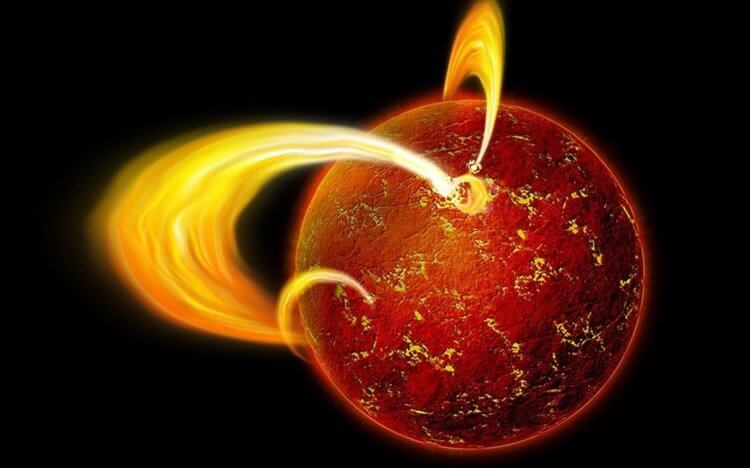
Недавнее увеличение солнечной активности связано с приближением Солнца к самой активной фазе 11-летнего цикла, а пик его активности приходится на 2024 год.
Солнце, увы, не будет вечным источником света и энергии. Его эволюционный путь длится миллиарды лет, в течение которых звезда развивается, стареет и умирает.
Освещая темноту
Возраст Солнца, как известно, составляет примерно 4,6 миллиардов лет. Многие ученые считают, что наша звезда и остальная часть Солнечной системы образовались из гигантского вращающегося облака газа и пыли, так называемой солнечной туманности. На самом деле Солнце не является уникальной или особенно сложной звездой.
И хотя на Солнце приходится 99,8% от общей массы Солнечной системы, на самом деле это просто большой газовый шар. Термоядерный синтез внутри звезды создает энергию, которая перемещается к поверхности Солнца в путешествии длинной в миллион лет. Эти процессы остановятся примерно через пять миллиардов лет, так что волноваться о скорой гибели звезды нам явно не стоит. И все же, вопросов к Солнцу у ученых немало.
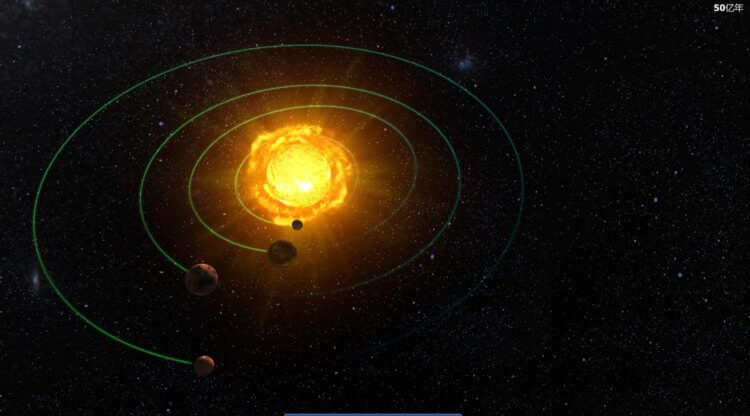
Солнечная система образовалась около 5 миллиардов лет назад
Космическая погода напрямую зависит от Солнца, которое выбрасывает в окружающее пространство поток заряженных частиц – «солнечный ветер». Иногда частицы извергаются из солнечных пятен (более холодных областей поверхности Солнца) порождая «солнечные вспышки», которые, к слову, могут привести к отключению электроэнергии на Земле.
Больше по теме: Самые распространенные мифы о Солнце: чему стоить верить?
Температура на поверхности Солнца (то есть видимой для нас его части) составляет около 5500 градусов по Цельсию. Поверхность звезды называется фотосферой – области из которой большая часть излучения выходит наружу. Излучение фотосферы называют солнечным светом, которому требуется примерно восемь минут и двадцать секунд чтобы достигнуть поверхности Земли и наших глаз.
Космическая погода
Выбрасывая в космическое пространство заряженные частицы – солнечный ветер – Солнце тем самым формирует космическую погоду, оказывая непосредственное влияние на геомагнитные бури на Земле. Последние происходят когда взрывы плазмы с поверхности Солнца вырываются через корональные дыры – пятна низкой плотности во внешней атмосфере звезды.
Скорость, с которой выброшенная плазма достигает Земли имеет важное значение, так как чем выше скорость, тем сильнее геомагнитная буря. Солнечный ветер распространяется со скоростью примерно равной 1,4 миллиона километров в час, но эта скорость может возрасти в пять раз из-за некоторых солнечных явлений.
Солнечный ветер поток заряженных частиц (плазмы), излучаемых Солнцем. Скорость, плотность и температура потока постоянно меняются.
Так, самая мощная геомагнитная буря за всю историю наблюдений началась из-за выброса корональной массы в сентябре 1859 года. Исследования показывают, что если бы геомагнитная буря такой силы обрушилась на Землю сегодня, стоимость ущерба составила бы два триллиона долларов.
Космическая погода включает в себя все без исключения условия и события на Солнце, которые могут повлиять на космические и наземные технологические системы, а через них на человеческую жизнь и деятельность.
Не пропустите: Солнце — величайшая загадка нашей звездной системы
Солнечные циклы
Солнце проходит естественный цикл примерно каждые 11 лет, достигая пика и спада своей активности. Цикл характеризуется увеличением и уменьшением солнечных пятен – темных областей на поверхности Солнца. Наибольшее количество солнечных пятен в любом солнечном цикле обозначается учеными как «солнечный максимум», а наименьшее как «солнечный минимум».
Извержения, которые происходят во время солнечного максимума, не причиняют вреда людям на Земле, но оказывают значительное влияние на радиосвязь. Недавно ученые сообщили о мощной солнечной вспышке, которая привела к отключению радиосвязи в Австралии, западной части Тихого океана и Восточной Азии.
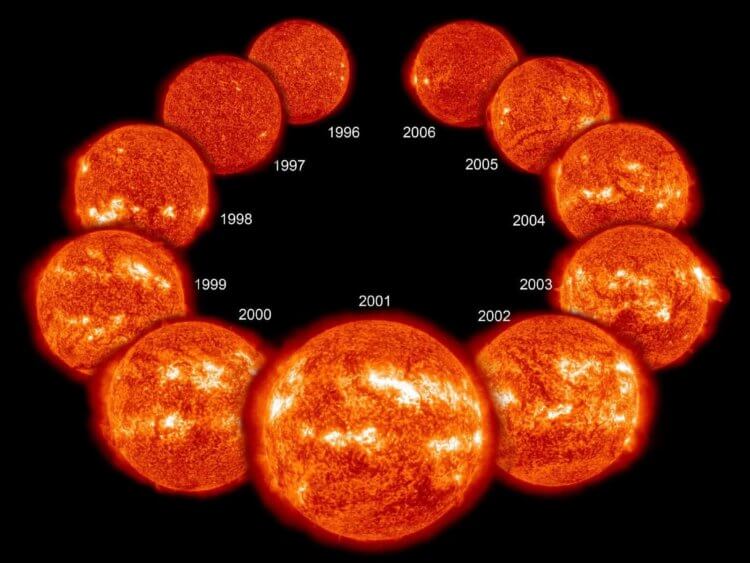
Солнечная цикличность — периодические изменения в солнечной активности.
На снимках предоставленных NASA видно большую группу солнечных пятен AR2993-94, что свидетельствует о пробуждении Солнца в новейшем 11-летнем цикле активности, который начался в 2019 году и, по прогнозам, достигнет пика в 2025 году.
Вам будет интересно: Сможет ли Солнце однажды превратиться в черную дыру?
Однако есть вероятность, что космическая погода не обойдется солнечным ветром из-за выбросов корональной массы. И если это произойдет, жители Земли смогут любоваться полярным сиянием.
Вспышки и извержения на Солнце могут повлиять на радиосвязь, электросети, навигационные сигналы и представлять опасность для космических аппаратов и астронавтов, – сообщили представители NASA в своем недавнем заявлении.
Иногда солнечные вспышки связаны с корональными выбросами массы или потоками заряженных частиц, которые устремляются в космос
Исследователи также отмечают, что солнечные вспышки и выбросы корональной массы станут частым явлением в течение следующих нескольких лет, что повысит уровень опасности солнечной активности. Необходимо отметить, что до сих пор мы избегали наихудших последствий солнечных бурь, но в будущем ситуация может измениться.
О том, какая судьба ожидает Солнце и похожие на него звезды, читайте на нашем канале в Яндекс.Дзен – там регулярно выходят статьи, которых нет на сайте
Солнечных пятен стало больше
Солнечные пятна – это один из способов, с помощью которого можно измерить уровень активности Солнца. Как правило, чем больше солнечных пятен мы наблюдаем, тем активнее звезда. Недавно исследователи обнаружили огромные скопления солнечных пятен, некоторые из которых настолько велики, что могут поглотить Землю целиком.
За обнаруженными «активными областями» под номером 2993 и 2994 (AR2993 и AR2994), вероятно, последует третья группа. Исследователи полагают, что именно она стала причиной мощной солнечной вспышки, что прошла мимо Земли в середине апреля. Каждая группа на поверхности Солнца состоит из нескольких солнечных пятен, занимая площадь превышающую диаметр Земли.
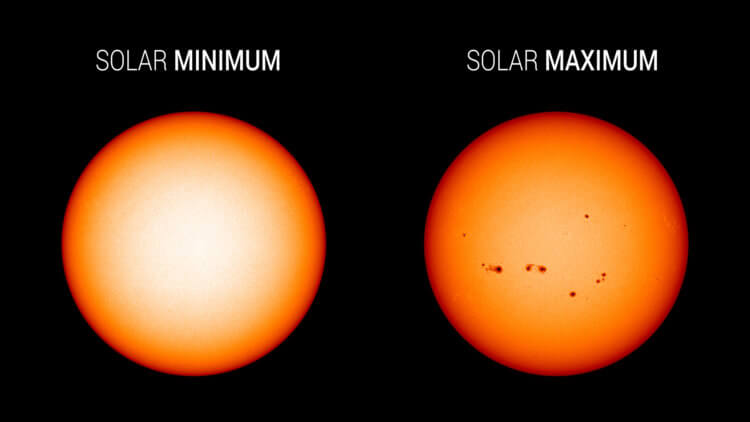
Солнечный минимум и максимум выглядят так
Солнечные пятна появляются на внешней поверхности Солнца (короне), оставаясь на ней от нескольких часов до нескольких месяцев, после чего начинают распадаться, – объясняют астрономы.
Причиной их появления, вероятно, является временное снижение температуры поверхности звезды во время создания магнитного поля. Астрономы документируют изменения частоты звездных пятен на Солнце с тех пор, как их впервые заметил Галилей и другие астрономы в 1600-х годах.
Это интересно: Как Солнце очищает моря и океаны от разлитой нефти
Отметим также, что солнечные бури, как и ураганы на нашей планете, оцениваются по пятибальной шкале. В целом в NASA считают, что Солнце в 2022 году будет вести себя относительно спокойно.
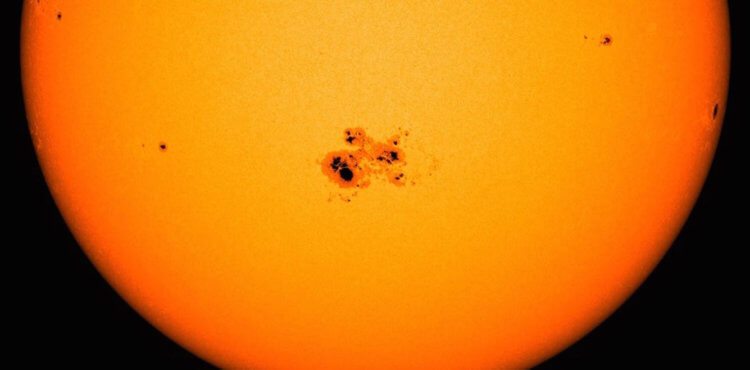
Чем больше пятен на Солнце, тем больше солнечных вспышек
Исследователи также наблюдают за ближайшими звездами и даже составили каталог активности звездных пятен 58 других солнцеподобных звезд. Ознакомиться с их работой можно в научном журнале Astronomical Journal, а продолжить наблюдения за космическим зондом Solar Orbiter, который уже сделал потрясающие снимки Венеры, Земли и Марса и позволил заново взглянуть на родную звезду.