
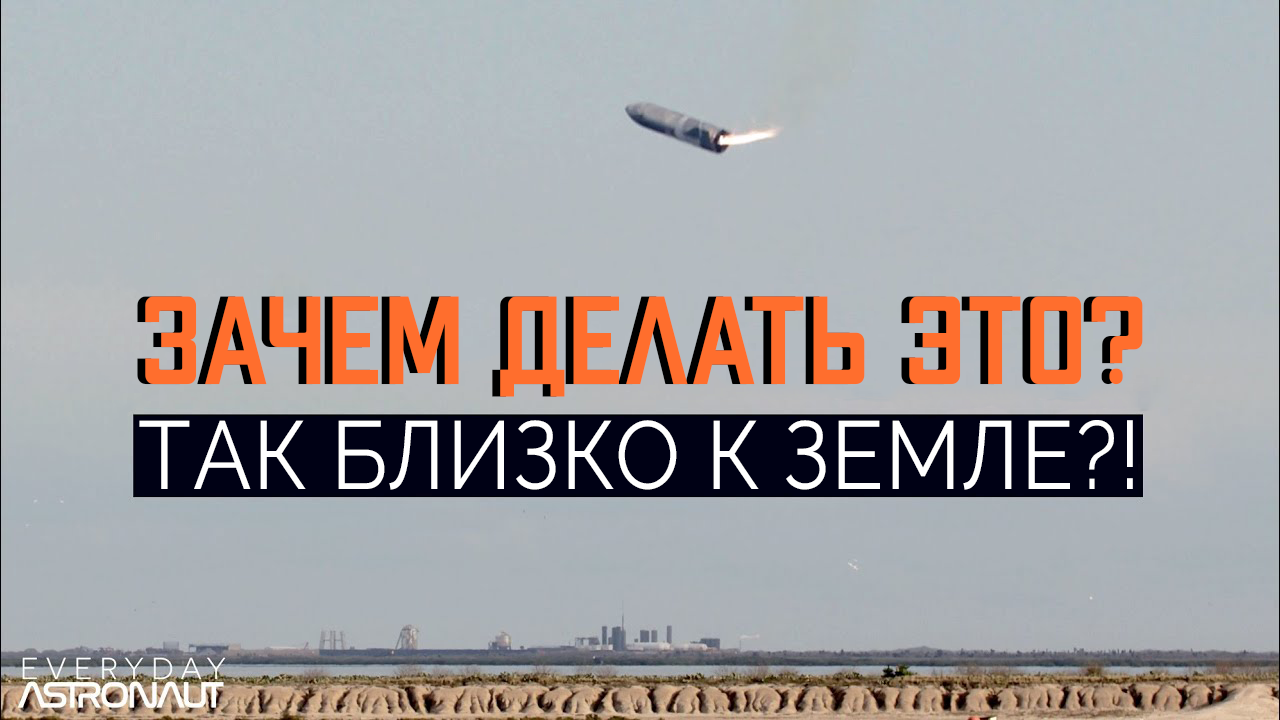
Starship выполняет маневры, которые еще никогда не осуществлялись. Это ракета шириной 9 м и высотой 50 м, которая падает с неба горизонтально, затем переворачивается и приземляется вертикально.
Попытки приземления вызвали много вопросов:
-
Почему они делают этот маневр?
-
Почему они делают этот маневр так близко к земле?
-
Будет ли это когда-нибудь достаточно безопасно для людей?
-
Почему они просто не начнут маневр раньше и не убедятся, что есть достаточно времени, чтобы внести поправки, если что-то пойдет не так?
-
Допустимы ли получаемые перегрузки?
-
Следует ли SpaceX просто переключиться на стиль посадки первой ступени Falcon 9?
В этой статье будут рассмотрены различные аспекты, влияющие на маневр приземления Starship:
-
Различные варианты сочетания двигателей в момент приземления
-
Предельная скорость
-
Гравитационное сопротивление
-
Отношение тяги к весу
-
Дросселирование двигателя
В предыдущем видео и статье Everyday Astronaut рассмотрел и ответил на вопросы о Starship. «Полное руководство по Starship: Starship vs Falcon 9, что нового и улучшенного?»
Переход Starship от переворота к вертикальному положению
Посадочный маневр Starship — это новый и уникальный стиль посадки ракеты. Starship начинает падать с неба пузом вниз, чтобы максимально сбросить скорость, насколько это физически возможно при свободном падении. На высоте около 500 м он включает два двигателя Raptor, полностью их отклоняет, складывает задние (нижние) закрылки и переворачивается из горизонтального положения в вертикальное, чтобы приземлиться хвостовой частью на свои посадочные опоры.
Когда задние (нижние) закрылки складываются, носовая часть испытывает значительно большее сопротивление по сравнению с хвостовой частью. Это, в сочетании с работающими двигателями Raptor, заставляет хвостовую часть вращаться под носом, переворачивая ракету в вертикальное положение. Когда-нибудь в будущем SpaceX может добавить ускорители горячего газа для помощи во вращении.
В результате того, что Starship запускает двигатели Raptor в горизонтальном положении, они должны выкачивать топливо из специальных баков, называемых головными. Причина этого в том, что двигателям необходимо получать достаточное количество жидкого топлива, но не газообразного. Если продолжать выкачивать жидкий метан (CH4) и жидкий кислород (LOX) из основных баков, двигатели в конечном итоге получат топливо в газообразном состоянии, что может привести к RUD (быстрой незапланированной разборке) двигателей.

Топливо перемещается на дно Starship
Из-за горизонтальной ориентации ракеты топливо перемещается на сторону, противоположную движению Starship. По мере замедления ракеты из-за постоянно уплотняющейся атмосферы топливо перемещается на дно.
Поскольку подводящие трубы от баков к двигателям Raptor расположены в хвостовой части ракеты, во время опускания хвостовой части двигатели получали бы в основном топливо в газообразном состоянии, если бы они пытались накачивать топливо из основных баков. Головные баки расположены в носовой части и между двумя основными баками Starship, они остаются почти заполненными до начала маневра переворота. Дренажные клапаны на головных баках расположены под небольшим углом для облегчения маневра.
При включении двигателей в горизонтальной ориентации создается значительная горизонтальная скорость, которая затем приводит к запланированному переворачиванию ракеты, чтобы нейтрализовать полученную горизонтальную скорость.
Предельная скорость при приземлении ракеты
Одна из целей маневра переворота состоит в том, чтобы максимально снизить скорость без вмешательства двигателей. Другая цель — контролировать пиковую температуру и ориентацию Starship во время схода с орбиты. Как правило, чем ниже конечная скорость ракеты, тем позже она может выполнить посадку, потому что двигателям больше не нужно снижать большую скорость.
Предельная скорость Starship
Предельная скорость — это максимальная скорость, которую достигает объект при падении через среду, такую как воздух, при которой сила гравитационного притяжения уравновешивается силой сопротивления среды. Предельная скорость изменяется при изменении условий вокруг объекта. Когда давление воздуха увеличивается и атмосфера становится плотнее, предельная скорость уменьшается, потому что объект испытывает большее сопротивление.
Маневр Starship можно сравнить с парашютистом в свободном падении. Когда парашютист падает животом вниз, его тело испытывает максимальное сопротивление воздуха, что означает, что его предельная скорость минимальна. Если бы парашютист падал вниз головой или ногами, у воздуха было бы гораздо меньше поверхности, чтобы замедлять парашютиста.

Источник: Everyday Astronaut
Так же, Starship имеет возможность изменять свою ориентацию и, следовательно, предельную скорость в зависимости от того, в каком положении находятся закрылки. Закрылки в этом случае напоминают руки и ноги парашютиста. Если закрылки выдвинуты больше, сопротивление Starship увеличится, а если они сложены, сопротивление уменьшится, тем самым увеличивая предельную скорость. Благодаря этому видна четкая разница между спуском первой ступени Falcon 9 и Starship. Первая ступень Falcon 9 имеет гораздо более высокую скорость, чем Starship, когда она спускается через атмосферу, потому что площадь поверхности для увеличения сопротивления меньше (двигателями вниз).
Сравнение Falcon 9 со Starship
Деклан Мерфи из flightclub.io рассчитывает высокоточные симуляции запусков ракет и, в данном случае, профили снижения SpaceX. Flight Club имеет возможность сравнить профиль полета SN8 с миссией Falcon 9 NROL-108. Моделирование показывает, что SN8 падал с максимальной скоростью 150 м/с, а затем, из-за постоянно уплотняющейся атмосферы, замедлился до 90 м/с, его максимальная скорость может быть выше, но непосредственно перед маневром переворота все еще останется достаточно низкой, чтобы выполнить безопасное приземление.
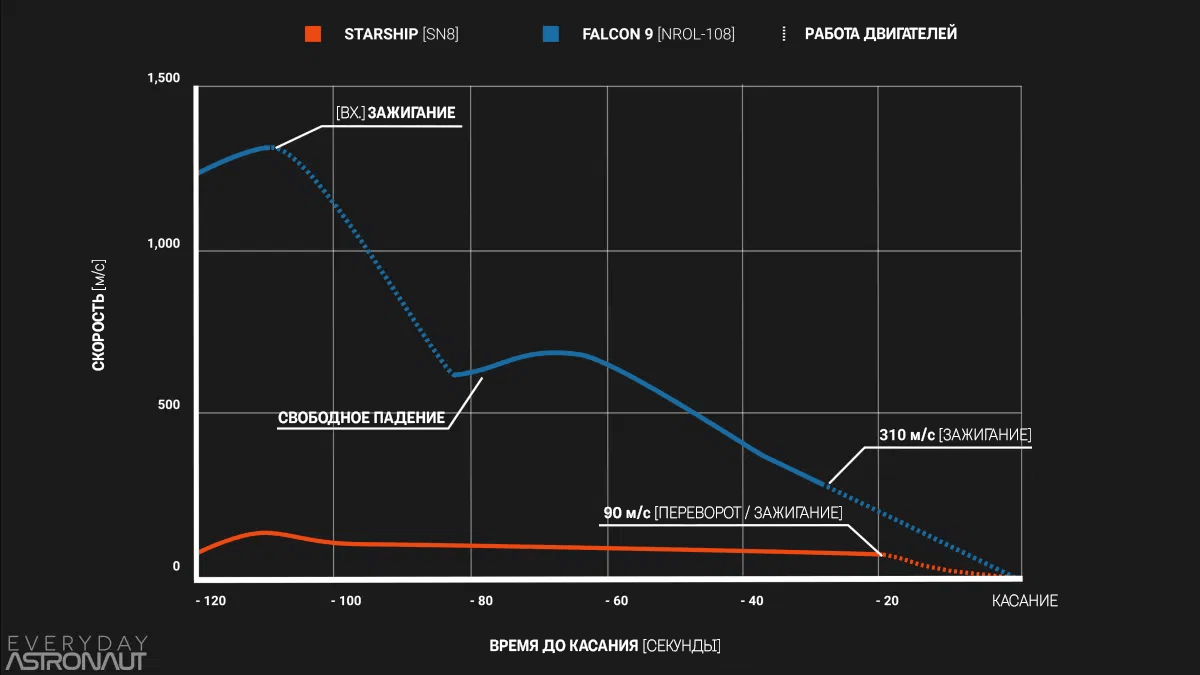

Несмотря на то, что разница в 220 м/с — лишь часть орбитальной скорости, которая составляет 7800 м/с, маневр переворота может оказаться недостаточным. Однако при наблюдении за элементами отношения тяги к весу и количества топлива, необходимого для различных соотношений тяги к весу, каждый метр в секунду имеет значение.
Отношение тяги к весу
Чтобы ракета зависла, она должна создавать такое же количество тяги, что и веса, при условии отсутствия атмосферы. Объект массой 1 кг весит на Земле 9,8 Н. Это связано с тем, что сила тяжести Земли составляет 9,8 Н. В этом примере ракета весит 1000 Н (или 1 кН) и создает тягу в 1000 Н в противоположном направлении, что означает, что отношение тяги к весу будет равно 1:1. Итоговое ускорение ракеты в этом случае будет равно нулю, потому что тяга ракеты абсолютно противодействует силе Земли.

Когда ракета развивает тягу 900 Н при массе 1000 Н, отношение тяги к весу понижается до 0,9:1. Каждую секунду, когда ракета имеет такое соотношение тяги к весу, она будет увеличивать свою скорость и ускоряться вниз. Однако, если ракета вернется к отношению тяги к весу 1:1, она не будет парить, а вместо этого будет постоянно снижаться со своей текущей скоростью. Соотношение тяги к весу 1:1 просто означает, что текущая скорость ракеты не меняется, независимо от того, парит она или движется.

Возвращение к зависанию
Чтобы вернуться в режим зависания, ракета должна увеличить отношение тяги к весу до значения большего, чем 1:1, чтобы компенсировать скорость движения вниз. В этом примере ракета увеличит свою тягу до 1100 Н, а когда она достигнет нулевой скорости, она вернется к тяге в 1000 Н.
Возможно и обратное. Если предположить, что атмосферы нет, то если парящая ракета увеличит отношение тяги к весу до 1,5:1, она будет ускоряться вверх. Чтобы вернуться в режим зависания, ракета должна создавать отношение тяги к весу менее 1:1, пока ее скорость снова не станет нулевой, после чего она может вернуться к соотношению тяги к весу 1:1 для поддержания нулевой скорости.
Дросселирование при приземлении
Отношение тяги к весу является основным фактором при дросселировании двигателя во время посадки. Если взять в качестве примера Falcon 9, она имеет слишком большую тягу для зависания даже на одном двигателе при минимальном положении дроссельной заслонки. Для того, чтобы Falcon 9 приземлилась нормально, она начнет зажигать двигатели с 70%-ным положением дроссельной заслонки, поэтому имеется возможность регулировать слишком быстрое или слишком медленное снижение. Используя бортовые компьютеры и другие различные инструменты, Falcon 9 будет стремиться иметь нулевую скорость сразу после того, как достигнет нулевой отметки над уровнем моря, выполняя свой маневр посадки.
Торможение у автомобиля
В этом примере, показанном на изображениях ниже, знак остановки — это земля, а автомобиль — падающая ракета. Автомобиль движется со скоростью 50 км/ч, приближаясь к знаку остановки. Цель состоит в том, чтобы остановить автомобиль прямо у знака «Стоп», не касаясь педали газа и не отпуская тормоза.
Использование тормоза с полным усилием было бы эквивалентно перезапуску двигателя ракеты при 100%-ном положении дроссельной заслонки, в то время как отсутствие приложения силы к тормозам является минимальным положением дроссельной заслонки. Прикладывать силу к акселератору было бы то же самое, что вообще не зажигать двигатель.
Отключение акселератора похоже на зажигание двигателя ракеты, как торможение двигателем в автомобилях с двигателем внутреннего сгорания или рекуперативного торможения гибридных и электрических транспортных средств. У Tesla есть возможность выбирать величину рекуперативного торможения, которая аналогична различным положениям дроссельной заслонки ракетного двигателя.
Дросселирование у автомобиля
В этом примере, низкая величина рекуперативного торможения будет соответствовать минимальной настройке дроссельной заслонки, в то время как большая величина рекуперативного торможения будет соответствовать высокой настройке дроссельной заслонки. Низкое значение приведет к более раннему отпусканию педали акселератора, тогда как высокое значение приведет к отпусканию педали акселератора позже, потому что автомобиль будет замедляться быстрее.
В этом примере, приложение разной силы к тормозам похоже на дросселирование ракетного двигателя. Если автомобиль начинает торможение раньше, он может оказывать меньшее давление на тормоза, чтобы автомобиль приблизился к знаку остановки. Однако, если автомобиль останавливается перед знаком «Стоп» после полного отпускания тормозов, это то же самое, что ракета, достигающая нулевой скорости над землей и упавшая до конца.
С пониманием отношения тяги к весу и того, как дросселировать двигатель при посадке, легче узнать, как потеря силы тяжести определяет оптимальное соотношение тяги к весу, чтобы максимально использовать оставшееся топливо.
Противодействие силе тяжести при посадке
Противодействие силе тяжести — это когда ракета использует двигатель для борьбы с гравитацией. В этом примере ракета запускается с соотношением тяги к весу 1:1. Каждую секунду двигатель создает столько же тяги, сколько весит ракета, он просто тратит топливо без ускорения.
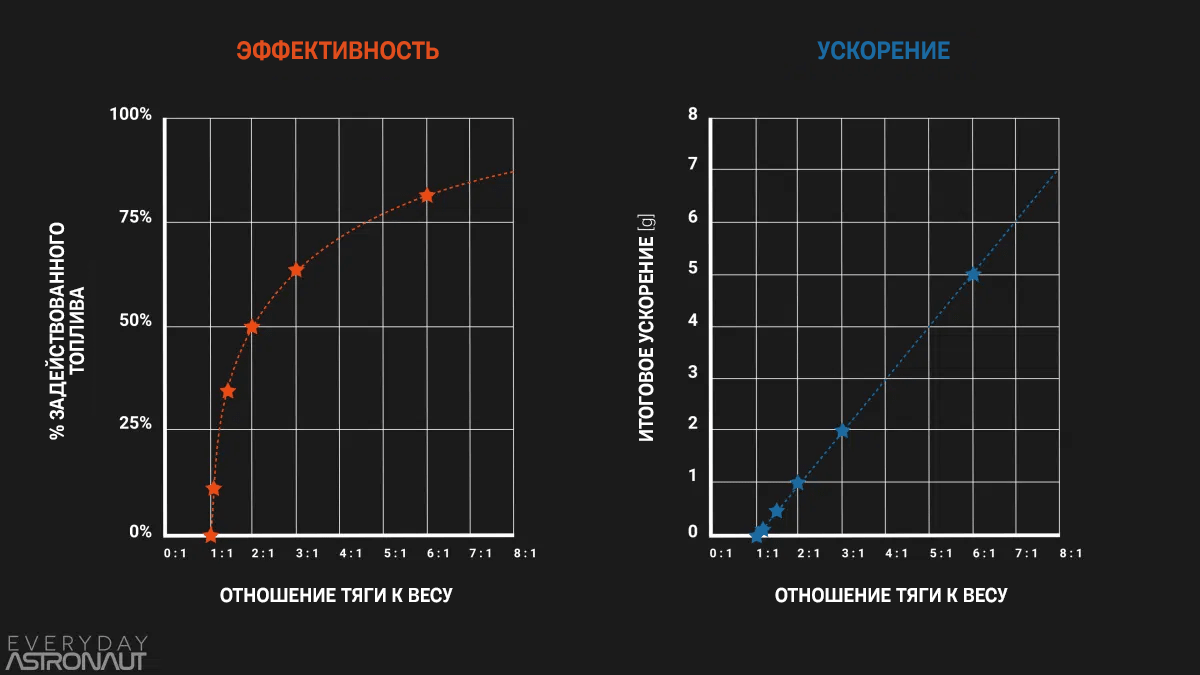
Для замедления ракеты отношение тяги к весу должно быть выше 1:1. При соотношении тяги к весу 1,1:1 91% топлива, используемого в настоящее время в ракете, борется с гравитацией, а остальные 9% используются для доставки ракеты туда, куда ей нужно.
При соотношении тяги к весу 1,5:1 66% топлива используется для борьбы с гравитацией, а 33% топлива используется для ускорения транспортного средства. Благодаря этому тяга ракеты увеличилась на 36% по сравнению с соотношением тяги к весу 1,1:1, что в пять раз превышает итоговое ускорение. Отношение тяги к весу 1,1:1 приведет к итоговому ускорению 0,1 G, тогда как отношение тяги к весу 1,5:1 приведет к итоговому ускорению 0,5 G.
Выше и выше
При увеличении отношения тяги к весу до 2:1 50% топлива используется для борьбы с гравитацией, а остальные 50% — для ускорения аппарата. В этом случае тяга увеличивается только на 33%, но ракета дает вдвое большее ускорение по сравнению с соотношением тяги к весу 1,5:1.
При соотношении тяги к весу 3:1 только 33% топлива используется для борьбы с гравитацией, а остальные 66% используются для ускорения аппарата. Тяга была увеличена на 50%, а ускорение ракеты увеличилось вдвое. При наличии гравитации потеря топлива на борьбу с ней обязательна.
Если взять в качестве примера Falcon 9 и зажигание её двигателей, то при низком соотношении тяги к весу (1,1:1) ей пришлось бы начать свой посадочный маневр на большей высоте, так как она замедлялась бы с итоговым ускорением всего лишь 0,1 G. Это привело бы к потере большого количества топлива, так как двигателям пришлось бы работать значительно дольше.
Если бы отношение тяги к весу Falcon 9 в этом примере было бы 2:1, у неё было бы итоговое ускорение 1 G, она могла бы начать свое приземление ближе к земле и потратила бы меньше топлива, поскольку двигатель не работал бы так долго.
Переворот Starship на разной высоте
Главная причина, по которой Starship переворачивается так близко к земле, заключается в том, чтобы максимально уменьшить предельную скорость. Таким образом, это уменьшит количество работы по замедлению, которую должны выполнять двигатели, чтобы мягко посадить Starship.
Каждый из трех двигателей Raptor, установленных на днище Starship внутри юбки, может дросселировать от 40% до 100% максимального газа. Это позволяет использовать разные комбинации тяги за счет дросселирования двигателей на разный процент. Один двигатель может создавать тягу от 880 кН до 2200 кН, с двумя двигателями — от 1760 кН до 4400 кН тяги, а со всеми тремя работающими двигателями тяга достигает от 2640 кН до 6600 кН.
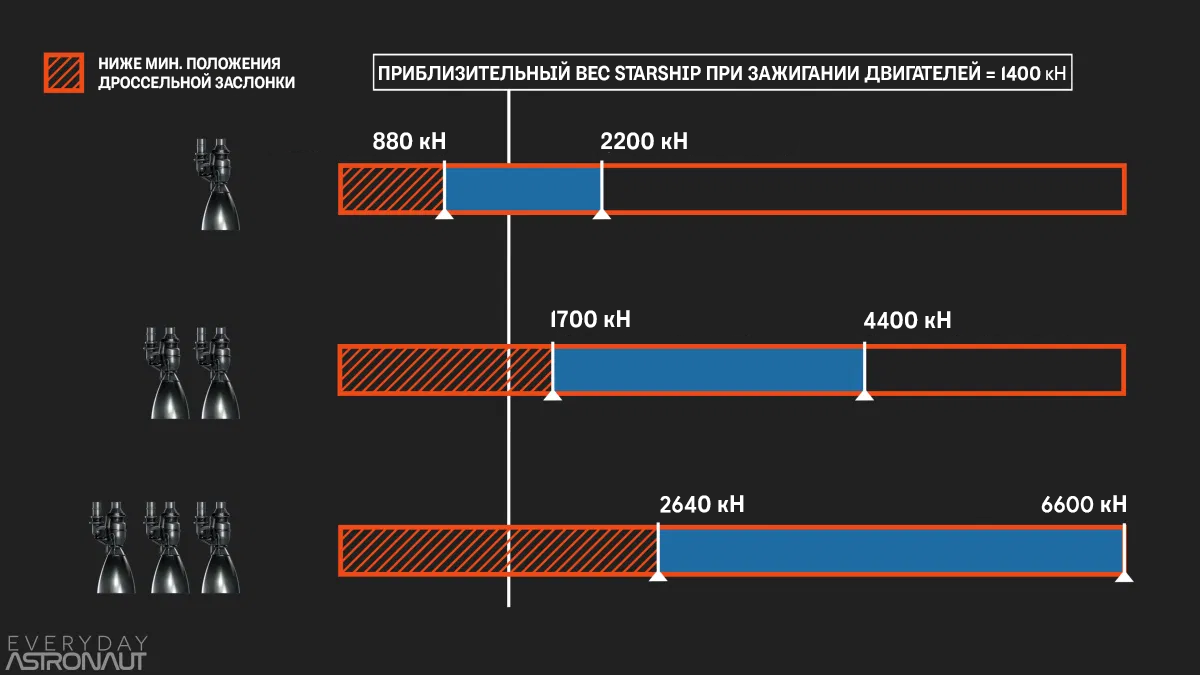
Маневр переворота возможно выполнять на разных двигателях и отказоустойчивых комбинациях, дающих одинаковый результат. Если три двигателя работают с минимальным открытием дроссельной заслонки 40%, отношение тяги к весу будет около 2:1. Это больше, чем один Raptor на полной тяге, и это приведет к очень позднему началу посадки, чтобы ракета не начала взлетать, поскольку вертикальная скорость убирается.
Если Starship потеряет один из трех двигателей, два оставшихся двигателя могут дросселировать, чтобы соответствовать выходной тяге всех трех. В сценарии зажигания только одного двигателя маневр может начаться намного раньше, однако достигнутая максимальное отношение тяги к весу будет только 1,6:1. Для этого потребуется значительно больше топлива по сравнению с зажиганием всех трех или даже двух двигателей. С точки зрения непредвиденных обстоятельств, если один работающий двигатель выйдет из строя, не будет достаточно времени, чтобы снова запустить другой.
Различные варианты высоты для маневра
Starship имеет различные варианты начальной высоты для маневра переворота. Самая высокая точка начала маневра находится на высоте 2,5 км с двумя двигателями во время переворота, затем с выключением одного и поддержанием почти минимального положения дроссельной заслонки.
Самая низкая точка, с которой Starship может начать маневр переворота, составляет 300 м, для чего требуется, чтобы все три двигателя Raptor были установлены с максимальным положением дроссельной заслонки. Starship и его пассажиры будут испытывать 4,5 G в этот момент.
Starship может переворачиваться на любой высоте от 2,5 км до 300 м. На высоте 550 м Starship может отключать разное количество двигателей, не имея при этом длительного и неэффективного использования при посадке.
Переворот на большой высоте на 2,5 км потребует на 370 м/с больше delta-v (изменения скорости), чем при запуске с 550 м. Поскольку для выхода на орбиту требуется примерно 7800 м/с, использование 370 м/с при приземлении снижает полезную нагрузку. Выполнение маневра переворота на 2 км выше может означать выведение на орбиту массы полезного груза на 20 т меньше. Это связано с тем, что скорость 370 м/с, необходимая для посадки, не будет использоваться для вывода полезной нагрузки на орбиту.

Экипаж во время маневра
Поскольку конечные планы SpaceX заключаются в отправке людей на Марс, маневр посадки, необходимый для выполнения этой задачи, нужно выполнить как можно скорее. В настоящее время двигатель Raptor все еще находится на начальной стадии разработки, и ему предстоит пройти еще много испытаний. По мере увеличения надежности двигателя повышается и надежность посадочного маневра. Starship должен будет успешно пройти множество испытаний, прежде чем люди получат возможность на нем летать.
Перегрузки
Пиковая перегрузка во время маневра переворота составляет всего 2,5 G, или в 2,5 раза больше силы тяжести Земли. Пассажиры могут почувствовать некоторую дезориентацию во время перехода из горизонтального положения в вертикальное, но нагрузка на их тело будет не выше, чем та, которую они испытывали бы на большинстве американских горок. SpaceX может установить вращающиеся сиденья в будущем, чтобы удерживать перегрузки, воздействующие на тело, только в одном направлении.
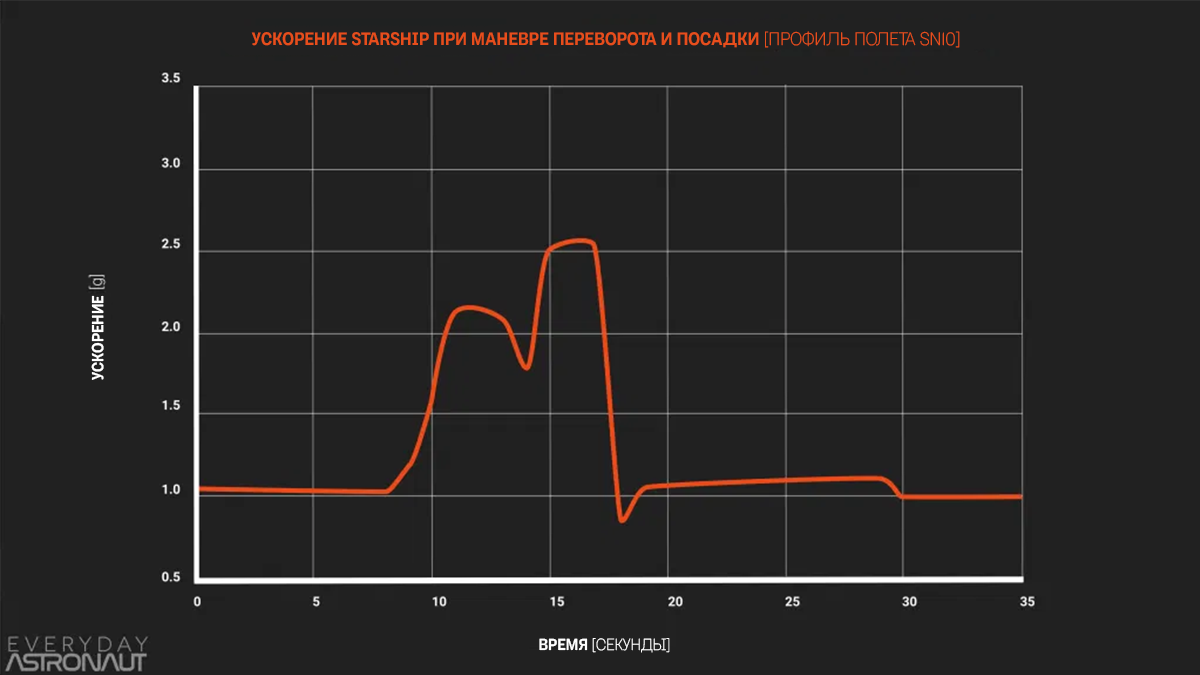
Фактически, нос Starship не очень сильно перемещается, несмотря на то, что хвост стремительно переходит из горизонтального положения в вертикальное. По сравнению со Starship, Falcon 9 может достигать пяти G во время посадки.

Заключение
Starship выполняет новый уникальный маневр приземления. Ни одна другая ракета или компания никогда не пытались применить такой сложный метод возвращения ракеты. Влияние и аспекты предельной скорости, гравитационного сопротивления и противодействие силе тяжести позволяют найти оптимальную высоту переворота, чтобы найти компромисс в эффективности и безопасности.
SpaceX пришла к выводу, что оптимальная высота для начала маневра переворота Starship составляет около 550 м. На этой высоте Starship использует наиболее эффективное количество delta-v около 250 м/с, а также имеет возможность безопасно приземлиться в случае неисправности двигателя. Это позволит Starship запуcтить двигатели и использовать оптимальное отношение тяги к весу 1,6:1 для замедления и приземления.
Масса полезной нагрузки, которую Starship может вывести на орбиту, также может определяться высотой, на которой он выполняет свой маневр. Меньше delta-v, используемого при посадке, означает, что больше delta-v может использоваться для вывода объектов и/или людей на орбиту. В конце концов, общая цель SpaceX — использовать Starship, чтобы в конечном итоге доставить людей на Луну, Марс и далее.
The classical rocket equation, or ideal rocket equation is a mathematical equation that describes the motion of vehicles that follow the basic principle of a rocket: a device that can apply acceleration to itself using thrust by expelling part of its mass with high velocity can thereby move due to the conservation of momentum.
It is credited to the Russian scientist Konstantin Tsiolkovsky (Константи́н Эдуа́рдович Циолко́вский) who independently derived it and published it in 1903,[1][2] although it had been independently derived and published by the British mathematician William Moore in 1810,[3] and later published in a separate book in 1813.[4] American Robert Goddard also developed it independently in 1912, and German Hermann Oberth derived it independently about 1920.
The maximum change of velocity of the vehicle,  (with no external forces acting) is:

where:
Given the effective exhaust velocity determined by the rocket motor’s design, the desired delta-v (e.g. orbital speed or escape velocity), and a given dry mass  , the equation can be solved for the required propellant mass
  :
:

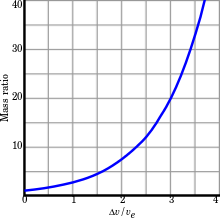
The necessary wet mass grows exponentially with the desired delta-v.
History[edit]
The equation is named after Russian scientist Konstantin Tsiolkovsky who independently derived it and published it in his 1903 work.[5][2]
The equation had been derived earlier by the British mathematician William Moore in 1810,[3] and later published in a separate book in 1813.[4]
American Robert Goddard independently developed the equation in 1912 when he began his research to improve rocket engines for possible space flight. German engineer Hermann Oberth independently derived the equation about 1920 as he studied the feasibility of space travel.
While the derivation of the rocket equation is a straightforward calculus exercise, Tsiolkovsky is honored as being the first to apply it to the question of whether rockets could achieve speeds necessary for space travel.
Experiment of the Boat by Tsiolkovsky[edit]

In order to understand the principle of rocket propulsion, Konstantin Tsiolkovsky proposed the famous experiment «of the boat». A person is in a boat away from the shore without oars. They want to reach this shore. They notice that the boat is loaded with a certain quantity of stones and have the idea of throwing, one by one and as quickly as possible, these stones in the opposite direction to the bank. Effectively, the quantity of movement of the stones thrown in one direction corresponds to an equal quantity of movement for the boat in the other direction.
Derivation[edit]
Most popular derivation[edit]
Consider the following system:
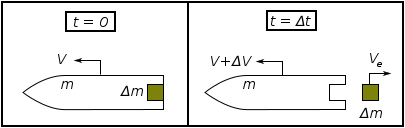
In the following derivation, «the rocket» is taken to mean «the rocket and all of its unexpended propellant».
Newton’s second law of motion relates external forces ( ) to the change in linear momentum of the whole system (including rocket and exhaust) as follows:
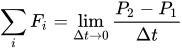
where  is the momentum of the rocket at time
  :
:

and  is the momentum of the rocket and exhausted mass at time
  :
:

and where, with respect to the observer:
The velocity of the exhaust  in the observer frame is related to the velocity of the exhaust in the rocket frame
  by (since exhaust velocity is in the negative direction)

Solving this yields:

and, using  , since ejecting a positive
  results in a decrease in mass in time,
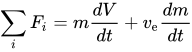
If there are no external forces then  (conservation of linear momentum) and
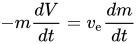
Assuming that is constant (known as the Tsiolkovsky’s hypothesis[2]), so it is not subject to integration, then the above equation may be integrated as follows:
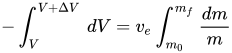
This then yields
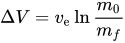
or equivalently
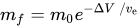
or
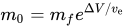
or

where  is the initial total mass including propellant, the final mass, and the velocity of the rocket exhaust with respect to the rocket (the specific impulse, or, if measured in time, that multiplied by gravity-on-Earth acceleration). If is NOT constant, we might not have rocket equations that are as simple as the above forms. Many rocket dynamics researches were based on the Tsiolkovsky’s constant hypothesis.
The value is the total working mass of propellant expended.
 (delta v) is the integration over time of the magnitude of the acceleration produced by using the rocket engine (what would be the actual acceleration if external forces were absent). In free space, for the case of acceleration in the direction of the velocity, this is the increase of the speed. In the case of an acceleration in opposite direction (deceleration) it is the decrease of the speed. Of course gravity and drag also accelerate the vehicle, and they can add or subtract to the change in velocity experienced by the vehicle. Hence delta-v may not always be the actual change in speed or velocity of the vehicle.
Other derivations[edit]
Impulse-based[edit]
The equation can also be derived from the basic integral of acceleration in the form of force (thrust) over mass.
By representing the delta-v equation as the following:
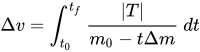
where T is thrust, is the initial (wet) mass and is the initial mass minus the final (dry) mass,
and realising that the integral of a resultant force over time is total impulse, assuming thrust is the only force involved,
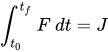
The integral is found to be:
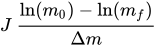
Realising that impulse over the change in mass is equivalent to force over propellant mass flow rate (p), which is itself equivalent to exhaust velocity,
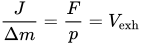
the integral can be equated to
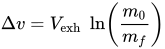
Acceleration-based[edit]
Imagine a rocket at rest in space with no forces exerted on it (Newton’s First Law of Motion). From the moment its engine is started (clock set to 0) the rocket expels gas mass at a constant mass flow rate R (kg/s) and at exhaust velocity relative to the rocket ve (m/s). This creates a constant force F propelling the rocket that is equal to R × ve. The rocket is subject to a constant force, but its total mass is decreasing steadily because it is expelling gas. According to Newton’s Second Law of Motion, its acceleration at any time t is its propelling force F divided by its current mass m:
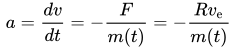
Now, the mass of fuel the rocket initially has on board is equal to m0 – mf. For the constant mass flow rate R it will therefore take a time T = (m0 – mf)/R to burn all this fuel. Integrating both sides of the equation with respect to time from 0 to T (and noting that R = dm/dt allows a substitution on the right), we obtain
![{displaystyle ~Delta v=v_{f}-v_{0}=-v_{text{e}}left[ln m_{f}-ln m_{0}right]=~v_{text{e}}ln left({frac {m_{0}}{m_{f}}}right).}](https://wikimedia.org/api/rest_v1/media/math/render/svg/e6b3f9376e3f80de022939656d53c9fdb0f5a881)
Limit of finite mass «pellet» expulsion[edit]
The rocket equation can also be derived as the limiting case of the speed change for a rocket that expels its fuel in the form of  pellets consecutively, as
  , with an effective exhaust speed
  such that the mechanical energy gained per unit fuel mass is given by
  .
.
In the rocket’s center-of-mass frame, if a pellet of mass  is ejected at speed
  and the remaining mass of the rocket is
  , the amount of energy converted to increase the rocket’s and pellet’s kinetic energy is

Using momentum conservation in the rocket’s frame just prior to ejection,  , from which we find
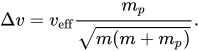
Let  be the initial fuel mass fraction on board and the initial fueled-up mass of the rocket. Divide the total mass of fuel
  into discrete pellets each of mass
 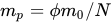 . The remaining mass of the rocket after ejecting
  pellets is then
  . The overall speed change after ejecting pellets is the sum
[6]

Notice that for large the last term in the denominator  and can be neglected to give

where  and
and  .
.
As  this Riemann sum becomes the definite integral

since the final remaining mass of the rocket is  .
.
Special relativity[edit]
If special relativity is taken into account, the following equation can be derived for a relativistic rocket,[7] with again standing for the rocket’s final velocity (after expelling all its reaction mass and being reduced to a rest mass of  ) in the inertial frame of reference where the rocket started at rest (with the rest mass including fuel being initially), and
  standing for the speed of light in a vacuum:
![{displaystyle {frac {m_{0}}{m_{1}}}=left[{frac {1+{frac {Delta v}{c}}}{1-{frac {Delta v}{c}}}}right]^{frac {c}{2v_{text{e}}}}}](https://wikimedia.org/api/rest_v1/media/math/render/svg/506b68f3ef6f9d1d236a2f4ab7bfbf995189b937)
Writing  as
as  allows this equation to be rearranged as
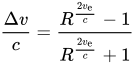
Then, using the identity ![{textstyle R^{frac {2v_{text{e}}}{c}}=exp left[{frac {2v_{text{e}}}{c}}ln Rright]}](https://wikimedia.org/api/rest_v1/media/math/render/svg/efed86ee6ab335e3c73886168248dbc1443e0b40) (here «exp» denotes the exponential function; see also Natural logarithm as well as the «power» identity at Logarithmic identities) and the identity
(here «exp» denotes the exponential function; see also Natural logarithm as well as the «power» identity at Logarithmic identities) and the identity 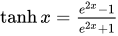 (see Hyperbolic function), this is equivalent to
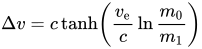
Terms of the equation[edit]
Delta-v[edit]
Delta-v (literally «change in velocity»), symbolised as Δv and pronounced delta-vee, as used in spacecraft flight dynamics, is a measure of the impulse that is needed to perform a maneuver such as launching from, or landing on a planet or moon, or an in-space orbital maneuver. It is a scalar that has the units of speed. As used in this context, it is not the same as the physical change in velocity of the vehicle.
Delta-v is produced by reaction engines, such as rocket engines and is proportional to the thrust per unit mass, and burn time, and is used to determine the mass of propellant required for the given manoeuvre through the rocket equation.
For multiple manoeuvres, delta-v sums linearly.
For interplanetary missions delta-v is often plotted on a porkchop plot which displays the required mission delta-v as a function of launch date.
Mass fraction[edit]
In aerospace engineering, the propellant mass fraction is the portion of a vehicle’s mass which does not reach the destination, usually used as a measure of the vehicle’s performance. In other words, the propellant mass fraction is the ratio between the propellant mass and the initial mass of the vehicle. In a spacecraft, the destination is usually an orbit, while for aircraft it is their landing location. A higher mass fraction represents less weight in a design. Another related measure is the payload fraction, which is the fraction of initial weight that is payload.
Effective exhaust velocity[edit]
The effective exhaust velocity is often specified as a specific impulse and they are related to each other by:

where
Applicability[edit]
The rocket equation captures the essentials of rocket flight physics in a single short equation. It also holds true for rocket-like reaction vehicles whenever the effective exhaust velocity is constant, and can be summed or integrated when the effective exhaust velocity varies. The rocket equation only accounts for the reaction force from the rocket engine; it does not include other forces that may act on a rocket, such as aerodynamic or gravitational forces. As such, when using it to calculate the propellant requirement for launch from (or powered descent to) a planet with an atmosphere, the effects of these forces must be included in the delta-V requirement (see Examples below). In what has been called «the tyranny of the rocket equation», there is a limit to the amount of payload that the rocket can carry, as higher amounts of propellant increment the overall weight, and thus also increase the fuel consumption.[8] The equation does not apply to non-rocket systems such as aerobraking, gun launches, space elevators, launch loops, tether propulsion or light sails.
The rocket equation can be applied to orbital maneuvers in order to determine how much propellant is needed to change to a particular new orbit, or to find the new orbit as the result of a particular propellant burn. When applying to orbital maneuvers, one assumes an impulsive maneuver, in which the propellant is discharged and delta-v applied instantaneously. This assumption is relatively accurate for short-duration burns such as for mid-course corrections and orbital insertion maneuvers. As the burn duration increases, the result is less accurate due to the effect of gravity on the vehicle over the duration of the maneuver. For low-thrust, long duration propulsion, such as electric propulsion, more complicated analysis based on the propagation of the spacecraft’s state vector and the integration of thrust are used to predict orbital motion.
Examples[edit]
Assume an exhaust velocity of 4,500 meters per second (15,000 ft/s) and a of 9,700 meters per second (32,000 ft/s) (Earth to LEO, including to overcome gravity and aerodynamic drag).
- Single-stage-to-orbit rocket:
 = 0.884, therefore 88.4% of the initial total mass has to be propellant. The remaining 11.6% is for the engines, the tank, and the payload.
 - Two-stage-to-orbit: suppose that the first stage should provide a of 5,000 meters per second (16,000 ft/s); = 0.671, therefore 67.1% of the initial total mass has to be propellant to the first stage. The remaining mass is 32.9%. After disposing of the first stage, a mass remains equal to this 32.9%, minus the mass of the tank and engines of the first stage. Assume that this is 8% of the initial total mass, then 24.9% remains. The second stage should provide a of 4,700 meters per second (15,000 ft/s); = 0.648, therefore 64.8% of the remaining mass has to be propellant, which is 16.2% of the original total mass, and 8.7% remains for the tank and engines of the second stage, the payload, and in the case of a space shuttle, also the orbiter. Thus together 16.7% of the original launch mass is available for all engines, the tanks, and payload.


Stages[edit]
In the case of sequentially thrusting rocket stages, the equation applies for each stage, where for each stage the initial mass in the equation is the total mass of the rocket after discarding the previous stage, and the final mass in the equation is the total mass of the rocket just before discarding the stage concerned. For each stage the specific impulse may be different.
For example, if 80% of the mass of a rocket is the fuel of the first stage, and 10% is the dry mass of the first stage, and 10% is the remaining rocket, then
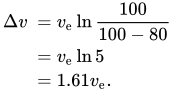
With three similar, subsequently smaller stages with the same for each stage, we have

and the payload is 10% × 10% × 10% = 0.1% of the initial mass.
A comparable SSTO rocket, also with a 0.1% payload, could have a mass of 11.1% for fuel tanks and engines, and 88.8% for fuel. This would give

If the motor of a new stage is ignited before the previous stage has been discarded and the simultaneously working motors have a different specific impulse (as is often the case with solid rocket boosters and a liquid-fuel stage), the situation is more complicated.
Common misconceptions[edit]
When viewed as a variable-mass system, a rocket cannot be directly analyzed with Newton’s second law of motion because the law is valid for constant-mass systems only.[9][10][11] It can cause confusion that the Tsiolkovsky rocket equation looks similar to the relativistic force equation  . Using this formula with
  as the varying mass of the rocket seems to derive the Tsiolkovsky rocket equation, but this derivation is not correct. Notice that the effective exhaust velocity does not even appear in this formula.
See also[edit]
- Delta-v budget
- Robert H. Goddard added terms for gravity and drag in vertical flight
- Jeep problem
- Mass ratio
- Oberth effect applying delta-v in a gravity well increases the final velocity
- Relativistic rocket
- Reversibility of orbits
- Spacecraft propulsion
- Variable-mass systems
- Working mass
References[edit]
- ^ К. Ціолковскій, Изслѣдованіе мировыхъ пространствъ реактивными приборами, 1903 (available online here Archived 2011-08-15 at the Wayback Machine in a RARed PDF)
- ^ a b c Tsiolkovsky, K. «Reactive Flying Machines» (PDF).
{{cite web}}: CS1 maint: url-status (link) - ^ a b Moore, William (1810). «On the Motion of Rockets both in Nonresisting and Resisting Mediums». Journal of Natural Philosophy, Chemistry & the Arts. 27: 276–285.
- ^ a b Moore, William (1813). A Treatise on the Motion of Rockets: to which is added, an Essay on Naval Gunnery, in theory and practice, etc. G. & S. Robinson.
- ^ К. Ціолковскій, Изслѣдованіе мировыхъ пространствъ реактивными приборами, 1903 (available online here Archived 2011-08-15 at the Wayback Machine in a RARed PDF)
- ^ Blanco, Philip (November 2019). «A discrete, energetic approach to rocket propulsion». Physics Education. 54 (6): 065001. Bibcode:2019PhyEd..54f5001B. doi:10.1088/1361-6552/ab315b. S2CID 202130640.
- ^ Forward, Robert L. «A Transparent Derivation of the Relativistic Rocket Equation» (see the right side of equation 15 on the last page, with R as the ratio of initial to final mass and w as the exhaust velocity, corresponding to ve in the notation of this article)
- ^ «The Tyranny of the Rocket Equation». NASA.gov. Retrieved 2016-04-18.
- ^ Plastino, Angel R.; Muzzio, Juan C. (1992). «On the use and abuse of Newton’s second law for variable mass problems». Celestial Mechanics and Dynamical Astronomy. Netherlands: Kluwer Academic Publishers. 53 (3): 227–232. Bibcode:1992CeMDA..53..227P. doi:10.1007/BF00052611. ISSN 0923-2958. S2CID 122212239. «We may conclude emphasizing that Newton’s second law is valid for constant mass only. When the mass varies due to accretion or ablation, [an alternate equation explicitly accounting for the changing mass] should be used.»
- ^ Halliday; Resnick (1977). Physics. Vol. 1. p. 199. ISBN 0-471-03710-9.
It is important to note that we cannot derive a general expression for Newton’s second law for variable mass systems by treating the mass in F = dP/dt = d(Mv) as a variable. […] We can use F = dP/dt to analyze variable mass systems only if we apply it to an entire system of constant mass having parts among which there is an interchange of mass.
[Emphasis as in the original] - ^
Kleppner, Daniel; Robert Kolenkow (1973). An Introduction to Mechanics. McGraw-Hill. pp. 133–134. ISBN 0-07-035048-5.Recall that F = dP/dt was established for a system composed of a certain set of particles[. … I]t is essential to deal with the same set of particles throughout the time interval[. …] Consequently, the mass of the system can not change during the time of interest.
External links[edit]
- How to derive the rocket equation
- Relativity Calculator – Learn Tsiolkovsky’s rocket equations
- Tsiolkovsky’s rocket equations plot and calculator in WolframAlpha
The classical rocket equation, or ideal rocket equation is a mathematical equation that describes the motion of vehicles that follow the basic principle of a rocket: a device that can apply acceleration to itself using thrust by expelling part of its mass with high velocity can thereby move due to the conservation of momentum.
It is credited to the Russian scientist Konstantin Tsiolkovsky (Константи́н Эдуа́рдович Циолко́вский) who independently derived it and published it in 1903,[1][2] although it had been independently derived and published by the British mathematician William Moore in 1810,[3] and later published in a separate book in 1813.[4] American Robert Goddard also developed it independently in 1912, and German Hermann Oberth derived it independently about 1920.
The maximum change of velocity of the vehicle, (with no external forces acting) is:
where:
Given the effective exhaust velocity determined by the rocket motor’s design, the desired delta-v (e.g. orbital speed or escape velocity), and a given dry mass , the equation can be solved for the required propellant mass :
The necessary wet mass grows exponentially with the desired delta-v.
History[edit]
The equation is named after Russian scientist Konstantin Tsiolkovsky who independently derived it and published it in his 1903 work.[5][2]
The equation had been derived earlier by the British mathematician William Moore in 1810,[3] and later published in a separate book in 1813.[4]
American Robert Goddard independently developed the equation in 1912 when he began his research to improve rocket engines for possible space flight. German engineer Hermann Oberth independently derived the equation about 1920 as he studied the feasibility of space travel.
While the derivation of the rocket equation is a straightforward calculus exercise, Tsiolkovsky is honored as being the first to apply it to the question of whether rockets could achieve speeds necessary for space travel.
Experiment of the Boat by Tsiolkovsky[edit]
In order to understand the principle of rocket propulsion, Konstantin Tsiolkovsky proposed the famous experiment «of the boat». A person is in a boat away from the shore without oars. They want to reach this shore. They notice that the boat is loaded with a certain quantity of stones and have the idea of throwing, one by one and as quickly as possible, these stones in the opposite direction to the bank. Effectively, the quantity of movement of the stones thrown in one direction corresponds to an equal quantity of movement for the boat in the other direction.
Derivation[edit]
Most popular derivation[edit]
Consider the following system:
In the following derivation, «the rocket» is taken to mean «the rocket and all of its unexpended propellant».
Newton’s second law of motion relates external forces () to the change in linear momentum of the whole system (including rocket and exhaust) as follows:
where is the momentum of the rocket at time :
and is the momentum of the rocket and exhausted mass at time :
and where, with respect to the observer:
The velocity of the exhaust in the observer frame is related to the velocity of the exhaust in the rocket frame by (since exhaust velocity is in the negative direction)
Solving this yields:
and, using , since ejecting a positive results in a decrease in mass in time,
If there are no external forces then (conservation of linear momentum) and
Assuming that is constant (known as the Tsiolkovsky’s hypothesis[2]), so it is not subject to integration, then the above equation may be integrated as follows:
This then yields
or equivalently
or
or
where is the initial total mass including propellant, the final mass, and the velocity of the rocket exhaust with respect to the rocket (the specific impulse, or, if measured in time, that multiplied by gravity-on-Earth acceleration). If is NOT constant, we might not have rocket equations that are as simple as the above forms. Many rocket dynamics researches were based on the Tsiolkovsky’s constant hypothesis.
The value is the total working mass of propellant expended.
(delta v) is the integration over time of the magnitude of the acceleration produced by using the rocket engine (what would be the actual acceleration if external forces were absent). In free space, for the case of acceleration in the direction of the velocity, this is the increase of the speed. In the case of an acceleration in opposite direction (deceleration) it is the decrease of the speed. Of course gravity and drag also accelerate the vehicle, and they can add or subtract to the change in velocity experienced by the vehicle. Hence delta-v may not always be the actual change in speed or velocity of the vehicle.
Other derivations[edit]
Impulse-based[edit]
The equation can also be derived from the basic integral of acceleration in the form of force (thrust) over mass.
By representing the delta-v equation as the following:
where T is thrust, is the initial (wet) mass and is the initial mass minus the final (dry) mass,
and realising that the integral of a resultant force over time is total impulse, assuming thrust is the only force involved,
The integral is found to be:
Realising that impulse over the change in mass is equivalent to force over propellant mass flow rate (p), which is itself equivalent to exhaust velocity,
the integral can be equated to
Acceleration-based[edit]
Imagine a rocket at rest in space with no forces exerted on it (Newton’s First Law of Motion). From the moment its engine is started (clock set to 0) the rocket expels gas mass at a constant mass flow rate R (kg/s) and at exhaust velocity relative to the rocket ve (m/s). This creates a constant force F propelling the rocket that is equal to R × ve. The rocket is subject to a constant force, but its total mass is decreasing steadily because it is expelling gas. According to Newton’s Second Law of Motion, its acceleration at any time t is its propelling force F divided by its current mass m:
Now, the mass of fuel the rocket initially has on board is equal to m0 – mf. For the constant mass flow rate R it will therefore take a time T = (m0 – mf)/R to burn all this fuel. Integrating both sides of the equation with respect to time from 0 to T (and noting that R = dm/dt allows a substitution on the right), we obtain
Limit of finite mass «pellet» expulsion[edit]
The rocket equation can also be derived as the limiting case of the speed change for a rocket that expels its fuel in the form of pellets consecutively, as , with an effective exhaust speed such that the mechanical energy gained per unit fuel mass is given by .
In the rocket’s center-of-mass frame, if a pellet of mass is ejected at speed and the remaining mass of the rocket is , the amount of energy converted to increase the rocket’s and pellet’s kinetic energy is
Using momentum conservation in the rocket’s frame just prior to ejection, , from which we find
Let be the initial fuel mass fraction on board and the initial fueled-up mass of the rocket. Divide the total mass of fuel into discrete pellets each of mass . The remaining mass of the rocket after ejecting pellets is then . The overall speed change after ejecting pellets is the sum
[6]
Notice that for large the last term in the denominator and can be neglected to give
where and .
As this Riemann sum becomes the definite integral
since the final remaining mass of the rocket is .
Special relativity[edit]
If special relativity is taken into account, the following equation can be derived for a relativistic rocket,[7] with again standing for the rocket’s final velocity (after expelling all its reaction mass and being reduced to a rest mass of ) in the inertial frame of reference where the rocket started at rest (with the rest mass including fuel being initially), and standing for the speed of light in a vacuum:
Writing as allows this equation to be rearranged as
Then, using the identity (here «exp» denotes the exponential function; see also Natural logarithm as well as the «power» identity at Logarithmic identities) and the identity (see Hyperbolic function), this is equivalent to
Terms of the equation[edit]
Delta-v[edit]
Delta-v (literally «change in velocity»), symbolised as Δv and pronounced delta-vee, as used in spacecraft flight dynamics, is a measure of the impulse that is needed to perform a maneuver such as launching from, or landing on a planet or moon, or an in-space orbital maneuver. It is a scalar that has the units of speed. As used in this context, it is not the same as the physical change in velocity of the vehicle.
Delta-v is produced by reaction engines, such as rocket engines and is proportional to the thrust per unit mass, and burn time, and is used to determine the mass of propellant required for the given manoeuvre through the rocket equation.
For multiple manoeuvres, delta-v sums linearly.
For interplanetary missions delta-v is often plotted on a porkchop plot which displays the required mission delta-v as a function of launch date.
Mass fraction[edit]
In aerospace engineering, the propellant mass fraction is the portion of a vehicle’s mass which does not reach the destination, usually used as a measure of the vehicle’s performance. In other words, the propellant mass fraction is the ratio between the propellant mass and the initial mass of the vehicle. In a spacecraft, the destination is usually an orbit, while for aircraft it is their landing location. A higher mass fraction represents less weight in a design. Another related measure is the payload fraction, which is the fraction of initial weight that is payload.
Effective exhaust velocity[edit]
The effective exhaust velocity is often specified as a specific impulse and they are related to each other by:
where
Applicability[edit]
The rocket equation captures the essentials of rocket flight physics in a single short equation. It also holds true for rocket-like reaction vehicles whenever the effective exhaust velocity is constant, and can be summed or integrated when the effective exhaust velocity varies. The rocket equation only accounts for the reaction force from the rocket engine; it does not include other forces that may act on a rocket, such as aerodynamic or gravitational forces. As such, when using it to calculate the propellant requirement for launch from (or powered descent to) a planet with an atmosphere, the effects of these forces must be included in the delta-V requirement (see Examples below). In what has been called «the tyranny of the rocket equation», there is a limit to the amount of payload that the rocket can carry, as higher amounts of propellant increment the overall weight, and thus also increase the fuel consumption.[8] The equation does not apply to non-rocket systems such as aerobraking, gun launches, space elevators, launch loops, tether propulsion or light sails.
The rocket equation can be applied to orbital maneuvers in order to determine how much propellant is needed to change to a particular new orbit, or to find the new orbit as the result of a particular propellant burn. When applying to orbital maneuvers, one assumes an impulsive maneuver, in which the propellant is discharged and delta-v applied instantaneously. This assumption is relatively accurate for short-duration burns such as for mid-course corrections and orbital insertion maneuvers. As the burn duration increases, the result is less accurate due to the effect of gravity on the vehicle over the duration of the maneuver. For low-thrust, long duration propulsion, such as electric propulsion, more complicated analysis based on the propagation of the spacecraft’s state vector and the integration of thrust are used to predict orbital motion.
Examples[edit]
Assume an exhaust velocity of 4,500 meters per second (15,000 ft/s) and a of 9,700 meters per second (32,000 ft/s) (Earth to LEO, including to overcome gravity and aerodynamic drag).
- Single-stage-to-orbit rocket: = 0.884, therefore 88.4% of the initial total mass has to be propellant. The remaining 11.6% is for the engines, the tank, and the payload.
- Two-stage-to-orbit: suppose that the first stage should provide a of 5,000 meters per second (16,000 ft/s); = 0.671, therefore 67.1% of the initial total mass has to be propellant to the first stage. The remaining mass is 32.9%. After disposing of the first stage, a mass remains equal to this 32.9%, minus the mass of the tank and engines of the first stage. Assume that this is 8% of the initial total mass, then 24.9% remains. The second stage should provide a of 4,700 meters per second (15,000 ft/s); = 0.648, therefore 64.8% of the remaining mass has to be propellant, which is 16.2% of the original total mass, and 8.7% remains for the tank and engines of the second stage, the payload, and in the case of a space shuttle, also the orbiter. Thus together 16.7% of the original launch mass is available for all engines, the tanks, and payload.
Stages[edit]
In the case of sequentially thrusting rocket stages, the equation applies for each stage, where for each stage the initial mass in the equation is the total mass of the rocket after discarding the previous stage, and the final mass in the equation is the total mass of the rocket just before discarding the stage concerned. For each stage the specific impulse may be different.
For example, if 80% of the mass of a rocket is the fuel of the first stage, and 10% is the dry mass of the first stage, and 10% is the remaining rocket, then
With three similar, subsequently smaller stages with the same for each stage, we have
and the payload is 10% × 10% × 10% = 0.1% of the initial mass.
A comparable SSTO rocket, also with a 0.1% payload, could have a mass of 11.1% for fuel tanks and engines, and 88.8% for fuel. This would give
If the motor of a new stage is ignited before the previous stage has been discarded and the simultaneously working motors have a different specific impulse (as is often the case with solid rocket boosters and a liquid-fuel stage), the situation is more complicated.
Common misconceptions[edit]
When viewed as a variable-mass system, a rocket cannot be directly analyzed with Newton’s second law of motion because the law is valid for constant-mass systems only.[9][10][11] It can cause confusion that the Tsiolkovsky rocket equation looks similar to the relativistic force equation . Using this formula with as the varying mass of the rocket seems to derive the Tsiolkovsky rocket equation, but this derivation is not correct. Notice that the effective exhaust velocity does not even appear in this formula.
See also[edit]
- Delta-v budget
- Robert H. Goddard added terms for gravity and drag in vertical flight
- Jeep problem
- Mass ratio
- Oberth effect applying delta-v in a gravity well increases the final velocity
- Relativistic rocket
- Reversibility of orbits
- Spacecraft propulsion
- Variable-mass systems
- Working mass
References[edit]
- ^ К. Ціолковскій, Изслѣдованіе мировыхъ пространствъ реактивными приборами, 1903 (available online here Archived 2011-08-15 at the Wayback Machine in a RARed PDF)
- ^ a b c Tsiolkovsky, K. «Reactive Flying Machines» (PDF).
{{cite web}}: CS1 maint: url-status (link) - ^ a b Moore, William (1810). «On the Motion of Rockets both in Nonresisting and Resisting Mediums». Journal of Natural Philosophy, Chemistry & the Arts. 27: 276–285.
- ^ a b Moore, William (1813). A Treatise on the Motion of Rockets: to which is added, an Essay on Naval Gunnery, in theory and practice, etc. G. & S. Robinson.
- ^ К. Ціолковскій, Изслѣдованіе мировыхъ пространствъ реактивными приборами, 1903 (available online here Archived 2011-08-15 at the Wayback Machine in a RARed PDF)
- ^ Blanco, Philip (November 2019). «A discrete, energetic approach to rocket propulsion». Physics Education. 54 (6): 065001. Bibcode:2019PhyEd..54f5001B. doi:10.1088/1361-6552/ab315b. S2CID 202130640.
- ^ Forward, Robert L. «A Transparent Derivation of the Relativistic Rocket Equation» (see the right side of equation 15 on the last page, with R as the ratio of initial to final mass and w as the exhaust velocity, corresponding to ve in the notation of this article)
- ^ «The Tyranny of the Rocket Equation». NASA.gov. Retrieved 2016-04-18.
- ^ Plastino, Angel R.; Muzzio, Juan C. (1992). «On the use and abuse of Newton’s second law for variable mass problems». Celestial Mechanics and Dynamical Astronomy. Netherlands: Kluwer Academic Publishers. 53 (3): 227–232. Bibcode:1992CeMDA..53..227P. doi:10.1007/BF00052611. ISSN 0923-2958. S2CID 122212239. «We may conclude emphasizing that Newton’s second law is valid for constant mass only. When the mass varies due to accretion or ablation, [an alternate equation explicitly accounting for the changing mass] should be used.»
- ^ Halliday; Resnick (1977). Physics. Vol. 1. p. 199. ISBN 0-471-03710-9.
It is important to note that we cannot derive a general expression for Newton’s second law for variable mass systems by treating the mass in F = dP/dt = d(Mv) as a variable. […] We can use F = dP/dt to analyze variable mass systems only if we apply it to an entire system of constant mass having parts among which there is an interchange of mass.
[Emphasis as in the original] - ^
Kleppner, Daniel; Robert Kolenkow (1973). An Introduction to Mechanics. McGraw-Hill. pp. 133–134. ISBN 0-07-035048-5.Recall that F = dP/dt was established for a system composed of a certain set of particles[. … I]t is essential to deal with the same set of particles throughout the time interval[. …] Consequently, the mass of the system can not change during the time of interest.
External links[edit]
- How to derive the rocket equation
- Relativity Calculator – Learn Tsiolkovsky’s rocket equations
- Tsiolkovsky’s rocket equations plot and calculator in WolframAlpha
Описание презентации по отдельным слайдам:
-

1 слайд
Ты уже перестал удивляться
Чудесам, что есть на Земле
Телевизору, голосу раций,
И компьютеру на столе.
Самолёты летят сквозь тучи
А к орбитам летят корабли
Только как до вещей тех могучих
Домечтаться люди могли? -
2 слайд
Вопросы для самоконтроля:
-
3 слайд
Ответы:
1 – 3
2 – 7
3 – 1
4 – 4
5 – 6
6 – 13
7 – 10
8 – 9
9 – 10
10 – 12
При взаимодействии двух тел их общий импульс остается неизменным. -
4 слайд
Тема урока:
Выяснить сущность реактивного движения, назначение и принцип действия ракет;
Познакомиться с конструкцией ракеты, многоступенчатыми ракетами;
Рассмотреть примеры реактивного движения в природе и технике;
Развивать познавательный интерес к научным исследованиям.
«Реактивное движение»
Цели урока: -
5 слайд
Реактивное движение
э т о
движение тела, возникающее в результате отделения от него с некоторой скоростью какой-нибудь его части.
-
6 слайд
Реактивное движение живых организмов
По принципу реактивного движения передвигаются некоторые представители животного мира, например, кальмары и осьминоги. Они способны развивать скорость 60 — 70 км/ч. -
-
8 слайд
Сопло – раструбы специальной формы, через которые газы из камеры сгорания мощной струёй устремляются наружу.
Назначение сопла – повысить скорость струи.
Устройство ракеты-носителя
С какой целью увеличивают скорость выхода струи газа -
9 слайд
Вывод формулы скорости ракеты
Вывод:
скорость ракеты тем больше, чем больше скорость истечения газов, и чем меньше масса самой ракеты. -
10 слайд
Николай Кибальчич
/учёный, революционер /Достижения:
Посвятил свою жизнь изобретению взрывчатых веществ, и составлению расчетов порохового двигателя летательного аппарата.
-
11 слайд
Циолковский
Константин ЭдуардовичДостижения:
Основоположник современной космонавтики, который выдвинул идею о возможности космических перелетов с помощью ракеты на жидком топливе
-
12 слайд
Королёв Сергей Павлович
/конструктор космических кораблей/
Достижения:Первый искусственный спутник
Автоматическая станция сфотографировавшая обратную сторону Луны;
Пилотируемые космические корабли -
13 слайд
Вопросы и задания по теме:
1. Какое движение называют реактивным?
2. На каком законе основано реактивное движение?
3. Каково назначение ракет?
4. Перечислите основные части любой космической ракеты.
5. Каков принцип действия ракеты?
6. Как изменить скорость ракеты? -
14 слайд
Сегодня на уроке мы:
ввели понятие реактивного движения;
познакомились с практическим использованием закона сохранения импульса на примере движения ракеты;
выяснили, что принципы реактивного движения находят применение в природе и технике.
Спасибо за урок!


Для начала сформулируем, что такое переменная масса.
Переменная масса – это масса тела, которая может меняться при медленных движениях из-за частичных приобретений или потерь составляющего вещества.
Уравнение движения материальной точки с переменной массой
Чтобы записать уравнение движения для тела с такой массой, возьмем для примера движение ракеты. В основе ее перемещений лежит очень простой принцип: она движется за счет выброса вещества с большой скоростью, а также сильного воздействия, оказываемого на это вещество. В свою очередь выбрасываемые газы также оказывают воздействие на ракету, придавая ей ускорение в противоположном направлении. Кроме того, ракета находится под действием внешних сил, таких, как гравитация Солнца и других планет, земная тяжесть, сопротивление среды, в которой она совершает движение.
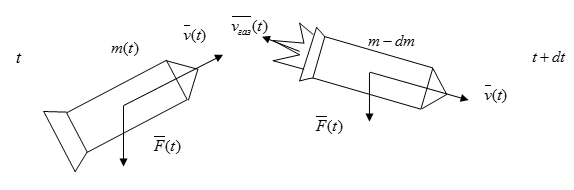
Рисунок 1
Обозначим массу ракеты в какой-либо момент времени t как m(t), а ее скорость как v(t). То количество движения, которая она при этом совершает, будет равно mv. После того, как пройдет время dt, обе эти величины получат приращение (соответственно dm и dv, причем значение dm будет меньше 0). Тогда количество движения, совершаемого ракетой, станет равно:
(m+dm)(v+dv).
Нам необходимо учитывать тот момент, что за время dt также происходит движение газов. Это количество тоже нужно добавить в формулу. Оно будет равно dmгазvгаз. Первый показатель означает массу газов, которые образуются за указанное время, а второй – их скорость.
Теперь нам нужно найти разность между суммарным количеством движения за время t+dt и количеством движения системы во время t. Так мы найдем приращение данной величины за время dt, которое будет равно Fdt (буквой F обозначена геометрическая сумма всех тех внешних сил, которые действуют в это время на ракету).
В итоге мы можем записать следующее:
(m+dm)(v+dv)+dmгаз+vгаз-mv=Fdt.
Поскольку нам важны именно предельные значения dmdt, dvdt и их производные, приравняем эти показатели к нулю. Значит, после раскрытия скобок произведение dm·dv может быть отброшено. С учетом сохранения массы получим:
dm+dmгаз=0.
Теперь исключим массу газов dmгаз и получим скорость, с которой газы будут покидать ракету (скорость струи вещества), выражающаяся разностью vотн=vгаз-v. Учитывая эти преобразования, можно переписать исходное уравнение в следующем виде:
dmv=vотнdm+Fdt.
Теперь разделим его на dt и получим:
mdvdt=vотнdmdt+F.
Уравнение Мещерского
Форма полученного уравнения точно такая же, как у уравнения, выражающего второй закон Ньютона. Но, если там мы имеем дело с постоянной массой тела, то здесь из-за потери вещества она постепенно меняется. К тому же помимо внешней силы нужно учитывать так называемую реактивную силу. В примере с ракетой это будет сила выходящей из нее газовой струи.
Уравнение mdvdt=vотнdmdt+F впервые вывел русский механик И.В. Мещерский, поэтому оно получило его имя. Также его называют уравнением движения тела с переменной массой.
Формула Циолковского
Попробуем исключить из уравнения движения ракеты внешние силы, воздействующие на нее. Предположим, что движение ракеты прямолинейно, а направление противоположно скорости газовой струи vотн. Будем считать направление полета положительным, тогда проекция вектора vотн является отрицательной. Она будет равна -vотн. Переведем предыдущее уравнение в скалярную форму:
mdv=vотнdm.
Тогда равенство примет вид:
dvdm=-vотнm.
Газовая струя может выходить во время полета с переменной скоростью. Проще всего, разумеется, принять ее в качестве константы. Такой случай наиболее важен для нас, поскольку так уравнение решить намного проще.
Исходя из начальных условий, определим, какое значение приобретет постоянная интегрирования С. Допустим, что в начале пути скорость ракеты будет равна 0, а масса m0. Следовательно, из предыдущего уравнения можем вывести:
C=vотн lnm0m.
Тогда мы получим соотношения следующего вида:
v=vотн lnm0m или m0m=evvотн.
Это соотношение и является формулой Циолковского.
Она предназначена для расчета запаса топлива, с помощью которого ракета может набрать необходимую скорость. При этом время сгорания топлива не обусловливает величину максимальной скорости ракеты. Чтобы разогнаться до предела, нужно увеличить скорость истечения газов. Для достижения первой космической скорости следует изменить конструкцию ракеты. Она должна быть многоступенчатой, поскольку необходимо меньшее соотношение между требуемой массой топлива и массой ракеты.
Разберем несколько примеров применения данных построений на практике.
Условие: у нас есть космический корабль, скорость которого постоянна. Для изменения направления полета в ней нужно включить двигатель, который выбрасывает газовую струю со скоростью vотн. Направление выброса перпендикулярно траектории корабля. Определите угол изменения вектора скорости при начальной массе корабля m0 и конечной m.
Решение
Ускорение по абсолютной величине будет равно a=ω2r=ωv, причем v=const.
Значит, уравнение движения будет выглядеть так:
mdvdt=vотнdmdt перейдет в mvωdt=-vотнdm.
Поскольку da=ωdt является углом поворота за время dt, то после интеграции первоначального уравнения получим:
a=vотнvlnm0m.
Ответ: искомый угол будет равен a=vотнvlnm0m.
Условие: масса ракеты перед стартом равна 250 кг. Вычислите высоту, которую она наберет через 20 секунд после начала работы двигателя. Известно, что топливо расходуется со скоростью 4 кг/с, а скорость истечения газов постоянна и равна 1500 м/с. Поле тяготения Земли можно считать однородным.
Решение
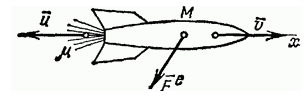
Рисунок 2
Начнем с записи уравнения Мещерского. Оно будет иметь следующий вид:
m∆v0∆t=μvотн-mg.
Здесь m=m0-μt и v0 – скорость ракеты в заданный момент времени. Разделим переменные:
∆v0=μvотнm0-μt-g∆t.
Теперь решим полученное уравнение с учетом первоначальных условий:
v0=vотнlnm0m0-μt-gt.
С учетом того, что H0=0 при t=0, у нас получится:
H=vотнt-gt22+vотнm0μ1-μtm0ln1-μtm0.
Добавим заданные значения и найдем ответ:
H=vотнt-gt22+vотнm0μ1-μtm0ln1-μtm0=3177,5 м.
Ответ: через 20 секунд высота ракеты будет составлять 3177,5 м.