
Атрибутивные процессы. Теории атрибуции, виды атрибуции, ошибки атрибуции (фундаментальные и мотивационные).
АТРИБУЦИЯ (англ. attribution) — в
социальной психологии — «реальный»
когнитивный процесс понимания и
объяснения поведения др. людей и своего
собственного. Суть А. заключается в
наделении людей качествами, которые не
м. 6. результатом социальной перцепции,
поскольку не присутствуют в явном виде
во внешнем, доступном наблюдателю
поведении, а атрибутируются (приписываются)
им. Т. о., А. — попытка интерпретировать
социальный объект, понять его поведение
в условиях дефицита информации путем
домысливания.
Можно сказать, что
процесс атрибуции служит человеку для
того, чтобы придать смысл окружающему.
Теории атрибуции
исследуют, какого рода информацию люди
берут в расчет, приписывая кому-либо
что-либо, а также включают анализ
мотивации
индивида понять причины и следствия
отношений, потребности людей понять
характер окружающего для ориентации в
нем и для возможности построить
предсказание событий и поступков.
Разработка этой
проблематики не означает исследования
того как следует
приписывать причины поведения другому
человеку а, напротив, как это на
самом деле делается
обычным человеком которого Ф. Хайдер
— основатель
исследований атрибуции — назвал «наивным
психологом».
Хайдер отмечал,
что люди в своих обыденных поступках,
в обыденной жизни всегда не просто
наблюдают явления, но анализируют их с
целью осмысления сути происходящего.
Отсюда их стремление прежде всего понять
причины поведения другого человека, и
если не хватает информации относительно
этих причин, то люди приписывают их.
Обычно они стремятся приписать стабильные,
достаточно широко распространенные и
типичные причины, хотя по-разному
оценивают намеренное и ненамеренное
поведение. Чтобы определить в каждом
конкретном случае, какую причину следует
приписать, необходимо знать возможные
типы причин. Для Хайдера — это причины
личностные (т.е. когда причина приписывается
действию субъекта) и причины, коренящиеся
в «среде» (т.е. такие, которые приписываются
обстоятельствам).
-
Теория
«корреспондентного выведения» Э.
Джонса и К. Дэвиса.
Авторы предлагают
следующую схему, помогающую понять
логический путь, которым следует человек,
приписывая причины поведения другому
человеку.
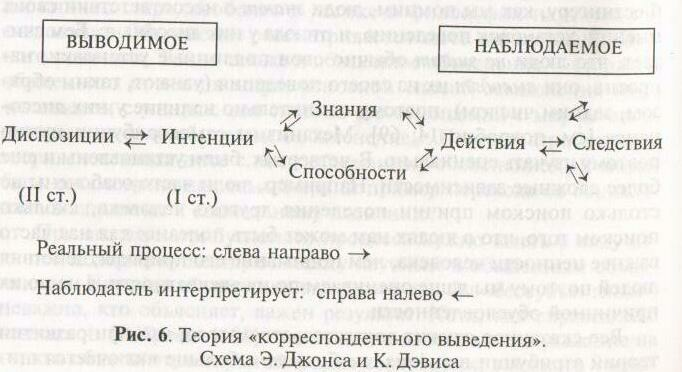
Рассмотрим случай
ДТП, когда автомобилист сбивает пешехода.
При размышлении о причинах инцидента
можно предложить следующую логику.
Реальный процесс осуществляется по
направлению слева направо: субъект
поступка (водитель) прежде всего обладает
некоторыми личностными чертами —
диспозициями (например, долей
безответственности), затем намерениями
— интенциями (например успеть «проскочить»
на красный свет), потом актуализует
другое при помощи знаний
(в нашем случае плохой подготовкой на
экзамене по получению водительских
прав), а также способностей
(например, недостаточной быстротой
реакций при виде препятствия). Результат
— автомобилист сшибает пешехода.
Иной порядок
следования событий раскрыт наблюдающему:
индивид прежде всего наблюдает следствия
каких-то действий другого
человека
(например, как автомобилист сшиб
пешехода), он может также наблюдать и
само действие
(видел, как автомобилист проехал на
красный свет). Но далее он уже ничего
наблюдать не может: он может только
умозаключать что-то относительно знаний
совершившего
поступок или его способностей.
Продолжая это рассуждение, наблюдающий
может также нечто предположить
относительно намерений (интенций)
субъекта поступка или даже относительно
характеристик его личности (диспозиций).
Но все это будет уже определенной
мыслительной операцией, которую Джонс
и Дэвис назвали
«корреспондентным
выведением», т.е. осуществлением вывода,
соответствующего ряду наблюдаемых
фактов. Наблюдатель, таким образом,
движется в своих заключениях справа
налево, на этом пути он и осуществляет
процесс приписывания.
Процесс выведения
(«вывода») расшифровывается более
подробно: выделяются две его стадии: а)
атрибуция интенций, б) атрибуция
диспозиций. На первом этапе наблюдатель
умозаключает, намеренно ли действие
или нет. (В нашем примере действие
намеренно, так как водитель, каким бы
плохим учеником на курсах он ни был,
знал возможные последствия и мог
совершить действие.) Второй шаг наблюдателя
— анализ того, какие диспозиции стоят
за этим (в нашем случае наблюдатель
может заключить о безответственности
водителя).
Это поэтапное
рассуждение, естественно, может включать
в себя ряд ошибок. Оказалось, что многие
ошибки зависят от двух показателей: а)
уникально или типично действие; б)
социально желательно оно или нет.
На значение
уникальности или типичности наблюдаемого
поступка в свое время обращал внимание
С. Л. Рубинштейн: «В обычных условиях
процесс познания другого человека
«свернут», лишь в случае наблюдения
отклоняющихся образцов он «развертывается»».
Понятно, что при типичном поступке
атрибуция его причин осуществляется
более или менее автоматически, а вот
при необычном — резонов для его объяснения
мало и тогда открывается простор для
атрибуции. Точно так же «социально
нежелательное поведение» (т.е. не
соответствующее принятым нормам,
требованиям определенных социальных
ролей: например, воспитательница детского
сада ударила малыша) допускает гораздо
больше возможных толкований.
-
Теория каузальной
атрибуции Келли.
Келли с помощью
этой теории делает попытку ответить на
вопрос: откуда берутся приписываемые
причины?
В этой теории
разбираются два случая:
1. Когда воспринимающий
черпает информацию из многих источников
и имеет возможность различным образом
комбинировать поведение объекта и его
причины, выбрав одну из них (рассматривается
при помощи принципа ковариации). Случай
1.
2. Когда воспринимающий
имеет одно-единственное наблюдение и
тем не менее должен как-то объяснить
причину события, которых может быть
несколько (рассматривается при помощи
принципа конфигурации). Случай
2.
-
Принцип ковариации
– для
случая 1.
Модель анализа
вариаций содержит перечень структурных
элементов атрибутивного процесса:
Личность, Стимул (объект), Обстоятельства.
Соответственно называются три вида
причин (а не два, как у Хайдера): личностные,
стимульные (или объектные) и
обстоятельственные. Три вида элементов
и три вида причин составляют «каузальное
пространство», которое изображается
при помощи куба, где стороны обозначают
виды атрибуции.
В том случае, когда
воспринимающий имеет возможность
пользоваться данными многих, а не одного
наблюдения, он «подбирает» причину к
тем факторам, с которыми, как ему кажется,
будет ковариировать результат.
Пример:
Событие: «Петров
сбежал с лекции по социальной психологии»
Возможные причины:
-
Личность Петрова
(личностные причины) -
Качество лекции
(стимульная или объектная причина) -
Обстоятельства
(обстоятельственная причина)
Выбор причины
основывается на сопоставлении наблюдений,
которые можно свести к трем группам:
1. а) почти все
сбежали с этой лекции;
б) никто другой
не сбежал с нее.
2. а) Петров не сбежал
с других лекций;
б) Петров сбежал
и с других лекций.
3. а) в прошлом Петров
также сбегал с этой лекции;
б) в прошлом
Петров никогда не сбегал с нее.
Чтобы правильно
подобрать причину, нужно ввести три
«критерия валидности»:
-
подобия
(консенсус): подобно ли поведение
субъекта (Петрова) поведению других
людей? -
различия:
отлично ли поведение субъекта (Петрова)
к данному объекту от поведения его к
другим объектам (лекциям)? -
соответствия:
является ли поведение субъекта (Петрова)
одинаковым в разных ситуациях?
В приведенных выше
суждениях можно выделить пары пунктов,
которые будут являться проверкой на
каждый из критериев.
-
Пункты 1а и 16 —
проверка на подобие. -
Пункты 2а и 26 —
проверка на различие. -
Пункты За и 36 —
проверка на соответствие.
Далее Келли
предлагает «ключ», т.е. те комбинации,
которые позволяют приписывать причину
адекватно. «Ключ» – ряд правил, по
которым следует строить заключение.
Термины: «низкое» – суждение, обозначаемое
буквой «б»; «высокое» – суждения в
таблице, обозначаемое буквой «а». Тогда
возможные комбинации суждений выглядят
следующим образом:
-
Если: низкое подобие
(16), низкое различие (26), высокое
соответствие (За), то атрибуция личностная
(16-26-За). -
Если: высокое
подобие (1а), высокое различие (2а), высокое
соответствие (За), то атрибуция стимулъная
(объектная)
(1а-2а-3а). -
Если: низкое подобие
(16), высокое различие (2а), низкое
соответствие (36), то атрибуция
обстоятельственная
(1б-2а-3б).
С этим «ключом»
сопоставляются ответы испытуемого
(т.е. того, кто оценивает ситуацию). Ответы
эти предлагается дать, глядя в «таблицу»
и сопоставляя их тем самым с имевшими
место ранее наблюдениями. Например,
наблюдатель знает, что никто другой не
сбежал с упомянутой лекции (16); он также
знает, что Петров сбежал и с других
лекций (26); ему известно, что и в прошлом
Петров сбегал с этой лекции (3а). Если в
таком случае испытуемый предлагает
вариант 16-26-За, т.е. приписывает причину
Петрову, то можно считать, что он приписал
ее правильно.

В третьем случае
неопределенность ситуации очевидна.
Схему, предложенную
Келли, нельзя рассматривать как
абсолютную. В ряде случаев, как отмечает
и сам автор, индивид может демонстрировать
выбор и сложных причин, например
«личностно-объектную» (когда налицо
la-26-За).
В целом же вывод,
который следует из описания принципа
ковариации (сочетания вариантов), звучит
так:
«Эффект приписывается
одной из возможных причин, с которой он
ковариантен по времени».
Иными словами,
принцип ковариации заключается в
следующем: эффект приписывается условию,
которое представлено, когда эффект
представлен, и отсутствует, когда эффект
отсутствует; в нем исследуются изменения
в зависимой переменной при варьировании
независимой переменной.
-
Принцип конфигурации
(теория каузальных схем) –
для случая 2
Суть: если в реальных
ситуациях человек не располагает никакой
информацией о реакциях субъекта на
аналогичные стимулы или о реакциях
других людей на тот же самый стимул
(т.е. не может использовать критерии
подобия, различия и соответствия), то
он должен обрисовать для себя всю
конфигурацию возможных причин и выбрать
одну из них.
Для того чтобы
облегчить задачу отбора единственной,
адекватной в данном случае причины,
предлагается учитывать следующие
возможные характеристики причин: а)
обесценивания, б) усиления, в)
систематического искажения информации.
В совокупности эти три разновидности
причин образуют «принципы конфигурации».
Рассмотрим подробно
принципы обесценивания, усиления и
систематического искажения информации:
-
Принцип обесценивания
означает, что субъект отбрасывает те
причины, которым есть альтернатива
(ибо таковые причины «обесцениваются»).
Пример приводится в известном эксперименте
Дж. Тибо и X. Риккена: демонстрировалась
«угодливость поведения» двух людей —
с высоким и низким социальным статусом.
Испытуемых просили объяснить причины
такого поведения. Для «низкого» по
статусу выбиралась внутренняя причина
(его бессилие в жизни) и внешняя (желание
получить помощь). Для «высокостатусного»
теоретически можно предположить эти
же причины. Однако испытуемые в данном
случае отбрасывали внешнюю причину
(так как, по их мнению, высокостатусный
не нуждается в помощи): внешняя причина
обесценилась наличием альтернативы
(сам себе может помочь). Поэтому во
втором случае причина приписана
внутренним качествам высокостатусного
человека (такой уж он есть). Отсюда
видно, что относительно первого случая
вывод неясен: могут быть справедливы
обе причины. Но по противопоставлению
второму случаю с высокостатусным
низкостатусному в эксперименте чаще
приписывалась внешняя причина. -
Специфическим
вариантом принципа обесценивания
является принцип усиления.
Суть его в том, что чаще приписывается
причина, которая чем-нибудь усиливается:
например, она кажется более вероятной,
потому что встречает препятствие. Келли
приводит такой пример: Фрэнк и Тони
выполняют задание. Фрэнк — трудное,
Тони — среднее. Оба успешны. Предлагается
ответить на вопрос, в чем причина их
успеха: в способностях того и другого
или во внешних обстоятельствах. Обычно
способности (внутренняя причина)
приписываются Фрэнку, так как для него
препятствие — трудность задания —
лишь усиливает предположение о его
высоких способностях.
Оба приведенных
примера могут быть проиллюстрированы
на таких схемах:
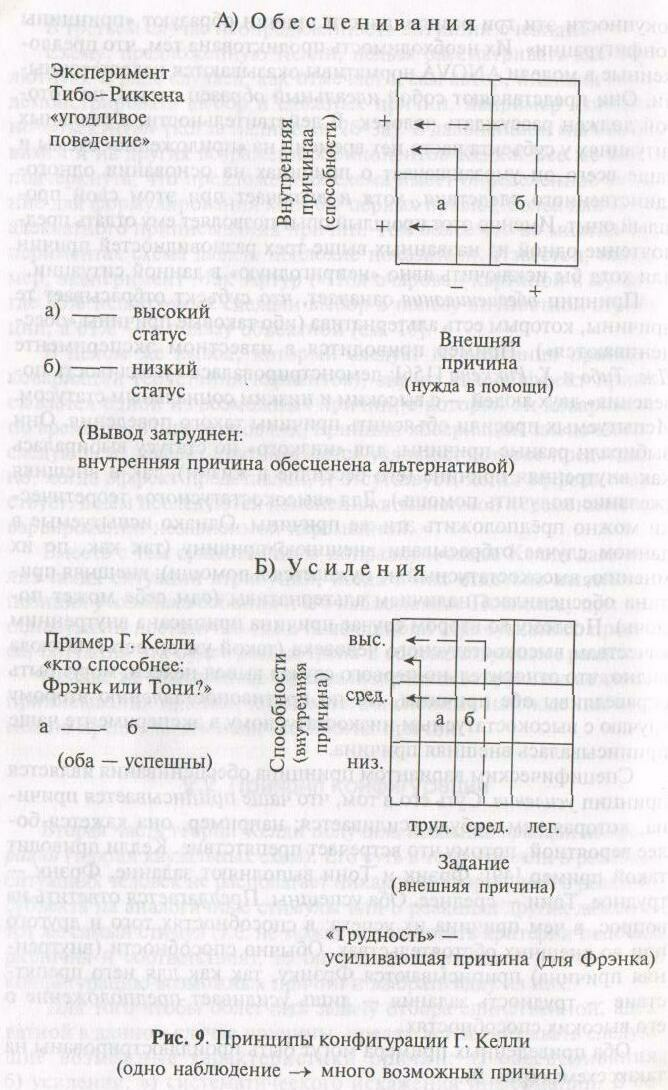
когда действие
совершается трудно, причина его чаще
приписывается субъекту, следовательно,
имеет место личностная атрибуция.
-
Но здесь уже
вступает в силу третий из предложенных
Келли принципов конфигурации —
систематическое
искажение суждений о людях.
Этот принцип рассматривается вместе
с ошибками атрибуции.
-
Ошибки
атрибуции:
В результате
многочисленных экспериментов были
выведены два класса ошибок атрибуции:
-
Фундаментальные.
В самом общем виде
фундаментальную ошибку можно определить
как «склонность людей игнорировать
ситуационные причины действий и их
результатов в пользу диспозиционных».
Фундаментальная ошибка заключается в
переоценке личностных и недооценке
обстоятельственных причин.
Л. Росс назвал
это явление «сверхатрибуция». Андреева
указывает на то, что фундаментальная
ошибка только одна, но у нее есть вариации
в проявлении:
-
«Ложное согласие»
— «есть мое мнение и неправильное» —
выражается в том, что воспринимающий
принимает свою точку зрения как
«нормальную» и потому полагает, что
другим должна быть свойственна такая
же точка зрения. Если она иная, значит,
дело в «личности» воспринимаемого.
Феномен «ложного согласия» проявляется
не только в переоценке типичности
своего поведения, но и в переоценке
своих чувств, верований и убеждений.
Некоторые исследователи полагают, что
«ложное согласие» вообще является
главной причиной, по которой люди
считают собственные убеждения единственно
верными. -
«Неравные
возможности»
— «начальник
умнее».
Отмечаются в ролевом поведении: в
определенных ролях легче проявляются
собственные позитивные качества, и
апелляция совершается именно к ним
(т.е. опять-таки к личности человека, в
данном случае обладающего такой ролью,
которая позволяет ему в большей мере
выразить себя). Здесь воспринимающий
легко может переоценить личностные
причины поведения, просто не приняв в
расчет ролевую позицию действующего
лица.
Л. Росс продемонстрировал
это положение при помощи такого
эксперимента. Он разделил группу
испытуемых на «экзаменаторов» и
«экзаменующихся». Первые задавали
различные вопросы, и «экзаменующиеся»,
как могли, отвечали на них. Затем Росс
попросил тех и других испытуемых оценить
свое поведение. «Экзаменаторы» оценили
и себя и «экзаменующихся» достаточно
высоко, а вот последние приписали большую
степень осведомленности «экзаменаторам»,
их личности. В данном случае не было
учтено то обстоятельство, что по условиям
эксперимента «экзаменаторы» выглядели
«умнее» просто потому, что это было
обусловлено их ролевой позицией. В
обыденной жизни именно этот механизм
включается при приписывании причин в
ситуации начальник—подчиненный.
-
«Большее доверие
вообще к фактам, чем к суждениям»,
проявляется в том, что первый взгляд
всегда обращен к личности. В наблюдаемом
сюжете личность непосредственно дана:
она — безусловный «факт», а обстоятельство
еще надо «вывести». Возможно, здесь
срабатывает тот механизм, который
зафиксирован в гештальтпсихологии:
первоначально воспринимается «фигура»,
а лишь затем — «фон». По мнению Л. Росса
и Р. Нисбета, «люди активны, динамичны
и интересны. Именно эти их свойства
обращают на себя внимание в первую
очередь. Напротив, ситуация обычно
сравнительно статична и зачастую
представляется туманной». -
«Легкость
построения ложных корреляций» — «все
толстые люди добрые». Сам
феномен ложных корреляций хорошо
известен и описан. Он состоит в том, что
наивный наблюдатель произвольно
соединяет какие-либо две личностные
черты как обязательно сопутствующие
друг другу. Особенно это относится к
неразрывному объединению внешней черты
человека и какого-либо его психологического
свойства (например: «все полные люди —
добрые», «все мужчины невысокого роста
— властолюбивы» и пр.). «Ложные корреляции»
облегчают процесс атрибуции, позволяя
почти автоматически приписывать причину
поведения наблюдаемой личности, совершая
произвольную «связку» черт и причин. -
«Игнорирование
информационной ценности неслучившегося».
Основанием для оценки поступков людей
может явиться не только то, что
«случилось», но и то, что «не случилось»,
т.е. и то, что человек «не сделал». Однако
при наивном наблюдении такая информация
о «неслучившемся» нередко опускается.
Поверхностно воспринимается именно
«случившееся», а субъект «случившегося»
— личность. К ней прежде всего и
апеллирует наивный наблюдатель.
Существует целый
ряд объяснений того, почему так
распространена фундаментальная ошибка
атрибуции.
Д. Гилберт утверждал,
что «первая атрибуция» — всегда
личностная, она делается автоматически,
а лишь потом начинается сложная работа
по перепроверке своего суждения о
причине. По мнению Гилберта, эта «работа»
может осуществляться либо «по Келли»,
либо «по Джонсу и Дэвису», но все это
совершается «потом»: непосредственное
суждение всегда адресовано личности.
Более глубокие
объяснения феномена фундаментальной
ошибки даются теми авторами, которые
апеллируют к некоторым социальным
нормам, представленным в культуре.
С. Московиси
полагает, что это в значительной мере
соотносится с общими нормами индивидуализма,
а Р. Браун отмечает, что такая норма
предписана даже в языке. По свидетельству
У. Мишела, эпитеты, применяемые к поведению
того или иного человека, могут быть
применены и к самому этому человеку
(«враждебные» действия совершаются
«враждебно настроенными людьми»;
«зависимое» поведение свойственно
«зависимым людям» и т.д.). В то же время
язык не позволяет таким же образом
связывать действия и ситуации.
К факторам культуры
следует добавить и некоторые
индивидуально-психологические
характеристики субъектов атрибутивного
процесса: в частности, было отмечено,
что существует связь предпочитаемого
типа атрибуции с «локусом контроля». В
свое время Дж. Роттер доказал, что люди
различаются в ожиданиях позитивной или
негативной оценки их поведения: интерналы
в большей степени доверяют своей
собственной возможности оценивать свое
поведение, в то время как экстерналы
воспринимают оценку своего поведения
как воздействие какой-то внешней причины
(удача, шанс и пр.).
Исследования
фундаментальной ошибки атрибуции были
дополнены изучением того, как приписываются
причины поведению другого человека в
двух различных ситуациях: когда тот
свободен
в выборе модели своего поведения и когда
тому данное поведение предписано
(т.е. он несвободен в выборе). Казалось
бы, естественным было ожидать, что
личностная атрибуция будет осуществлена
значительно более определенно в первом
случае, где наблюдаемый индивид —
подлинный субъект действия. Однако в
ряде экспериментов эта идея не
подтвердилась.
-
Мотивационные.
Такого рода ошибки
представлены различными «защитами»,
пристрастиями, которые субъект
атрибутивного процесса включает в свои
действия.
Первоначально эти
ошибки были выявлены в ситуациях, когда
испытуемые стремились сохранить свою
самооценку в ходе приписывания причин
поведения другого человека. Величина
самооценки зависела в большой степени
от того, приписываются ли себе или
другому успехи
или неудачи.
Значительная
разработка этой проблемы принадлежит
Б. Вайнеру.
В центре его внимания — способы
приписывания причин в ситуациях успеха
и неудачи. Он предложил рассматривать
три измерения в каждой причине:
внутреннее —
внешнее;
стабильное —
нестабильное;
контролируемое —
неконтролируемое.
Различные сочетания
этих измерений дают восемь моделей
(возможных наборов причин):
1) внутренняя —
стабильная — неконтролируемая;
2) внутренняя —
стабильная — контролируемая;
3) внутренняя —
нестабильная — неконтролируемая;
4) внутренняя —
нестабильная — контролируемая;
5) внешняя —
стабильная — неконтролируемая;
6) внешняя —
стабильная — контролируемая;
7) внешняя —
нестабильная — неконтролируемая;
 внешняя —
нестабильная — контролируемая.
Вайнер предположил,
что выбор каждого сочетания обусловлен
различной мотивацией. Это можно пояснить
следующим примером. Ученик плохо ответил
урок. В разных случаях он по-разному
объясняет свое поведение: если он
сослался на низкие способности к данному
предмету, то он избирает ситуацию 1; если
он признает, что ленился, то, возможно,
выбирает ситуацию 2; если сослался на
внезапную болезнь перед ответом, то
выбирает ситуацию 3; если отвлекся на
просмотр телепередачи — ситуацию 4;
если обвинил школу в слишком высокой
требовательности, то выбирает ситуацию
5; если учитель оценивается как плохой
— то ситуацию 6; если просто «не везет»,
то ситуацию 7; наконец, если сосед
ремонтирует дом и постоянно стучит,
мешая заниматься, то это будет уместно
объяснить ситуацией 8.
Как видно, процесс
объяснения причин здесь включает в себя
представление о достигаемой цели, иными
словами, связан с мотивацией
достижения.
(Так, теперь пошли
мои личные рассуждения и личные
рассуждения других не ученых, поэтому
не ручаюсь за то, что они верны. Я не
ученый, я только учусь. =) )
-
Пример применения
защит по Фрейду: когда человек «использует»
механизм отрицания для сохранения
самооценки. -
Об ожиданиях: если
человек поступает не
так как мы ожидали, то мы всегда находим
оправдание,
то
есть сохраняем
образ человека таким, какой он был до
случившегося. (мотив – сохранение
образа, избегание рекатегоризации). -
О потребностях:
Мы пытаемся объяснить поведение других
исходя из собственных потребностей,
приписывая эти потребности другим
(например, потребностью в самоутверждении
объясняем критику человека в свой
адрес)
Соседние файлы в предмете [НЕСОРТИРОВАННОЕ]
- #
- #
- #
- #
- #
- #
- #
- #
- #
- #
- #
Attribution is a term used in psychology which deals with how individuals perceive the causes of everyday experience, as being either external or internal. Models to explain this process are called attribution theory. Psychological research into attribution began with the work of Fritz Heider in the early 20th century, and the theory was further advanced by Harold Kelley and Bernard Weiner. Heider first introduced the concept of perceived ‘locus of causality’ to define the perception of one’s environment.[2] For instance, an experience may be perceived as being caused by factors outside the person’s control (external) or it may be perceived as the person’s own doing (internal). These initial perceptions are called attributions.[2] Psychologists use these attributions to better understand an individual’s motivation and competence.[3] The theory is of particular interest to employers who use it to increase worker motivation, goal orientation, and productivity.
Psychologists have identified various biases in the way people attribute causation, especially when dealing with others. The fundamental attribution error describes the tendency to attribute dispositional or personality-based explanations for behavior, rather than considering external factors. We tend to assume others are responsible for their own misfortunes, in other words, while blaming external factors for our own. Culture bias is when someone makes an assumption about the behavior of a person based on their own cultural practices and beliefs.
Attribution theory has been criticised as being mechanistic and reductionist for assuming that people are rational, logical, and systematic thinkers.[4] It also fails to address the social, cultural, and historical factors that shape attributions of cause.
Background[edit]
Gestalt psychologist Fritz Heider is often described as the early-20th-century «father of attribution theory».[5] In his 1920 dissertation, Heider addressed the problem of phenomenology: why do perceivers attribute the properties such as color to perceived objects, when those properties are mental constructs? Heider’s answer that perceivers attribute that which they «directly» sense – vibrations in the air for instance – to an object they construe as causing those to sense data. «Perceivers faced with sensory data thus see the perceptual object as ‘out there’, because they attribute the sensory data to their underlying causes in the world.»[6] Heider extended this idea to attributions about people: «motives, intentions, sentiments … the core processes which manifest themselves in overt behavior».[6]
Perceived Locus of Causality[edit]
Heider first introduced the concept of perceived locus of causality using it to define interpersonal perception of one’s environment.[2] This theory explains how individuals perceive the causality of different events whether being external or internally based.[2] These initial perceptions are called attributions.[2] These attributions are viewed on a continuum of external to internal motivation.[7] Understanding an individual’s perception of causality also opens doors to a better understanding of how to better motivate an individual in specific tasks by increasing levels of autonomy, relatedness, and competence.[3] The theory of perceived locus of causality lead to Deci and Ryan’s theory of self-determination.[3] Self-determination theory uses perceived locus of causality to measure feelings of autonomy from behaviors performed by the individual.[3] For this reason perceived locus of causality has caught the eye of employers and psychologists to help determine how to increase an individuals motivation and goal orientation to increase effectiveness within their respective fields.[8] Research has shown that spectators at an athletic event often attribute their team’s victory to internal causes and their team’s losses to external causes.[9] This is an example of self-serving attribution error or fundamental attribution error and is more common than one might think.[9]
Types of attributions[edit]
External[edit]
External attribution, also called situational attribution, refers to interpreting someone’s behavior as being caused by the individual’s environment.[2][10] For example, if one’s car tire is punctured, it may be attributed to a hole in the road; by making attributions to the poor condition of the highway, one can make sense of the event without any discomfort that it may in reality have been the result of their own bad driving.[11] Individuals are more likely to associate unfortunate events with external factors than with internal factors.[12]
Example: A child attributes his feelings to the weather outside his house; he feels sad because it is raining outside.
Internal[edit]
Internal attribution, or dispositional attribution, refers to the process of assigning the cause of behavior to some internal characteristic, likeability and motivation, rather than to outside forces.[13] This concept has overlap with the Locus of control, in which individuals feel they are personally responsible for everything that happens to them.
Example: A child attributes the weather to his feelings; it is raining outside his house because he is feeling sad.
Theories and models[edit]
Common sense psychology[edit]
From the book The Psychology of Interpersonal Relations (1958), Fritz Heider tried to explore the nature of interpersonal relationship, and espoused the concept of what he called «common sense» or «naïve psychology». In his theory, he believed that people observe, analyze, and explain behaviors with explanations. Although people have different kinds of explanations for the events of human behaviors, Heider found it is very useful to group explanation into two categories; Internal (personal) and external (situational) attributions.[14] When an internal attribution is made, the cause of the given behavior is assigned to the individual’s characteristics such as ability, personality, mood, efforts, attitudes, or disposition. When an external attribution is made, the cause of the given behavior is assigned to the situation in which the behavior was seen such as the task, other people, or luck (that the individual producing the behavior did so because of the surrounding environment or the social situation). These two types lead to very different perceptions of the individual engaging in a behavior.[15]
Correspondent inference[edit]
Correspondent inferences state that people make inferences about a person when their actions are freely chosen, are unexpected, and result in a small number of desirable effects. According to Edward E. Jones and Keith Davis’ correspondent inference theory, people make correspondent inferences by reviewing the context of behavior. It describes how people try to find out an individual’s personal characteristics from the behavioral evidence. People make inferences on the basis of three factors; degree of choice, expectedness of behavior, and effects of someone’s behaviors. For example, we believe we can make stronger assumptions about a man who gives half of his money to charity, than we can about one who gives $5 to charity. An average person would not want to donate as much as the first man because they would lose a lot of money. By donating half of his money, it is easier for someone to figure out what the first man’s personality is like. The second factor, that affects correspondence of action and inferred characteristic, is the number of differences between the choices made and the previous alternatives. If there aren’t many differences, the assumption made will match the action because it is easy to guess the important aspect between each choice.[16]
Covariation model[edit]
The covariation model states that people attribute behavior to the factors that are present when a behavior occurs and absent when it does not. Thus, the theory assumes that people make causal attributions in a rational, logical fashion, and that they assign the cause of an action to the factor that co-varies most closely with that action.[17] Harold Kelley’s covariation model of attribution looks to three main types of information from which to make an attribution decision about an individual’s behavior. The first is consensus information, or information on how other people in the same situation and with the same stimulus behave. The second is distinctive information, or how the individual responds to different stimuli. The third is consistency information, or how frequent the individual’s behavior can be observed with similar stimulus but varied situations. From these three sources of affirmation observers make attribution decisions on the individual’s behavior as either internal or external. There have been claims that people under-utilise consensus information, although there has been some dispute over this.[18]
There are several levels in the covariation model: high and low. Each of these levels influences the three covariation model criteria. High consensus is when many people can agree on an event or area of interest. Low consensus is when very few people can agree. High distinctiveness is when the event or area of interest is very unusual, whereas low distinctness is when the event or area of interest is fairly common. High consistency is when the event or area of interest continues for a length of time and low consistency is when the event or area of interest goes away quickly.[18]
Three-dimensional model[edit]
Bernard Weiner proposed that individuals have initial affective responses to the potential consequences of the intrinsic or extrinsic motives of the actor, which in turn influence future behavior.[19] That is, a person’s own perceptions or attributions as to why they succeeded or failed at an activity determine the amount of effort the person will engage in activities in the future. Weiner suggests that individuals exert their attribution search and cognitively evaluate casual properties on the behaviors they experience. When attributions lead to positive affect and high expectancy of future success, such attributions should result in greater willingness to approach to similar achievement tasks in the future than those attributions that produce negative affect and low expectancy of future success.[20] Eventually, such affective and cognitive assessment influences future behavior when individuals encounter similar situations.
Weiner’s achievement attribution has three categories:
- stable theory (stable and unstable)
- locus of control (internal and external)
- controllability (controllable or uncontrollable)
Stability influences individuals’ expectancy about their future; control is related with individuals’ persistence on mission; causality influences emotional responses to the outcome of task.
Bias and errors[edit]
While people strive to find reasons for behaviors, they fall into many traps of biases and errors. As Fritz Heider says, «our perceptions of causality are often distorted by our needs and certain cognitive biases». The following are examples of attributional biases.
Fundamental attribution error[edit]
The fundamental attribution error describes the habit to misunderstand dispositional or personality-based explanations for behavior, rather than considering external factors. The fundamental attribution error is most visible when people explain and assume the behavior of others. For example, if a person is overweight, a person’s first assumption might be that they have a problem with overeating or are lazy, and not that they might have a medical reason for being heavier set.
When evaluating others’ behaviors, the situational context is often ignored in favor of assuming the disposition of the actor to be the cause of an observed behavior. This is because, when a behavior occurs, attention is most often focused on the person performing the behavior. Thus the individual is more salient than the environment, and dispositional attributions are made more often than situational attributions to explain the behavior of others.[11]
However, when evaluating one’s own behavior, the situational factors are often exaggerated when there is a negative outcome, while dispositional factors are exaggerated when there is a positive outcome.[11]
The core process assumptions of attitude construction models are mainstays of social cognition research and are not controversial—as long as we talk about «judgment». Once the particular judgment made can be thought of as a person’s «attitude», however, construal assumptions elicit discomfort, presumably because they dispense with the intuitively appealing attitude concept.[23]
Sociocultural disparities are a main source for the propensity of the fundamental attribution error caused by an augment of inferring dispositional attribution while ignoring situational attribution.[24]
Culture bias[edit]
Culture bias is when someone makes an assumption about the behavior of a person based on their own cultural practices and beliefs. An example of culture bias is the dichotomy of «individualistic» and «collectivistic cultures». People in individualist cultures, generally Anglo-America and Anglo-Saxon European, are characterized as societies which value individualism, personal goals, and independence. People in collectivist cultures are thought to regard individuals as members of groups such as families, tribes, work units, and nations, and tend to value conformity and interdependence. In other words, working together and being involved as a group is more common in certain cultures that view each person as a part of the community. This cultural trait is common in Asia, traditional Native American societies, and Africa. Research shows that culture, either individualist or collectivist, affects how people make attributions.[25]
People from individualist cultures are more inclined to make fundamental-attribution error than people from collectivist cultures. Individualist cultures tend to attribute a person’s behavior due to their internal factors whereas collectivist cultures tend to attribute a person’s behavior to his external factors.[26]
Research suggests that individualist cultures engage in self-serving bias more than do collectivist cultures, i.e. individualist cultures tend to attribute success to internal factors and to attribute failure to external factors. In contrast, collectivist cultures engage in the opposite of self-serving bias i.e. self-effacing bias, which is: attributing success to external factors and blaming failure on internal factors (the individual).[27]
Further research suggests that in the United States in particular, culture bias implies a hyperbolized function of culture within the social environments dominated by minorities. These research findings are further supported by aggravation of the perception that there is less of a role in the presence of psychological development of minorities as opposed to their Caucasian counterparts.[28]
Actor/observer difference[edit]
People tend to attribute other people’s behaviors to their dispositional factors while attributing their own actions to situational factors. In the same situation, people’s attribution can differ depending on their role as actor or observer.[29] For example, when a person scores a low grade on a test, they find situational factors to justify the negative event such as saying that the teacher asked a question that he/she never went over in class. However, if another person scores poorly on a test, the person will attribute the results to internal factors such as laziness and inattentiveness in classes. The theory of the actor-observer bias was first developed by E. Jones and R. Nisbett in 1971, whose explanation for the effect was that when we observe other people, we tend to focus on the person, whereas when we are actors, our attention is focused towards situational factors. The actor/observer bias is used less frequently with people one knows well such as friends and family since one knows how his/her close friends and family will behave in certain situation, leading him/her to think more about the external factors rather than internal factors.[original research?]
Dispositional attributions[edit]
Dispositional attribution is a tendency to attribute people’s behaviors to their dispositions; that is, to their personality, character, and ability.[30]
For example, when a normally pleasant waiter is being rude to his/her customer, the customer may assume he/she has a bad character. The customer, just by looking at the attitude that the waiter is giving him/her, instantly decides that the waiter is a bad person. The customer oversimplifies the situation by not taking into account all the unfortunate events that might have happened to the waiter which made him/her become rude at that moment. Therefore, the customer made dispositional attribution by attributing the waiter’s behavior directly to his/her personality rather than considering situational factors that might have caused the whole «rudeness».[31]
The degree of dispositional attribution varies greatly within people. As seen within culture bias, dispositional attribution is impacted by personal beliefs and individual perspectives. Research has shown that dispositional attribution can be influenced by explicit inferences (i.e. instructions or information provided to an individual) that can essentially «guide» a person’s judgement.[32]
Self-serving bias[edit]
Self-serving bias is attributing dispositional and internal factors for success, while external and uncontrollable factors are used to explain the reason for failure. For example, if a person gets promoted, it is because of his/her ability and competence whereas if he/she does not get promoted, it is because his/her manager does not like him/her (external, uncontrollable factor). Originally, researchers assumed that self-serving bias is strongly related to the fact that people want to protect their self-esteem. However, an alternative information processing explanation is that when the outcomes match people’s expectations, they make attributions to internal factors; for example, someone who passes a test might believe it was because of their intelligence. Whereas when the outcome does not match their expectations, they make external attributions or excuses; the same person might excuse failing a test by saying that they did not have enough time to study. People also use defensive attribution to avoid feelings of vulnerability and to differentiate themselves from a victim of a tragic accident.[33] An alternative version of the theory of self-serving bias states that the bias does not arise because people wish to protect their private self-esteem, but to protect their self-image (a self-presentational bias). This version of the theory, which is in line with social desirability bias, would predict that people attribute their successes to situational factors, for fear that others will disapprove of them looking overly vain if they should attribute successes to themselves.[citation needed][34]
For example, the just-world hypothesis states that coming to believe that «good things happen to good people and bad things happen to bad people» will reduce feelings of vulnerability.[citation needed] This belief would have side-effects of blaming the victim even in tragic situations. When a mudslide destroys several houses in a rural neighborhood, a person living in a more urban setting might blame the victims for choosing to live in a certain area or not building a safer, stronger house. Another example of attributional bias is optimism bias in which most people believe positive events happen to them more often than to others and that negative events happen to them less often than to others. For example, smokers on average believe they are less likely to get lung cancer than other smokers.[35]
Defensive attribution hypothesis[edit]
The defensive attribution hypothesis is a social psychological term referring to a set of beliefs held by an individual with the function of defending themselves from concern that they will be the cause or victim of a mishap. Commonly, defensive attributions are made when individuals witness or learn of a mishap happening to another person. In these situations, attributions of responsibility to the victim or harm-doer for the mishap will depend upon the severity of the outcomes of the mishap and the level of personal and situational similarity between the individual and victim. More responsibility will be attributed to the harm-doer as the outcome becomes more severe, and as personal or situational similarity decreases.[33]
An example of defensive attribution is the just-world hypothesis, which is where «good things happen to good people and bad things happen to bad people». People believe in this in order to avoid feeling vulnerable to situations that they have no control over. However, this also leads to blaming the victim even in a tragic situation. When people hear someone died from a car accident, they decide that the driver was drunk at the time of the accident, and so they reassure themselves that an accident will never happen to them. Despite the fact there was no other information provided, people will automatically attribute that the accident was the driver’s fault due to an internal factor (in this case, deciding to drive while drunk), and thus they would not allow it to happen to themselves.
Another example of defensive attribution is optimism bias, in which people believe positive events happen to them more often than to others and that negative events happen to them less often than to others. Too much optimism leads people to ignore some warnings and precautions given to them. For example, smokers believe that they are less likely to get lung cancer than other smokers.[35]
Cognitive Dissonance Theory[edit]
Cognitive dissonance theory refers to a situation involving conflicting attitudes, beliefs or behaviors that cause arousal within the individual.[36] The arousal often produces a feeling of mental or even physical discomfort either leading the individual to alter their own attitudes, beliefs, or behaviors or attributions of the situation.[37] It is much harder for a person to change their behaviors or beliefs than it is to change how they perceive a situation.[38] For example, if someone perceives themselves as being very capable in a sport but perform poorly during a game they are more likely to attribute or blame the poor performance on an external factor than on internal factors such as their skill and ability. This is done in an effort to preserve their current held believes and perceptions about them selves. Otherwise they are left to face the thought that they are not as good at the sport as they originally thought causing a feeling of dissonance and arousal.[38]
Application[edit]
Attribution theory can be applied to juror decision making. Jurors use attributions to explain the cause of the defendant’s intent and actions related to the criminal behavior.[39] The attribution made (situational or dispositional) might affect a juror’s punitiveness towards the defendant.[40] When jurors attribute a defendant’s behavior to dispositional attributions they tend to be more punitive and are more likely find a defendant guilty[40] and to recommend a death sentence compared to a life sentence.[41]
In Marketing Communication[edit]
The Attribution theories have been used as a tool to analyze causal attributions made by consumers and its effectiveness in marketing communication.[42][43][44][clarification needed] Attribution theory has also been utilized to examine external and internal factors of corporate social responsibility (CSR), and the affects the different social movements corporations endorsed have on consumers and their emotions. [45]
In clinical psychology[edit]
Attribution theory has had a big application in clinical psychology.[46] Abramson, Seligman, and Teasdale developed a theory of the depressive attributional style, claiming that individuals who tend to attribute their failures to internal, stable and global factors are more vulnerable to clinical depression.[47] This style is correlated with self-reported rates of depression,[48][49] as well as posttraumatic stress disorder, anxiety,[50][51] and higher risks of developing depression.[52] The Depressive attributional style is defined by high levels of pessimism, rumination,[53] hopelessness, self-criticism,[54] poorer academic performance,[55] and a tendency to believe negative outcomes and events are one’s own fault.[56] People with this attributional style may place high levels of importance on their own reputation and social status. They may be sensitive to rejection by peers and may often interpret actions as more hostile then they really are.[57][58] Some research has suggested that this attributional style may not result an increased levels of depression amongst certain cultures. A study conducted by researchers at Tsinghua University found that this style was common amongst Buddhists due to cultural beliefs in ideas such as Karma yet they did not demonstrate increased levels of depression.[59] This explanatory style may be caused by depressive symptoms in the patient’s parents.[60]
The Attributional Style Questionnaire (ASQ) was developed back in 1996 to assess whether individuals have the depressogenic attributional style.[61] However, the ASQ has been criticized, with some researchers preferring to use a technique called Content Analysis of Verbatim Explanation (CAVE) in which an individual’s ordinary writings are analyzed to assess whether s/he is vulnerable to the depressive attributional style. The key advantage of using content analysis is its non-invasive nature, in contrast to collecting survey answers or simulating social experiences.[62]
In sport and exercise[edit]
Attribution theory has been applied to a variety of sports and exercise contexts, such as, children’s motivation for physical activity[63] and African soccer where attributions are placed toward magic and rituals, such as what magician is consulted before the game begins, rather than the technical and mechanical aspects of playing football.[64]
In education[edit]
Attribution theory has been used to research motivation in such educational contexts such as mathematics[65] The way in which teachers attribute behavior can impact their response to problematic children.[66]
Learned helplessness[edit]
The concept of learned helplessness emerged from animal research in which psychologists Martin Seligman and Steven F. Maier discovered that dogs classically conditioned to an electrical shock which they could not escape, subsequently failed to attempt to escape an avoidable shock in a similar situation.[67] They argued that learned helplessness applied to human psychopathology. In particular, individuals who attribute negative outcomes to internal, stable and global factors reflect a view in which they have no control over their situation. It is suggested that this aspect of not attempting to better a situation exacerbates negative mood, and may lead to clinical depression and related mental illnesses.[68]
Perceptual salience[edit]
When people try to make attributions about another’s behavior, their information focuses on the individual. Their perception of that individual is lacking most of the external factors which might affect the individual. The gaps tend to be skipped over and the attribution is made based on the perception information most salient. The most salient perceptual information dominates a person’s perception of the situation.[69]
For individuals making behavioral attributions about themselves, the situation and external environment are entirely salient, but their own body and behavior are less so. This leads to the tendency to make an external attribution in regard to their own behavior.[70]
Criticism[edit]
Attribution theory has been criticised as being mechanistic and reductionist for assuming that people are rational, logical, and systematic thinkers.[4] The fundamental attribution error, however, demonstrates that they are cognitive misers and motivated tacticians. It also fails to address the social, cultural, and historical factors that shape attributions of cause. This has been addressed extensively by discourse analysis, a branch of psychology that prefers to use qualitative methods including the use of language to understand psychological phenomena. The linguistic categorization theory for example demonstrates how language influences our attribution style.[71]
See also[edit]
- Abductive reasoning – Form of logical inference which seeks the simplest and most likely explanation
- Attribution bias – Systematic errors made when people evaluate their own and others’ behaviors
- Living educational theory – Method in educational research
- Naïve realism – Human tendency to believe that we see the world around us objectively
- Psychological projection – Attributing parts of the self to others
- Religious attribution
- Trait ascription bias
- Locus of control – Concept in psychology
- Explanatory style
References[edit]
- ^ a b c d e f Ryan, Richard M.; Connell, James P. (1989). «Perceived locus of causality and internalization: Examining reasons for acting in two domains». Journal of Personality and Social Psychology. 57 (5): 749–761. doi:10.1037/0022-3514.57.5.749. ISSN 1939-1315. PMID 2810024.
- ^ a b c d Turban, Daniel B.; Tan, Hwee Hoon; Brown, Kenneth G.; Sheldon, Kennon M. (2007). «Antecedents and Outcomes of Perceived Locus of Causality: An Application of Self-Determination Theory». Journal of Applied Social Psychology. 37 (10): 2376–2404. doi:10.1111/j.1559-1816.2007.00263.x. ISSN 1559-1816.
- ^ a b «Attribution Theory». Assignment Point. 2016-04-23. Retrieved 2019-11-12.
- ^ Sanderson, Catherine (2010). Social Psychology. John Wiley & Sons. p. 112. ISBN 978-0-471-25026-5.
- ^ a b Malle, Bertram F. (2004). How the Mind Explains Behavior: Folk Explanations, Meaning, and Social Interaction. MIT Press. pp. 7–8. ISBN 978-0-262-13445-3.
- ^ Goudas, Marios; Biddle, Stuart; Fox, Kenneth (1994). «Perceived locus of causality, goal orientations, and perceived competence in school physical education classes». British Journal of Educational Psychology. 64 (3): 453–463. doi:10.1111/j.2044-8279.1994.tb01116.x. ISSN 2044-8279. PMID 7811633.
- ^ BAENA EXTREMERA, Antonio; RUIZ-JUAN, Francisco; GRANERO-GALLEGOS, Antonio (2016). «A Cross-Cultural Analysis in Predicting 2X2 Achievement Goals in Physical Education Based on Social Goals, Perceived Locus of Causality and Causal Attribution». Studia Psychologica. 58 (1): 74–88. doi:10.21909/sp.2016.01.708. ISSN 0039-3320.
- ^ a b Wann, Daniel L.; Schrader, Michael P. (2000-04-01). «Controllability and Stability in the Self-Serving Attributions of Sport Spectators». The Journal of Social Psychology. 140 (2): 160–168. doi:10.1080/00224540009600455. ISSN 0022-4545. PMID 10808638. S2CID 9050818.
- ^ Kelley, Harold H. (1973). «The processes of causal attribution». American Psychologist. 28 (2): 107–128. doi:10.1037/h0034225. ISSN 0003-066X.
- ^ a b c Heider. F (1958). The psychology of interpersonal relations. New York: Wiley. ISBN 9780898592825.
- ^ Hyland, Ruth; Cooper, Merri-Ann (June 1976). «Internal-External Control and Attribution of Responsibility for a Positive Accident». Journal of Social Psychology. 99 (1): 147. doi:10.1080/00224545.1976.9924760.
- ^ Myers, David G. (2010). Social psychology (10th ed.). New York, NY. p. 104. ISBN 978-0-07-337066-8. OCLC 667213323.
- ^ Lilienfeld, Scott O.; Lynn, Steven Jay; Namy, Laura L.; Woolf, Nancy J. (2010). «Social Psychology». Psychology: A Framework For Everyday Thinking. Pearson Education. p. 380. ISBN 978-0-205-65048-4.
- ^ Aronson. Social Psychology. pp. 106–108.[full citation needed]
- ^ Lipe, Marlys G. «Counterfactual reasoning as a framework for attribution theories». Retrieved 2017-04-25.
- ^ Kelley, Harold H. (1967). «Attribution Theory in Social Psychology». In Levine, David (ed.). Nebraska Symposium on Motivation. Vol. 15. University of Nebraska Press. pp. 192–238.
- ^ a b McLeod, Saul. «Attribution Theory». Simply Psychology. Retrieved 27 April 2017.
- ^ Weiner, B. (1992). Human Motivation: Metaphors, Theories and Research. Newbury Park, CA: Sage Publications. ISBN 978-0-7619-0491-5.[page needed]
- ^ Munton; Silvester; Stratton; Hanks (1999). Attributions in Action. John Wiley & Sons. ISBN 978-0-471-98216-6.[page needed]
- ^ Schwarz, N. (2006). «Attitude Research: Between Ockham’s Razor and the Fundamental Attribution Error». Journal of Consumer Research. 33 (1): 19–21. doi:10.1086/504124. S2CID 143682392.
- ^ Worthy, L. D.; Lavigne, T.; Romero, F. (2020-07-27). Attributions. Maricopa Open Digital Press.
- ^ Hongyin Wang (1993). 跨文化心理学导论 [Introduction to Cross-Cultural Psychology]. Shanxi Normal University Press. ISBN 978-7-5613-0864-6.
- ^ Perrius, Chris (2011-03-11). «Individualism, collectivism, and attribution». Retrieved 27 April 2017.
- ^ «6.3 Individual and Cultural Differences in Person Perception». Individual and Cultural Differences in Person Perception. University of Minnesota Libraries Publishing edition, 2015. This edition adapted from a work originally produced in 2010 by a publisher who has requested that it not receive attribution. 2015-10-27.
- ^ Causadias, José M.; Vitriol, Joseph A.; Atkin, Annabelle L. (2018-11-01). «The cultural (mis)attribution bias in developmental psychology in the United States». Journal of Applied Developmental Psychology. Where diversity meets inclusion: Applied developmental perspectives. 59: 65–74. doi:10.1016/j.appdev.2018.01.003. ISSN 0193-3973. S2CID 149006020.
- ^ Jones; Nisbett (1971). The Actor and the Observer: Divergent Perceptions of the Causes of Behavior. New York: General Learning Press. ISBN 978-0-382-25026-2.[page needed]
- ^ Pettigrew (1979). «The ultimate attribution error: Extending Allport’s cognitive analysis of prejudice, Personality and Social Psychology Bulletin». Personality and Social Psychology Bulletin. 5 (4): 461–476. doi:10.1177/014616727900500407. S2CID 144300903.
- ^ Graham; Folkes (1990). Attribution Theory: Applications to Achievement, Mental Health, and Interpersonal Conflict. Lawrence Erlbaum Associates. ISBN 978-0-8058-0531-4.
- ^ Kestemont, Jenny; Vandekerckhove, Marie; Ma, Ning; Van Hoeck, Nicole; Van Overwalle, Frank (June 2013). «Situation and person attributions under spontaneous and intentional instructions: an fMRI study». Social Cognitive and Affective Neuroscience. 8 (5): 481–493. doi:10.1093/scan/nss022. ISSN 1749-5016. PMC 3682431. PMID 22345370.
- ^ a b Shaver, Kelly G. (1970). «Defensive Attribution: Effects of Severity and Relevance on the Responsibility Assigned for an Accident». Journal of Personality and Social Psychology. 14 (2): 101–113. doi:10.1037/h0028777.
- ^ Wasylkiw, L. (2007). «Social Desirability Bias». In Baumeister, R. F.; Vohs, K. D. (eds.). Encyclopedia of Social Psychology. Vol. 2. SAGE Publications. p. 891.
- ^ a b Roesch; Amirkham (1997). «Boundary Conditions for Self-serving Attributions: Another Look at the Sports Pages». Journal of Applied Social Psychology. 27 (3): 245–261. doi:10.1111/j.1559-1816.1997.tb00631.x.
- ^ Wheeler, R. Wade; Davis, John M. (1979-04-01). «Decision Making as a Function of Locus of Control and Cognitive Dissonance». Psychological Reports. 44 (2): 499–502. doi:10.2466/pr0.1979.44.2.499. ISSN 0033-2941. S2CID 145005785.
- ^ Festinger, Leon (1962). «Cognitive Dissonance». Scientific American. 207 (4): 93–106. Bibcode:1962SciAm.207d..93F. doi:10.1038/scientificamerican1062-93. ISSN 0036-8733. JSTOR 24936719. PMID 13892642. S2CID 56193073.
- ^ a b Elliot, Andrew J.; Devine, Patricia G. (1994). «On the motivational nature of cognitive dissonance: Dissonance as psychological discomfort». Journal of Personality and Social Psychology. 67 (3): 382–394. doi:10.1037/0022-3514.67.3.382. ISSN 0022-3514.
- ^ Moskowitz, G. B. (2005). Social cognition: Understanding self and others. New York, NY: Guilford Press. ISBN 9781593850852.
- ^ a b Sommers, S. R. & Ellsworth, P. C. (2000). «Race in the courtroom: Perceptions of guilt and dispositional attributions» (PDF). Personality and Social Psychology Bulletin. 26 (11): 1367–1379. doi:10.1177/0146167200263005. S2CID 41135203.
- ^ Cochran, J. K.; Boots, D. P. & Heide, K. M. (2003). «Attribution styles and attitudes toward capital punishment for juveniles, the mentally incompetent, and the mentally retarded». Justice Quarterly. 20 (1): 65–93. doi:10.1080/07418820300095461. S2CID 145415185.
- ^ Swinyard, William R.; Ray, Michael L. (1977). «Advertising-Selling Interactions: An Attribution Theory Experiment». Journal of Marketing Research. SAGE Publications. 14 (4): 509–516. doi:10.1177/002224377701400408. ISSN 0022-2437. S2CID 220636996.
- ^ Sparkman, Richard M. Jr.; Locander, William B. (1980). «Attribution Theory and Advertising Effectiveness». Journal of Consumer Research. Oxford University Press. 7 (3): 219–224. doi:10.1086/208810. ISSN 0093-5301.
- ^ Laczniak, Russell N.; DeCarlo, Thomas E.; Ramaswami, Sridhar N. (2001). «Consumers’ Responses to Negative Word-of-Mouth Communication: An Attribution Theory Perspective». Journal of Consumer Psychology. Wiley. 11 (1): 57–73. doi:10.1207/s15327663jcp1101_5. ISSN 1057-7408.
- ^ Ginder, Whitney; Kwon, Wi-Suk; Byun, Sang-Eun (2019-09-11). «Effects of Internal–External Congruence-Based CSR Positioning: An Attribution Theory Approach». Journal of Business Ethics. 169 (2): 355–369. doi:10.1007/s10551-019-04282-w. ISSN 0167-4544.
- ^ Antaki, C. & Brewin, C., eds. (1982). Attributions and psychological change: Applications of attributional theories to clinical and educational practice. London: Academic Press. ISBN 0-12-058780-7. OCLC 8815906.[page needed]
- ^ Abramson, Lyn Y.; Seligman, Martin E.; Teasdale, John D. (1978). «Learned helplessness in humans: Critique and reformulation». Journal of Abnormal Psychology. 87 (1): 49–74. doi:10.1037/0021-843X.87.1.49. PMID 649856. S2CID 2845204.
- ^ Xiao, Jing; Qiu, Yu; He, Yini; Cui, Lixia; Auerbach, Randy P.; McWhinnie, Chad M.; Yao, Shuqiao (2016). «‘Weakest Link’ as a Cognitive Vulnerability Within the Hopelessness Theory of Depression in Chinese University Students: Weakest Link Vulnerability to Depression». Stress and Health. 32 (1): 20–27. doi:10.1002/smi.2571. PMC 4379125. PMID 24639362.
- ^ McQuade, Julia D.; Hoza, Betsy; Murray-Close, Dianna; Waschbusch, Daniel A.; Owens, Julie S. (2011-06-01). «Changes in Self-Perceptions in Children With ADHD: A Longitudinal Study of Depressive Symptoms and Attributional Style». Behavior Therapy. 42 (2): 170–182. doi:10.1016/j.beth.2010.05.003. ISSN 0005-7894. PMC 3990436. PMID 21496504.
- ^ O’Sullivan, Danny J.; O’Sullivan, Maura E.; O’Connell, Brendan D.; O’Reilly, Ken; Sarma, Kiran M. (2018-02-14). «Attributional style and depressive symptoms in a male prison sample». PLOS ONE. 13 (2): e0190394. Bibcode:2018PLoSO..1390394O. doi:10.1371/journal.pone.0190394. ISSN 1932-6203. PMC 5812561. PMID 29444084.
- ^ Penton, Tegan; Thierry, Guillaume L.; Davis, Nick J. (2014). «Individual differences in attributional style but not in interoceptive sensitivity, predict subjective estimates of action intention». Frontiers in Human Neuroscience. 8. doi:10.3389/fnhum.2014.00638. ISSN 1662-5161. PMID 25191254.
- ^ Schierholz, Anna; Krüger, Antje; Barenbrügge, Jens; Ehring, Thomas (2016). «What mediates the link between childhood maltreatment and depression? The role of emotion dysregulation, attachment, and attributional style». European Journal of Psychotraumatology. 7: 32652. doi:10.3402/ejpt.v7.32652. ISSN 2000-8066. PMC 5084388. PMID 27790969.
- ^ Lo, Cola S. L.; Ho, Samuel M. Y.; Hollon, Steven D. (2010). «The Effects of Rumination and Depressive Symptoms on the Prediction of Negative Attributional Style Among College Students». Cognitive Therapy and Research. 34 (2): 116–123. doi:10.1007/s10608-009-9233-2. ISSN 0147-5916. PMC 2946552. PMID 20949120.
- ^ Auerbach, Randy P.; Ho, Moon-Ho Ringo; Kim, Judy C. (2014-08-01). «Identifying Cognitive and Interpersonal Predictors of Adolescent Depression». Journal of Abnormal Child Psychology. 42 (6): 913–924. doi:10.1007/s10802-013-9845-6. ISSN 1573-2835. PMC 4087100. PMID 24398789.
- ^ Houston, Diane M. (2016). «Revisiting the relationship between attributional style and academic performance». Journal of Applied Social Psychology. 46 (3): 192–200. doi:10.1111/jasp.12356. ISSN 0021-9029. PMC 4989416. PMID 27594711.
- ^ Klumparendt, Anne; Nelson, Janna; Barenbrügge, Jens; Ehring, Thomas (2019-01-22). «Associations between childhood maltreatment and adult depression: a mediation analysis». BMC Psychiatry. 19 (1): 36. doi:10.1186/s12888-019-2016-8. ISSN 1471-244X. PMC 6343339. PMID 30669984.
- ^ Prinstein, Mitchell J.; Aikins, Julie Wargo (2004). «Cognitive moderators of the longitudinal association between peer rejection and adolescent depressive symptoms». Journal of Abnormal Child Psychology. 32 (2): 147–158. doi:10.1023/b:jacp.0000019767.55592.63. ISSN 0091-0627. PMC 4165605. PMID 15164857.
- ^ Jeon, Im Hong; Kim, Kyung Ran; Kim, Hwan Hee; Park, Jin Young; Lee, Mikyung; Jo, Hye Hyun; Koo, Se Jun; Jeong, Yu Jin; Song, Yun Young; Kang, Jee In; Lee, Su Young; Lee, Eun; An, Suk Kyoon (2013-02-08). «Attributional Style in Healthy Persons: Its Association with ‘Theory of Mind’ Skills». Psychiatry Investigation. 10 (1): 34–40. doi:10.4306/pi.2013.10.1.34. ISSN 1738-3684. PMC 3590428. PMID 23482524.
- ^ Liu, Michelle T.; Wang, Fei; Peng, Kaiping (2017). «The «Depressive» Attributional Style Is Not That Depressive for Buddhists». Frontiers in Psychology. 8: 1003. doi:10.3389/fpsyg.2017.01003. ISSN 1664-1078. PMC 5487417. PMID 28701970.
- ^ Sutherland, Susanna; Brunwasser, Steven M.; Nestor, Bridget A.; McCauley, Elizabeth; Diamond, Guy; Schloredt, Kelly; Garber, Judy (2021-01-02). «Prospective Relations between Parents’ Depressive Symptoms and Children’s Attributional Style». Journal of Clinical Child & Adolescent Psychology. 50 (1): 77–87. doi:10.1080/15374416.2019.1567346. ISSN 1537-4416. PMC 6761048. PMID 30908080.
- ^ Peterson, Christopher; Semmel, Amy; von Baeyer, Carl; Abramson, Lyn Y.; Metalsky, Gerald I.; Seligman, Martin E. P. (September 1982). «The Attributional Style Questionnaire». Cognitive Therapy and Research. 6 (3): 287–299. doi:10.1007/BF01173577. S2CID 30737751.
- ^ Schulman, Peter; Castellon, Camilo; Seligman, Martin E.P. (1989). «Assessing explanatory style: The content analysis of verbatim explanations and the attributional style questionnaire». Behaviour Research and Therapy. 27 (5): 505–509. doi:10.1016/0005-7967(89)90084-3. PMID 2818415.
- ^ Biddle, S; Akande, A; Vlachopolous, S; Fox, K (1996). «Towards an understanding of children’s motivation for physical activity: Achievement goal orientations, beliefs about sport success, and sport emotion in Zimbabwean children». Psychology and Health. 12 (1): 49–55. doi:10.1080/08870449608406921.
- ^ Njororai, WWS (2019). «Culture of magic and sorcery in African football». Africa’s Elite Football: 99–116. doi:10.4324/9780429029059-8. ISBN 9780429029059. S2CID 213361828.
- ^ Hamm, JM; Perry, RP; Chipperfield, JG; Hladkyj, S; Parker, PC; Weiner, B (2020). «Reframing achievement setbacks: A motivation intervention to improve 8-year graduation rates for students in Science, Technology, Engineering, and Mathematics (STEM) fields». Psychological Science. 31 (6): 623–633. doi:10.1177/0956797620904451. PMID 32374639. S2CID 218533337.
- ^ Nemer, Shannon L.; Sutherland, Kevin S.; Chow, Jason C.; Kunemund, Rachel L. (2019). «A Systematic Literature Review Identifying Dimensions of Teacher Attributions for Challenging Student Behavior». Education and Treatment of Children. 42 (4): 557–578. doi:10.1353/etc.2019.0026. ISSN 1934-8924. S2CID 208688896.
- ^ Maier; Seligman (1976). «Learned Helplessness: Theory and Evidence». Journal of Experimental Psychology: General. 105 (1): 3–46. doi:10.1037/0096-3445.105.1.3. S2CID 29069740.
- ^ Seligman, Martin (1975). Helplessness: On Depression, Development, and Death. Freeman/Times Books/Henry Holt & Co. ISBN 978-0-7167-0752-3.[page needed]
- ^ Aronson. Social Psychology. pp. 113–114.[full citation needed]
- ^ Huffman. Psychology in Action. p. 622.[full citation needed]
- ^ Aarts, Bas (July 2006). «Conceptions of categorization in the history of linguistics». Language Sciences. 28 (4): 361–385. doi:10.1016/j.langsci.2005.10.001.
Further reading[edit]
- Gordon, L. M.; Graham, S. (2006). «Attribution theory». The Encyclopedia of Human Development. Vol. 1. Thousand Oaks: Sage Publications. pp. 142–144. ISBN 978-1-4129-0475-9.
- Aarts, Bas (July 2006). «Conceptions of categorization in the history of linguistics». Language Sciences. 28 (4): 361–385. doi:10.1016/j.langsci.2005.10.001.
Attribution is a term used in psychology which deals with how individuals perceive the causes of everyday experience, as being either external or internal. Models to explain this process are called attribution theory. Psychological research into attribution began with the work of Fritz Heider in the early 20th century, and the theory was further advanced by Harold Kelley and Bernard Weiner. Heider first introduced the concept of perceived ‘locus of causality’ to define the perception of one’s environment.[2] For instance, an experience may be perceived as being caused by factors outside the person’s control (external) or it may be perceived as the person’s own doing (internal). These initial perceptions are called attributions.[2] Psychologists use these attributions to better understand an individual’s motivation and competence.[3] The theory is of particular interest to employers who use it to increase worker motivation, goal orientation, and productivity.
Psychologists have identified various biases in the way people attribute causation, especially when dealing with others. The fundamental attribution error describes the tendency to attribute dispositional or personality-based explanations for behavior, rather than considering external factors. We tend to assume others are responsible for their own misfortunes, in other words, while blaming external factors for our own. Culture bias is when someone makes an assumption about the behavior of a person based on their own cultural practices and beliefs.
Attribution theory has been criticised as being mechanistic and reductionist for assuming that people are rational, logical, and systematic thinkers.[4] It also fails to address the social, cultural, and historical factors that shape attributions of cause.
Background[edit]
Gestalt psychologist Fritz Heider is often described as the early-20th-century «father of attribution theory».[5] In his 1920 dissertation, Heider addressed the problem of phenomenology: why do perceivers attribute the properties such as color to perceived objects, when those properties are mental constructs? Heider’s answer that perceivers attribute that which they «directly» sense – vibrations in the air for instance – to an object they construe as causing those to sense data. «Perceivers faced with sensory data thus see the perceptual object as ‘out there’, because they attribute the sensory data to their underlying causes in the world.»[6] Heider extended this idea to attributions about people: «motives, intentions, sentiments … the core processes which manifest themselves in overt behavior».[6]
Perceived Locus of Causality[edit]
Heider first introduced the concept of perceived locus of causality using it to define interpersonal perception of one’s environment.[2] This theory explains how individuals perceive the causality of different events whether being external or internally based.[2] These initial perceptions are called attributions.[2] These attributions are viewed on a continuum of external to internal motivation.[7] Understanding an individual’s perception of causality also opens doors to a better understanding of how to better motivate an individual in specific tasks by increasing levels of autonomy, relatedness, and competence.[3] The theory of perceived locus of causality lead to Deci and Ryan’s theory of self-determination.[3] Self-determination theory uses perceived locus of causality to measure feelings of autonomy from behaviors performed by the individual.[3] For this reason perceived locus of causality has caught the eye of employers and psychologists to help determine how to increase an individuals motivation and goal orientation to increase effectiveness within their respective fields.[8] Research has shown that spectators at an athletic event often attribute their team’s victory to internal causes and their team’s losses to external causes.[9] This is an example of self-serving attribution error or fundamental attribution error and is more common than one might think.[9]
Types of attributions[edit]
External[edit]
External attribution, also called situational attribution, refers to interpreting someone’s behavior as being caused by the individual’s environment.[2][10] For example, if one’s car tire is punctured, it may be attributed to a hole in the road; by making attributions to the poor condition of the highway, one can make sense of the event without any discomfort that it may in reality have been the result of their own bad driving.[11] Individuals are more likely to associate unfortunate events with external factors than with internal factors.[12]
Example: A child attributes his feelings to the weather outside his house; he feels sad because it is raining outside.
Internal[edit]
Internal attribution, or dispositional attribution, refers to the process of assigning the cause of behavior to some internal characteristic, likeability and motivation, rather than to outside forces.[13] This concept has overlap with the Locus of control, in which individuals feel they are personally responsible for everything that happens to them.
Example: A child attributes the weather to his feelings; it is raining outside his house because he is feeling sad.
Theories and models[edit]
Common sense psychology[edit]
From the book The Psychology of Interpersonal Relations (1958), Fritz Heider tried to explore the nature of interpersonal relationship, and espoused the concept of what he called «common sense» or «naïve psychology». In his theory, he believed that people observe, analyze, and explain behaviors with explanations. Although people have different kinds of explanations for the events of human behaviors, Heider found it is very useful to group explanation into two categories; Internal (personal) and external (situational) attributions.[14] When an internal attribution is made, the cause of the given behavior is assigned to the individual’s characteristics such as ability, personality, mood, efforts, attitudes, or disposition. When an external attribution is made, the cause of the given behavior is assigned to the situation in which the behavior was seen such as the task, other people, or luck (that the individual producing the behavior did so because of the surrounding environment or the social situation). These two types lead to very different perceptions of the individual engaging in a behavior.[15]
Correspondent inference[edit]
Correspondent inferences state that people make inferences about a person when their actions are freely chosen, are unexpected, and result in a small number of desirable effects. According to Edward E. Jones and Keith Davis’ correspondent inference theory, people make correspondent inferences by reviewing the context of behavior. It describes how people try to find out an individual’s personal characteristics from the behavioral evidence. People make inferences on the basis of three factors; degree of choice, expectedness of behavior, and effects of someone’s behaviors. For example, we believe we can make stronger assumptions about a man who gives half of his money to charity, than we can about one who gives $5 to charity. An average person would not want to donate as much as the first man because they would lose a lot of money. By donating half of his money, it is easier for someone to figure out what the first man’s personality is like. The second factor, that affects correspondence of action and inferred characteristic, is the number of differences between the choices made and the previous alternatives. If there aren’t many differences, the assumption made will match the action because it is easy to guess the important aspect between each choice.[16]
Covariation model[edit]
The covariation model states that people attribute behavior to the factors that are present when a behavior occurs and absent when it does not. Thus, the theory assumes that people make causal attributions in a rational, logical fashion, and that they assign the cause of an action to the factor that co-varies most closely with that action.[17] Harold Kelley’s covariation model of attribution looks to three main types of information from which to make an attribution decision about an individual’s behavior. The first is consensus information, or information on how other people in the same situation and with the same stimulus behave. The second is distinctive information, or how the individual responds to different stimuli. The third is consistency information, or how frequent the individual’s behavior can be observed with similar stimulus but varied situations. From these three sources of affirmation observers make attribution decisions on the individual’s behavior as either internal or external. There have been claims that people under-utilise consensus information, although there has been some dispute over this.[18]
There are several levels in the covariation model: high and low. Each of these levels influences the three covariation model criteria. High consensus is when many people can agree on an event or area of interest. Low consensus is when very few people can agree. High distinctiveness is when the event or area of interest is very unusual, whereas low distinctness is when the event or area of interest is fairly common. High consistency is when the event or area of interest continues for a length of time and low consistency is when the event or area of interest goes away quickly.[18]
Three-dimensional model[edit]
Bernard Weiner proposed that individuals have initial affective responses to the potential consequences of the intrinsic or extrinsic motives of the actor, which in turn influence future behavior.[19] That is, a person’s own perceptions or attributions as to why they succeeded or failed at an activity determine the amount of effort the person will engage in activities in the future. Weiner suggests that individuals exert their attribution search and cognitively evaluate casual properties on the behaviors they experience. When attributions lead to positive affect and high expectancy of future success, such attributions should result in greater willingness to approach to similar achievement tasks in the future than those attributions that produce negative affect and low expectancy of future success.[20] Eventually, such affective and cognitive assessment influences future behavior when individuals encounter similar situations.
Weiner’s achievement attribution has three categories:
- stable theory (stable and unstable)
- locus of control (internal and external)
- controllability (controllable or uncontrollable)
Stability influences individuals’ expectancy about their future; control is related with individuals’ persistence on mission; causality influences emotional responses to the outcome of task.
Bias and errors[edit]
While people strive to find reasons for behaviors, they fall into many traps of biases and errors. As Fritz Heider says, «our perceptions of causality are often distorted by our needs and certain cognitive biases». The following are examples of attributional biases.
Fundamental attribution error[edit]
The fundamental attribution error describes the habit to misunderstand dispositional or personality-based explanations for behavior, rather than considering external factors. The fundamental attribution error is most visible when people explain and assume the behavior of others. For example, if a person is overweight, a person’s first assumption might be that they have a problem with overeating or are lazy, and not that they might have a medical reason for being heavier set.
When evaluating others’ behaviors, the situational context is often ignored in favor of assuming the disposition of the actor to be the cause of an observed behavior. This is because, when a behavior occurs, attention is most often focused on the person performing the behavior. Thus the individual is more salient than the environment, and dispositional attributions are made more often than situational attributions to explain the behavior of others.[11]
However, when evaluating one’s own behavior, the situational factors are often exaggerated when there is a negative outcome, while dispositional factors are exaggerated when there is a positive outcome.[11]
The core process assumptions of attitude construction models are mainstays of social cognition research and are not controversial—as long as we talk about «judgment». Once the particular judgment made can be thought of as a person’s «attitude», however, construal assumptions elicit discomfort, presumably because they dispense with the intuitively appealing attitude concept.[23]
Sociocultural disparities are a main source for the propensity of the fundamental attribution error caused by an augment of inferring dispositional attribution while ignoring situational attribution.[24]
Culture bias[edit]
Culture bias is when someone makes an assumption about the behavior of a person based on their own cultural practices and beliefs. An example of culture bias is the dichotomy of «individualistic» and «collectivistic cultures». People in individualist cultures, generally Anglo-America and Anglo-Saxon European, are characterized as societies which value individualism, personal goals, and independence. People in collectivist cultures are thought to regard individuals as members of groups such as families, tribes, work units, and nations, and tend to value conformity and interdependence. In other words, working together and being involved as a group is more common in certain cultures that view each person as a part of the community. This cultural trait is common in Asia, traditional Native American societies, and Africa. Research shows that culture, either individualist or collectivist, affects how people make attributions.[25]
People from individualist cultures are more inclined to make fundamental-attribution error than people from collectivist cultures. Individualist cultures tend to attribute a person’s behavior due to their internal factors whereas collectivist cultures tend to attribute a person’s behavior to his external factors.[26]
Research suggests that individualist cultures engage in self-serving bias more than do collectivist cultures, i.e. individualist cultures tend to attribute success to internal factors and to attribute failure to external factors. In contrast, collectivist cultures engage in the opposite of self-serving bias i.e. self-effacing bias, which is: attributing success to external factors and blaming failure on internal factors (the individual).[27]
Further research suggests that in the United States in particular, culture bias implies a hyperbolized function of culture within the social environments dominated by minorities. These research findings are further supported by aggravation of the perception that there is less of a role in the presence of psychological development of minorities as opposed to their Caucasian counterparts.[28]
Actor/observer difference[edit]
People tend to attribute other people’s behaviors to their dispositional factors while attributing their own actions to situational factors. In the same situation, people’s attribution can differ depending on their role as actor or observer.[29] For example, when a person scores a low grade on a test, they find situational factors to justify the negative event such as saying that the teacher asked a question that he/she never went over in class. However, if another person scores poorly on a test, the person will attribute the results to internal factors such as laziness and inattentiveness in classes. The theory of the actor-observer bias was first developed by E. Jones and R. Nisbett in 1971, whose explanation for the effect was that when we observe other people, we tend to focus on the person, whereas when we are actors, our attention is focused towards situational factors. The actor/observer bias is used less frequently with people one knows well such as friends and family since one knows how his/her close friends and family will behave in certain situation, leading him/her to think more about the external factors rather than internal factors.[original research?]
Dispositional attributions[edit]
Dispositional attribution is a tendency to attribute people’s behaviors to their dispositions; that is, to their personality, character, and ability.[30]
For example, when a normally pleasant waiter is being rude to his/her customer, the customer may assume he/she has a bad character. The customer, just by looking at the attitude that the waiter is giving him/her, instantly decides that the waiter is a bad person. The customer oversimplifies the situation by not taking into account all the unfortunate events that might have happened to the waiter which made him/her become rude at that moment. Therefore, the customer made dispositional attribution by attributing the waiter’s behavior directly to his/her personality rather than considering situational factors that might have caused the whole «rudeness».[31]
The degree of dispositional attribution varies greatly within people. As seen within culture bias, dispositional attribution is impacted by personal beliefs and individual perspectives. Research has shown that dispositional attribution can be influenced by explicit inferences (i.e. instructions or information provided to an individual) that can essentially «guide» a person’s judgement.[32]
Self-serving bias[edit]
Self-serving bias is attributing dispositional and internal factors for success, while external and uncontrollable factors are used to explain the reason for failure. For example, if a person gets promoted, it is because of his/her ability and competence whereas if he/she does not get promoted, it is because his/her manager does not like him/her (external, uncontrollable factor). Originally, researchers assumed that self-serving bias is strongly related to the fact that people want to protect their self-esteem. However, an alternative information processing explanation is that when the outcomes match people’s expectations, they make attributions to internal factors; for example, someone who passes a test might believe it was because of their intelligence. Whereas when the outcome does not match their expectations, they make external attributions or excuses; the same person might excuse failing a test by saying that they did not have enough time to study. People also use defensive attribution to avoid feelings of vulnerability and to differentiate themselves from a victim of a tragic accident.[33] An alternative version of the theory of self-serving bias states that the bias does not arise because people wish to protect their private self-esteem, but to protect their self-image (a self-presentational bias). This version of the theory, which is in line with social desirability bias, would predict that people attribute their successes to situational factors, for fear that others will disapprove of them looking overly vain if they should attribute successes to themselves.[citation needed][34]
For example, the just-world hypothesis states that coming to believe that «good things happen to good people and bad things happen to bad people» will reduce feelings of vulnerability.[citation needed] This belief would have side-effects of blaming the victim even in tragic situations. When a mudslide destroys several houses in a rural neighborhood, a person living in a more urban setting might blame the victims for choosing to live in a certain area or not building a safer, stronger house. Another example of attributional bias is optimism bias in which most people believe positive events happen to them more often than to others and that negative events happen to them less often than to others. For example, smokers on average believe they are less likely to get lung cancer than other smokers.[35]
Defensive attribution hypothesis[edit]
The defensive attribution hypothesis is a social psychological term referring to a set of beliefs held by an individual with the function of defending themselves from concern that they will be the cause or victim of a mishap. Commonly, defensive attributions are made when individuals witness or learn of a mishap happening to another person. In these situations, attributions of responsibility to the victim or harm-doer for the mishap will depend upon the severity of the outcomes of the mishap and the level of personal and situational similarity between the individual and victim. More responsibility will be attributed to the harm-doer as the outcome becomes more severe, and as personal or situational similarity decreases.[33]
An example of defensive attribution is the just-world hypothesis, which is where «good things happen to good people and bad things happen to bad people». People believe in this in order to avoid feeling vulnerable to situations that they have no control over. However, this also leads to blaming the victim even in a tragic situation. When people hear someone died from a car accident, they decide that the driver was drunk at the time of the accident, and so they reassure themselves that an accident will never happen to them. Despite the fact there was no other information provided, people will automatically attribute that the accident was the driver’s fault due to an internal factor (in this case, deciding to drive while drunk), and thus they would not allow it to happen to themselves.
Another example of defensive attribution is optimism bias, in which people believe positive events happen to them more often than to others and that negative events happen to them less often than to others. Too much optimism leads people to ignore some warnings and precautions given to them. For example, smokers believe that they are less likely to get lung cancer than other smokers.[35]
Cognitive Dissonance Theory[edit]
Cognitive dissonance theory refers to a situation involving conflicting attitudes, beliefs or behaviors that cause arousal within the individual.[36] The arousal often produces a feeling of mental or even physical discomfort either leading the individual to alter their own attitudes, beliefs, or behaviors or attributions of the situation.[37] It is much harder for a person to change their behaviors or beliefs than it is to change how they perceive a situation.[38] For example, if someone perceives themselves as being very capable in a sport but perform poorly during a game they are more likely to attribute or blame the poor performance on an external factor than on internal factors such as their skill and ability. This is done in an effort to preserve their current held believes and perceptions about them selves. Otherwise they are left to face the thought that they are not as good at the sport as they originally thought causing a feeling of dissonance and arousal.[38]
Application[edit]
Attribution theory can be applied to juror decision making. Jurors use attributions to explain the cause of the defendant’s intent and actions related to the criminal behavior.[39] The attribution made (situational or dispositional) might affect a juror’s punitiveness towards the defendant.[40] When jurors attribute a defendant’s behavior to dispositional attributions they tend to be more punitive and are more likely find a defendant guilty[40] and to recommend a death sentence compared to a life sentence.[41]
In Marketing Communication[edit]
The Attribution theories have been used as a tool to analyze causal attributions made by consumers and its effectiveness in marketing communication.[42][43][44][clarification needed] Attribution theory has also been utilized to examine external and internal factors of corporate social responsibility (CSR), and the affects the different social movements corporations endorsed have on consumers and their emotions. [45]
In clinical psychology[edit]
Attribution theory has had a big application in clinical psychology.[46] Abramson, Seligman, and Teasdale developed a theory of the depressive attributional style, claiming that individuals who tend to attribute their failures to internal, stable and global factors are more vulnerable to clinical depression.[47] This style is correlated with self-reported rates of depression,[48][49] as well as posttraumatic stress disorder, anxiety,[50][51] and higher risks of developing depression.[52] The Depressive attributional style is defined by high levels of pessimism, rumination,[53] hopelessness, self-criticism,[54] poorer academic performance,[55] and a tendency to believe negative outcomes and events are one’s own fault.[56] People with this attributional style may place high levels of importance on their own reputation and social status. They may be sensitive to rejection by peers and may often interpret actions as more hostile then they really are.[57][58] Some research has suggested that this attributional style may not result an increased levels of depression amongst certain cultures. A study conducted by researchers at Tsinghua University found that this style was common amongst Buddhists due to cultural beliefs in ideas such as Karma yet they did not demonstrate increased levels of depression.[59] This explanatory style may be caused by depressive symptoms in the patient’s parents.[60]
The Attributional Style Questionnaire (ASQ) was developed back in 1996 to assess whether individuals have the depressogenic attributional style.[61] However, the ASQ has been criticized, with some researchers preferring to use a technique called Content Analysis of Verbatim Explanation (CAVE) in which an individual’s ordinary writings are analyzed to assess whether s/he is vulnerable to the depressive attributional style. The key advantage of using content analysis is its non-invasive nature, in contrast to collecting survey answers or simulating social experiences.[62]
In sport and exercise[edit]
Attribution theory has been applied to a variety of sports and exercise contexts, such as, children’s motivation for physical activity[63] and African soccer where attributions are placed toward magic and rituals, such as what magician is consulted before the game begins, rather than the technical and mechanical aspects of playing football.[64]
In education[edit]
Attribution theory has been used to research motivation in such educational contexts such as mathematics[65] The way in which teachers attribute behavior can impact their response to problematic children.[66]
Learned helplessness[edit]
The concept of learned helplessness emerged from animal research in which psychologists Martin Seligman and Steven F. Maier discovered that dogs classically conditioned to an electrical shock which they could not escape, subsequently failed to attempt to escape an avoidable shock in a similar situation.[67] They argued that learned helplessness applied to human psychopathology. In particular, individuals who attribute negative outcomes to internal, stable and global factors reflect a view in which they have no control over their situation. It is suggested that this aspect of not attempting to better a situation exacerbates negative mood, and may lead to clinical depression and related mental illnesses.[68]
Perceptual salience[edit]
When people try to make attributions about another’s behavior, their information focuses on the individual. Their perception of that individual is lacking most of the external factors which might affect the individual. The gaps tend to be skipped over and the attribution is made based on the perception information most salient. The most salient perceptual information dominates a person’s perception of the situation.[69]
For individuals making behavioral attributions about themselves, the situation and external environment are entirely salient, but their own body and behavior are less so. This leads to the tendency to make an external attribution in regard to their own behavior.[70]
Criticism[edit]
Attribution theory has been criticised as being mechanistic and reductionist for assuming that people are rational, logical, and systematic thinkers.[4] The fundamental attribution error, however, demonstrates that they are cognitive misers and motivated tacticians. It also fails to address the social, cultural, and historical factors that shape attributions of cause. This has been addressed extensively by discourse analysis, a branch of psychology that prefers to use qualitative methods including the use of language to understand psychological phenomena. The linguistic categorization theory for example demonstrates how language influences our attribution style.[71]
See also[edit]
- Abductive reasoning – Form of logical inference which seeks the simplest and most likely explanation
- Attribution bias – Systematic errors made when people evaluate their own and others’ behaviors
- Living educational theory – Method in educational research
- Naïve realism – Human tendency to believe that we see the world around us objectively
- Psychological projection – Attributing parts of the self to others
- Religious attribution
- Trait ascription bias
- Locus of control – Concept in psychology
- Explanatory style
References[edit]
- ^ a b c d e f Ryan, Richard M.; Connell, James P. (1989). «Perceived locus of causality and internalization: Examining reasons for acting in two domains». Journal of Personality and Social Psychology. 57 (5): 749–761. doi:10.1037/0022-3514.57.5.749. ISSN 1939-1315. PMID 2810024.
- ^ a b c d Turban, Daniel B.; Tan, Hwee Hoon; Brown, Kenneth G.; Sheldon, Kennon M. (2007). «Antecedents and Outcomes of Perceived Locus of Causality: An Application of Self-Determination Theory». Journal of Applied Social Psychology. 37 (10): 2376–2404. doi:10.1111/j.1559-1816.2007.00263.x. ISSN 1559-1816.
- ^ a b «Attribution Theory». Assignment Point. 2016-04-23. Retrieved 2019-11-12.
- ^ Sanderson, Catherine (2010). Social Psychology. John Wiley & Sons. p. 112. ISBN 978-0-471-25026-5.
- ^ a b Malle, Bertram F. (2004). How the Mind Explains Behavior: Folk Explanations, Meaning, and Social Interaction. MIT Press. pp. 7–8. ISBN 978-0-262-13445-3.
- ^ Goudas, Marios; Biddle, Stuart; Fox, Kenneth (1994). «Perceived locus of causality, goal orientations, and perceived competence in school physical education classes». British Journal of Educational Psychology. 64 (3): 453–463. doi:10.1111/j.2044-8279.1994.tb01116.x. ISSN 2044-8279. PMID 7811633.
- ^ BAENA EXTREMERA, Antonio; RUIZ-JUAN, Francisco; GRANERO-GALLEGOS, Antonio (2016). «A Cross-Cultural Analysis in Predicting 2X2 Achievement Goals in Physical Education Based on Social Goals, Perceived Locus of Causality and Causal Attribution». Studia Psychologica. 58 (1): 74–88. doi:10.21909/sp.2016.01.708. ISSN 0039-3320.
- ^ a b Wann, Daniel L.; Schrader, Michael P. (2000-04-01). «Controllability and Stability in the Self-Serving Attributions of Sport Spectators». The Journal of Social Psychology. 140 (2): 160–168. doi:10.1080/00224540009600455. ISSN 0022-4545. PMID 10808638. S2CID 9050818.
- ^ Kelley, Harold H. (1973). «The processes of causal attribution». American Psychologist. 28 (2): 107–128. doi:10.1037/h0034225. ISSN 0003-066X.
- ^ a b c Heider. F (1958). The psychology of interpersonal relations. New York: Wiley. ISBN 9780898592825.
- ^ Hyland, Ruth; Cooper, Merri-Ann (June 1976). «Internal-External Control and Attribution of Responsibility for a Positive Accident». Journal of Social Psychology. 99 (1): 147. doi:10.1080/00224545.1976.9924760.
- ^ Myers, David G. (2010). Social psychology (10th ed.). New York, NY. p. 104. ISBN 978-0-07-337066-8. OCLC 667213323.
- ^ Lilienfeld, Scott O.; Lynn, Steven Jay; Namy, Laura L.; Woolf, Nancy J. (2010). «Social Psychology». Psychology: A Framework For Everyday Thinking. Pearson Education. p. 380. ISBN 978-0-205-65048-4.
- ^ Aronson. Social Psychology. pp. 106–108.[full citation needed]
- ^ Lipe, Marlys G. «Counterfactual reasoning as a framework for attribution theories». Retrieved 2017-04-25.
- ^ Kelley, Harold H. (1967). «Attribution Theory in Social Psychology». In Levine, David (ed.). Nebraska Symposium on Motivation. Vol. 15. University of Nebraska Press. pp. 192–238.
- ^ a b McLeod, Saul. «Attribution Theory». Simply Psychology. Retrieved 27 April 2017.
- ^ Weiner, B. (1992). Human Motivation: Metaphors, Theories and Research. Newbury Park, CA: Sage Publications. ISBN 978-0-7619-0491-5.[page needed]
- ^ Munton; Silvester; Stratton; Hanks (1999). Attributions in Action. John Wiley & Sons. ISBN 978-0-471-98216-6.[page needed]
- ^ Schwarz, N. (2006). «Attitude Research: Between Ockham’s Razor and the Fundamental Attribution Error». Journal of Consumer Research. 33 (1): 19–21. doi:10.1086/504124. S2CID 143682392.
- ^ Worthy, L. D.; Lavigne, T.; Romero, F. (2020-07-27). Attributions. Maricopa Open Digital Press.
- ^ Hongyin Wang (1993). 跨文化心理学导论 [Introduction to Cross-Cultural Psychology]. Shanxi Normal University Press. ISBN 978-7-5613-0864-6.
- ^ Perrius, Chris (2011-03-11). «Individualism, collectivism, and attribution». Retrieved 27 April 2017.
- ^ «6.3 Individual and Cultural Differences in Person Perception». Individual and Cultural Differences in Person Perception. University of Minnesota Libraries Publishing edition, 2015. This edition adapted from a work originally produced in 2010 by a publisher who has requested that it not receive attribution. 2015-10-27.
- ^ Causadias, José M.; Vitriol, Joseph A.; Atkin, Annabelle L. (2018-11-01). «The cultural (mis)attribution bias in developmental psychology in the United States». Journal of Applied Developmental Psychology. Where diversity meets inclusion: Applied developmental perspectives. 59: 65–74. doi:10.1016/j.appdev.2018.01.003. ISSN 0193-3973. S2CID 149006020.
- ^ Jones; Nisbett (1971). The Actor and the Observer: Divergent Perceptions of the Causes of Behavior. New York: General Learning Press. ISBN 978-0-382-25026-2.[page needed]
- ^ Pettigrew (1979). «The ultimate attribution error: Extending Allport’s cognitive analysis of prejudice, Personality and Social Psychology Bulletin». Personality and Social Psychology Bulletin. 5 (4): 461–476. doi:10.1177/014616727900500407. S2CID 144300903.
- ^ Graham; Folkes (1990). Attribution Theory: Applications to Achievement, Mental Health, and Interpersonal Conflict. Lawrence Erlbaum Associates. ISBN 978-0-8058-0531-4.
- ^ Kestemont, Jenny; Vandekerckhove, Marie; Ma, Ning; Van Hoeck, Nicole; Van Overwalle, Frank (June 2013). «Situation and person attributions under spontaneous and intentional instructions: an fMRI study». Social Cognitive and Affective Neuroscience. 8 (5): 481–493. doi:10.1093/scan/nss022. ISSN 1749-5016. PMC 3682431. PMID 22345370.
- ^ a b Shaver, Kelly G. (1970). «Defensive Attribution: Effects of Severity and Relevance on the Responsibility Assigned for an Accident». Journal of Personality and Social Psychology. 14 (2): 101–113. doi:10.1037/h0028777.
- ^ Wasylkiw, L. (2007). «Social Desirability Bias». In Baumeister, R. F.; Vohs, K. D. (eds.). Encyclopedia of Social Psychology. Vol. 2. SAGE Publications. p. 891.
- ^ a b Roesch; Amirkham (1997). «Boundary Conditions for Self-serving Attributions: Another Look at the Sports Pages». Journal of Applied Social Psychology. 27 (3): 245–261. doi:10.1111/j.1559-1816.1997.tb00631.x.
- ^ Wheeler, R. Wade; Davis, John M. (1979-04-01). «Decision Making as a Function of Locus of Control and Cognitive Dissonance». Psychological Reports. 44 (2): 499–502. doi:10.2466/pr0.1979.44.2.499. ISSN 0033-2941. S2CID 145005785.
- ^ Festinger, Leon (1962). «Cognitive Dissonance». Scientific American. 207 (4): 93–106. Bibcode:1962SciAm.207d..93F. doi:10.1038/scientificamerican1062-93. ISSN 0036-8733. JSTOR 24936719. PMID 13892642. S2CID 56193073.
- ^ a b Elliot, Andrew J.; Devine, Patricia G. (1994). «On the motivational nature of cognitive dissonance: Dissonance as psychological discomfort». Journal of Personality and Social Psychology. 67 (3): 382–394. doi:10.1037/0022-3514.67.3.382. ISSN 0022-3514.
- ^ Moskowitz, G. B. (2005). Social cognition: Understanding self and others. New York, NY: Guilford Press. ISBN 9781593850852.
- ^ a b Sommers, S. R. & Ellsworth, P. C. (2000). «Race in the courtroom: Perceptions of guilt and dispositional attributions» (PDF). Personality and Social Psychology Bulletin. 26 (11): 1367–1379. doi:10.1177/0146167200263005. S2CID 41135203.
- ^ Cochran, J. K.; Boots, D. P. & Heide, K. M. (2003). «Attribution styles and attitudes toward capital punishment for juveniles, the mentally incompetent, and the mentally retarded». Justice Quarterly. 20 (1): 65–93. doi:10.1080/07418820300095461. S2CID 145415185.
- ^ Swinyard, William R.; Ray, Michael L. (1977). «Advertising-Selling Interactions: An Attribution Theory Experiment». Journal of Marketing Research. SAGE Publications. 14 (4): 509–516. doi:10.1177/002224377701400408. ISSN 0022-2437. S2CID 220636996.
- ^ Sparkman, Richard M. Jr.; Locander, William B. (1980). «Attribution Theory and Advertising Effectiveness». Journal of Consumer Research. Oxford University Press. 7 (3): 219–224. doi:10.1086/208810. ISSN 0093-5301.
- ^ Laczniak, Russell N.; DeCarlo, Thomas E.; Ramaswami, Sridhar N. (2001). «Consumers’ Responses to Negative Word-of-Mouth Communication: An Attribution Theory Perspective». Journal of Consumer Psychology. Wiley. 11 (1): 57–73. doi:10.1207/s15327663jcp1101_5. ISSN 1057-7408.
- ^ Ginder, Whitney; Kwon, Wi-Suk; Byun, Sang-Eun (2019-09-11). «Effects of Internal–External Congruence-Based CSR Positioning: An Attribution Theory Approach». Journal of Business Ethics. 169 (2): 355–369. doi:10.1007/s10551-019-04282-w. ISSN 0167-4544.
- ^ Antaki, C. & Brewin, C., eds. (1982). Attributions and psychological change: Applications of attributional theories to clinical and educational practice. London: Academic Press. ISBN 0-12-058780-7. OCLC 8815906.[page needed]
- ^ Abramson, Lyn Y.; Seligman, Martin E.; Teasdale, John D. (1978). «Learned helplessness in humans: Critique and reformulation». Journal of Abnormal Psychology. 87 (1): 49–74. doi:10.1037/0021-843X.87.1.49. PMID 649856. S2CID 2845204.
- ^ Xiao, Jing; Qiu, Yu; He, Yini; Cui, Lixia; Auerbach, Randy P.; McWhinnie, Chad M.; Yao, Shuqiao (2016). «‘Weakest Link’ as a Cognitive Vulnerability Within the Hopelessness Theory of Depression in Chinese University Students: Weakest Link Vulnerability to Depression». Stress and Health. 32 (1): 20–27. doi:10.1002/smi.2571. PMC 4379125. PMID 24639362.
- ^ McQuade, Julia D.; Hoza, Betsy; Murray-Close, Dianna; Waschbusch, Daniel A.; Owens, Julie S. (2011-06-01). «Changes in Self-Perceptions in Children With ADHD: A Longitudinal Study of Depressive Symptoms and Attributional Style». Behavior Therapy. 42 (2): 170–182. doi:10.1016/j.beth.2010.05.003. ISSN 0005-7894. PMC 3990436. PMID 21496504.
- ^ O’Sullivan, Danny J.; O’Sullivan, Maura E.; O’Connell, Brendan D.; O’Reilly, Ken; Sarma, Kiran M. (2018-02-14). «Attributional style and depressive symptoms in a male prison sample». PLOS ONE. 13 (2): e0190394. Bibcode:2018PLoSO..1390394O. doi:10.1371/journal.pone.0190394. ISSN 1932-6203. PMC 5812561. PMID 29444084.
- ^ Penton, Tegan; Thierry, Guillaume L.; Davis, Nick J. (2014). «Individual differences in attributional style but not in interoceptive sensitivity, predict subjective estimates of action intention». Frontiers in Human Neuroscience. 8. doi:10.3389/fnhum.2014.00638. ISSN 1662-5161. PMID 25191254.
- ^ Schierholz, Anna; Krüger, Antje; Barenbrügge, Jens; Ehring, Thomas (2016). «What mediates the link between childhood maltreatment and depression? The role of emotion dysregulation, attachment, and attributional style». European Journal of Psychotraumatology. 7: 32652. doi:10.3402/ejpt.v7.32652. ISSN 2000-8066. PMC 5084388. PMID 27790969.
- ^ Lo, Cola S. L.; Ho, Samuel M. Y.; Hollon, Steven D. (2010). «The Effects of Rumination and Depressive Symptoms on the Prediction of Negative Attributional Style Among College Students». Cognitive Therapy and Research. 34 (2): 116–123. doi:10.1007/s10608-009-9233-2. ISSN 0147-5916. PMC 2946552. PMID 20949120.
- ^ Auerbach, Randy P.; Ho, Moon-Ho Ringo; Kim, Judy C. (2014-08-01). «Identifying Cognitive and Interpersonal Predictors of Adolescent Depression». Journal of Abnormal Child Psychology. 42 (6): 913–924. doi:10.1007/s10802-013-9845-6. ISSN 1573-2835. PMC 4087100. PMID 24398789.
- ^ Houston, Diane M. (2016). «Revisiting the relationship between attributional style and academic performance». Journal of Applied Social Psychology. 46 (3): 192–200. doi:10.1111/jasp.12356. ISSN 0021-9029. PMC 4989416. PMID 27594711.
- ^ Klumparendt, Anne; Nelson, Janna; Barenbrügge, Jens; Ehring, Thomas (2019-01-22). «Associations between childhood maltreatment and adult depression: a mediation analysis». BMC Psychiatry. 19 (1): 36. doi:10.1186/s12888-019-2016-8. ISSN 1471-244X. PMC 6343339. PMID 30669984.
- ^ Prinstein, Mitchell J.; Aikins, Julie Wargo (2004). «Cognitive moderators of the longitudinal association between peer rejection and adolescent depressive symptoms». Journal of Abnormal Child Psychology. 32 (2): 147–158. doi:10.1023/b:jacp.0000019767.55592.63. ISSN 0091-0627. PMC 4165605. PMID 15164857.
- ^ Jeon, Im Hong; Kim, Kyung Ran; Kim, Hwan Hee; Park, Jin Young; Lee, Mikyung; Jo, Hye Hyun; Koo, Se Jun; Jeong, Yu Jin; Song, Yun Young; Kang, Jee In; Lee, Su Young; Lee, Eun; An, Suk Kyoon (2013-02-08). «Attributional Style in Healthy Persons: Its Association with ‘Theory of Mind’ Skills». Psychiatry Investigation. 10 (1): 34–40. doi:10.4306/pi.2013.10.1.34. ISSN 1738-3684. PMC 3590428. PMID 23482524.
- ^ Liu, Michelle T.; Wang, Fei; Peng, Kaiping (2017). «The «Depressive» Attributional Style Is Not That Depressive for Buddhists». Frontiers in Psychology. 8: 1003. doi:10.3389/fpsyg.2017.01003. ISSN 1664-1078. PMC 5487417. PMID 28701970.
- ^ Sutherland, Susanna; Brunwasser, Steven M.; Nestor, Bridget A.; McCauley, Elizabeth; Diamond, Guy; Schloredt, Kelly; Garber, Judy (2021-01-02). «Prospective Relations between Parents’ Depressive Symptoms and Children’s Attributional Style». Journal of Clinical Child & Adolescent Psychology. 50 (1): 77–87. doi:10.1080/15374416.2019.1567346. ISSN 1537-4416. PMC 6761048. PMID 30908080.
- ^ Peterson, Christopher; Semmel, Amy; von Baeyer, Carl; Abramson, Lyn Y.; Metalsky, Gerald I.; Seligman, Martin E. P. (September 1982). «The Attributional Style Questionnaire». Cognitive Therapy and Research. 6 (3): 287–299. doi:10.1007/BF01173577. S2CID 30737751.
- ^ Schulman, Peter; Castellon, Camilo; Seligman, Martin E.P. (1989). «Assessing explanatory style: The content analysis of verbatim explanations and the attributional style questionnaire». Behaviour Research and Therapy. 27 (5): 505–509. doi:10.1016/0005-7967(89)90084-3. PMID 2818415.
- ^ Biddle, S; Akande, A; Vlachopolous, S; Fox, K (1996). «Towards an understanding of children’s motivation for physical activity: Achievement goal orientations, beliefs about sport success, and sport emotion in Zimbabwean children». Psychology and Health. 12 (1): 49–55. doi:10.1080/08870449608406921.
- ^ Njororai, WWS (2019). «Culture of magic and sorcery in African football». Africa’s Elite Football: 99–116. doi:10.4324/9780429029059-8. ISBN 9780429029059. S2CID 213361828.
- ^ Hamm, JM; Perry, RP; Chipperfield, JG; Hladkyj, S; Parker, PC; Weiner, B (2020). «Reframing achievement setbacks: A motivation intervention to improve 8-year graduation rates for students in Science, Technology, Engineering, and Mathematics (STEM) fields». Psychological Science. 31 (6): 623–633. doi:10.1177/0956797620904451. PMID 32374639. S2CID 218533337.
- ^ Nemer, Shannon L.; Sutherland, Kevin S.; Chow, Jason C.; Kunemund, Rachel L. (2019). «A Systematic Literature Review Identifying Dimensions of Teacher Attributions for Challenging Student Behavior». Education and Treatment of Children. 42 (4): 557–578. doi:10.1353/etc.2019.0026. ISSN 1934-8924. S2CID 208688896.
- ^ Maier; Seligman (1976). «Learned Helplessness: Theory and Evidence». Journal of Experimental Psychology: General. 105 (1): 3–46. doi:10.1037/0096-3445.105.1.3. S2CID 29069740.
- ^ Seligman, Martin (1975). Helplessness: On Depression, Development, and Death. Freeman/Times Books/Henry Holt & Co. ISBN 978-0-7167-0752-3.[page needed]
- ^ Aronson. Social Psychology. pp. 113–114.[full citation needed]
- ^ Huffman. Psychology in Action. p. 622.[full citation needed]
- ^ Aarts, Bas (July 2006). «Conceptions of categorization in the history of linguistics». Language Sciences. 28 (4): 361–385. doi:10.1016/j.langsci.2005.10.001.
Further reading[edit]
- Gordon, L. M.; Graham, S. (2006). «Attribution theory». The Encyclopedia of Human Development. Vol. 1. Thousand Oaks: Sage Publications. pp. 142–144. ISBN 978-1-4129-0475-9.
- Aarts, Bas (July 2006). «Conceptions of categorization in the history of linguistics». Language Sciences. 28 (4): 361–385. doi:10.1016/j.langsci.2005.10.001.
Все мы стремимся жить в логичном и главное контролируемом мире, наполненном людьми, чьи мотивы действия легко читаются и совершенно понятны. Но жизнь устроена иначе, и в большинстве случаев слов собеседника недостаточно, чтобы полностью прочитать его как открытую книгу. Если ты хочешь легко характеризовать человека, необходимо поработать над атрибуцией. Что это и как осуществлять психологическую работу, рассмотрим далее.
В этой статье:
Немного теорииФундаментальная ошибка атрибуцииПрочие ошибки атрибуцииКак удержать атрибуцию
Немного теории

Картина мира при таком подходе во многом иллюзорна. Ты должна понимать, что роль такого «наивного психолога» избавляет тебя от лишней тревожности и вероятных неприятностей. Атрибуция – метод психологической защиты, позволяющий подсознанию активно искать знакомые аспекты в незнакомых людях.
Также отметим, что есть три атрибутивных типа. Данное явление не тренируется, оно является врожденным:
- восприятие в большей степени физических черт (тогда атрибуция проявляется в сокращенном виде);
- больший упор на психологические черты характера (самое сильное влияние атрибуции);
- комплексная атрибуция – восприятие физических и психологических характеристик одновременно.
Благодаря классификации атрибуционных типов, можно увидеть, что одни люди склонны в большей мере в процессе межличностного восприятия фиксировать физические черты, другие воспринимают преимущественно психологические черты характера окружающих. В последнем случае открывается широкий простор для атрибуции.

Что такое каузальная атрибуция?
Каузальная атрибуция – это психологический феномен, проявляющийся в том, что мы объясняем поступки окружающих, исходя из того, что о них знаем и как их воспринимаем. Данная особенность восприятия может работать в отношении одного человека, некой общности людей или социальной группы. При этом выводы, которые мы делаем, обычно основываются на наших ожиданиях, обусловленных жизненным опытом.
Термин «каузальная атрибуция» имеет латинское происхождение. Он образован от слов causa (переводится как «причина») и attributio (присвоение, приписать свойство). То есть, буквально его можно прочитать как «приписывание причин».
Данный феномен связан с восприятием и с мышлением. Он основывается на достраивании картины и воссоздании недостающей информации. Человек непроизвольно находит простые объяснения поступков, совершаемых другими людьми и им самим. При этом логическому мышлению часто мешают эмоции, поэтому каузальная атрибуция ярче всего проявляется, когда человек объясняет успехи и неудачи (как чужие, так и собственные).
Термин «атрибуция» применяется для обозначения приписывания различных свойств, а слово «каузальный» подразумевает, что речь идёт о причинах. Впервые данное словосочетание использовал австрийский психолог Фриц Хайдер, исследовавший особенности того, как люди интерпретируют информацию при недостатке данных.
Фундаментальная ошибка атрибуции
В процессе интерпретации чужих и своих поступков мы делим причины на группы: внутренние и внешние. В идеальном случае человек с психологическим образованием объяснил бы поведение любого собеседника и своё собственное, как совокупность внешних и внутренних факторов. Но в реальности дело обстоит иначе: весы суждений всегда склоняются в ту или иную сторону, в зависимости от базового опыта.
Вот несколько примеров, которые помогут лучше понять суть явления:
- в институте экзамен и так уж получилось, что результатом стала двойка. Как ты объяснишь это досадное недоразумение? Вопросы плохие попались, преподаватель меня невзлюбил, и вообще звезды так сошлись. Далее пойдут отговорки, обвинения в адрес кого угодно, но не себя самого;
- ты опоздала на работу, а начальник влепил выговор и лишил премии. Виноват, конечно, начальник, ведь это он отрезал тебе часть зарплаты;
- у тебя лишний вес, а подруга принесла торт к чаепитию. Конечно, в лишних сантиметрах будет виновата именно она.
При объяснении своих неудач мы руководствуемся внешними факторами, а не реальными. К примеру, твой коллега по обучению не сдал экзамен. Он просто всю ночь гулял, не занимался, спал на лекциях. Ты объясняешь его неудачи внутренними факторами, за которые только он в ответе.
Это и есть атрибуция или фундаментальная ее ошибка, с помощью которой ты объясняешь свои успехи личными качествами (внутренними факторами), а неудачи — внешними обстоятельствами. При этом, оценивая поступки чужого человека, феномен абсолютно противоположен.
Внешние факторы атрибуции могут быть контролируемым и неконтролируемым. Ты можешь сдать экзамен по музыке, благодаря врожденному таланту, или сдать тест на отлично лишь благодаря долгой усердной работой над собой.

Вред
Перечислять вред, причиняемый фундаментальной ошибкой атрибуции, можно долго:
- «сама виновата, шалава!» – сколько несчастных, изнасилованных помимо их воли, слышали это, вместо утешения и поддержки?
- отношения с близким человеком могут быть с лёгкостью разрушены, если каждый партнёр начнёт объяснять поведение другого в духе: «он/она такой/такая!» вместо того, чтобы разбираться;
- такое распространённое чувство, как зависть, в немалой степени обязано своим существованием фундаментальной ошибке атрибуции: «вот же сволочь успешная!»;
- обьяснение «просто человек такой» сплошь и рядом закрывает возможность для помощи, сочувствия, да хотя бы просто любопытства;
- неудачные попытки «изменить себя», «обрести уверенность», «стать мачо». Иными словами, получить «свойства, необходимые для успеха», а не научиться умениям, полезным для достижения целей.
Прочие ошибки атрибуции
На прием к психологам и психотерапевтам чаще всего приходят люди с конкретным запросом: «Я его/ее не понимаю». Его – супруга, подругу, маму, ребенка-подростка и т.д. Основной проблемой является именно нарушение восприятия по типу атрибуции. Психологи называют ошибкой атрибуции такое действие, когда ты оцениваешь всех и вся через призму своего опыта.
Ошибки атрибуции следующие:
- всё, что отличается от нашего поведения — нетипично и ненормально. Следовательно, если человек отличается от нас по поведению, значит, он плохой;
- если человек не компетентен в том же, в чем и ты, то значит он глупый. Может быть ты здорово печешь пироги, а твоя подруга не умеет. Это абсолютно не значит, что она плохая хозяйка. Зато она замечательно варит борщ;
- игнорирование опыта. У каждого человека до знакомства была своя история, кто-то родился в обеспеченной семье, кто-то в бедной, у кого-то была возможность получить хорошее образование, а кто-то закончил только школу. И те, и другие люди с равной вероятностью могут быть хорошими или плохими.

Как обнаружить у себя
Пожалуй, одно из основных проявлений данного искажения – краткость обьяснения действий человека. Если к тому же в этом кратком объяснении упоминается какое-то свойство, классификация или атрибут, например, «он холерик/слабовольный/мачо/лидер/герой», то это почти наверняка фундаментальная ошибка атрибуции.
Это достаточно грубое и неточное определение, пригодное в качестве маяка вида «возможно, когнитивное искажение». Оно неверно, скажем, в случае «да он водопроводчик, вот и починил быстро кран».
Если же вы не можете продолжить ваше обьяснение перечнем того, что человек сделал (например, «он много чинил разные краны, поэтому быстро исправил мой»), тогда у вас почти наверняка фундаментальная ошибка атрибуции.
Как удержать атрибуцию
Поскольку данный феномен является обыденной частью общения, а также защитным механизмом психики, то нет смысла избавляться от него полностью. Но есть ряд правил, позволяющих снизить влияние этого явления на общение:
- если атрибуция возникла как защитный механизм, то не противься ей. Например, на тебя из-за угла резко выскочил человек. Подсознание сработает четко, и ты отпрянешь назад;
- при знакомстве будь доброжелательна всегда, какие бы эмоции у тебя не вызвал человек. Первое впечатление может быть обманчивым, а вот твои особенности общения оппонент запомнит надолго;
- не обсуждай внешность и поступки других людей. Все субъективно. Сегодня у тебя может не быть времени вымыть голову, но это не означает, что ты неопрятна. Возможно, что-то случилось или дети потребовали больше времени, чем обычно;
- не отвечай и не додумывай за другого человека. Например, муж был без настроения весь вечер, с неохотой разговаривал с тобой. Ты сразу же додумала, что он не любит тебя, злится на что-то и т.д. На самом деле, может быть, у него случились неприятности на работе или что-то болит.

Конечно, техника нашего общения закладывается с раннего возраста и развивается в течение всей жизни. Поэтому и работа над особенностями восприятия и дальнейшего взаимодействия с людьми будет не однодневной. Прежде всего, попытайся вспомнить, каким было твое первое впечатление при знакомстве с уже старыми товарищами. Возможно и оно не соответствовало действительности.
Таким образом, атрибуция как особенность восприятия важна для понимания. Зная основные ошибки, ты не будешь допускать их в общении и сможешь построить хорошие коммуникации.
Теории каузальной атрибуции
Существует несколько разных теорий, объясняющих механизм действия каузальной атрибуции. При этом наиболее популярными являются две из них, каждую из которых следует рассмотреть подробно.
Теория корреспондентских отношений
Данную теорию создали психологи Эдвард Джонс и Кит Дэвис. Они выдвинули предположение, что люди склонны считать любое поведение окружающих преднамеренным и объяснять его личностными качествами. Это должно помогать нам лучше понимать, чего можно ждать от людей в будущем. Если человек повёл себя дружелюбно, мы полагаем, что он доброжелателен и впредь будет вести себя так же.
Таким образом, согласно данной теории, каузальная атрибуция – это склонность делать естественные умозаключения о том, что поступки человека полностью соответствуют его внутреннему миру. Для обозначения ситуации, когда наблюдатель делает вывод о личности человека по его поведению, авторы ввели понятие «корреспондентский вывод». Они утверждают, что данный вывод мы делаем, опираясь на такие источники информации как:
- Свобода выбора. Если человек имел возможность выбирать и выбрал именно это действие, значит, оно объясняется его личностными особенностями.
- Случайность или преднамеренность поведения. Если определенные действия совершены человеком намеренно, мы пытаемся объяснить их внутренними факторами, если же что-то получилось случайно, мы ищем внешние причины.
- Социальная желательность. Если кто-то совершает поступки, характеризующиеся низкой социальной желательностью (то есть, «неправильные»), их объясняют личностными качествами.
- Персонализм. Если чьи-то поступки влияют на нас, мы полагаем, что они обусловлены личностными качествами человека.
- Гедонистическая релевантность. Также на наши выводы о личных качествах другого человека влияет то, принесли нам его действия пользу или вред.
Модель ковариации Келли
Автором данной теории атрибуции является американский социальный психолог Гарольд Келли (Harold Kelley), опубликовавший её в 1967 году. Она представляет собой логическую модель, в соответствии с которой люди объясняют определенное поведение внутренними мотивами или внешними факторами.
В математической статистике термином «ковариация» называют взаимную зависимость двух случайных величин. В рамках модели Келли под ковариацией подразумевается зависимость атрибуции от случайных факторов, которые замечает и учитывает наблюдатель.
По мнению Келли, интерпретируя поведение другого человека, люди неосознанно используют те же принципы, что и ученые в своих исследованиях. В частности, он выделил три критерия:
- Консенсус (подобие). Соответствует ли поведение человека типичному поведению, свойственному большинству людей?
- Отличительность. Отличаются ли поступки человека по отношению к наблюдателю от поступков по отношению к другим людям?
- Согласованность. Во всех ли ситуациях человек ведёт себя по отношению к наблюдателю одинаково, или его поведение зависит от ситуации?
В качестве примера рассмотрим реакцию человека (пусть его зовут Сергей), на рассказанный в компании анекдот. Если все, включая Сергея, смеются, можно сделать вывод о высоком консенсусе. Если засмеялся только Сергей, консенсус низок.
Если Сергей смеётся, когда анекдоты рассказывает этот рассказчик, но не хуже воспринимает других, отличительность высокая. Если смешными ему кажутся все анекдоты, отличительность низкая. Если Сергей всегда смеется, когда анекдоты рассказывает этот человек, согласованность высока, если нет – согласованность низка.
Теперь представим ситуацию, в которой шутки конкретного человека вызывают смех у всей компании, но при этом они не так охотно смеются в ответ на шутки другого. В таком случае мы полагаем, что Сергей смеётся, поскольку рассмешивший его рассказчик действительно талантливо рассказывает анекдоты. Если смеется только Сергей, и при этом он смеется вообще над каждой шуткой, мы можем прийти к выводу, что его просто легко рассмешить.
В описанном выше примере мы исходим из того, что у нас есть возможность понаблюдать, как Сергей ведёт себя в разных ситуациях, как он реагирует на разных рассказчиков, как ведут себя остальные участники. Однако в действительности мы часто не обладаем такой полнотой информации, и всё равно находим для себя удобное объяснение любой ситуации, которое считаем достаточно точным.
В 1972 году Келли опубликовал работу, расширяющую его теорию. Он дополнил её принципами, объясняющими, как мы делаем выводы, при недостатке информации. В частности, данный недостаток восполняется за счёт личных убеждений и накопленного жизненного опыта. В опубликованной работе Келли предложил 2 схемы:
- Множество достаточных причин. Может существовать несколько факторов, каждого из которых достаточно, чтобы оказать необходимое влияние. Интересным побочным эффектом этой схемы является обесценивание отдельных факторов, если мы предполагаем, что у сложившейся ситуации несколько причин (если человек опоздал на работу, поскольку в кране не было воды, а его автобус задержался, он не придаёт значения тому, что проспал).
- Множество необходимых причин. Данная схема подразумевает, что мы искусственно объединяем несколько факторов для объяснения определенного события, поскольку только такая комплексная причина выглядит достаточной.
Также Келли описал «Принцип усиления», согласно которому роль причины значительно преувеличивается при наличии отрицательных факторов. Например, если человек справился с задачей, несмотря на непредвиденные сложности, он гораздо выше оценивает свои заслуги.
Рекомендации
- Шутка! Практическое руководство скептика по выявлению заблуждений в мышлении
, учебник по заблуждениям. «Ложная атрибуция»: с. 56. - Мермин, Н. Дэвид (2004). «Мог ли Фейнман это сказать?». Физика сегодня
.
57
(5): 10–11. Bibcode:2004ФТ …. 57э..10М. Дои:10.1063/1.1768652. - Недостаток обнаружения обмана, Media Watch.
- МакГлоун, Мэтью С. (2005). «Цитируется вне контекста: контекстомия и ее последствия». Журнал связи
.
55
(2): 330–346. Дои:10.1111 / j.1460-2466.2005.tb02675.x.
По мнению социальных психологов, фундаментальная ошибка атрибуции – это такое явление, которому подвержено большинство людей на планете. Если человек осознает, в чем состоит его суть, то он способен лучше понимать, как формируется его оценочное суждение о ближайшем окружении и как видят его поступки другие индивиды.
Помимо этого он обретает умение более объективно анализировать собственные достижения и неудачи. В статье будет детально рассмотрено такое понятие, как «каузальная атрибуция», систематически изложены ее различные стили и типы, а также перечислены основные ошибки атрибуции и их влияния на жизнь личности.
Содержание статьи
- Атрибуция – что это такое?
- Типы атрибуции
- Личностная атрибуция
- Объектный тип каузальной атрибуции
- Обстоятельный тип
- Ошибки атрибуции
Атрибуция – что это такое?
Атрибуцией в психологической науке называют процесс наделения одним человеком другого такими личностными качествами и индивидуальными характеристиками, которые объективно в актуальном поле восприятия он зафиксировать не может.
Если говорить проще, то людям свойственно «додумывать» за другого человека его поведение, основываясь не на реальной ситуации, а скорее на внутренних предпочтениях. Используя механизм атрибуции, индивид анализирует и пытается спрогнозировать поведенческие паттерны тех, кто встречается ему на жизненном пути, тем самым облегчая себе оценку их действий.
Возникновение данного феномена психологи связывают с тем, что зачастую личности не хватает той информации, которую она получила в момент непосредственного наблюдения. Поэтому подобные «пустоты» восприятия индивид заполняет собственными рациональными «фантазиями», основанными на прошлом опыте.
Однако выбор того или иного объяснения чужого поведения не проходит слепо, чаще всего он отталкивается от тех факторов происходящей ситуации, на которые обращает основное внимание наблюдатель.
К ним относятся:
- субъективные факторы: личностные особенности и усилия наблюдаемого;
- ситуационные факторы: конкретные условия и общая обстановка, в которых проходит акт поведения.
Великолепным примером ошибки атрибуции является история, которая случилась со знаменитым зоологом Конрадом Лоренцом. В одной из своих автобиографических книг он рассказывал о ситуации, когда к его загородному дому подошли туристы и стали через забор наблюдать за тем, как высокий и бородатый мужчина бегал в одни шортах по высокой траве, размахивая руками и о чем-то весело крича.
С их стороны могло показаться, что они зафиксировали момент, когда великий ученый сошел с ума. Однако Лоренц поясняет, что на самом деле на лужайке он был не один, а вместе с маленькими утятами, которых за высокой травой было не рассмотреть. На тот момент он изучал эффект импринтинга у пернатых. Туристы же, при отсутствии полного объема информации, спокойно додумали наиболее подходящую под наблюдаемую ситуацию версию. Это и называется атрибуцией.
Сила атрибуции всецело базируется на таких двух «китах»:
- Насколько наблюдаемый поступок соответствует ролевым ожиданиям и предпочтениям наблюдателя. То есть чем больше общего между тем, что увидел индивид и как он это понял (процесс понимания включает в себя отсылку к личностным предпочтениям и ожиданиям), тем меньше дефицит информационного поля, а значит эффект приписывания слабее.
- Насколько наблюдаемое действие вписывается в те культурные нормы, в которых вырос наблюдатель.
Типы атрибуции
В социальной психологии принято разделять атрибуцию на три отдельных типа, каждый из которых отличается своими особенностями. Рассмотрим их поподробнее.
Личностная атрибуция
Причина приписывается наблюдателем основному «виновнику» поведенческого паттерна. То есть индивиду свойственно «съезжать» в своих рассуждениях на личность другого человека, как фактор, приводящий к некоторому результату. Например, коллега получил повышение по службе. Как будет объясняться его достижение тем, кто предпочитает личностную атрибуцию? Уж точно не такими объективными причинами, как трудолюбие, упорство или профессионализм. Скорее, что он – подлиза, карьерист и выслуживается перед начальством.
Аналогичным образом это касается и такого распространенного явления, как самобичевание. Допустим, некоторая женщина не может найти достойного избранника по жизни. При личностной атрибуции ей свойственно будут винить во всех бедах исключительно саму себя.
Например: « Я уродливая, поэтому никто не хочет со мной встречаться» или «Я не достаточно интересная, чтобы кто-то из мужчин мною заинтересовался». И это притом, что реальные причины могут лежать совсем в другой плоскости, которую человек сознательно игнорирует, предпочитая излюбленные механизмы объяснения собственных неудач.
Психологи убеждены, что в подобный тип атрибуции абсолютно не продуктивен и со временем способен привести к сильной депрессии, неврозам разной интенсивности, суицидальным наклонностям и стойкому снижению самооценки. Индивид, который не пытается взглянуть на свое поведение критично, «со стороны», обречен на негативную рефлексию и все вытекающие из этого последствия.
Объектный тип каузальной атрибуции
В случае атрибуции стимулом личность предпочитает делать виновником сложившийся ситуации некий сторонний предмет или объект. Например, ребенок разбил фамильную вазу. Как он объяснит свой поступок? Очень просто: «Ваза разбилась сама». То есть то, что он весь день бегал около нее, а в итоге зацепил и разбил – это не важно. По его логике ваза хотела разбиться сама, будто обладая отдельным сознанием.
Большинство серьезных проблем в межличностном поведении индивида берут свое начало именно из объектного типа атрибуции. Так, ревнивый муж объясняет то, что избил жену тем, что она дала для этого повод. Группа старшеклассников интерпретируют свои издевательства над животным тем, что оно на них лаяло. Подпитывающей почвой для такой атрибуции служит неконтролируемая личностью агрессия, а также вспышки гнева, после которых индивиду, чтобы утихомирить свою совесть, нужно как-то оправдать собственное деструктивное поведение.
Обстоятельный тип
Для индивидов, склонных к этому типу, во всем всегда виноваты сложившиеся обстоятельства, некоторые факторы внешней среды, на первый взгляд никак не соотносящиеся с ситуацией. Так ипохондрик находит в «магнитных бурях» причину для приема лекарств, а алкоголик в «знаках судьбы» — повод выпить. При этом абсолютно полностью игнорируются объективные факторы, провоцирующие то или иное поведение.
Психологи убеждены, что таким образом человек пытается перенести внутреннее напряжение вовне, переложив ответственность за события на плечи кого-то или чего-то другого. Особенно характерно подобное для религиозных и занимающихся эзотерическими практиками людей. Они объясняют свои удачи – «даром небес», а неудачи – «кознями дьявола». Обстоятельный тип крайне плохо поддается психотерапевтическому влиянию, так как его корни залегают глубоко в детстве личности.
Ошибки атрибуции
Социальные психологи определили, что фундаментальные ошибки атрибуции состоят из двух самостоятельных факторов:
- Диспозиционный фактор — это объяснение поведенческих реакций личностными качествами участвующих в его осуществлении субъектов.
- Ситуационный фактор – объяснение поведения особенностями самой ситуации.
Причем для «рядового» человека свойственно интерпретировать происходящие события таким образом, что чужое поведение описывается с помощью диспозиционных механизмов, а собственное – ситуационными явлениями. То есть, если кого-то с работы на остановке обрызгал автобус, то «сам виноват, нужно было смотреть, где стоишь», а если обрызгали самого индивида, то виноват невнимательный водитель, дорожная служба или дождь.
Отдельного упоминания заслуживает и групповая ошибка атрибуции, которая немногим отличается от вышеупомянутого примера. Особенность ее в том, что она свойственна не для одной отдельной личности, а для целого коллектива. Так, в результате рабочего процесса один отдел компании объясняет удачи другого сложившимися обстоятельствами, а собственные – личностными успехами его членов, которые больше вкладывались в общее дело.
Психологические исследования показали, что причиной ошибок атрибуции выступают такие явления, как:
- «Ложное согласие». Интересные феномен, суть которого в том, что личность уверена, ее оценочные суждения и взгляды на жизнь – «правильные» или «нормальные», и свойственны большинству других людей. Как следствие, индивид переоценивает собственные убеждения, и недооценивает их у других. На фоне этого зачастую возникают этнические и религиозные конфликты.
- «Неравные возможности». Отлично проявляется данное явление в крупных компаниях, особенно в момент резкого подъема или, наоборот, спада производства. Если в этом момент спросить у начальника, что стало причиной успеха, он ответит: «Мое руководство и старательность». В момент производственных неудач ответ кардинально меняется и звучит как: «Они не хотят работать, им не хватает ответственности и профессионализма». То есть роль предписывает личности некоторые суждения, будто бы ей соответствующие. Так студенты считают преподавателя очень умным человеком, а уже сами став учителями, понимают, что это вовсе не так.
- «Предпочтение фактов – суждениям». Важно понимать, что фактом здесь выступает – личность другого человека. Отличным примером этого выступает народная мудрость: «Встречают по одёжке, а провожают – по уму». Только в данном случае провожают тоже по одёжке, потому что так удобнее.
- «Шаблонное суждение». Объединение нескольких личностных особенностей в логическую цепочку. Таким образом, формируются стереотипы, что высокие люди – высокомерны, а люди с лишним весом – добряки.
Напоследок хочется сказать, что индивиду свойственно мгновенно и безапелляционно давать оценку действий других людей. Это существенно экономит силы и энергию и занимает намного меньше времени, чем кропотливый анализ всех аспектов ситуации.
Однако в большинстве случаев подобная стратегия не приводит к положительным последствиям, а только создает проблемы с взаимопониманием у членов общества. Поэтому психологи рекомендуют своим клиентам пытаться смотреть на себя «со стороны» и пробовать вжиться в роль другого человека. Подобные процедуры позволяют нивелировать ошибки атрибуции, что сделает личность более успешной и счастливой.