
From Wikipedia, the free encyclopedia
«Invalid proof» redirects here. For any type of invalid proof besides mathematics, see Fallacy.
«0 = 1» redirects here. For the algebraic structure where this equality holds, see Null ring.
In mathematics, certain kinds of mistaken proof are often exhibited, and sometimes collected, as illustrations of a concept called mathematical fallacy. There is a distinction between a simple mistake and a mathematical fallacy in a proof, in that a mistake in a proof leads to an invalid proof while in the best-known examples of mathematical fallacies there is some element of concealment or deception in the presentation of the proof.
For example, the reason why validity fails may be attributed to a division by zero that is hidden by algebraic notation. There is a certain quality of the mathematical fallacy: as typically presented, it leads not only to an absurd result, but does so in a crafty or clever way.[1] Therefore, these fallacies, for pedagogic reasons, usually take the form of spurious proofs of obvious contradictions. Although the proofs are flawed, the errors, usually by design, are comparatively subtle, or designed to show that certain steps are conditional, and are not applicable in the cases that are the exceptions to the rules.
The traditional way of presenting a mathematical fallacy is to give an invalid step of deduction mixed in with valid steps, so that the meaning of fallacy is here slightly different from the logical fallacy. The latter usually applies to a form of argument that does not comply with the valid inference rules of logic, whereas the problematic mathematical step is typically a correct rule applied with a tacit wrong assumption. Beyond pedagogy, the resolution of a fallacy can lead to deeper insights into a subject (e.g., the introduction of Pasch’s axiom of Euclidean geometry,[2] the five colour theorem of graph theory). Pseudaria, an ancient lost book of false proofs, is attributed to Euclid.[3]
Mathematical fallacies exist in many branches of mathematics. In elementary algebra, typical examples may involve a step where division by zero is performed, where a root is incorrectly extracted or, more generally, where different values of a multiple valued function are equated. Well-known fallacies also exist in elementary Euclidean geometry and calculus.[4][5]
Howlers[edit]
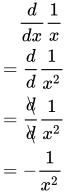
Anomalous cancellation in calculus
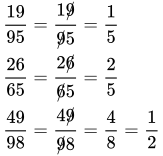
Examples exist of mathematically correct results derived by incorrect lines of reasoning. Such an argument, however true the conclusion appears to be, is mathematically invalid and is commonly known as a howler. The following is an example of a howler involving anomalous cancellation:

Here, although the conclusion 16/64 = 1/4 is correct, there is a fallacious, invalid cancellation in the middle step.[note 1] Another classical example of a howler is proving the Cayley–Hamilton theorem by simply substituting the scalar variables of the characteristic polynomial by the matrix.
Bogus proofs, calculations, or derivations constructed to produce a correct result in spite of incorrect logic or operations were termed «howlers» by Maxwell.[2] Outside the field of mathematics the term howler has various meanings, generally less specific.
Division by zero[edit]
The division-by-zero fallacy has many variants. The following example uses a disguised division by zero to «prove» that 2 = 1, but can be modified to prove that any number equals any other number.
- Let a and b be equal, nonzero quantities
- Multiply by a
- Subtract b2
- Factor both sides: the left factors as a difference of squares, the right is factored by extracting b from both terms
- Divide out (a − b)
- Use the fact that a = b
- Combine like terms on the left
- Divide by the non-zero b






- Q.E.D.[6]
The fallacy is in line 5: the progression from line 4 to line 5 involves division by a − b, which is zero since a = b. Since division by zero is undefined, the argument is invalid.
Analysis[edit]
Mathematical analysis as the mathematical study of change and limits can lead to mathematical fallacies — if the properties of integrals and differentials are ignored. For instance, a naive use of integration by parts can be used to give a false proof that 0 = 1.[7] Letting u = 1/log x and dv = dx/x, we may write:

after which the antiderivatives may be cancelled yielding 0 = 1. The problem is that antiderivatives are only defined up to a constant and shifting them by 1 or indeed any number is allowed. The error really comes to light when we introduce arbitrary integration limits a and b.

Since the difference between two values of a constant function vanishes, the same definite integral appears on both sides of the equation.
Multivalued functions[edit]
Many functions do not have a unique inverse. For instance, while squaring a number gives a unique value, there are two possible square roots of a positive number. The square root is multivalued. One value can be chosen by convention as the principal value; in the case of the square root the non-negative value is the principal value, but there is no guarantee that the square root given as the principal value of the square of a number will be equal to the original number (e.g. the principal square root of the square of −2 is 2). This remains true for nth roots.
Positive and negative roots[edit]
Care must be taken when taking the square root of both sides of an equality. Failing to do so results in a «proof» of[8] 5 = 4.
Proof:
- Start from
- Write this as
- Rewrite as
- Add 81/4 on both sides:
- These are perfect squares:
- Take the square root of both sides:
- Add 9/2 on both sides:
- Q.E.D.




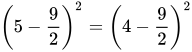


The fallacy is in the second to last line, where the square root of both sides is taken: a2 = b2 only implies a = b if a and b have the same sign, which is not the case here. In this case, it implies that a = –b, so the equation should read
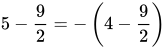
which, by adding 9/2 on both sides, correctly reduces to 5 = 5.
Another example illustrating the danger of taking the square root of both sides of an equation involves the following fundamental identity[9]

which holds as a consequence of the Pythagorean theorem. Then, by taking a square root,

Evaluating this when x = π , we get that
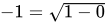
or

which is incorrect.
The error in each of these examples fundamentally lies in the fact that any equation of the form

where  , has two solutions:

and it is essential to check which of these solutions is relevant to the problem at hand.[10] In the above fallacy, the square root that allowed the second equation to be deduced from the first is valid only when cos x is positive. In particular, when x is set to π, the second equation is rendered invalid.
Square roots of negative numbers[edit]
Invalid proofs utilizing powers and roots are often of the following kind:

The fallacy is that the rule 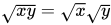 is generally valid only if at least one of
  and
and  is non-negative (when dealing with real numbers), which is not the case here.[11]
Alternatively, imaginary roots are obfuscated in the following:

The error here lies in the third equality, as the rule  only holds for positive real a and real b, c.
Complex exponents[edit]
When a number is raised to a complex power, the result is not uniquely defined (see Exponentiation § Failure of power and logarithm identities). If this property is not recognized, then errors such as the following can result:

The error here is that the rule of multiplying exponents as when going to the third line does not apply unmodified with complex exponents, even if when putting both sides to the power i only the principal value is chosen. When treated as multivalued functions, both sides produce the same set of values, being {e2πn | n ∈ ℤ}.
Geometry[edit]
Many mathematical fallacies in geometry arise from using an additive equality involving oriented quantities (such as adding vectors along a given line or adding oriented angles in the plane) to a valid identity, but which fixes only the absolute value of (one of) these quantities. This quantity is then incorporated into the equation with the wrong orientation, so as to produce an absurd conclusion. This wrong orientation is usually suggested implicitly by supplying an imprecise diagram of the situation, where relative positions of points or lines are chosen in a way that is actually impossible under the hypotheses of the argument, but non-obviously so.
In general, such a fallacy is easy to expose by drawing a precise picture of the situation, in which some relative positions will be different from those in the provided diagram. In order to avoid such fallacies, a correct geometric argument using addition or subtraction of distances or angles should always prove that quantities are being incorporated with their correct orientation.
Fallacy of the isosceles triangle[edit]

The fallacy of the isosceles triangle, from (Maxwell 1959, Chapter II, § 1), purports to show that every triangle is isosceles, meaning that two sides of the triangle are congruent. This fallacy was known to Lewis Carroll and may have been discovered by him. It was published in 1899.[12][13]
Given a triangle △ABC, prove that AB = AC:
- Draw a line bisecting ∠A.
- Draw the perpendicular bisector of segment BC, which bisects BC at a point D.
- Let these two lines meet at a point O.
- Draw line OR perpendicular to AB, line OQ perpendicular to AC.
- Draw lines OB and OC.
- By AAS, △RAO ≅ △QAO (∠ORA = ∠OQA = 90°; ∠RAO = ∠QAO; AO = AO (common side)).
- By RHS,[note 2] △ROB ≅ △QOC (∠BRO = ∠CQO = 90°; BO = OC (hypotenuse); RO = OQ (leg)).
- Thus, AR = AQ, RB = QC, and AB = AR + RB = AQ + QC = AC.
Q.E.D.
As a corollary, one can show that all triangles are equilateral, by showing that AB = BC and AC = BC in the same way.
The error in the proof is the assumption in the diagram that the point O is inside the triangle. In fact, O always lies on the circumcircle of the △ABC (except for isosceles and equilateral triangles where AO and OD coincide). Furthermore, it can be shown that, if AB is longer than AC, then R will lie within AB, while Q will lie outside of AC, and vice versa (in fact, any diagram drawn with sufficiently accurate instruments will verify the above two facts). Because of this, AB is still AR + RB, but AC is actually AQ − QC; and thus the lengths are not necessarily the same.
Proof by induction[edit]
There exist several fallacious proofs by induction in which one of the components, basis case or inductive step, is incorrect. Intuitively, proofs by induction work by arguing that if a statement is true in one case, it is true in the next case, and hence by repeatedly applying this, it can be shown to be true for all cases. The following «proof» shows that all horses are the same colour.[14][note 3]
- Let us say that any group of N horses is all of the same colour.
- If we remove a horse from the group, we have a group of N − 1 horses of the same colour. If we add another horse, we have another group of N horses. By our previous assumption, all the horses are of the same colour in this new group, since it is a group of N horses.
- Thus we have constructed two groups of N horses all of the same colour, with N − 1 horses in common. Since these two groups have some horses in common, the two groups must be of the same colour as each other.
- Therefore, combining all the horses used, we have a group of N + 1 horses of the same colour.
- Thus if any N horses are all the same colour, any N + 1 horses are the same colour.
- This is clearly true for N = 1 (i.e. one horse is a group where all the horses are the same colour). Thus, by induction, N horses are the same colour for any positive integer N. i.e. all horses are the same colour.
The fallacy in this proof arises in line 3. For N = 1, the two groups of horses have N − 1 = 0 horses in common, and thus are not necessarily the same colour as each other, so the group of N + 1 = 2 horses is not necessarily all of the same colour. The implication «every N horses are of the same colour, then N + 1 horses are of the same colour» works for any N > 1, but fails to be true when N = 1. The basis case is correct, but the induction step has a fundamental flaw.
See also[edit]
- Anomalous cancellation – Kind of arithmetic error
- Division by zero – Class of mathematical expression
- List of incomplete proofs
- Mathematical coincidence – Coincidence in mathematics
- Paradox – Statement that apparently contradicts itself
- Proof by intimidation – Marking an argument as obvious or trivial
Notes[edit]
- ^ The same fallacy also applies to the following:

- ^ Hypotenuse–leg congruence
- ^ George Pólya’s original «proof» was that any n girls have the same colour eyes.
References[edit]
- ^ Maxwell 1959, p. 9
- ^ a b Maxwell 1959
- ^ Heath & Heiberg 1908, Chapter II, §I
- ^ Barbeau, Ed (1991). «Fallacies, Flaws, and Flimflam» (PDF). The College Mathematics Journal. 22 (5). ISSN 0746-8342.
- ^ «soft question – Best Fake Proofs? (A M.SE April Fools Day collection)». Mathematics Stack Exchange. Retrieved 2019-10-24.
- ^ Heuser, Harro (1989), Lehrbuch der Analysis – Teil 1 (6th ed.), Teubner, p. 51, ISBN 978-3-8351-0131-9
- ^ Barbeau, Ed (1990), «Fallacies, Flaws and Flimflam #19: Dolt’s Theorem», The College Mathematics Journal, 21 (3): 216–218, doi:10.1080/07468342.1990.11973308
- ^ Frohlichstein, Jack (1967). Mathematical Fun, Games and Puzzles (illustrated ed.). Courier Corporation. p. 207. ISBN 0-486-20789-7. Extract of page 207
- ^ Maxwell 1959, Chapter VI, §I.1
- ^ Maxwell 1959, Chapter VI, §II
- ^ Nahin, Paul J. (2010). An Imaginary Tale: The Story of «i«. Princeton University Press. p. 12. ISBN 978-1-4008-3029-9. Extract of page 12
- ^ S.D.Collingwood, ed. (1899), The Lewis Carroll Picture Book, Collins, pp. 190–191
- ^ Robin Wilson (2008), Lewis Carroll in Numberland, Penguin Books, pp. 169–170, ISBN 978-0-14-101610-8
- ^ Pólya, George (1954). Induction and Analogy in Mathematics. Mathematics and plausible reasoning. Vol. 1. Princeton. p. 120.
- Barbeau, Edward J. (2000), Mathematical fallacies, flaws, and flimflam, MAA Spectrum, Mathematical Association of America, ISBN 978-0-88385-529-4, MR 1725831.
- Bunch, Bryan (1997), Mathematical fallacies and paradoxes, New York: Dover Publications, ISBN 978-0-486-29664-7, MR 1461270.
- Heath, Sir Thomas Little; Heiberg, Johan Ludvig (1908), The thirteen books of Euclid’s Elements, Volume 1, The University Press.
- Maxwell, E. A. (1959), Fallacies in mathematics, Cambridge University Press, ISBN 0-521-05700-0, MR 0099907.
External links[edit]
- Invalid proofs at Cut-the-knot (including literature references)
- Classic fallacies with some discussion
- More invalid proofs from AhaJokes.com
- Math jokes including an invalid proof
From Wikipedia, the free encyclopedia
«Invalid proof» redirects here. For any type of invalid proof besides mathematics, see Fallacy.
«0 = 1» redirects here. For the algebraic structure where this equality holds, see Null ring.
In mathematics, certain kinds of mistaken proof are often exhibited, and sometimes collected, as illustrations of a concept called mathematical fallacy. There is a distinction between a simple mistake and a mathematical fallacy in a proof, in that a mistake in a proof leads to an invalid proof while in the best-known examples of mathematical fallacies there is some element of concealment or deception in the presentation of the proof.
For example, the reason why validity fails may be attributed to a division by zero that is hidden by algebraic notation. There is a certain quality of the mathematical fallacy: as typically presented, it leads not only to an absurd result, but does so in a crafty or clever way.[1] Therefore, these fallacies, for pedagogic reasons, usually take the form of spurious proofs of obvious contradictions. Although the proofs are flawed, the errors, usually by design, are comparatively subtle, or designed to show that certain steps are conditional, and are not applicable in the cases that are the exceptions to the rules.
The traditional way of presenting a mathematical fallacy is to give an invalid step of deduction mixed in with valid steps, so that the meaning of fallacy is here slightly different from the logical fallacy. The latter usually applies to a form of argument that does not comply with the valid inference rules of logic, whereas the problematic mathematical step is typically a correct rule applied with a tacit wrong assumption. Beyond pedagogy, the resolution of a fallacy can lead to deeper insights into a subject (e.g., the introduction of Pasch’s axiom of Euclidean geometry,[2] the five colour theorem of graph theory). Pseudaria, an ancient lost book of false proofs, is attributed to Euclid.[3]
Mathematical fallacies exist in many branches of mathematics. In elementary algebra, typical examples may involve a step where division by zero is performed, where a root is incorrectly extracted or, more generally, where different values of a multiple valued function are equated. Well-known fallacies also exist in elementary Euclidean geometry and calculus.[4][5]
Howlers[edit]
Anomalous cancellation in calculus
Examples exist of mathematically correct results derived by incorrect lines of reasoning. Such an argument, however true the conclusion appears to be, is mathematically invalid and is commonly known as a howler. The following is an example of a howler involving anomalous cancellation:
Here, although the conclusion 16/64 = 1/4 is correct, there is a fallacious, invalid cancellation in the middle step.[note 1] Another classical example of a howler is proving the Cayley–Hamilton theorem by simply substituting the scalar variables of the characteristic polynomial by the matrix.
Bogus proofs, calculations, or derivations constructed to produce a correct result in spite of incorrect logic or operations were termed «howlers» by Maxwell.[2] Outside the field of mathematics the term howler has various meanings, generally less specific.
Division by zero[edit]
The division-by-zero fallacy has many variants. The following example uses a disguised division by zero to «prove» that 2 = 1, but can be modified to prove that any number equals any other number.
- Let a and b be equal, nonzero quantities
- Multiply by a
- Subtract b2
- Factor both sides: the left factors as a difference of squares, the right is factored by extracting b from both terms
- Divide out (a − b)
- Use the fact that a = b
- Combine like terms on the left
- Divide by the non-zero b
- Q.E.D.[6]
The fallacy is in line 5: the progression from line 4 to line 5 involves division by a − b, which is zero since a = b. Since division by zero is undefined, the argument is invalid.
Analysis[edit]
Mathematical analysis as the mathematical study of change and limits can lead to mathematical fallacies — if the properties of integrals and differentials are ignored. For instance, a naive use of integration by parts can be used to give a false proof that 0 = 1.[7] Letting u = 1/log x and dv = dx/x, we may write:
after which the antiderivatives may be cancelled yielding 0 = 1. The problem is that antiderivatives are only defined up to a constant and shifting them by 1 or indeed any number is allowed. The error really comes to light when we introduce arbitrary integration limits a and b.
Since the difference between two values of a constant function vanishes, the same definite integral appears on both sides of the equation.
Multivalued functions[edit]
Many functions do not have a unique inverse. For instance, while squaring a number gives a unique value, there are two possible square roots of a positive number. The square root is multivalued. One value can be chosen by convention as the principal value; in the case of the square root the non-negative value is the principal value, but there is no guarantee that the square root given as the principal value of the square of a number will be equal to the original number (e.g. the principal square root of the square of −2 is 2). This remains true for nth roots.
Positive and negative roots[edit]
Care must be taken when taking the square root of both sides of an equality. Failing to do so results in a «proof» of[8] 5 = 4.
Proof:
- Start from
- Write this as
- Rewrite as
- Add 81/4 on both sides:
- These are perfect squares:
- Take the square root of both sides:
- Add 9/2 on both sides:
- Q.E.D.
The fallacy is in the second to last line, where the square root of both sides is taken: a2 = b2 only implies a = b if a and b have the same sign, which is not the case here. In this case, it implies that a = –b, so the equation should read
which, by adding 9/2 on both sides, correctly reduces to 5 = 5.
Another example illustrating the danger of taking the square root of both sides of an equation involves the following fundamental identity[9]
which holds as a consequence of the Pythagorean theorem. Then, by taking a square root,
Evaluating this when x = π , we get that
or
which is incorrect.
The error in each of these examples fundamentally lies in the fact that any equation of the form
where , has two solutions:
and it is essential to check which of these solutions is relevant to the problem at hand.[10] In the above fallacy, the square root that allowed the second equation to be deduced from the first is valid only when cos x is positive. In particular, when x is set to π, the second equation is rendered invalid.
Square roots of negative numbers[edit]
Invalid proofs utilizing powers and roots are often of the following kind:
The fallacy is that the rule is generally valid only if at least one of and is non-negative (when dealing with real numbers), which is not the case here.[11]
Alternatively, imaginary roots are obfuscated in the following:
The error here lies in the third equality, as the rule only holds for positive real a and real b, c.
Complex exponents[edit]
When a number is raised to a complex power, the result is not uniquely defined (see Exponentiation § Failure of power and logarithm identities). If this property is not recognized, then errors such as the following can result:
The error here is that the rule of multiplying exponents as when going to the third line does not apply unmodified with complex exponents, even if when putting both sides to the power i only the principal value is chosen. When treated as multivalued functions, both sides produce the same set of values, being {e2πn | n ∈ ℤ}.
Geometry[edit]
Many mathematical fallacies in geometry arise from using an additive equality involving oriented quantities (such as adding vectors along a given line or adding oriented angles in the plane) to a valid identity, but which fixes only the absolute value of (one of) these quantities. This quantity is then incorporated into the equation with the wrong orientation, so as to produce an absurd conclusion. This wrong orientation is usually suggested implicitly by supplying an imprecise diagram of the situation, where relative positions of points or lines are chosen in a way that is actually impossible under the hypotheses of the argument, but non-obviously so.
In general, such a fallacy is easy to expose by drawing a precise picture of the situation, in which some relative positions will be different from those in the provided diagram. In order to avoid such fallacies, a correct geometric argument using addition or subtraction of distances or angles should always prove that quantities are being incorporated with their correct orientation.
Fallacy of the isosceles triangle[edit]
The fallacy of the isosceles triangle, from (Maxwell 1959, Chapter II, § 1), purports to show that every triangle is isosceles, meaning that two sides of the triangle are congruent. This fallacy was known to Lewis Carroll and may have been discovered by him. It was published in 1899.[12][13]
Given a triangle △ABC, prove that AB = AC:
- Draw a line bisecting ∠A.
- Draw the perpendicular bisector of segment BC, which bisects BC at a point D.
- Let these two lines meet at a point O.
- Draw line OR perpendicular to AB, line OQ perpendicular to AC.
- Draw lines OB and OC.
- By AAS, △RAO ≅ △QAO (∠ORA = ∠OQA = 90°; ∠RAO = ∠QAO; AO = AO (common side)).
- By RHS,[note 2] △ROB ≅ △QOC (∠BRO = ∠CQO = 90°; BO = OC (hypotenuse); RO = OQ (leg)).
- Thus, AR = AQ, RB = QC, and AB = AR + RB = AQ + QC = AC.
Q.E.D.
As a corollary, one can show that all triangles are equilateral, by showing that AB = BC and AC = BC in the same way.
The error in the proof is the assumption in the diagram that the point O is inside the triangle. In fact, O always lies on the circumcircle of the △ABC (except for isosceles and equilateral triangles where AO and OD coincide). Furthermore, it can be shown that, if AB is longer than AC, then R will lie within AB, while Q will lie outside of AC, and vice versa (in fact, any diagram drawn with sufficiently accurate instruments will verify the above two facts). Because of this, AB is still AR + RB, but AC is actually AQ − QC; and thus the lengths are not necessarily the same.
Proof by induction[edit]
There exist several fallacious proofs by induction in which one of the components, basis case or inductive step, is incorrect. Intuitively, proofs by induction work by arguing that if a statement is true in one case, it is true in the next case, and hence by repeatedly applying this, it can be shown to be true for all cases. The following «proof» shows that all horses are the same colour.[14][note 3]
- Let us say that any group of N horses is all of the same colour.
- If we remove a horse from the group, we have a group of N − 1 horses of the same colour. If we add another horse, we have another group of N horses. By our previous assumption, all the horses are of the same colour in this new group, since it is a group of N horses.
- Thus we have constructed two groups of N horses all of the same colour, with N − 1 horses in common. Since these two groups have some horses in common, the two groups must be of the same colour as each other.
- Therefore, combining all the horses used, we have a group of N + 1 horses of the same colour.
- Thus if any N horses are all the same colour, any N + 1 horses are the same colour.
- This is clearly true for N = 1 (i.e. one horse is a group where all the horses are the same colour). Thus, by induction, N horses are the same colour for any positive integer N. i.e. all horses are the same colour.
The fallacy in this proof arises in line 3. For N = 1, the two groups of horses have N − 1 = 0 horses in common, and thus are not necessarily the same colour as each other, so the group of N + 1 = 2 horses is not necessarily all of the same colour. The implication «every N horses are of the same colour, then N + 1 horses are of the same colour» works for any N > 1, but fails to be true when N = 1. The basis case is correct, but the induction step has a fundamental flaw.
See also[edit]
- Anomalous cancellation – Kind of arithmetic error
- Division by zero – Class of mathematical expression
- List of incomplete proofs
- Mathematical coincidence – Coincidence in mathematics
- Paradox – Statement that apparently contradicts itself
- Proof by intimidation – Marking an argument as obvious or trivial
Notes[edit]
- ^ The same fallacy also applies to the following:
- ^ Hypotenuse–leg congruence
- ^ George Pólya’s original «proof» was that any n girls have the same colour eyes.
References[edit]
- ^ Maxwell 1959, p. 9
- ^ a b Maxwell 1959
- ^ Heath & Heiberg 1908, Chapter II, §I
- ^ Barbeau, Ed (1991). «Fallacies, Flaws, and Flimflam» (PDF). The College Mathematics Journal. 22 (5). ISSN 0746-8342.
- ^ «soft question – Best Fake Proofs? (A M.SE April Fools Day collection)». Mathematics Stack Exchange. Retrieved 2019-10-24.
- ^ Heuser, Harro (1989), Lehrbuch der Analysis – Teil 1 (6th ed.), Teubner, p. 51, ISBN 978-3-8351-0131-9
- ^ Barbeau, Ed (1990), «Fallacies, Flaws and Flimflam #19: Dolt’s Theorem», The College Mathematics Journal, 21 (3): 216–218, doi:10.1080/07468342.1990.11973308
- ^ Frohlichstein, Jack (1967). Mathematical Fun, Games and Puzzles (illustrated ed.). Courier Corporation. p. 207. ISBN 0-486-20789-7. Extract of page 207
- ^ Maxwell 1959, Chapter VI, §I.1
- ^ Maxwell 1959, Chapter VI, §II
- ^ Nahin, Paul J. (2010). An Imaginary Tale: The Story of «i«. Princeton University Press. p. 12. ISBN 978-1-4008-3029-9. Extract of page 12
- ^ S.D.Collingwood, ed. (1899), The Lewis Carroll Picture Book, Collins, pp. 190–191
- ^ Robin Wilson (2008), Lewis Carroll in Numberland, Penguin Books, pp. 169–170, ISBN 978-0-14-101610-8
- ^ Pólya, George (1954). Induction and Analogy in Mathematics. Mathematics and plausible reasoning. Vol. 1. Princeton. p. 120.
- Barbeau, Edward J. (2000), Mathematical fallacies, flaws, and flimflam, MAA Spectrum, Mathematical Association of America, ISBN 978-0-88385-529-4, MR 1725831.
- Bunch, Bryan (1997), Mathematical fallacies and paradoxes, New York: Dover Publications, ISBN 978-0-486-29664-7, MR 1461270.
- Heath, Sir Thomas Little; Heiberg, Johan Ludvig (1908), The thirteen books of Euclid’s Elements, Volume 1, The University Press.
- Maxwell, E. A. (1959), Fallacies in mathematics, Cambridge University Press, ISBN 0-521-05700-0, MR 0099907.
External links[edit]
- Invalid proofs at Cut-the-knot (including literature references)
- Classic fallacies with some discussion
- More invalid proofs from AhaJokes.com
- Math jokes including an invalid proof
From Wikipedia, the free encyclopedia
«Invalid proof» redirects here. For any type of invalid proof besides mathematics, see Fallacy.
«0 = 1» redirects here. For the algebraic structure where this equality holds, see Null ring.
In mathematics, certain kinds of mistaken proof are often exhibited, and sometimes collected, as illustrations of a concept called mathematical fallacy. There is a distinction between a simple mistake and a mathematical fallacy in a proof, in that a mistake in a proof leads to an invalid proof while in the best-known examples of mathematical fallacies there is some element of concealment or deception in the presentation of the proof.
For example, the reason why validity fails may be attributed to a division by zero that is hidden by algebraic notation. There is a certain quality of the mathematical fallacy: as typically presented, it leads not only to an absurd result, but does so in a crafty or clever way.[1] Therefore, these fallacies, for pedagogic reasons, usually take the form of spurious proofs of obvious contradictions. Although the proofs are flawed, the errors, usually by design, are comparatively subtle, or designed to show that certain steps are conditional, and are not applicable in the cases that are the exceptions to the rules.
The traditional way of presenting a mathematical fallacy is to give an invalid step of deduction mixed in with valid steps, so that the meaning of fallacy is here slightly different from the logical fallacy. The latter usually applies to a form of argument that does not comply with the valid inference rules of logic, whereas the problematic mathematical step is typically a correct rule applied with a tacit wrong assumption. Beyond pedagogy, the resolution of a fallacy can lead to deeper insights into a subject (e.g., the introduction of Pasch’s axiom of Euclidean geometry,[2] the five colour theorem of graph theory). Pseudaria, an ancient lost book of false proofs, is attributed to Euclid.[3]
Mathematical fallacies exist in many branches of mathematics. In elementary algebra, typical examples may involve a step where division by zero is performed, where a root is incorrectly extracted or, more generally, where different values of a multiple valued function are equated. Well-known fallacies also exist in elementary Euclidean geometry and calculus.[4][5]
Howlers[edit]
Anomalous cancellation in calculus
Examples exist of mathematically correct results derived by incorrect lines of reasoning. Such an argument, however true the conclusion appears to be, is mathematically invalid and is commonly known as a howler. The following is an example of a howler involving anomalous cancellation:
Here, although the conclusion 16/64 = 1/4 is correct, there is a fallacious, invalid cancellation in the middle step.[note 1] Another classical example of a howler is proving the Cayley–Hamilton theorem by simply substituting the scalar variables of the characteristic polynomial by the matrix.
Bogus proofs, calculations, or derivations constructed to produce a correct result in spite of incorrect logic or operations were termed «howlers» by Maxwell.[2] Outside the field of mathematics the term howler has various meanings, generally less specific.
Division by zero[edit]
The division-by-zero fallacy has many variants. The following example uses a disguised division by zero to «prove» that 2 = 1, but can be modified to prove that any number equals any other number.
- Let a and b be equal, nonzero quantities
- Multiply by a
- Subtract b2
- Factor both sides: the left factors as a difference of squares, the right is factored by extracting b from both terms
- Divide out (a − b)
- Use the fact that a = b
- Combine like terms on the left
- Divide by the non-zero b
- Q.E.D.[6]
The fallacy is in line 5: the progression from line 4 to line 5 involves division by a − b, which is zero since a = b. Since division by zero is undefined, the argument is invalid.
Analysis[edit]
Mathematical analysis as the mathematical study of change and limits can lead to mathematical fallacies — if the properties of integrals and differentials are ignored. For instance, a naive use of integration by parts can be used to give a false proof that 0 = 1.[7] Letting u = 1/log x and dv = dx/x, we may write:
after which the antiderivatives may be cancelled yielding 0 = 1. The problem is that antiderivatives are only defined up to a constant and shifting them by 1 or indeed any number is allowed. The error really comes to light when we introduce arbitrary integration limits a and b.
Since the difference between two values of a constant function vanishes, the same definite integral appears on both sides of the equation.
Multivalued functions[edit]
Many functions do not have a unique inverse. For instance, while squaring a number gives a unique value, there are two possible square roots of a positive number. The square root is multivalued. One value can be chosen by convention as the principal value; in the case of the square root the non-negative value is the principal value, but there is no guarantee that the square root given as the principal value of the square of a number will be equal to the original number (e.g. the principal square root of the square of −2 is 2). This remains true for nth roots.
Positive and negative roots[edit]
Care must be taken when taking the square root of both sides of an equality. Failing to do so results in a «proof» of[8] 5 = 4.
Proof:
- Start from
- Write this as
- Rewrite as
- Add 81/4 on both sides:
- These are perfect squares:
- Take the square root of both sides:
- Add 9/2 on both sides:
- Q.E.D.
The fallacy is in the second to last line, where the square root of both sides is taken: a2 = b2 only implies a = b if a and b have the same sign, which is not the case here. In this case, it implies that a = –b, so the equation should read
which, by adding 9/2 on both sides, correctly reduces to 5 = 5.
Another example illustrating the danger of taking the square root of both sides of an equation involves the following fundamental identity[9]
which holds as a consequence of the Pythagorean theorem. Then, by taking a square root,
Evaluating this when x = π , we get that
or
which is incorrect.
The error in each of these examples fundamentally lies in the fact that any equation of the form
where , has two solutions:
and it is essential to check which of these solutions is relevant to the problem at hand.[10] In the above fallacy, the square root that allowed the second equation to be deduced from the first is valid only when cos x is positive. In particular, when x is set to π, the second equation is rendered invalid.
Square roots of negative numbers[edit]
Invalid proofs utilizing powers and roots are often of the following kind:
The fallacy is that the rule is generally valid only if at least one of and is non-negative (when dealing with real numbers), which is not the case here.[11]
Alternatively, imaginary roots are obfuscated in the following:
The error here lies in the third equality, as the rule only holds for positive real a and real b, c.
Complex exponents[edit]
When a number is raised to a complex power, the result is not uniquely defined (see Exponentiation § Failure of power and logarithm identities). If this property is not recognized, then errors such as the following can result:
The error here is that the rule of multiplying exponents as when going to the third line does not apply unmodified with complex exponents, even if when putting both sides to the power i only the principal value is chosen. When treated as multivalued functions, both sides produce the same set of values, being {e2πn | n ∈ ℤ}.
Geometry[edit]
Many mathematical fallacies in geometry arise from using an additive equality involving oriented quantities (such as adding vectors along a given line or adding oriented angles in the plane) to a valid identity, but which fixes only the absolute value of (one of) these quantities. This quantity is then incorporated into the equation with the wrong orientation, so as to produce an absurd conclusion. This wrong orientation is usually suggested implicitly by supplying an imprecise diagram of the situation, where relative positions of points or lines are chosen in a way that is actually impossible under the hypotheses of the argument, but non-obviously so.
In general, such a fallacy is easy to expose by drawing a precise picture of the situation, in which some relative positions will be different from those in the provided diagram. In order to avoid such fallacies, a correct geometric argument using addition or subtraction of distances or angles should always prove that quantities are being incorporated with their correct orientation.
Fallacy of the isosceles triangle[edit]
The fallacy of the isosceles triangle, from (Maxwell 1959, Chapter II, § 1), purports to show that every triangle is isosceles, meaning that two sides of the triangle are congruent. This fallacy was known to Lewis Carroll and may have been discovered by him. It was published in 1899.[12][13]
Given a triangle △ABC, prove that AB = AC:
- Draw a line bisecting ∠A.
- Draw the perpendicular bisector of segment BC, which bisects BC at a point D.
- Let these two lines meet at a point O.
- Draw line OR perpendicular to AB, line OQ perpendicular to AC.
- Draw lines OB and OC.
- By AAS, △RAO ≅ △QAO (∠ORA = ∠OQA = 90°; ∠RAO = ∠QAO; AO = AO (common side)).
- By RHS,[note 2] △ROB ≅ △QOC (∠BRO = ∠CQO = 90°; BO = OC (hypotenuse); RO = OQ (leg)).
- Thus, AR = AQ, RB = QC, and AB = AR + RB = AQ + QC = AC.
Q.E.D.
As a corollary, one can show that all triangles are equilateral, by showing that AB = BC and AC = BC in the same way.
The error in the proof is the assumption in the diagram that the point O is inside the triangle. In fact, O always lies on the circumcircle of the △ABC (except for isosceles and equilateral triangles where AO and OD coincide). Furthermore, it can be shown that, if AB is longer than AC, then R will lie within AB, while Q will lie outside of AC, and vice versa (in fact, any diagram drawn with sufficiently accurate instruments will verify the above two facts). Because of this, AB is still AR + RB, but AC is actually AQ − QC; and thus the lengths are not necessarily the same.
Proof by induction[edit]
There exist several fallacious proofs by induction in which one of the components, basis case or inductive step, is incorrect. Intuitively, proofs by induction work by arguing that if a statement is true in one case, it is true in the next case, and hence by repeatedly applying this, it can be shown to be true for all cases. The following «proof» shows that all horses are the same colour.[14][note 3]
- Let us say that any group of N horses is all of the same colour.
- If we remove a horse from the group, we have a group of N − 1 horses of the same colour. If we add another horse, we have another group of N horses. By our previous assumption, all the horses are of the same colour in this new group, since it is a group of N horses.
- Thus we have constructed two groups of N horses all of the same colour, with N − 1 horses in common. Since these two groups have some horses in common, the two groups must be of the same colour as each other.
- Therefore, combining all the horses used, we have a group of N + 1 horses of the same colour.
- Thus if any N horses are all the same colour, any N + 1 horses are the same colour.
- This is clearly true for N = 1 (i.e. one horse is a group where all the horses are the same colour). Thus, by induction, N horses are the same colour for any positive integer N. i.e. all horses are the same colour.
The fallacy in this proof arises in line 3. For N = 1, the two groups of horses have N − 1 = 0 horses in common, and thus are not necessarily the same colour as each other, so the group of N + 1 = 2 horses is not necessarily all of the same colour. The implication «every N horses are of the same colour, then N + 1 horses are of the same colour» works for any N > 1, but fails to be true when N = 1. The basis case is correct, but the induction step has a fundamental flaw.
See also[edit]
- Anomalous cancellation – Kind of arithmetic error
- Division by zero – Class of mathematical expression
- List of incomplete proofs
- Mathematical coincidence – Coincidence in mathematics
- Paradox – Statement that apparently contradicts itself
- Proof by intimidation – Marking an argument as obvious or trivial
Notes[edit]
- ^ The same fallacy also applies to the following:
- ^ Hypotenuse–leg congruence
- ^ George Pólya’s original «proof» was that any n girls have the same colour eyes.
References[edit]
- ^ Maxwell 1959, p. 9
- ^ a b Maxwell 1959
- ^ Heath & Heiberg 1908, Chapter II, §I
- ^ Barbeau, Ed (1991). «Fallacies, Flaws, and Flimflam» (PDF). The College Mathematics Journal. 22 (5). ISSN 0746-8342.
- ^ «soft question – Best Fake Proofs? (A M.SE April Fools Day collection)». Mathematics Stack Exchange. Retrieved 2019-10-24.
- ^ Heuser, Harro (1989), Lehrbuch der Analysis – Teil 1 (6th ed.), Teubner, p. 51, ISBN 978-3-8351-0131-9
- ^ Barbeau, Ed (1990), «Fallacies, Flaws and Flimflam #19: Dolt’s Theorem», The College Mathematics Journal, 21 (3): 216–218, doi:10.1080/07468342.1990.11973308
- ^ Frohlichstein, Jack (1967). Mathematical Fun, Games and Puzzles (illustrated ed.). Courier Corporation. p. 207. ISBN 0-486-20789-7. Extract of page 207
- ^ Maxwell 1959, Chapter VI, §I.1
- ^ Maxwell 1959, Chapter VI, §II
- ^ Nahin, Paul J. (2010). An Imaginary Tale: The Story of «i«. Princeton University Press. p. 12. ISBN 978-1-4008-3029-9. Extract of page 12
- ^ S.D.Collingwood, ed. (1899), The Lewis Carroll Picture Book, Collins, pp. 190–191
- ^ Robin Wilson (2008), Lewis Carroll in Numberland, Penguin Books, pp. 169–170, ISBN 978-0-14-101610-8
- ^ Pólya, George (1954). Induction and Analogy in Mathematics. Mathematics and plausible reasoning. Vol. 1. Princeton. p. 120.
- Barbeau, Edward J. (2000), Mathematical fallacies, flaws, and flimflam, MAA Spectrum, Mathematical Association of America, ISBN 978-0-88385-529-4, MR 1725831.
- Bunch, Bryan (1997), Mathematical fallacies and paradoxes, New York: Dover Publications, ISBN 978-0-486-29664-7, MR 1461270.
- Heath, Sir Thomas Little; Heiberg, Johan Ludvig (1908), The thirteen books of Euclid’s Elements, Volume 1, The University Press.
- Maxwell, E. A. (1959), Fallacies in mathematics, Cambridge University Press, ISBN 0-521-05700-0, MR 0099907.
External links[edit]
- Invalid proofs at Cut-the-knot (including literature references)
- Classic fallacies with some discussion
- More invalid proofs from AhaJokes.com
- Math jokes including an invalid proof
From Wikipedia, the free encyclopedia
«Invalid proof» redirects here. For any type of invalid proof besides mathematics, see Fallacy.
«0 = 1» redirects here. For the algebraic structure where this equality holds, see Null ring.
In mathematics, certain kinds of mistaken proof are often exhibited, and sometimes collected, as illustrations of a concept called mathematical fallacy. There is a distinction between a simple mistake and a mathematical fallacy in a proof, in that a mistake in a proof leads to an invalid proof while in the best-known examples of mathematical fallacies there is some element of concealment or deception in the presentation of the proof.
For example, the reason why validity fails may be attributed to a division by zero that is hidden by algebraic notation. There is a certain quality of the mathematical fallacy: as typically presented, it leads not only to an absurd result, but does so in a crafty or clever way.[1] Therefore, these fallacies, for pedagogic reasons, usually take the form of spurious proofs of obvious contradictions. Although the proofs are flawed, the errors, usually by design, are comparatively subtle, or designed to show that certain steps are conditional, and are not applicable in the cases that are the exceptions to the rules.
The traditional way of presenting a mathematical fallacy is to give an invalid step of deduction mixed in with valid steps, so that the meaning of fallacy is here slightly different from the logical fallacy. The latter usually applies to a form of argument that does not comply with the valid inference rules of logic, whereas the problematic mathematical step is typically a correct rule applied with a tacit wrong assumption. Beyond pedagogy, the resolution of a fallacy can lead to deeper insights into a subject (e.g., the introduction of Pasch’s axiom of Euclidean geometry,[2] the five colour theorem of graph theory). Pseudaria, an ancient lost book of false proofs, is attributed to Euclid.[3]
Mathematical fallacies exist in many branches of mathematics. In elementary algebra, typical examples may involve a step where division by zero is performed, where a root is incorrectly extracted or, more generally, where different values of a multiple valued function are equated. Well-known fallacies also exist in elementary Euclidean geometry and calculus.[4][5]
Howlers[edit]
Anomalous cancellation in calculus
Examples exist of mathematically correct results derived by incorrect lines of reasoning. Such an argument, however true the conclusion appears to be, is mathematically invalid and is commonly known as a howler. The following is an example of a howler involving anomalous cancellation:
Here, although the conclusion 16/64 = 1/4 is correct, there is a fallacious, invalid cancellation in the middle step.[note 1] Another classical example of a howler is proving the Cayley–Hamilton theorem by simply substituting the scalar variables of the characteristic polynomial by the matrix.
Bogus proofs, calculations, or derivations constructed to produce a correct result in spite of incorrect logic or operations were termed «howlers» by Maxwell.[2] Outside the field of mathematics the term howler has various meanings, generally less specific.
Division by zero[edit]
The division-by-zero fallacy has many variants. The following example uses a disguised division by zero to «prove» that 2 = 1, but can be modified to prove that any number equals any other number.
- Let a and b be equal, nonzero quantities
- Multiply by a
- Subtract b2
- Factor both sides: the left factors as a difference of squares, the right is factored by extracting b from both terms
- Divide out (a − b)
- Use the fact that a = b
- Combine like terms on the left
- Divide by the non-zero b
- Q.E.D.[6]
The fallacy is in line 5: the progression from line 4 to line 5 involves division by a − b, which is zero since a = b. Since division by zero is undefined, the argument is invalid.
Analysis[edit]
Mathematical analysis as the mathematical study of change and limits can lead to mathematical fallacies — if the properties of integrals and differentials are ignored. For instance, a naive use of integration by parts can be used to give a false proof that 0 = 1.[7] Letting u = 1/log x and dv = dx/x, we may write:
after which the antiderivatives may be cancelled yielding 0 = 1. The problem is that antiderivatives are only defined up to a constant and shifting them by 1 or indeed any number is allowed. The error really comes to light when we introduce arbitrary integration limits a and b.
Since the difference between two values of a constant function vanishes, the same definite integral appears on both sides of the equation.
Multivalued functions[edit]
Many functions do not have a unique inverse. For instance, while squaring a number gives a unique value, there are two possible square roots of a positive number. The square root is multivalued. One value can be chosen by convention as the principal value; in the case of the square root the non-negative value is the principal value, but there is no guarantee that the square root given as the principal value of the square of a number will be equal to the original number (e.g. the principal square root of the square of −2 is 2). This remains true for nth roots.
Positive and negative roots[edit]
Care must be taken when taking the square root of both sides of an equality. Failing to do so results in a «proof» of[8] 5 = 4.
Proof:
- Start from
- Write this as
- Rewrite as
- Add 81/4 on both sides:
- These are perfect squares:
- Take the square root of both sides:
- Add 9/2 on both sides:
- Q.E.D.
The fallacy is in the second to last line, where the square root of both sides is taken: a2 = b2 only implies a = b if a and b have the same sign, which is not the case here. In this case, it implies that a = –b, so the equation should read
which, by adding 9/2 on both sides, correctly reduces to 5 = 5.
Another example illustrating the danger of taking the square root of both sides of an equation involves the following fundamental identity[9]
which holds as a consequence of the Pythagorean theorem. Then, by taking a square root,
Evaluating this when x = π , we get that
or
which is incorrect.
The error in each of these examples fundamentally lies in the fact that any equation of the form
where , has two solutions:
and it is essential to check which of these solutions is relevant to the problem at hand.[10] In the above fallacy, the square root that allowed the second equation to be deduced from the first is valid only when cos x is positive. In particular, when x is set to π, the second equation is rendered invalid.
Square roots of negative numbers[edit]
Invalid proofs utilizing powers and roots are often of the following kind:
The fallacy is that the rule is generally valid only if at least one of and is non-negative (when dealing with real numbers), which is not the case here.[11]
Alternatively, imaginary roots are obfuscated in the following:
The error here lies in the third equality, as the rule only holds for positive real a and real b, c.
Complex exponents[edit]
When a number is raised to a complex power, the result is not uniquely defined (see Exponentiation § Failure of power and logarithm identities). If this property is not recognized, then errors such as the following can result:
The error here is that the rule of multiplying exponents as when going to the third line does not apply unmodified with complex exponents, even if when putting both sides to the power i only the principal value is chosen. When treated as multivalued functions, both sides produce the same set of values, being {e2πn | n ∈ ℤ}.
Geometry[edit]
Many mathematical fallacies in geometry arise from using an additive equality involving oriented quantities (such as adding vectors along a given line or adding oriented angles in the plane) to a valid identity, but which fixes only the absolute value of (one of) these quantities. This quantity is then incorporated into the equation with the wrong orientation, so as to produce an absurd conclusion. This wrong orientation is usually suggested implicitly by supplying an imprecise diagram of the situation, where relative positions of points or lines are chosen in a way that is actually impossible under the hypotheses of the argument, but non-obviously so.
In general, such a fallacy is easy to expose by drawing a precise picture of the situation, in which some relative positions will be different from those in the provided diagram. In order to avoid such fallacies, a correct geometric argument using addition or subtraction of distances or angles should always prove that quantities are being incorporated with their correct orientation.
Fallacy of the isosceles triangle[edit]
The fallacy of the isosceles triangle, from (Maxwell 1959, Chapter II, § 1), purports to show that every triangle is isosceles, meaning that two sides of the triangle are congruent. This fallacy was known to Lewis Carroll and may have been discovered by him. It was published in 1899.[12][13]
Given a triangle △ABC, prove that AB = AC:
- Draw a line bisecting ∠A.
- Draw the perpendicular bisector of segment BC, which bisects BC at a point D.
- Let these two lines meet at a point O.
- Draw line OR perpendicular to AB, line OQ perpendicular to AC.
- Draw lines OB and OC.
- By AAS, △RAO ≅ △QAO (∠ORA = ∠OQA = 90°; ∠RAO = ∠QAO; AO = AO (common side)).
- By RHS,[note 2] △ROB ≅ △QOC (∠BRO = ∠CQO = 90°; BO = OC (hypotenuse); RO = OQ (leg)).
- Thus, AR = AQ, RB = QC, and AB = AR + RB = AQ + QC = AC.
Q.E.D.
As a corollary, one can show that all triangles are equilateral, by showing that AB = BC and AC = BC in the same way.
The error in the proof is the assumption in the diagram that the point O is inside the triangle. In fact, O always lies on the circumcircle of the △ABC (except for isosceles and equilateral triangles where AO and OD coincide). Furthermore, it can be shown that, if AB is longer than AC, then R will lie within AB, while Q will lie outside of AC, and vice versa (in fact, any diagram drawn with sufficiently accurate instruments will verify the above two facts). Because of this, AB is still AR + RB, but AC is actually AQ − QC; and thus the lengths are not necessarily the same.
Proof by induction[edit]
There exist several fallacious proofs by induction in which one of the components, basis case or inductive step, is incorrect. Intuitively, proofs by induction work by arguing that if a statement is true in one case, it is true in the next case, and hence by repeatedly applying this, it can be shown to be true for all cases. The following «proof» shows that all horses are the same colour.[14][note 3]
- Let us say that any group of N horses is all of the same colour.
- If we remove a horse from the group, we have a group of N − 1 horses of the same colour. If we add another horse, we have another group of N horses. By our previous assumption, all the horses are of the same colour in this new group, since it is a group of N horses.
- Thus we have constructed two groups of N horses all of the same colour, with N − 1 horses in common. Since these two groups have some horses in common, the two groups must be of the same colour as each other.
- Therefore, combining all the horses used, we have a group of N + 1 horses of the same colour.
- Thus if any N horses are all the same colour, any N + 1 horses are the same colour.
- This is clearly true for N = 1 (i.e. one horse is a group where all the horses are the same colour). Thus, by induction, N horses are the same colour for any positive integer N. i.e. all horses are the same colour.
The fallacy in this proof arises in line 3. For N = 1, the two groups of horses have N − 1 = 0 horses in common, and thus are not necessarily the same colour as each other, so the group of N + 1 = 2 horses is not necessarily all of the same colour. The implication «every N horses are of the same colour, then N + 1 horses are of the same colour» works for any N > 1, but fails to be true when N = 1. The basis case is correct, but the induction step has a fundamental flaw.
See also[edit]
- Anomalous cancellation – Kind of arithmetic error
- Division by zero – Class of mathematical expression
- List of incomplete proofs
- Mathematical coincidence – Coincidence in mathematics
- Paradox – Statement that apparently contradicts itself
- Proof by intimidation – Marking an argument as obvious or trivial
Notes[edit]
- ^ The same fallacy also applies to the following:
- ^ Hypotenuse–leg congruence
- ^ George Pólya’s original «proof» was that any n girls have the same colour eyes.
References[edit]
- ^ Maxwell 1959, p. 9
- ^ a b Maxwell 1959
- ^ Heath & Heiberg 1908, Chapter II, §I
- ^ Barbeau, Ed (1991). «Fallacies, Flaws, and Flimflam» (PDF). The College Mathematics Journal. 22 (5). ISSN 0746-8342.
- ^ «soft question – Best Fake Proofs? (A M.SE April Fools Day collection)». Mathematics Stack Exchange. Retrieved 2019-10-24.
- ^ Heuser, Harro (1989), Lehrbuch der Analysis – Teil 1 (6th ed.), Teubner, p. 51, ISBN 978-3-8351-0131-9
- ^ Barbeau, Ed (1990), «Fallacies, Flaws and Flimflam #19: Dolt’s Theorem», The College Mathematics Journal, 21 (3): 216–218, doi:10.1080/07468342.1990.11973308
- ^ Frohlichstein, Jack (1967). Mathematical Fun, Games and Puzzles (illustrated ed.). Courier Corporation. p. 207. ISBN 0-486-20789-7. Extract of page 207
- ^ Maxwell 1959, Chapter VI, §I.1
- ^ Maxwell 1959, Chapter VI, §II
- ^ Nahin, Paul J. (2010). An Imaginary Tale: The Story of «i«. Princeton University Press. p. 12. ISBN 978-1-4008-3029-9. Extract of page 12
- ^ S.D.Collingwood, ed. (1899), The Lewis Carroll Picture Book, Collins, pp. 190–191
- ^ Robin Wilson (2008), Lewis Carroll in Numberland, Penguin Books, pp. 169–170, ISBN 978-0-14-101610-8
- ^ Pólya, George (1954). Induction and Analogy in Mathematics. Mathematics and plausible reasoning. Vol. 1. Princeton. p. 120.
- Barbeau, Edward J. (2000), Mathematical fallacies, flaws, and flimflam, MAA Spectrum, Mathematical Association of America, ISBN 978-0-88385-529-4, MR 1725831.
- Bunch, Bryan (1997), Mathematical fallacies and paradoxes, New York: Dover Publications, ISBN 978-0-486-29664-7, MR 1461270.
- Heath, Sir Thomas Little; Heiberg, Johan Ludvig (1908), The thirteen books of Euclid’s Elements, Volume 1, The University Press.
- Maxwell, E. A. (1959), Fallacies in mathematics, Cambridge University Press, ISBN 0-521-05700-0, MR 0099907.
External links[edit]
- Invalid proofs at Cut-the-knot (including literature references)
- Classic fallacies with some discussion
- More invalid proofs from AhaJokes.com
- Math jokes including an invalid proof
Муниципальное казённое общеобразовательное учреждение
«Мармыжанская средняя общеобразовательная школа»
Советского района Курской области
Проектно-исследовательская работа
«К чему приводят
математические ошибки»
Выполнила:
Помогаева Виктория,
ученица 9 класса
Руководитель:
Гладилина Елена Петровна,
учитель математики
п. им. Ленина
2021 г.
Содержание
- Введение……………………………………………………………………3
- План работы над проектом………………………………………………..5
- Основная часть……………………………………………………………..6
- Математические ошибки на ТВ……………………………………….6
- Математические ошибки при использовании разных единиц измерения ………………………………………………………………7
- Математические ошибки при программировании…………………..10
- Математические ошибки в реальной жизни…………………………12
- Заключение………………………………………………………………..14
- Использованная литература………………………………………………15
-
Введение
«В математических вопросах нельзя
пренебрегать даже самыми мелкими
ошибками».
И. Ньютон.
Мы постоянно слышим от учителя на уроках математики: «Будьте внимательными, не делайте ошибок», и все делаем эти ошибки. Чаще всего просто в вычислениях. Думаем, что если бы мы пользовались на уроках математики и на экзаменах калькуляторами, то этих ошибок бы не было. Для нас, учеников, эти ошибки могут привести к неудовлетворительной оценке на уроке или, самое страшное, на экзамене. Во взрослой жизни все уже производят расчеты с помощью калькуляторов или ЭВМ. Неужели и там бывают математические ошибки? Почему они возникают и к каким последствиям могут привести?
Гипотеза: математическая ошибка может привести как к курьёзным ситуациям, так и к серьёзным проблемам (авариям, катастрофам, разрушениям)
Актуальность проекта:
Актуальность данной проблемы имеет как личный аспект, так и масштабный характер (ошибиться может каждый). Но к чему может привести математическая ошибка – это ключевой вопрос, в котором и хотелось разобраться. Ведь математика касается всех сфер нашей жизни, как частной, так и в масштабе государства.
Цель проекта: собрать и оформить информацию о последствиях математической ошибки; показать значимость математической ошибки.
Задачи проекта:
- найти примеры ошибок, которые приводили к курьёзным ситуациям;
- найти ответ на вопрос: были ли случаи, когда математические ошибки, повлекли за собой серьёзные проблемы: катастрофы, аварии, разрушения.
- найти ответ на вопрос: как может нам навредить математическая неграмотность.
- Поделиться информацией с одноклассниками
- План работы над проектом
- Наблюдения, сопоставления по теме проекта
- Нахождение информации о математических ошибках на телевидении
- Нахождение информации о математических ошибках, приведших к катастрофам, авариям. Попытаться их классифицировать.
- Поиск информации о математических ошибках в жизненных ситуациях
- Создание презентации к проекту
- Оформление проекта, защита проекта
- Показ одноклассникам презентации
- Основная часть
Изучая математику, мы уже можем заметить какие-то ошибки у взрослых. Например, многие путают понятия «число» и «цифра». Даже в средствах массовой информации говорят: «получилась солидная цифра», «цифра сто двадцать пять», «а теперь сопоставим полученные многозначные цифры», «сложив полученные цифры, получим…». Но ведь в математике цифр всего 10, а чисел — бесконечное множество и только с числами можно
проводить различные математические действия. Лишь, упоминая официальные показатели, например статистические данные, допускается говорить слово «цифра».
Часто мы слышим от взрослых, что когда температура воздуха изменилась с -100С до -200С, то «она стала больше». Но ведь -10 больше, чем -20. Поэтому грамотнее говорить, что температура понизилась.
Но все это всего лишь показывает математическую неграмотность человека и не может привести к какой-либо трагедии.
Введя запрос в Интернете «математические ошибки» я нашла много интересного. С этой информацией я и хочу поделиться.
- Математические ошибки на ТВ
- «Сериал «Звездный путь» Военный суд, 1967 г. Керк говорит, что компьютер может усилить звук в число раз, равное «единице в сороковой степени», а это равно единице». [1]
- Математическая ошибка Юрия Дудя о кратчайшем расстоянии между двумя объектами на Земле. Расстояние определяется не по параллели, а по диаметральному сечению.
- В комедийном фильме 1965 года «Операция „ы“ и другие приключения Шурика» Леонида Гайдая герой Михаила Пуговкина — прораб СМУ, рассказывая о достижениях в строительстве, говорит: «Если поставить этажи один на другой, то мы получим здание в два раза выше, чем всемирно известная Эйфелева башня или втрое выше, чем знаменитый Нотр-Дам де Пари».[1]
На самом деле, высота Эйфелевой башни 325 м (325*2=650), а Нотр-Дам де Пари — 35 м (35*3=105). - Кадр из американской программы новостей. Всего проголосовало 193% избирателей.
- 4 декабря 2011 года в России прошли выборы. Тогда на ТВ появилась такая интересная информация: «В Воронежской области насчитали 128,96% голосов. Однако, в Ростовской области и того больше — 146,47%. Свердловская область — 115,35%».
Такие ошибки часто называют «киноляпы» или «курьёзные ошибки». Замечают их не все, и они не приводят к какой-либо трагедии.
А теперь рассмотрим более серьезные ошибки в истории человечества.
Ошибки при использовании разных единиц измерения
Почти каждая страна в мире использует метрическую систему мер, Кроме Соединённых Штатов. Обычно это не особо большая проблема. Но на протяжении всей истории было несколько случаев, когда использование разных систем измерения величин приводило к катастрофическим результатам.
а) Потопление военного корабля «Ваза»
«10 августа 1628 года Швеция запустила новый, хорошо вооружённый и большой военный корабль «Ваза». Судно едва проплыло 20 минут, когда затонуло менее чем в миле от берега. Тридцать человек погибли в результате потопления. Корабль был позже найден в 20-м веке и сейчас хранится в Музее Вазы.
Историки измерили весь корабль и обнаружили, что его строители использовали две разные единицы измерения. Одной был шведский фут, а другой – амстердамский фут. Шведский фут составляет 30,48 см, в то время как амстердамский – 27,94 см.
Разница между обеими единицами измерения привела к тому, что одна сторона оказалась тяжелее другой. Вот почему корабль наклонился в сторону и быстро затонул после того, как по нему ударили два порыва ветра. Историки добавляют, что влияние ветра было усугублено тем фактом, что верх корабля был тяжелее его дна». [3]
б) В самолёте Air Canada закончилось топливо (1983 год)
«В июле 1983 года самолёт Boeing 767 Air Canada, летевший из Оттавы в Эдмонтон с 69 пассажирами и членами экипажа, вынужден был совершить аварийную посадку после того, как закончился запас топлива на высоте 12500 м. Двигатели внезапно потеряли мощность, и самолёт начал снижаться к земле.
Авария была связана с ошибкой преобразования. Air Canada использовала британскую систему мер, но перешла на метрическую, которую уже использовал этот Boeing 767. Наземные экипажи Air Canada использовали британскую систему при заправке самолёта. Они измеряли топливо в фунтах вместо килограммов.
Один килограмм равен 2,2 фунта. Это означало, что у самолёта было всего около половины количества топлива, необходимого для завершения полёта.
К счастью, 69 пассажиров на борту отделались незначительными травмами». [2]
в) Крушение орбитального аппарата Mars Climate Orbiter
«Mars Climate Orbiter был совместным проектом компании Lockheed Martin и NASA / JPL стоимостью 125 миллионов долларов. Проект получил неловкое завершение, когда орбитальный аппарат, скорее всего, потерпел крушение на Марсе из-за простой ошибки преобразования в 1999 году. Lockheed Martin использовал британскую систему мер при программировании программного обеспечения, но НАСА использовало метрическую систему.
Инженеры НАСА обнаружили бы ошибку, если бы обратили внимание. Однако они этого не сделали. Никто не понимал, что что-то не так во время девятимесячного путешествия Mars Climate Orbiter на Марс. Ошибка стала очевидной только тогда, когда НАСА потеряло связь с орбитальным аппаратом.
В ответ на инцидент Джон Логсдон из Института космической политики Университета имени Джорджа Вашингтона сказал, что всё это было «глупо». Джон Пайк из Федерации американских учёных добавил: «Было неловко потерять космический корабль из-за такой простой математической ошибки». [2]
г) Крушение американских горок в Токио (2003 год)
«В декабре 2003 года в токийском Диснейленде один из автомобилей аттракциона «Космическая гора» внезапно сошел с рельсов из-за сломанной оси. Почему сломалась ось? Согласно официальному отчёту, выпущенному в январе 2004 года, ось была не того размера, потому что существовала путаница в метрической и английской системах мер.
К счастью, никто из людей, не пострадал». [2]
д) Если вы думаете, что в нашей стране таких ошибок быть не может, то ошибаетесь. Вот, что рассказывает очевидец: «Привезли, значит, нам на завод какие-то нестандартные ж/д цистерны под концентрированную серную кислоту. …на них указана ёмкость — но, правда, в галлонах. Ну, мы ж не дураки: в инете полно калькуляторов по переводу единиц измерения! Пересчитываем в кубометры, задаём автомату указание, сколько наливать, ждём, когда отключится… А вот кислота начинает литься через край! Срочно вырубаем, но пролив уже есть, что, мягко говоря, неприятно. Последствия пролива устранили, стали разбираться, и выяснилось, что галлоны разные бывают! Судя по всему, мы посчитали объём цистерны в классических английских галлонах, а есть ещё и американские, которые меньше, и в которых эта самая ёмкость была указана на цистернах». [4]
(Американский галлон равен 3,785411784 литра. Британский галлон — 4,5461 литра)
3) Математические ошибки при программировании
Огромные суммы денег и оборудование стоимостью в миллионы долларов были потеряны просто потому, что кто-то допустил небольшую математическую ошибку. Компьютеры также допускают подобные ошибки, но в них можно винить людей, так как именно они занимались программированием.
а) «25 февраля 1991 года иракская ракета «Скад» нанесла удар по базе армии США в Даране, Саудовская Аравия, убив 28 солдат и ранив ещё 100. Катастрофа была неожиданной, если учесть, что база была защищена системой ПВО «Патриот». Расследования показали, что система не пыталась перехватить «Скад».
Ошибка была связана с программным обеспечением, питающим часы системы. Часы записывали время в десятых секундах (одна десятая секунды), но сохраняли эти данные в виде целого числа. Для этого они преобразовывали время в 24-битное число с плавающей точкой. Однако округление времени при их преобразовании привело к постепенному увеличению погрешности в работе системы. В результате система не смогла перехватить ракеты после 20 часов непрерывного использования.
Во время атаки рассматриваемая ракетная батарея «Патриот» проработала 100 часов. Разница во времени была такова, что она искала не в той части неба входящую ракету и поэтому не нашла цели. Армия США была проинформирована об этой проблеме с программным обеспечением и выпустила обновление 16 февраля. Обновление достигло базы в Дхаране 26 февраля, на следующий день после атаки». [4]
б) Испанская программа подводных лодок S-80
В 2003 году Испания запустила программу подводных лодок S-80 на сумму 2,7 миллиарда долларов для строительства чётырех дизель-электрических подводных лодок для ВМС Испании. Испания почти завершила строительство одной из них в 2013 году, когда обнаружила, что лодка на 70 тонн тяжелее, чем должна была быть. Испанский флот боялся, что подводная лодка никогда не всплывёт, если уйдёт под воду.
Подводная лодка оказалась тяжёлой после того, как кто-то поставил десятичную точку в неправильном месте во время вычислений. Никто не обнаружил ошибку, пока первая субмарина не была закончена, а остальные три уже строились. Позже Испания подписала контракт на 14 миллионов долларов с Electric Boat из Гротона, штат Коннектикут, чтобы те помогли им снизить вес 2200-тонной подводной лодки.
в) Взрыв ракеты Ariane 5
4 июня 1996 года ракета Ariane 5 Европейского космического агентства взорвалась через 37 секунд после взлёта. На борту космического корабля находились четыре спутника. Ракета и спутники стоили 370 миллионов долларов. Авария была связана с целочисленной ошибкой переполнения в программном обеспечении, используемом для запуска ракеты.
Целочисленное переполнение – это математическая ошибка, которая возникает, когда числа, сгенерированные системой, превышают объём памяти этой системы. Ariane 5 работала на 16-битном программном обеспечении, способном хранить числа до 32767. Ракете удалось создать числа намного больше этого.
Европейское космическое агентство использовало то же программное обеспечение, что и в ракетах Ariane 4. У них были проблемы с Ariane 5, потому что она была быстрее, чем Ariane 4. Чем быстрее, тем больше числа. Программное обеспечение не может обрабатывать большие показания, из-за чего ракета становится негодной. Наземный контроль приказал самоуничтожиться.
г) Разрушение ракеты — носителя «Протон-М» в 2010 году.
РИА новости сообщает: «К неудачному запуску трех спутников системы ГЛОНАСС могла привести математическая ошибка в программе, заложенной в бортовой комплекс ракеты — носителя. Сейчас ее эксперты занимаются выяснением всех обстоятельств аварии. По некоторым данным, ракета-носитель «Протон-М» после запуска отклонилась от заданной траектории на восемь градусов. Дмитрий Медведев поручил найти виновных в утрате спутников и проверить расходование средств на выполнение программы создания отечественной навигационной группировки». [5]
Все приведённые выше примеры заставляют задуматься над тем, что фактов, когда математическая ошибка ведет к серьёзным авариям, катастрофам, разрушениям значительно больше, чем можно было себе представить.
4)Математические ошибки в реальной жизни
Но, не все мы станем программистами, инженерами и т. д. Но математические ошибки в любой сфере деятельности могут причинить вред тебе самому и тем, кто тебя окружает. Есть люди, которые преднамеренно пользуются нашей математической неграмотностью. Я приведу лишь несколько примеров.
Вот некоторые уловки маркетологов в магазинах и супермаркетах:
1) «Снижение стоимости продукта всего на копейки, рубль может существенно увеличивать продажи. Все дело в том, что даже мизерное снижение стоимости товара дает нам чувство экономии. Для многих покупателей покупка продукта по 999 руб. воспринимается заметно выгодней, чем по цене в 1000 рублей. Этот эффект называют «эффектом левой цифры».
Благодаря подобной уловке маркетологи заставляют клиентов воспринимать только крайние левые числа. Например, психологически многие клиенты, купившие товар по цене 999 руб., воспринимают покупку по цене 900 рублей.
Примечательно, что эта ситуация для цен типа 549 и 550 рублей не производит такой же эффект, хотя разница в ценах составляет тот же 1 рубль. Но в этом примере в обоих сценариях психологически люди считают, что приобретают товар за 500 руб.
Именно поэтому разница между этими ценами не создает восприятия сбережения. Но почему так происходит? Все дело в том, что наш мозг обычно обращает внимание только на первую цифру. На уроках математики мы учимся округлять, делать прикидки, и если будем делать это автоматически, то не попадемся на эту уловку». [6]
2) Вес продукта
«Замечали такое, что ваш любимый товар внезапно становился дешевле? Например, молоко, сливочное масло, сок, майонез и т. д. Нередко маркетологи идут на хитрую уловку: снижают стоимость товара, уменьшая при этом вес. Поэтому, в следующий раз, когда вы захотите, не глядя бросить в корзину самый дешёвый товар, внимательно изучите его этикетку. Возможно, он несколько легче своих аналогов, а его цена дешевле лишь на 1 рубль». [6]
3)Микрокредиты
«Тема микрозаймов сейчас более чем актуальна в России. Это подтверждают цифры. Только по предварительным данным, за 2019 год 11 млн российских граждан взяли в долг больше 200 млрд руб. С каждым годом эти цифры увеличиваются примерно на четверть. Около 40 % клиентов МФО в России – это люди в возрасте 25–36 лет, другими словами, трудоспособное население.
Рассчитать, какой процент переплаты будет начислен, также очень просто. Если ставка равна 1 % в день, а заем берется на 15 дней, то переплата составит 15 %. За 20 дней переплата возрастет до 20 %, за 30 дней – до 30 % и т. д.» [7]
Прежде чем брать кредит, подумайте, сможете ли вы его погасить вовремя, и стоит ли столько процентов переплачивать.
- Заключение.
Вывод: Мною был собран и оформлен материал о последствиях математической ошибки. Продемонстрирована значимость математической ошибки. Нашла своё подтверждение гипотеза: математическая ошибка может привести не только к курьёзным ситуациям, но и к серьёзным проблемам. Последствия даже маленьких математических ошибок могут быть непредсказуемыми.
В нашем мире от математики зависит больше, чем когда-либо в истории, и поэтому цена ошибок, намного выше.
Человеческий фактор – самая главная причина различных катастроф. И обидно бывает, когда огромный труд многих людей губится из-за «незначительных» ошибок в расчетах, а то и вовсе из-за глупости тех, кто эти расчеты делал.
Поэтому, хочется сказать: «Ребята, уделяйте достаточно внимания изучению математики за школьной партой!» Дело в том, что когда мы станем взрослыми, то даже одна очень маленькая ошибка может стоить жизни многим людям.
Список литературы
Источники, представленные в Internet:
- http://hijos.ru/2011/11/06/matematicheskie-kinolyapy/
- https://m.fishki.net/3118774-10-dorogostojawih-matematicheskih-oshibok/gallery-7117630-photo.html
- https://ru.wikipedia.org/wiki/Ваза_(корабль)
- https://pikabu.ru/story/10_prostyikh_no_dorogostoyashchikh_matematicheskikh_oshibok_v_istorii_6912640
- РИА Новости (RIA.RU).
- https://basetop.ru/samyie-hitryie-marketingovyie-ulovki-dlya-povyisheniya-prodazh/
- https://iklife.ru/finansy/zajmy/chto-takoe-mikrozajm-prostymi-slovami.html
«Недействительное доказательство» перенаправляется сюда. По поводу любого типа недействительных доказательств, кроме математических, см. Заблуждение.
В математика, некоторые виды ошибочных доказательств часто выставляются, а иногда и собираются в качестве иллюстраций концепции, называемой математическая ошибка. Есть различие между простым ошибка и математическая ошибка в доказательстве, когда ошибка в доказательстве приводит к недействительному доказательству, в то время как в наиболее известных примерах математических ошибок присутствует некоторый элемент утаивания или обмана в представлении доказательства.[1]
Например, причину, по которой не действует достоверность, можно отнести к деление на ноль что скрыто алгебраической записью. Есть определенное качество математической ошибки: в том виде, в котором ее обычно представляют, она приводит не только к абсурдному результату, но и делает это хитрым или хитрым способом.[2] Поэтому эти заблуждения по педагогическим причинам обычно принимают форму ложных доказательства очевидного противоречия. Хотя доказательства ошибочны, ошибки, как правило, преднамеренные, являются сравнительно малозаметными или предназначены для демонстрации того, что определенные шаги являются условными и неприменимы в случаях, которые являются исключениями из правил.
Традиционный способ представления математической ошибки состоит в том, чтобы дать неверный шаг вывода, смешанный с действительными шагами, так что значение заблуждение здесь немного отличается от логическая ошибка. Последнее обычно применяется к форме аргументации, которая не соответствует действующим правилам логического вывода, тогда как проблемный математический шаг обычно является правильным правилом, применяемым с неявным неправильным предположением. Помимо педагогики, разрешение ошибки может привести к более глубокому пониманию предмета (например, введение Аксиома Паша из Евклидова геометрия[3], то теорема пяти цветов из теория графов ). Псевдария, древняя утерянная книга ложных доказательств, приписывается Евклид.[4]
Математические ошибки существуют во многих областях математики. В элементарная алгебра, типичные примеры могут включать этап, на котором деление на ноль выполняется, где корень неправильно извлекается или, в более общем смысле, где разные значения многозначная функция приравниваются. Известные заблуждения существуют также в элементарной евклидовой геометрии и исчисление.[5][6]
Ревуны
Аномальный
отмена
в исчислении
Существуют примеры математически правильных результатов, полученных в результате неправильных рассуждений. Такой аргумент, каким бы верным он ни казался, математически неверен. инвалид и широко известен как ревун.[1] Ниже приводится пример ревуна, включающего аномальная отмена:
Здесь хотя вывод 16/64 = 1/4 правильно, на среднем этапе происходит ошибочная, недействительная отмена.[примечание 1] Другой классический пример ревуна — доказательство теоремы Кэли – Гамильтона простой заменой скалярных переменных характеристического полинома матрицей.
Поддельные доказательства, вычисления или выводы, построенные для получения правильного результата, несмотря на неправильную логику или операции, Максвелл назвал «воплями».[7] За пределами области математики термин ревун имеет различные значения, как правило, менее конкретные.
Деление на ноль
В ошибка деления на ноль есть много вариантов. В следующем примере используется замаскированное деление на ноль, чтобы «доказать», что 2 = 1, но его можно изменить, чтобы доказать, что любое число равно любому другому числу.
- Позволять а и б равны, ненулевые величины
- Умножить на а
- Вычесть б2
- Фактор обе стороны: левые факторы как разница квадратов, право факторизуется путем извлечения б с обоих условий
- Разделить (а − б)
- Наблюдая за этим а = б
- Объедините похожие термины слева
- Разделить на ненулевое б
- Q.E.D.[8]
Ошибка в строке 5: переход от строки 4 к строке 5 включает деление на а − б, который равен нулю, поскольку а = б. С деление на ноль не определено, аргумент недопустим.
Анализ
Математический анализ как математическое исследование изменений и пределы может привести к математическим ошибкам — если свойства интегралы и дифференциалы игнорируются. Например, наивное использование интеграция по частям может использоваться для ложного доказательства того, что 0 = 1.[9] Сдача ты = 1/бревно Икс и dv = dx/Икс, мы можем написать:
после чего первообразные могут быть отменены, давая 0 = 1. Проблема в том, что первообразные определены только вплоть до а постоянный и смещение их на 1 или любое другое число разрешено. Ошибка действительно обнаруживается, когда мы вводим произвольные пределы интегрирования а и б.
Поскольку разница между двумя значениями постоянной функции равна нулю, по обе стороны уравнения появляется один и тот же определенный интеграл.
Многозначные функции
Многие функции не имеют уникального обратный. Например, возведение числа в квадрат дает уникальное значение, но есть два возможных квадратные корни положительного числа. Квадратный корень многозначный. По соглашению можно выбрать одно значение в качестве основная стоимость; в случае квадратного корня неотрицательное значение является главным значением, но нет гарантии, что квадратный корень, заданный как главное значение квадрата числа, будет равен исходному числу (например, главный квадратный корень квадрата −2 равно 2). Это остается верным для энные корни.
Положительные и отрицательные корни
Следует соблюдать осторожность при приеме квадратный корень обеих сторон равенство. Невыполнение этого требования приводит к «доказательству»[10] 5 = 4.
Доказательство:
- Начать с
- Напишите это как
- Перепишите как
- Добавлять 81/4 с обеих сторон:
- Это идеальные квадраты:
- Извлеките квадратный корень из обеих частей:
- Добавлять 9/2 с обеих сторон:
- Q.E.D.
Ошибка заключается в предпоследней строке, где извлекается квадратный корень из обеих частей: а2 = б2 только подразумевает а = б если а и б имеют такой же знак, чего здесь нет. В этом случае это означает, что а = –б, поэтому уравнение должно выглядеть так:
который, добавив 9/2 с обеих сторон правильно уменьшается до 5 = 5.
Другой пример, иллюстрирующий опасность извлечения квадратного корня из обеих частей уравнения, включает следующее фундаментальное тождество[11]
которое выполняется как следствие теорема Пифагора. Затем, извлекая квадратный корень,
так что

Но оценивая это, когда Икс = π мы получаем это

или же

что неверно.
Ошибка в каждом из этих примеров в основном заключается в том, что любое уравнение вида
куда , имеет два решения:
и важно проверить, какое из этих решений имеет отношение к рассматриваемой проблеме.[12] В указанном выше заблуждении квадратный корень, который позволил вывести второе уравнение из первого, действителен только тогда, когда cosИкс положительный. В частности, когда Икс установлен на π, второе уравнение становится недействительным.
Квадратные корни отрицательных чисел
Недействительные доказательства, использующие силы и корни, часто бывают следующего вида:
Ошибка в том, что правило обычно действует, только если оба и неотрицательны (при работе с действительными числами), что здесь не так.[13]
В качестве альтернативы мнимые корни запутываются в следующем:
Ошибка здесь заключается в последнем равенстве, где мы игнорируем другие корни четвертой степени из 1,[заметка 2] которые равны −1, я и —я (куда я это мнимая единица ). Поскольку мы возводили нашу фигуру в квадрат, а затем пустили корни, мы не всегда можем предположить, что все корни будут правильными. Итак, правильные корни четвертой степени я и —я, которые представляют собой мнимые числа, которые возводятся в квадрат до -1.
Комплексные показатели
Когда число возводится в комплексную степень, результат не определяется однозначно (см. Несостоятельность тождеств силы и логарифма ). Если это свойство не распознается, могут возникнуть следующие ошибки:
Ошибка здесь в том, что правило умножения показателей степени, как при переходе к третьей строке, не применяется без изменений со сложными показателями, даже если при установке обеих сторон в степень я выбирается только главное значение. Когда рассматривается как многозначные функции, обе стороны производят одинаковый набор значений, будучи {е2πп | п ∈ ℤ}.
Геометрия
Многие математические ошибки в геометрия возникают из-за использования аддитивного равенства, включающего ориентированные величины (например, добавление векторов вдоль заданной линии или добавление ориентированных углов в плоскости) к действительной идентичности, но которое фиксирует только абсолютное значение (одной из) этих величин. Затем эта величина включается в уравнение с неправильной ориентацией, чтобы сделать абсурдный вывод. Эта неправильная ориентация обычно подразумевается путем предоставления неточной схемы ситуации, в которой относительное положение точек или линий выбирается таким образом, который фактически невозможен в соответствии с гипотезами аргумента, но неочевидно.
В общем, такое заблуждение легко выявить, нарисовав точную картину ситуации, в которой некоторые относительные положения будут отличаться от тех, что указаны на представленной диаграмме. Чтобы избежать таких заблуждений, правильный геометрический аргумент с использованием сложения или вычитания расстояний или углов должен всегда доказывать, что величины включаются с их правильной ориентацией.
Ошибка равнобедренного треугольника
Ошибочность равнобедренного треугольника из (Максвелл 1959, Глава II, § 1), имеет целью показать, что каждый треугольник является равнобедренный, что означает, что две стороны треугольника равны конгруэнтный. Это заблуждение было приписано Льюис Кэрролл.[14]
Для треугольника △ ABC докажите, что AB = AC:
- Нарисуйте линию деление пополам ∠А.
- Нарисуйте серединный перпендикуляр к отрезку BC, который делит BC пополам в точке D.
- Пусть эти две прямые пересекаются в точке O.
- Проведите линию OR перпендикулярно AB, линию OQ перпендикулярно AC.
- Нарисуйте линии OB и OC.
- К ААС, △ RAO ≅ △ QAO (∠ORA = ∠OQA = 90 °; ∠RAO = ∠QAO; AO = AO (общая сторона)).
- К RHS,[заметка 3] △ ROB ≅ △ QOC (∠BRO = ∠CQO = 90 °; BO = OC (гипотенуза); RO = OQ (нога)).
- Таким образом, AR = AQ, RB = QC и AB = AR + RB = AQ + QC = AC.
Q.E.D.
Как следствие, можно показать, что все треугольники равносторонние, показав, что AB = BC и AC = BC таким же образом.
Ошибка доказательства состоит в предположении на диаграмме, что точка O внутри треугольник. Фактически, O всегда лежит в описанной окружности треугольника ABC (за исключением равнобедренных и равносторонних треугольников, в которых AO и OD совпадают). Кроме того, можно показать, что если AB длиннее, чем AC, то R будет лежать в AB, а Q будет лежать за пределами переменного тока, и наоборот (фактически, любая диаграмма, нарисованная с помощью достаточно точных инструментов, подтвердит два вышеуказанных факта). Из-за этого AB по-прежнему AR + RB, но AC на самом деле AQ — QC; и, следовательно, длины не обязательно одинаковы.
Доказательство по индукции.
Существует несколько ошибочных доказательства по индукции в котором один из компонентов, базисный случай или индуктивный шаг, неверен. Интуитивно, индукционные доказательства работают, утверждая, что если утверждение истинно в одном случае, оно истинно в следующем, и, следовательно, многократно применяя это утверждение, можно показать, что оно истинно для всех случаев. Следующее «доказательство» показывает, что все лошади одного цвета.[15][примечание 4]
- Скажем, что любая группа N лошади все одного цвета.
- Если мы удалим лошадь из группы, у нас будет группа N — 1 лошадь такого же цвета. Если мы добавим еще одну лошадь, у нас будет еще одна группа N лошади. По нашему предыдущему предположению, все лошади в этой новой группе одного цвета, поскольку это группа N лошади.
- Таким образом, мы построили две группы N лошади все одного цвета, с N — 1 общая лошадь. Поскольку у этих двух групп есть несколько общих лошадей, они должны быть одного цвета.
- Следовательно, объединив всех используемых лошадей, мы получим группу N + 1 лошадь одного цвета.
- Таким образом, если N лошади все одного цвета, любые N + 1 лошади одного цвета.
- Это явно верно для N = 1 (т.е. одна лошадь — это группа, в которой все лошади одного цвета). Таким образом, по индукции N лошади одного цвета для любого положительного целого числа N. т.е. все лошади одного цвета.
Ошибка в этом доказательстве возникает в строке 3. Ибо N = 1, две группы лошадей имеют N — 1 = 0 общих лошадей и, следовательно, не обязательно одного цвета, поэтому группа N + 1 = 2 лошади не обязательно одного цвета. Значение «каждый N лошади одного цвета, то N + 1 лошадь одного цвета «работает на любые N > 1, но это не так, когда N = 1. Базовый случай правильный, но индукционный шаг имеет фундаментальный недостаток. Если бы нам дополнительно дали тот факт, что любые две лошади одного цвета, то мы могли бы правильно произвести индукцию из базового случая N = 2.
Смотрите также
- Аномальная отмена — арифметическая ошибка
- Деление на ноль — Результат, полученный как действительное число при делении на ноль
- Список неполных доказательств — Статья со списком Википедии
- Математическое совпадение — совпадение по математике
- Парадокс — Заявление, которое явно противоречит самому себе
- Доказательство запугиванием — Метод убедить кого-то, используя жаргон или заявляя, что он понятен
Примечания
Рекомендации
- ^ а б «Окончательный глоссарий высшего математического жаргона — математическая ошибка». Математическое хранилище. 2019-08-01. Получено 2019-10-24.
- ^ Максвелл 1959, п. 9
- ^ Максвелл 1959
- ^ Хит и Хелберг 1908, Глава II, §I
- ^ Барбо, Эд (1991). «Заблуждения, недостатки и вздор» (PDF). Математический журнал колледжа. 22 (5). ISSN 0746-8342.
- ^ «Мягкий вопрос — Лучшие фальшивые доказательства? (Коллекция, посвященная Дню дураков от M.SE)». Обмен стеками математики. Получено 2019-10-24.
- ^ Максвелл 1959
- ^ Хойзер, Харро (1989), Lehrbuch der Analysis — часть 1 (6-е изд.), Teubner, p. 51, ISBN 978-3-8351-0131-9
- ^ Барбо, Эд (1990), «Заблуждения, недостатки и вздор № 19: Теорема Долта», Математический журнал колледжа, 21 (3): 216–218
- ^ Frohlichstein, Джек (1967). Математические развлечения, игры и головоломки (иллюстрированный ред.). Курьерская корпорация. п. 207. ISBN 0-486-20789-7. Отрывок страницы 207
- ^ Максвелл 1959, Глава VI, §I.1
- ^ Максвелл 1959, Глава VI, §II
- ^ Нахин, Пол Дж. (2010). Воображаемая сказка: История «я«. Издательство Принстонского университета. п. 12. ISBN 978-1-4008-3029-9. Выдержка страницы 12
- ^ Робин Уилсон (2008), Льюис Кэрролл в Numberland, Penguin Books, стр. 169–170, ISBN 978-0-14-101610-8
- ^ Полиа, Джордж (1954). Индукция и аналогия в математике. Математика и правдоподобные рассуждения. 1. Принстон. п. 120.
- Барбо, Эдвард Дж. (2000), Математические заблуждения, недостатки и вздор, МАА Спектр, Математическая ассоциация Америки, ISBN 978-0-88385-529-4, МИСТЕР 1725831.
- Связка, Брайан (1997), Математические заблуждения и парадоксы, Нью-Йорк: Dover Publications, ISBN 978-0-486-29664-7, МИСТЕР 1461270.
- Хит, сэр Томас Литтл; Хейберг, Йохан Людвиг (1908), Тринадцать книг Евклида Элементов, Том 1, Университетское издательство.
- Максвелл, Э. (1959), Заблуждения в математике, Издательство Кембриджского университета, ISBN 0-521-05700-0, МИСТЕР 0099907.
внешняя ссылка
- Недействительные доказательства в Разрезать узел (включая литературные ссылки)
- Классические заблуждения с некоторым обсуждением
- Больше недействительных доказательств с AhaJokes.com
- Математические анекдоты с недействительным доказательством
Математическая ошибка
Cтраница 1
Математическая ошибка, допущенная при обработке результатов анализа, обесценивает всю работу, на которую часто расходуется много труда и време-ни. Поэтому аналитик должен правильно и аккуратно выполнять расчеты, помня, что ошибка в расчете равноценна ошибке в анализе.
[1]
Математическая ошибка, допущенная при обработке результатов анализа, обесценивает всю работу, на которую часто расходуется много труда и времени. По — этому аналитик должен правильно и аккуратно выполнять расчеты, помня, что ошибка в расчете равноценна ошибке в анализе.
[2]
Однако математическая ошибка, допущенная в работе, свела на нет полученные результаты.
[3]
Существенные ошибки могут возникнуть в результате математических ошибок, ошибок в применении учетной политики, неверного истолкования фактов, обмана или оплошности. Корректировка этих ошибок должна включаться в определение прибыли или убытка за отчетный период.
[4]
Мне кажется, что в некоторых пунктах он впал в математические ошибки и, разумеется, что конечный результат не является исчерпывающим выражением взаимодействия между реальными молекулами; но он так талантливо и смело взялся за этот трудный вопрос, что его исследование даст, вероятно, заметный толчок развитию учения о молекулярном строении тел. Несомненно, эта диссертация заставила многих исследователей изучить голландский язык, на котором она написана.
[5]
Является ли статья технически безупречной, то есть не содержащей технических или математических ошибок или других несообразностей.
[6]
Математическая ошибка, допущенная при обработке результатов анализа, обесценивает всю работу, на которую часто расходуется много труда и времени. Поэтому аналитик должен правильно и аккуратно выполнять расчеты, помня, что ошибка в расчете равноценна ошибке в анализе.
[7]
Арно ( соавтор Пор-Рояля логики. Гюйгенс вместе со мной заметил, что обычно математические ошибки, называемые паралогизмами, вызываются неряшливостью формы. И, конечно, не пустяк то, что Аристотель вывел для этих форм строгие законы и тем самым оказался первым, кто вне математики писал MaTeMaTH4ecKii ( Fragmente…
[8]
Эти замечания не означают, что инженер может позволить себе пренебрегать математической строгостью. Инженер, который получает неверные результаты благодаря математическим ошибкам, плохой инженер. Он должен рассматривать строгость не как вещь в себе, а как средство избежать подобные ошибки.
[9]
Какую бы высокую квалификацию ни имел аналитик и насколько бы точно он ни работал, математическая ошибка, допущенная в вычислениях, сделает бессмысленной всю выполненную, может быть, очень длительную работу. Поэтому техник-аналитик должен помнить, что ошибка в расчете равносильна ошибке в анализе.
[10]
Внутреннее сопротивление вольтметра 1Мом, установленное по умолчанию, в большинстве случаев оказывает пренебрежимо малое влияние на работу схемы. Его значение можно изменить, однако использование вольтметра с очень высоким внутренним сопротивлением в схемах с низким выходным импедансом может привести к математической ошибке во время моделирования работы схемы.
[11]
Внутреннее сопротивление амперметра 1 мОм ( миллиОм), устанавливаемое по умолчанию, в большинстве случаев оказывает пренебрежимо малое влияние на работу схемы. Можно снизить это сопротивление, однако использование амперметра с очень низким сопротивлением в схемах с высоким выходным импедансом ( относительно выводов амперметра) может привести к математической ошибке во время моделирования работы схемы.
[12]
Пейпет обобщил формулу Телкес на случай произвольной связи между Re и R и предпринял попытку ее исследования. Однако Пей-пету не удалось получить не только формулы Альтенкирха ( как это должно было бы быть), но даже правильного условия максимума т, так как в процессе исследования им была допущена грубая математическая ошибка.
[13]
В пяти структурах из числа приведенных в табл. 1 — 2 в местах V обнаружена повышенная электронная плотность, которую почти с полной уверенностью можно приписать катионам, находящимся в центрах гидратных комплексов и не плавающим в объеме полостей. В нескольких типах структур катионы, очевидно, занимают места I. В последних двух структурах заполнение этих мест не катионами, а кислородом почти наверняка является результатом математической ошибки.
[14]
Внутреннее правдоподобие может уменьшаться в связи с появлением ошибок чисто математического характера. Эти ошибки могут быть весьма разнообразными. Прикладное математическое исследование не может и не должно по своей строгости находиться на уровне чистой математики, однако это не значит, что исследователь можег допускать математические ошибки, приводящие к заведомо неверным результатам. Важно предотвратить математические ошибки, которые могут возникать из-за недостаточной разработанности аспектов приложений той или иной области математики к конкретным задачам. Условия возможности применяемых упрощений при этом оказываются недостаточно ясными. В результате может получиться, что исследователь приходит к неправильному решению, полагая, что он упрощает или даже уточняет его.
[15]
Страницы:
1
2

Это была одна из тех досадных мелочей, которые легко упустить при проектировании; но как только что-нибудь происходит, они становятся очевидны даже ребёнку.
Вот плитка шоколада. Как вы думаете, в каком месте она переломится, если на неё надавить?

Правильно, вдоль этих выемок.
Так вот, квадратное окно состоит из четырех 90-градусных выемок, а стало быть, у него есть четыре слабых места. Если бы на ваш дом надавили, то трещина непременно прошла бы через угол какого-нибудь окна:

Вы замечали, что иллюминаторы во всех самолётах круглые? Это делается не для красоты — круглая форма не позволяет разорвать самолёт на куски. Давление распределяется по всей кривой, вместо того, чтобы идти трещинами по углам (как выяснилось) и разрывать самолёт в клочья.
Поверьте, выяснить это было нелегко. Эксперты понятия не имели, почему конструкция самолёта разваливается, пока не протестировали структуру путём многократной симуляции давления на кабину. Конечно же, фюзеляж, в конце концов, лопнул, и разрыв начинался как раз с этих пресловутых углов.
С тех пор иллюминаторы у всех самолётов только круглые.
2. Угол взлётно-посадочной полосы становится причиной крушения истребителей

Не надо быть пилотом, чтобы понять — посадить самолёт на авианосец чрезвычайно сложно. Эта взлетно-посадочная полоса в миниатюре, напичканная другими самолётами, вдобавок ещё и качается на волнах.
Но была и ещё одна проблема… До смешного простая.
Первые авианосцы выглядели вот так:

Плавающая взлетно-посадочная полоса. Какой ещё она может быть?
С одной стороны — самолёты, ожидающие взлёта, с другой стороны пытаетесь приземлиться вы. Если не остановитесь вовремя — будет один большой клубок адского пламени. А остановиться вовремя, это вам не баран покашлял — поимка тормозного троса требовала серьёзного навыка. В итоге авианосцы пошли по мультяшной логике и установили сети, которые могли бы останавливать самолёты, не поймавшие тормозной трос. Тем не менее, прозевавшие тормозной трос самолёты иногда умудрялись перескакивать даже через сеть.
И какой была блестящая инновация, позволившая намного более обезопасить приземление?
Они отвернули посадочную полосу примерно на 9 градусов. Всего-то делов!

Но с кривым углом самолёт, который не поймал трос, мог дать полный газ, снова пойти на взлёт, и совершить ещё одну попытку. А другие самолёты спокойно ждали вне ВПП от греха подальше.
3. Огромная галерея обвалилась из-за (казалось бы) несущественного изменения дизайна

Хозяева Hyatt Regency — нового отеля в Канзас Сити, мечтали, чтобы всё у них было со всякими сопелками и свистелками. Архитектурная фирма, ответственная за дизайн здания, выступила с предложением сделать несколько галерей, которые крепились бы к потолку. Задумка была очень изящной. Вот только её воплощение привело к гибели более ста человек.
Недостаток проекта был прост до смешного: один длинный стержень был заменен на два коротких.
Если и есть принцип, одинаковый для всех человеческих существ, так это то, что мы всегда предпочитаем путь наименьшего сопротивления. Первоначальный план заключался в том, чтобы расположить две галереи одна над другой, причём обе должны были поддерживаться одним длинным стержнем, прикреплённым к потолку. Вот так:

Выглядит довольно просто, не так ли? Вся конструкция висит на одном длинном стержне, что делает её настолько же прочной, насколько и сложной для сборки — стержень должен проходить сквозь обе галереи.
Штука в том, что с большими деталями сложно управляться — затащить в дом стол гораздо легче в разобранном виде. Кроме того, у стержня должна быть резьба по всей длине — чтобы можно было закрутить гайку до верхней галереи.
Сталелитейная компания, ответственная за изготовление стержня, внесла в конструкцию одно небольшое изменение — заменила один длинный стержень двумя короткими. Вот так:

Это небольшое изменение убило 114 человек, покалечило 216 и обошлось компании в 140 миллионов долларов по судебным искам.
Один стержень, две гайки. Каждая гайка должна была нести вес только своей собственной платформы. Что есть хорошо, потому что каждая гайка (и сварная балка, к которой она прикручивается) может выдержать вес только одной галереи.
После изменения дизайна получилось, что верхняя гайка должна была нести вес двух галерей. Трагедия была неминуема. Однако, несмотря на очевидность, никто из инженеров и профессионалов-строителей этой ошибки так и не заметил.
И вот, однажды ночью во время конкурса танцев несущая гайка не выдержала, и обе галереи рухнули.
В ходе последующих судебных разбирательств выяснилось, что ни сталелитейная компания, ни инженерные фирмы, отвечающие за строительство, не потрудились даже сделать расчёт, который показал бы этот вопиющий изъян.
4. Причиной гибели нескольких сот человек стали дверные петли ночного клуба

В Бостоне тридцатых-сороковых самым модным местом был ночной клуб Cocoanut Grove. Там всегда кипела жизнь, собирались местные знаменитости. Ну и, естественно, частенько было не протолкнуться. Иногда народу собиралось чуть не вдвое больше официальной вместимости заведения, которая составляла 460 человек.
Ни хозяев, ни посетителей это не смущало. До 1942 года, когда при пожаре погибло 492 человека.
Парадокс в том, что виновником большинства смертей стал совсем не огонь, а… дверные петли.
Причина до смешного проста:
Помощник официанта в потёмках не мог найти электрическую розетку. Чтобы оглядеться, он зажег спичку и случайно подпалил какую-то легковоспламеняющуюся деталь интерьера. Парень не успел и глазом моргнуть, как огонь перекинулся на яркие декорации, имитирующие тропический лес, и вскоре весь клуб оказался в дыму и пламени. Всё произошло так молниеносно, что тела некоторых жертв так и нашли потом сидящими со стаканами в руках.
Среди многочисленных нарушений техники безопасности — начиная от количества посетителей до использования сухой хвои в оформлении клуба — был один фатальный недостаток, о котором никто даже и подумать не мог: все двери заведения открывались внутрь.
Пожарные подсчитали, что если бы двери открывались наружу, список жертв сократился бы на триста имён.
5. Мост Такома-Нэрроуз разрушился из-за того, что был слишком цельным

Мост Такома-Нэрроуз (один из крупнейших в США висячих мостов) считался чудом инженерной мысли, пока не рухнул в пролив Такома-Нэрроуз, погубив оставленную в машине собаку. Её хозяин благополучно добежал до безопасного места (при этом предусмотрительно захватив с собой камеру, с помощью которой снял уникальные, сенсационные кадры).
Теперь будущим физикам и инженерам на примере этого моста объясняют, как не надо делать.
Причина случившегося до смешного проста: мост был слишком цельным, без полостей.
Вы замечали, какими хрупкими выглядят самые большие мосты? Они буквально просвечиваются:

Если вы думаете, что это делается для красоты или экономии металла, вы глубоко заблуждаетесь. Настоящее предназначение всего этого ажура — пропускать воздух.
Вы можете укрепить мост как угодно прочно — и он всё равно будет раскачиваться на ветру. Этого нельзя не учитывать.
Проектировщики моста через пролив Такома решили не забивать себе голову подобной ерундой. Они решили, что для ветра тут и без того достаточно места:

Они ошибались
С самого начала было ясно — с мостом что-то не так. Как только поднимался ветер, полотно начинало изгибаться, трястись и выручиваться, за что ещё во время возведения мост получил в народе прозвище «Галопирующая Герти».
В один прекрасный день частота колебаний ветрового потока совпала с собственной частотой колебаний конструкций моста. Центральный пролет моста затрепетал, как осенний лист, забился в конвульсиях и рухнул в пролив.

Строительство нового моста завершилось только в 1943-м. На этот раз в конструкцию были введены открытые фермы, стойки жёсткости, деформационные швы и системы гашения вибраций.
Вот как это выглядит сейчас:

6. Титаник затонул оттого, что центральный винт не мог менять направление движения

Теорий о том, как можно было предотвратить гибель Титаника — уйма. Одни считают, что айсберг надо было таранить в лоб, а не обходить, другие — что не стоило гневить Бога хвастливыми заявлениями о непотопляемости корабля…
Креатив креативом, но большинство критиков всё же грешат на недостаточное внимание, которое создатели Титаника уделили мерам безопасности.
Истинная причина трагедии оказалась до смешного простой: центральный винт рулевого механизма не мог менять направление движения.
На Титанике было установлено три винта. Два наружных, которые приводились в движение поршневыми двигателями, и центральный — управляемый паровой турбиной.
У паровых турбин по сравнению с их поршневыми аналогами есть существенное преимущество — сочетание меньшего размера и большей эффективности. Но есть и недостаток — они могут вращаться только в одну сторону. Пар не может менять направление, а значит и вал, приводимый в движение паром, будет крутиться только в одну сторону.
Поэтому, когда старший помощник капитана по фамилии Мэрдок попытался дать «полный назад» чтобы избежать столкновения с айсбергом, внешние винты завертелась в обратную сторону, в то время как центральный просто остановился.
Тем не менее, центральный винт находился непосредственно перед рулевым пером. После его отключения на рулевое перо стало попадать меньше воды, отчего управлять судном стало крайне трудно.

Если бы центральный винт, в случае необходимости, мог дать задний ход, и не мешал управлять движением судна (или если бы они вообще не давали задний ход), то вполне возможно, что Титаник вообще не задел бы айсберг, и жизни 1514 человек и восьми собак оказались бы вне опасности…