
Результаты авторизованых пользователей
| Название теста | Дата | Результат | Пользователь |
|---|---|---|---|
| Право / Тест с ответами: “Принципы гражданского процесса” | 02-11-2023 10:12:08 am | 5/5 | Анна Жолудева |
| Информатика / Тест с ответами: “Текстовый документ” | 02-11-2023 08:57:10 am | 17/20 | Данил Божко |
| Информатика / Тест с ответами: “Текстовый документ” | 02-11-2023 08:55:10 am | 14/20 | Данил Божко |
| Информатика / Тест с ответами: “Текстовый документ” | 02-11-2023 08:51:56 am | 12/20 | Данил Божко |
| Право / Тест с ответами: “Юридическая ответственность” | 02-11-2023 08:27:48 am | 18/20 | Артем Максутов |
Результаты
#1. Наибольшая доля энергии в РФ вырабатывается на
A. ГЭС
A. ГЭС
B. ТЭС
B. ТЭС
C. АЭС
C. АЭС
#2. Укажите правильное утверждение
A. в состав топливно-энергетического комплекса входят отрасли по добыче топлива и выработке электроэнергии
A. в состав топливно-энергетического комплекса входят отрасли по добыче топлива и выработке электроэнергии
B. активно разрабатывается лишь половина разведанных месторождений российского газа
B. активно разрабатывается лишь половина разведанных месторождений российского газа
C. самые крупные (общегеологические) запасы угля имеет Донецкий угольный бассейн
C. самые крупные (общегеологические) запасы угля имеет Донецкий угольный бассейн
#3. Бурый уголь добывают в этом бассейне
A. Печорском
A. Печорском
B. Канско-Ачинском
B. Канско-Ачинском
C. Кузнецком
C. Кузнецком
#4. Какой из представленных ниже районов РФ обладает максимальными потенциальными гидроресурсами
A. Дальний Восток
A. Дальний Восток
B. Восточная Сибирь
B. Восточная Сибирь
C. Западная Сибирь
C. Западная Сибирь
#5. К нетрадиционным источникам энергии относят эту энергию
A. торфа
A. торфа
B. солнца
B. солнца
C. урана
C. урана
#6. Важнейшая задача теплоэнергетики
A. максимальный объем экспорта
A. максимальный объем экспорта
B. экономия энергоресурсов
B. экономия энергоресурсов
C. увеличение цен на энергоресурсы
C. увеличение цен на энергоресурсы
#7. При эксплуатации АЭС отсутствуют эта проблема
A. загрязнение атмосферы
A. загрязнение атмосферы
B. переработка ядерных отходов
B. переработка ядерных отходов
C. обеспечение радиационной безопасности
C. обеспечение радиационной безопасности
#8. На какой из представленных ниже крупных рек РФ не создано каскада ГЭС
A. Волге
A. Волге
B. Оби
B. Оби
C. Енисее
C. Енисее
#9. Какой из представленных ниже трубопроводов не является газопроводом
A. “Дружба”
A. “Дружба”
B. “Голубой поток”
B. “Голубой поток”
C. “Сияние Севера”
C. “Сияние Севера”
#10. Основной нефтяной базой России является
A. Западно-Сибирская
A. Западно-Сибирская
B. Дальневосточная
B. Дальневосточная
C. Северо-Европейская
C. Северо-Европейская
#11. Самый экологически чистый вид топлива
A. торф
A. торф
B. газ
B. газ
C. дрова
C. дрова
#12. Какое количество каменного угля нужно сжечь, чтобы выделилось столько же энергии, сколько выделяется из 1 кг ядерного топлива
A. 8000 т
A. 8000 т
B. 5000 т
B. 5000 т
C. 3000 т
C. 3000 т
#13. В РФ действует всего столько нефтеперерабатывающих заводов
A. около 60
A. около 60
B. около 30
B. около 30
C. около 160
C. около 160
#14. Что такое топливно-энергетический комплекс
A. совокупность отраслей, связанных с производством и распределением энергии
A. совокупность отраслей, связанных с производством и распределением энергии
B. предприятия по добыче горючих полезных ископаемых
B. предприятия по добыче горючих полезных ископаемых
C. предприятия по выработке электроэнергии
C. предприятия по выработке электроэнергии
#15. Укажите правильное утверждение
A. в состав топливно-энергетического комплекса входят отрасли по добыче топлива и выработке электроэнергии
A. в состав топливно-энергетического комплекса входят отрасли по добыче топлива и выработке электроэнергии
B. Саудовская Аравия имеет большие запасы газа, чем Россия
B. Саудовская Аравия имеет большие запасы газа, чем Россия
C. тепловой коэффициент у нефти больше, чем у каменного угля
C. тепловой коэффициент у нефти больше, чем у каменного угля
#16. Какая ТЭС является самой мощной в РФ
A. Костромская
A. Костромская
B. Сургутская
B. Сургутская
C. Рефтинская
C. Рефтинская
#17. Единственная в РФ приливная электростанция находится
A. на Ямале
A. на Ямале
B. на Камчатке
B. на Камчатке
C. на Кольском полуострове
C. на Кольском полуострове
#18. Нефтеперерабатывающие заводы обычно располагаются
A. в крупных морских портах
A. в крупных морских портах
B. в местах добычи нефти
B. в местах добычи нефти
C. в районах потребления нефтепродуктов
C. в районах потребления нефтепродуктов
#19. Теплоэнергетике не принадлежит этот вид промышленности
A. газовая
A. газовая
B. нефтяная
B. нефтяная
C. химическая
C. химическая
#20. Какая отрасль использует коксующийся уголь
A. автомобилестроение
A. автомобилестроение
B. лесоперерабатывающая
B. лесоперерабатывающая
C. черная металлургия
C. черная металлургия
При фазовом переходе скачком изменился коэффициент теплового расширения вещества.
Какое(-ие) утверждение(-я) справедливо(-ы)?
А. При данном переходе не выделялась и не поглощалась теплота.
Б. Данный переход является фазовым переходом второго рода.
1) только А
2) только Б
3) и А, и Б
4) ни А, ни Б
Показать
1
Выберите два верных утверждения, которые соответствуют содержанию текста. Запишите в ответ их номера.
1. Переход воды из жидкого состояния в газообразное при кипении является фазовым переходом первого рода.
2. Переход воды из жидкого состояния в газообразное при кипении является фазовым переходом второго рода.
3. Переход воды из жидкого состояния в газообразное при кипении не является фазовым переходом.
4. Переход воды из жидкого состояния в газообразное при кипении может быть отнесён к фазовому переходу как первого, так и второго рода — в зависимости от условий, при которых происходит переход.
5. При фазовом переходе скачком изменилась удельная теплоёмкость вещества. Данный переход является фазовым переходом второго рода.
2
Один конец железной проволоки прикрепили к неподвижному штативу, а ко второму концу прикрепили груз и перекинули проволоку через неподвижный блок, в результате чего она оказалась натянутой горизонтально, получив возможность изменять свою длину. Через проволоку начали пропускать электрический ток, медленно нагревая её до красного каления. При нагревании проволока светилась всё ярче и, вследствие теплового расширения, медленно удлинялась. При температуре +917 °C произошёл фазовый переход. Укажите, что произошло с яркостью свечения проволоки в момент фазового перехода — она начала светиться более ярко или более тускло по сравнению с моментом, предшествующим фазовому переходу?
Ответ поясните.
3
Переход воды из жидкого состояния в газообразное при кипении
1) является фазовым переходом первого рода
2) является фазовым переходом второго рода
3) не является фазовым переходом
4) может быть отнесён к фазовому переходу как первого, так и второго рода – в зависимости от условий, при которых происходит переход
Тест по географии Топливно-энергетический комплекс для 9 класса с ответами. Тест включает 2 варианта. В каждом варианте 2 части. Часть А — 7 заданий, часть В — 1 задание.
1 вариант
Часть А
А1. Какое топливо имеет наибольший тепловой коэффициент?
1) каменный уголь
2) бурый уголь
3) торф
4) газ
А2. Какой продукт получают при переработке нефти?
1) керосин
2) бензин
3) мазут
4) все перечисленное верно
А3. Какой источник энергии является неисчерпаемым?
1) энергия ветра
2) газ
3) уголь
4) нефть
А4. Какой угольный бассейн России является основным?
1) Печорский
2) Южно-Якутский
3) Донецкий
4) Кузнецкий
А5. Укажите город — центр Печорского бассейна.
1) Сыктывкар
2) Ухта
3) Воркута
4) Нарьян-Мар
А6. Какой тип электростанций производит наибольшее количество энергии в России?
1) АЭС
2) ГЭС
3) ТЭС
4) доли всех станций равны
А7. Укажите основную нефтяную базу России.
1) Волго-Уральская
2) Северо-Западная
3) Западно-Сибирская
4) Северо-Кавказская
Часть В
В1. Какой бассейн имеет самые крупные запасы угля в России и в мире?
2 вариант
Часть А
А1. Какое топливо имеет наибольший тепловой коэффициент?
1) нефть
2) дрова
3) сланцы
4) каменный уголь
А2. Какое место занимает Россия по запасам нефти в мире?
1) первое
2) второе
3) третье
4) четвертое
А3. Какой источник энергии является исчерпаемым?
1) уголь
2) энергия приливов и отливов
3) энергия Солнца
4) энергия ветра
А4. Какой угольный бассейн имеет только открытую добычу угля?
1) Кузнецкий
2) Канско-Ачинский
3) Донецкий
4) Печорский
А5. Укажите город — центр Западно-Сибирской нефтяной базы.
1) Уренгой
2) Сургут
3) Томск
4) Новосибирск
А6. Какая АЭС расположена на Урале?
1) Обнинская
2) Белоярская
3) Билибинская
4) Балаковская
А7. Укажите основной район добычи газа в России.
1) Северный
2) Уральский
3) Западно-Сибирский
4) Поволжский
Часть В
B1. Как называется соотношение добычи разных видов топлива и выработанной энергии и их использования в хозяйстве?
Ответы на тест по географии Топливно-энергетический комплекс для 9 класса
1 вариант
А1-4
А2-4
А3-1
А4-4
А5-3
А6-3
А7-3
В1. Тунгусский
2 вариант
А1-1
А2-2
А3-1
А4-2
А5-2
А6-2
А7-3
В1. Топливно-энергетический баланс
Опубликовано: 19.08.2020
Обновлено: 19.08.2020
а)
1 – 2;
б)
2 – 3;
в)
3 – 4;
+
г) 2 – 3 и 4 – 1.
91. При любом циклическом
процессе:
а)
работа, совершаемая газом за цикл, равна
нулю;
б)
количество теплоты, получаемое газом
за цикл, равно нулю;
в)
изменение объема газа за цикл не равно
нулю;
+
г) изменение внутренней энергии газа
за цикл равно нулю.
92. Какие из агрегатных состояний вещества охватывает изотерма Ван-дер-Ваальса, построенная для температуры ниже критической?
а) только газ;
б) только жидкость;
+в) газ и жидкость;
г) газ, жидкость и твердое тело.
93. Какие из агрегатных состояний вещества охватывает изотерма Ван-дер-Ваальса, построенная для температуры выше критической?
+а) только газ;
б) только жидкость;
в) газ и жидкость;
г) газ, жидкость и твердое тело.
94. В процессе плавления
твердого тела подводимое тепло идет на
разрыв межатомных (межмолекулярных)
связей и разрушение кристаллической
решетки. Внутренняя энергия тела при
этом:
а)
не изменяется;
+
б) увеличивается;
в)
уменьшается;
г)
иногда увеличивается, иногда уменьшается.
95. Назовите верную
формулировку второго закона термодинамики:
а)
самопроизвольные процессы всегда
сопровождаются убыванием энергии;
б)
энтропия открытой системы либо уменьшается
(в необратимых процессах), либо остается
постоянной (в обратимых процессах);
в)
ни при каких условиях невозможно
увеличение энтропии термодинамической
системы;
+г)
энтропия изолированной системы либо
возрастает (в необратимых процессах),
либо остаётся неизменной (в необратимых
процессах).
96. Укажите ошибочное утверждение. Энтропия — это
а)
физическая величина, определяющая
направление протекания процессов в
природе;
б)
функция состояния, полным дифференциалом
которой в обратимых процессах является
приведенное количество теплоты δQ/Т;
в)
физическая величина, характеризующая
вероятность состояния системы;
+г)
функция процесса, полным дифференциалом
которой в обратимых процессах является
приведенное количество теплоты δQ/Т.
97. Какое из перечисленных утверждений ошибочно:
а)
энтропия системы равна сумме энтропий
тел, входящих в эту систему;
+б)
энтропия системы зависит от процесса,
в результате которого система пришла
в данное состояние;
в)
энтропия замкнутой системы может
оставаться постоянной;
г)
энтропия зависит от параметров состояния
системы и не зависит от пути, по которому
система пришла в это состояние.
98. Вычислите максимальное значение кпд, которое может иметь тепловая машина с температурой нагревателя и температурой холодильника:
а)
 ;
;
б)
 ;
;
в)
 ;
;
+г)
 .
.
99. Температура нагревателя
тепловой машины, совершающей цикл Карно,
равна 400 К, а холодильника 300 К. Термический
коэффициент полезного действия машины
составляет
а)
5%;
б)
10%;
в)
15%;
+г)
20% .
100. Чтобы увеличить
КПД идеальной тепловой машины, нужно:
А. Повысить температуру нагревателя.
Б. Понизить температуру холодильника.
Какое(ие) из утверждений правильно(ы)?
а)
Только А;
б)
Только Б;
+
в) И А, и Б;
г)
Ни А, ни Б.
101. Какое выражение
соответствует первому началу термодинамики
при изотермическом сжатии идеального
газа?
+а)
Q=A;
б)
Q=ΔU;
в)
Q=ΔU+A;
г)
ΔU=-A.
Соседние файлы в предмете [НЕСОРТИРОВАННОЕ]
- #
- #
- #
- #
- #
- #
- #
- #
- #
- #
- #
From Wikipedia, the free encyclopedia
A temperature coefficient describes the relative change of a physical property that is associated with a given change in temperature. For a property R that changes when the temperature changes by dT, the temperature coefficient α is defined by the following equation:

Here α has the dimension of an inverse temperature and can be expressed e.g. in 1/K or K−1.
If the temperature coefficient itself does not vary too much with temperature and  , a linear approximation will be useful in estimating the value R of a property at a temperature T, given its value R0 at a reference temperature T0:

where ΔT is the difference between T and T0.
For strongly temperature-dependent α, this approximation is only useful for small temperature differences ΔT.
Temperature coefficients are specified for various applications, including electric and magnetic properties of materials as well as reactivity. The temperature coefficient of most of the reactions lies between −2 and 3.
Negative temperature coefficient[edit]
Most ceramics exhibit negative temperature dependence of resistance behaviour. This effect is governed by an Arrhenius equation over a wide range of temperatures:

where R is resistance, A and B are constants, and T is absolute temperature (K).
The constant B is related to the energies required to form and move the charge carriers responsible for electrical conduction – hence, as the value of B increases, the material becomes insulating. Practical and commercial NTC resistors aim to combine modest resistance with a value of B that provides good sensitivity to temperature. Such is the importance of the B constant value, that it is possible to characterize NTC thermistors using the B parameter equation:

where  is resistance at temperature
  .
.
Therefore, many materials that produce acceptable values of include materials that have been alloyed or possess variable negative temperature coefficient (NTC), which occurs when a physical property (such as thermal conductivity or electrical resistivity) of a material lowers with increasing temperature, typically in a defined temperature range. For most materials, electrical resistivity will decrease with increasing temperature.
Materials with a negative temperature coefficient have been used in floor heating since 1971. The negative temperature coefficient avoids excessive local heating beneath carpets, bean bag chairs, mattresses, etc., which can damage wooden floors, and may infrequently cause fires.
Reversible temperature coefficient[edit]
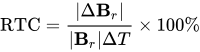
Residual magnetic flux density or Br changes with temperature and it is one of the important characteristics of magnet performance. Some applications, such as inertial gyroscopes and traveling-wave tubes (TWTs), need to have constant field over a wide temperature range. The reversible temperature coefficient (RTC) of Br is defined as:
To address these requirements, temperature compensated magnets were developed in the late 1970s.[1] For conventional SmCo magnets, Br decreases as temperature increases. Conversely, for GdCo magnets, Br increases as temperature increases within certain temperature ranges. By combining samarium and gadolinium in the alloy, the temperature coefficient can be reduced to nearly zero.
Electrical resistance[edit]
The temperature dependence of electrical resistance and thus of electronic devices (wires, resistors) has to be taken into account when constructing devices and circuits. The temperature dependence of conductors is to a great degree linear and can be described by the approximation below.
![{displaystyle operatorname {rho } (T)=rho _{0}left[1+alpha _{0}left(T-T_{0}right)right]}](https://wikimedia.org/api/rest_v1/media/math/render/svg/e6592d9ec18d3c1c33ee3448336a1565d9e83754)
where
![{displaystyle alpha _{0}={frac {1}{rho _{0}}}left[{frac {delta rho }{delta T}}right]_{T=T_{0}}}](https://wikimedia.org/api/rest_v1/media/math/render/svg/83381dbf76253a0bb27a4650c45381c6d49ef947)
 just corresponds to the specific resistance temperature coefficient at a specified reference value (normally T = 0 °C)[2]
That of a semiconductor is however exponential:
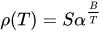
where  is defined as the cross sectional area and
  and
and  are coefficients determining the shape of the function and the value of resistivity at a given temperature.
For both, is referred to as the temperature coefficient of resistance (TCR).[3]
This property is used in devices such as thermistors.
Positive temperature coefficient of resistance[edit]
A positive temperature coefficient (PTC) refers to materials that experience an increase in electrical resistance when their temperature is raised. Materials which have useful engineering applications usually show a relatively rapid increase with temperature, i.e. a higher coefficient. The higher the coefficient, the greater an increase in electrical resistance for a given temperature increase. A PTC material can be designed to reach a maximum temperature for a given input voltage, since at some point any further increase in temperature would be met with greater electrical resistance. Unlike linear resistance heating or NTC materials, PTC materials are inherently self-limiting. On the other hand, NTC material may also be inherently self-limiting if constant current power source is used.
Some materials even have exponentially increasing temperature coefficient. Example of such a material is PTC rubber.
Negative temperature coefficient of resistance[edit]
A negative temperature coefficient (NTC) refers to materials that experience a decrease in electrical resistance when their temperature is raised. Materials which have useful engineering applications usually show a relatively rapid decrease with temperature, i.e. a lower coefficient. The lower the coefficient, the greater a decrease in electrical resistance for a given temperature increase. NTC materials are used to create inrush current limiters (because they present higher initial resistance until the current limiter reaches quiescent temperature), temperature sensors and thermistors.
Negative temperature coefficient of resistance of a semiconductor[edit]
An increase in the temperature of a semiconducting material results in an increase in charge-carrier concentration. This results in a higher number of charge carriers available for recombination, increasing the conductivity of the semiconductor. The increasing conductivity causes the resistivity of the semiconductor material to decrease with the rise in temperature, resulting in a negative temperature coefficient of resistance.
Temperature coefficient of elasticity[edit]
The elastic modulus of elastic materials varies with temperature, typically decreasing with higher temperature.
Temperature coefficient of reactivity[edit]
In nuclear engineering, the temperature coefficient of reactivity is a measure of the change in reactivity (resulting in a change in power), brought about by a change in temperature of the reactor components or the reactor coolant. This may be defined as

Where  is reactivity and T is temperature. The relationship shows that
  is the value of the partial differential of reactivity with respect to temperature and is referred to as the «temperature coefficient of reactivity». As a result, the temperature feedback provided by has an intuitive application to passive nuclear safety. A negative is broadly cited as important for reactor safety, but wide temperature variations across real reactors (as opposed to a theoretical homogeneous reactor) limit the usability of a single metric as a marker of reactor safety.[4]
In water moderated nuclear reactors, the bulk of reactivity changes with respect to temperature are brought about by changes in the temperature of the water. However each element of the core has a specific temperature coefficient of reactivity (e.g. the fuel or cladding). The mechanisms which drive fuel temperature coefficients of reactivity are different from water temperature coefficients. While water expands as temperature increases, causing longer neutron travel times during moderation, fuel material will not expand appreciably. Changes in reactivity in fuel due to temperature stem from a phenomenon known as doppler broadening, where resonance absorption of fast neutrons in fuel filler material prevents those neutrons from thermalizing (slowing down).[5]
Mathematical derivation of temperature coefficient approximation[edit]
In its more general form, the temperature coefficient differential law is:

Where is defined:

And is independent of  .
.
Integrating the temperature coefficient differential law:

Applying the Taylor series approximation at the first order, in the proximity of , leads to:

Units[edit]
The thermal coefficient of electrical circuit parts is sometimes specified as ppm/°C, or ppm/K. This specifies the fraction (expressed in parts per million) that its electrical characteristics will deviate when taken to a temperature above or below the operating temperature.
See also[edit]
- Microbolometer (used to measure TCRs)
References[edit]
- ^ «About Us». Electron Energy Corporation. Archived from the original on October 29, 2009.
- ^ Kasap, S. O. (2006). Principles of Electronic Materials and Devices (Third ed.). Mc-Graw Hill. p. 126.
- ^ Alenitsyn, Alexander G.; Butikov, Eugene I.; Kondraryez, Alexander S. (1997). Concise Handbook of Mathematics and Physics. CRC Press. pp. 331–332. ISBN 0-8493-7745-5.
- ^ Duderstadt & Hamilton 1976, pp. 259–261
- ^ Duderstadt & Hamilton 1976, pp. 556–559
Bibliography[edit]
- Duderstadt, Jame J.; Hamilton, Louis J. (1976). Nuclear Reactor Analysis. Wiley. ISBN 0-471-22363-8.
From Wikipedia, the free encyclopedia
A temperature coefficient describes the relative change of a physical property that is associated with a given change in temperature. For a property R that changes when the temperature changes by dT, the temperature coefficient α is defined by the following equation:
Here α has the dimension of an inverse temperature and can be expressed e.g. in 1/K or K−1.
If the temperature coefficient itself does not vary too much with temperature and , a linear approximation will be useful in estimating the value R of a property at a temperature T, given its value R0 at a reference temperature T0:
where ΔT is the difference between T and T0.
For strongly temperature-dependent α, this approximation is only useful for small temperature differences ΔT.
Temperature coefficients are specified for various applications, including electric and magnetic properties of materials as well as reactivity. The temperature coefficient of most of the reactions lies between −2 and 3.
Negative temperature coefficient[edit]
Most ceramics exhibit negative temperature dependence of resistance behaviour. This effect is governed by an Arrhenius equation over a wide range of temperatures:
where R is resistance, A and B are constants, and T is absolute temperature (K).
The constant B is related to the energies required to form and move the charge carriers responsible for electrical conduction – hence, as the value of B increases, the material becomes insulating. Practical and commercial NTC resistors aim to combine modest resistance with a value of B that provides good sensitivity to temperature. Such is the importance of the B constant value, that it is possible to characterize NTC thermistors using the B parameter equation:
where is resistance at temperature .
Therefore, many materials that produce acceptable values of include materials that have been alloyed or possess variable negative temperature coefficient (NTC), which occurs when a physical property (such as thermal conductivity or electrical resistivity) of a material lowers with increasing temperature, typically in a defined temperature range. For most materials, electrical resistivity will decrease with increasing temperature.
Materials with a negative temperature coefficient have been used in floor heating since 1971. The negative temperature coefficient avoids excessive local heating beneath carpets, bean bag chairs, mattresses, etc., which can damage wooden floors, and may infrequently cause fires.
Reversible temperature coefficient[edit]
Residual magnetic flux density or Br changes with temperature and it is one of the important characteristics of magnet performance. Some applications, such as inertial gyroscopes and traveling-wave tubes (TWTs), need to have constant field over a wide temperature range. The reversible temperature coefficient (RTC) of Br is defined as:
To address these requirements, temperature compensated magnets were developed in the late 1970s.[1] For conventional SmCo magnets, Br decreases as temperature increases. Conversely, for GdCo magnets, Br increases as temperature increases within certain temperature ranges. By combining samarium and gadolinium in the alloy, the temperature coefficient can be reduced to nearly zero.
Electrical resistance[edit]
The temperature dependence of electrical resistance and thus of electronic devices (wires, resistors) has to be taken into account when constructing devices and circuits. The temperature dependence of conductors is to a great degree linear and can be described by the approximation below.
where
just corresponds to the specific resistance temperature coefficient at a specified reference value (normally T = 0 °C)[2]
That of a semiconductor is however exponential:
where is defined as the cross sectional area and and are coefficients determining the shape of the function and the value of resistivity at a given temperature.
For both, is referred to as the temperature coefficient of resistance (TCR).[3]
This property is used in devices such as thermistors.
Positive temperature coefficient of resistance[edit]
A positive temperature coefficient (PTC) refers to materials that experience an increase in electrical resistance when their temperature is raised. Materials which have useful engineering applications usually show a relatively rapid increase with temperature, i.e. a higher coefficient. The higher the coefficient, the greater an increase in electrical resistance for a given temperature increase. A PTC material can be designed to reach a maximum temperature for a given input voltage, since at some point any further increase in temperature would be met with greater electrical resistance. Unlike linear resistance heating or NTC materials, PTC materials are inherently self-limiting. On the other hand, NTC material may also be inherently self-limiting if constant current power source is used.
Some materials even have exponentially increasing temperature coefficient. Example of such a material is PTC rubber.
Negative temperature coefficient of resistance[edit]
A negative temperature coefficient (NTC) refers to materials that experience a decrease in electrical resistance when their temperature is raised. Materials which have useful engineering applications usually show a relatively rapid decrease with temperature, i.e. a lower coefficient. The lower the coefficient, the greater a decrease in electrical resistance for a given temperature increase. NTC materials are used to create inrush current limiters (because they present higher initial resistance until the current limiter reaches quiescent temperature), temperature sensors and thermistors.
Negative temperature coefficient of resistance of a semiconductor[edit]
An increase in the temperature of a semiconducting material results in an increase in charge-carrier concentration. This results in a higher number of charge carriers available for recombination, increasing the conductivity of the semiconductor. The increasing conductivity causes the resistivity of the semiconductor material to decrease with the rise in temperature, resulting in a negative temperature coefficient of resistance.
Temperature coefficient of elasticity[edit]
The elastic modulus of elastic materials varies with temperature, typically decreasing with higher temperature.
Temperature coefficient of reactivity[edit]
In nuclear engineering, the temperature coefficient of reactivity is a measure of the change in reactivity (resulting in a change in power), brought about by a change in temperature of the reactor components or the reactor coolant. This may be defined as
Where is reactivity and T is temperature. The relationship shows that is the value of the partial differential of reactivity with respect to temperature and is referred to as the «temperature coefficient of reactivity». As a result, the temperature feedback provided by has an intuitive application to passive nuclear safety. A negative is broadly cited as important for reactor safety, but wide temperature variations across real reactors (as opposed to a theoretical homogeneous reactor) limit the usability of a single metric as a marker of reactor safety.[4]
In water moderated nuclear reactors, the bulk of reactivity changes with respect to temperature are brought about by changes in the temperature of the water. However each element of the core has a specific temperature coefficient of reactivity (e.g. the fuel or cladding). The mechanisms which drive fuel temperature coefficients of reactivity are different from water temperature coefficients. While water expands as temperature increases, causing longer neutron travel times during moderation, fuel material will not expand appreciably. Changes in reactivity in fuel due to temperature stem from a phenomenon known as doppler broadening, where resonance absorption of fast neutrons in fuel filler material prevents those neutrons from thermalizing (slowing down).[5]
Mathematical derivation of temperature coefficient approximation[edit]
In its more general form, the temperature coefficient differential law is:
Where is defined:
And is independent of .
Integrating the temperature coefficient differential law:
Applying the Taylor series approximation at the first order, in the proximity of , leads to:
Units[edit]
The thermal coefficient of electrical circuit parts is sometimes specified as ppm/°C, or ppm/K. This specifies the fraction (expressed in parts per million) that its electrical characteristics will deviate when taken to a temperature above or below the operating temperature.
See also[edit]
- Microbolometer (used to measure TCRs)
References[edit]
- ^ «About Us». Electron Energy Corporation. Archived from the original on October 29, 2009.
- ^ Kasap, S. O. (2006). Principles of Electronic Materials and Devices (Third ed.). Mc-Graw Hill. p. 126.
- ^ Alenitsyn, Alexander G.; Butikov, Eugene I.; Kondraryez, Alexander S. (1997). Concise Handbook of Mathematics and Physics. CRC Press. pp. 331–332. ISBN 0-8493-7745-5.
- ^ Duderstadt & Hamilton 1976, pp. 259–261
- ^ Duderstadt & Hamilton 1976, pp. 556–559
Bibliography[edit]
- Duderstadt, Jame J.; Hamilton, Louis J. (1976). Nuclear Reactor Analysis. Wiley. ISBN 0-471-22363-8.